



How to Automate Security Audits Without Hiring a Bigger Compliance Team


Join thousands of professionals and get the latest insight on Compliance & Cybersecurity.
Summary
- Automating security compliance can slash costs by up to 40% and reduce the time spent on manual evidence collection by over 75%.
- The key to escaping the endless audit cycle is shifting from periodic, manual checks to a continuous, "always-audit-ready" posture.
- Achieve this by centralizing controls, automating evidence collection, implementing continuous monitoring, and generating on-demand reports.
- Platforms like Cyber Sierra's GRC module provide the automation needed to streamline the entire audit workflow, from evidence collection to reporting.
Is your compliance team stuck in an endless cycle of chasing evidence, wrestling with spreadsheets, and bracing for the next audit? You're not alone. Many security and IT professionals feel they are constantly prepping for audits instead of doing the strategic work that moves the business forward.
The numbers back this up. The average internal audit cycle can stretch across several weeks, dominated by manual evidence requests, documentation formatting, and back-and-forth with auditors. According to Paubox, organizations leveraging GRC automation reduce compliance costs by up to 40% and decrease audit findings by 70%. Even more striking: automated compliance platforms have been shown to cut the time spent on manual evidence collection by over 75%.
The good news? You don't need to hire more people to get there. You need a smarter system. Here's a 4-step automation framework that transforms your team from reactive audit-preppers into a proactive, always-audit-ready operation — all without expanding your headcount.
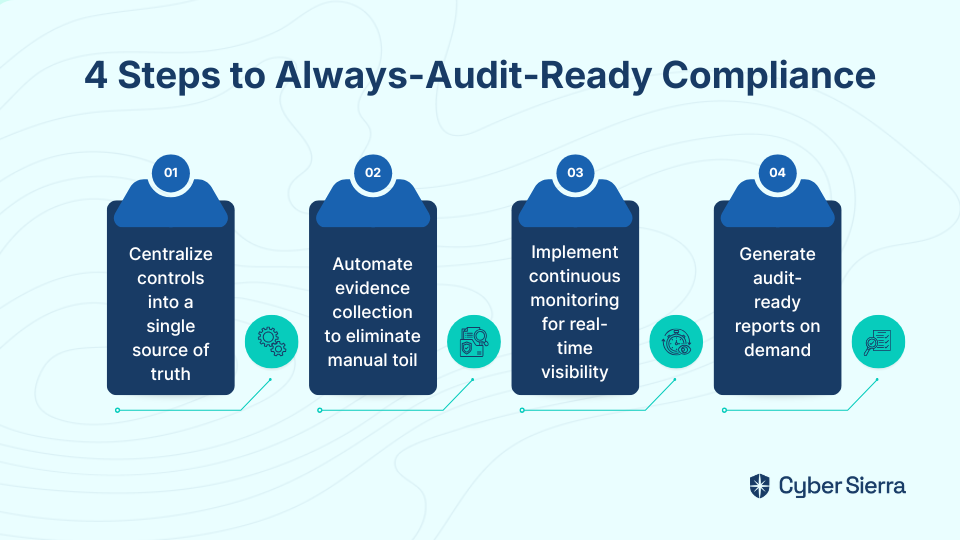
Step 1: Centralize Your Controls to Create a Single Source of Truth
If your compliance management is spread across a patchwork of spreadsheets, scripts, and siloed tools — one for SOC 2, another for PCI DSS, yet another for SOX — you're doing the same work multiple times. This fragmentation is a common source of inefficiency, especially when trying to manage overlapping controls for frameworks like PCI and SOX.
The fix starts with consolidation. A centralized control repository lets you map a single security control to multiple compliance frameworks simultaneously. Instead of maintaining separate trackers for NIST, ISO 27001, HIPAA, and GDPR, you manage one unified control library that satisfies all of them. This is the foundational shift that makes everything else in this framework possible.
How to do it: Implement a dedicated audit and risk management software platform that supports cross-framework control mapping. Look for a solution that offers a single dashboard view across all your active frameworks, and that can auto-map overlapping controls so you're not duplicating effort.
Cyber Sierra's CCM module is purpose-built for exactly this. It builds a central controls repository with near real-time updates and supports management across multiple frameworks — NIST, ISO 27001, PCI DSS, GDPR, HIPAA — from a single interface. Control testing and validation are automated, replacing the slow, error-prone process of manual checks.
Step 2: Automate Evidence Collection to Eliminate Manual Toil
Manual evidence collection is the single biggest time sink in audit preparation. Hunting down screenshots, pulling logs, exporting configurations — it's slow, inconsistent, and produces only a point-in-time snapshot that's outdated almost immediately after you capture it.
The scalability problem is real. At enterprise scale, this kind of manual collection becomes impossible; success depends entirely on automation.
The solution is to connect your compliance platform directly to the systems that generate evidence. That means API integrations with your cloud providers (AWS, Azure, GCP), your HRIS, your version control systems like GitHub, and your SIEM tools. When these integrations are in place, evidence is pulled automatically, timestamped, and stored — no human intervention required.
This approach aligns with what CyberProof describes as Automated Security Control Assessment (ASCA): a continuous evaluation model where controls are assessed in real-time, integrated with existing security tooling, and automatically generate audit-ready logs. The result is evidence that's always current, always organized, and always accessible.
Cyber Sierra's GRC module automates this entire evidence pipeline. It pulls data continuously from your tech stack and organizes it against the relevant controls and frameworks. Teams using this kind of automation report a 40% reduction in manual compliance effort — time that gets redirected toward actual risk management work rather than administrative busywork.
Step 3: Implement Continuous Monitoring for Real-Time Visibility
Here's the uncomfortable truth about periodic compliance checks: a misconfiguration or control failure can sit undetected for weeks between review cycles. By the time your next scheduled audit rolls around, you've accumulated what practitioners call "compliance debt" — a backlog of unresolved findings that triggers a scramble to remediate before the auditor arrives.
Continuous monitoring flips this dynamic entirely. Instead of quarterly snapshots, your controls are evaluated 24/7. When something drifts out of compliance — a user access policy changes, a cloud storage bucket becomes publicly accessible, a security patch falls behind — you get an alert in real time, not weeks later during audit prep.
Deloitte's research reinforces this: continuous monitoring ensures risks and anomalies are visible in real-time, significantly enhancing an organization's security posture while reducing reliance on manual testing. The shift from periodic to perpetual oversight is what separates organizations that are always audit-ready from those that are perpetually scrambling.
The impact on remediation speed is substantial. Paubox reports that organizations using GRC automation decrease their average issue remediation time from 30 days down to 5 days — a 6x improvement that dramatically reduces the window of exposure.
Cyber Sierra's CCM platform delivers this always-on visibility. It provides a real-time dashboard of your security posture across all monitored frameworks, detects exceptions and anomalies as they occur, and surfaces actionable risk intelligence so your team can remediate proactively rather than reactively. The platform transforms security compliance from a periodic fire drill into a living, breathing process.
Step 4: Generate Audit-Ready Reports on Demand
Even when your evidence collection is automated and your controls are continuously monitored, there's one final hurdle: packaging everything into a format that auditors can work with. For many compliance teams, this is still a painful, manual process — copying data into report templates, formatting outputs, and triple-checking that every control has the right supporting documentation attached.
Modern audit and risk management software eliminates this step entirely. A well-integrated GRC platform should let you generate comprehensive, framework-specific audit reports with a single click — pulling from your continuously updated evidence repository to produce a document that's organized, timestamped, and ready to hand to an auditor.
There's an added trust-building benefit here: you can give auditors read-only access to your platform directly, letting them pull evidence themselves rather than waiting on your team to compile it. It may take multiple walkthroughs to win over auditors accustomed to traditional methods, but once they see the immutable and organized audit trail, the relationship becomes far more efficient for both sides.
Cyber Sierra's GRC platform makes this a reality. It maintains detailed, immutable audit trails of all control activities and evidence, and generates on-demand reports for frameworks including SOC 2, ISO 27001, GDPR, HIPAA, and PCI DSS. When an auditor asks for evidence, your answer is no longer "give us a few days" — it's "here it is."
Before vs. After: The Automation Difference
The transformation this framework delivers is easier to grasp as a direct contrast:
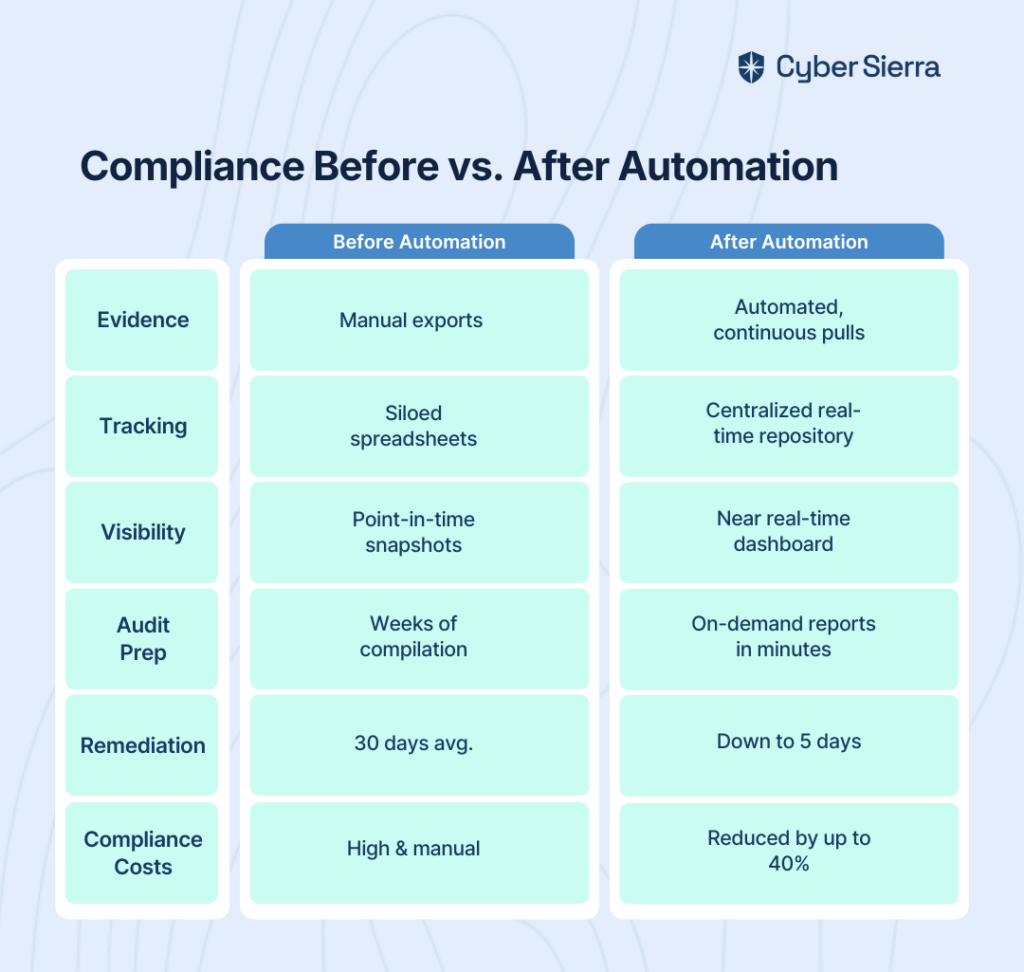
| Before Automation | After Automation | |
|---|---|---|
| Evidence Collection | Manual screenshots and log exports, done periodically | Continuous, automated pulls from integrated systems |
| Control Tracking | Spreadsheets across multiple frameworks, prone to gaps | Centralized repository with real-time updates |
| Visibility | Point-in-time snapshots, quickly outdated | Near real-time dashboard across all frameworks |
| Audit Prep | Weeks of frantic evidence compilation | On-demand reports generated in minutes |
| Team Focus | Reactive fire-fighting before each audit | Proactive risk management and strategic improvements |
| Remediation Speed | Average of 30 days to resolve findings | Down to 5 days with continuous monitoring |
| Compliance Costs | High, driven by manual labor | Reduced by up to 40% |
The shift isn't just operational — it's cultural. Your compliance team stops being the department that's always behind and starts being the team that's always ahead.
From Audit Panic to Permanent Readiness
Breaking the cycle of reactive audit prep doesn't require more headcount—it requires a smarter system. The fundamental shift is from periodic, manual checks to a continuous, "always-audit-ready" posture. This is built on two key pillars:
- Automated Evidence Collection: Stop chasing screenshots and logs. Pull compliance data directly from your tech stack, continuously and without manual effort.
- Continuous Control Monitoring: Gain real-time visibility into your compliance status. Get alerted to misconfigurations the moment they happen, not weeks later during audit prep.
Your first step today? Identify the single most time-consuming piece of evidence your team manually gathers for audits. That's your prime target for automation.
When you’re ready to trade audit fire drills for a streamlined, proactive workflow, see how Cyber Sierra’s automated evidence collection and continuous monitoring can help. Book a demo to learn how to build a compliance program that's always on and always ready.
Frequently Asked Questions
What is security compliance automation?
Security compliance automation uses software to replace manual tasks like evidence collection, control monitoring, and reporting. It connects to your tech stack to continuously pull data, helping you stay audit-ready 24/7 and reducing administrative work for your team.
How does automating compliance reduce costs?
Automation cuts costs by reducing the manual hours your team spends on repetitive audit prep tasks. Studies show it can lower compliance costs by up to 40% by eliminating manual evidence collection, streamlining reporting, and enabling faster remediation of issues.
What is the first step to automating our audit process?
The first step is to centralize your controls into a single source of truth using a GRC platform. This involves mapping your existing security controls to multiple frameworks (like SOC 2, ISO 27001) in one place, which creates the foundation for all other automation.
Will compliance automation replace our existing security team?
No, automation is designed to augment your team, not replace it. It handles the repetitive, low-value administrative tasks, freeing up your compliance professionals to focus on strategic work like risk management, process improvement, and strengthening your security posture.
How does continuous control monitoring work?
Continuous control monitoring automatically and constantly checks your systems against security controls. Instead of periodic manual checks, it provides real-time alerts when a control fails or a system drifts from its compliant state, enabling immediate remediation.
Can a single tool manage compliance for multiple frameworks like SOC 2 and GDPR?
Yes, modern GRC platforms are built for cross-framework management. They allow you to map a single control to multiple frameworks (e.g., SOC 2, ISO 27001, GDPR, HIPAA) so you don't duplicate work, and you can generate framework-specific reports from a unified dashboard.
