How to Streamline Third-Party Risk Management With Automation


Join thousands of professionals and get the latest insight on Compliance & Cybersecurity.
Summary
- Manual Third-Party Risk Management (TPRM) is a major operational bottleneck, with traditional processes failing to keep up with evolving cyber threats and the scale of modern vendor ecosystems.
- Automating TPRM provides continuous, real-time visibility into your vendor risk landscape, shifting your team's focus from administrative tasks to strategic threat prevention.
- A successful automation strategy covers the entire TPRM lifecycle, including vendor discovery, onboarding, risk assessment, continuous monitoring, and reporting.
- Cyber Sierra's TPRM platform automates vendor assessments and provides 24/7 monitoring to help you manage supply chain risk efficiently.
You've set up a robust vendor network to support your business operations, but now you're drowning in security questionnaires, compliance certifications, and risk assessments. What was meant to enhance your business has become a "massive operational bottleneck," consuming valuable time and resources while still leaving your organization vulnerable to third-party risks.
This scenario is all too familiar for security professionals and risk managers. As your vendor ecosystem expands, traditional manual Third-Party Risk Management (TPRM) processes simply can't keep pace with the growing complexity and scale of modern business relationships.
The Growing Strain of Manual TPRM
Third-Party Risk Management is the process of identifying, assessing, and mitigating risks associated with outsourcing tasks to third-party vendors or service providers. While essential for protecting your organization, manual TPRM processes are becoming increasingly unsustainable.
Organizations now rely more heavily than ever on external vendors for core and non-core functions. Each of these relationships expands your attack surface and introduces significant risks, including operational disruptions, security breaches, and compliance failures. According to IBM, these risks can severely impact your organization's reputation, operational capabilities, and bottom line.
The problem? Most organizations still tackle TPRM with spreadsheets, email chains, and disjointed processes—methods that were barely adequate a decade ago and are completely overwhelming today.
The Breaking Point: Critical Challenges in Traditional TPRM
Manual TPRM processes are breaking under pressure from several critical challenges:
- Evolving Cybersecurity Threats: Supply chain attacks are increasingly sophisticated, specifically targeting vendor access credentials to penetrate your organization. Traditional point-in-time assessments can't keep pace with these rapidly evolving threats.
- Scaling and Resource Constraints: Managing thousands of third-party relationships with unique risk profiles is virtually impossible with manual methods. As one security professional noted on Reddit, "I talked to an organisation who was using OneTrust for 2 suppliers (for more, they did not have resources)."
- Assessment and Questionnaire Fatigue: Standardized templates like the SIG (Shared Assessments Questionnaire) often create more problems than they solve. As one user explained, "many questions means that your Third Parties have many questions to answer and you have many answers to evaluate," leading to analysis paralysis.
- Lack of Real-Time Visibility: Traditional, point-in-time assessments quickly become outdated, offering no insight into emerging risks that develop between assessment cycles.
- Regulatory Complexity: Managing compliance with overlapping regulations like GDPR and CCPA manually is a significant burden, especially as regulatory requirements continue to expand and evolve.
- Lengthy Onboarding Cycles: Manual due diligence and onboarding processes can significantly delay business operations, creating friction between security, procurement, and business units.

The Automation Advantage: Core Benefits of a Streamlined TPRM Program
Automation offers a direct solution to these challenges, transforming TPRM from a reactive burden into a proactive strategic advantage:
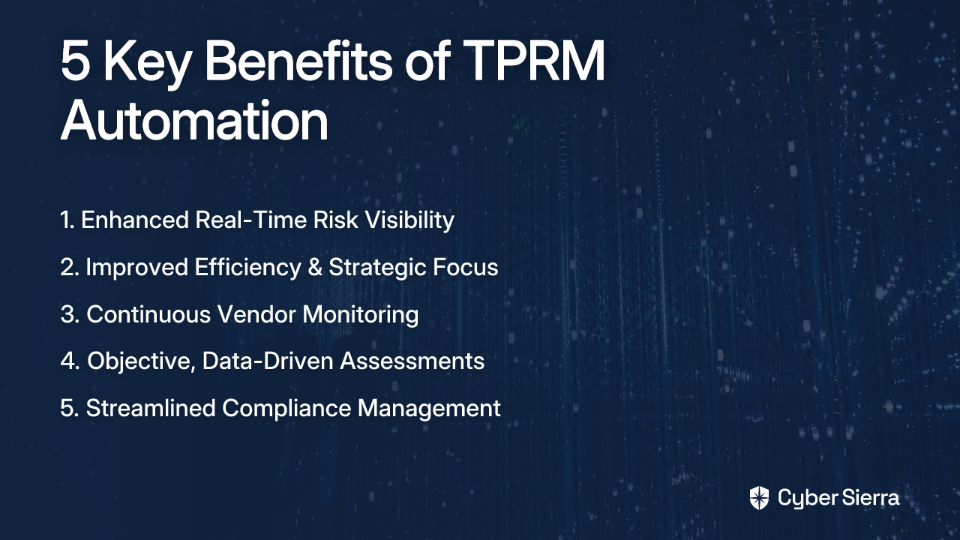
- Enhanced Risk Visibility: Instead of relying on static snapshots, automation provides a comprehensive, real-time view of your third-party risk landscape. This means you can identify and address emerging risks before they impact your business.
- Improved Efficiency and Strategic Focus: By automating manual, repetitive tasks like sending questionnaires and reminders, you free up your team to focus on strategic threat prevention and high-risk vendor management. According to Diligent, this shift from administrative burden to strategic focus is one of the most valuable benefits of TPRM automation.
- Real-Time Continuous Monitoring: Automated tools enable ongoing monitoring of your vendors' cybersecurity posture, with instant alerts for security or compliance issues. One security professional highlighted how valuable this is: "Super helpful to check if a vendor says they've patched X, you can see if that's reflected in their external exposure."
- Objective, Data-Driven Assessments: Automation reduces subjectivity and human error by using standardized, data-driven risk scores and analysis, ensuring consistent evaluation across your vendor ecosystem.
- Streamlined Compliance Management: Automated tools can assess compliance against frameworks like NIST and ISO 27001, while tracking regulatory changes to ensure vendors meet their obligations.
Automating the TPRM Lifecycle: A Step-by-Step Guide
Let's break down the TPRM lifecycle and examine how automation transforms each stage:
1. Vendor Discovery & Classification
Manual Approach: Using spreadsheets to track vendors, often leading to an incomplete or outdated inventory with inconsistent risk classifications.
Automated Solution: Integrate with procurement systems to automatically build a comprehensive vendor inventory. Use AI to classify vendors by inherent risk based on data access and service criticality, ensuring consistent risk-based prioritization.
2. Evaluation, Onboarding & Due Diligence
Manual Approach: Lengthy email chains, sending massive questionnaires, and manually reviewing documents, often delaying vendor onboarding by weeks or months.
Automated Solution: Deploy standardized, automated onboarding workflows to collect data efficiently. Leverage AI tools to streamline security questionnaires, saving hours or days of manual effort. According to UpGuard, this can reduce onboarding times by up to 75%.
3. Risk Assessment & Analysis
Manual Approach: Subjective analysis of questionnaire answers with difficulty comparing vendors consistently across different risk dimensions.
Automated Solution: Standardize risk assessments with automated scoring based on predefined criteria. Automate the detection of third-party risks across different profiles using attack surface management techniques. As CentralEyes notes, this ensures consistent evaluation against your organization's risk appetite.
4. Risk Mitigation & Remediation
Manual Approach: Tracking remediation efforts in spreadsheets, leading to lost findings and frustration. As one user complained, "they do not do a good job at repeat findings that have been remediated."
Automated Solution: Implement automated workflows for flagging, evaluating, and tracking risks. Create a centralized system that tracks remediation progress and ensures findings are not forgotten once addressed, providing clear accountability and visibility.
5. Continuous Monitoring
Manual Approach: Annual or biennial assessments that miss real-time threats and changes in vendor security posture.
Automated Solution: This is where automation truly shines. Implement continuous monitoring tools that provide an "outside-in view" of a vendor's external security posture, allowing you to validate technical claims against real-world data. For example, if a vendor claims they've implemented a critical patch, continuous monitoring can verify this is reflected in their actual security posture.
6. Documentation & Reporting
Manual Approach: Scrambling to pull together data for audits from disparate sources, often with incomplete information.
Automated Solution: Maintain a centralized repository for all vendor documentation, creating a clear audit trail. Generate real-time risk dashboards and reports for stakeholders automatically, ensuring compliance requirements are met without last-minute fire drills.
Choosing Your Automation Ally: Key Features of an Effective TPRM Platform
When selecting a TPRM automation platform, focus on these critical capabilities:
- User-Friendliness and Simplicity: The platform must be easy to use. As one user lamented, "a bad user interface just means a ton of pushback and resistance from main stakeholders." Look for a "simple interface [that] is easy to navigate and you're not overwhelmed with the findings."
- Validation and Depth, Not Just Scores: The tool should go beyond surface-level scores. It needs to provide deep insights and validate vendor claims. Users are frustrated when tools "don't tell you e.g. whether your TP are doing code review." The goal is to "validate technical claims against real-world data where possible."
- Customization and Flexibility: The ability to create customizable questionnaires and assessment templates is crucial to avoid the "analysis paralysis" of overly long, standardized forms.
- Scalability: The solution must be able to handle your organization's growth, whether you have dozens or "tens of thousands of suppliers."
- Integration Capabilities: The platform should easily integrate with your existing systems (GRC, procurement, etc.) to create a unified view of risk.
From Operational Bottleneck to Strategic Enabler
Automating your TPRM program isn't just about efficiency—it's about transforming one of your biggest organizational challenges into a strategic advantage. By implementing the right automated solution, you can:
- Replace time-consuming manual processes with streamlined workflows
- Shift from reactive risk management to proactive risk prevention
- Transform vendor relationships from potential vulnerabilities to secure partnerships
The result is a resilient organization with the visibility and control needed to thrive in today's complex business environment.
As cyber threats continue to evolve and regulatory requirements expand, the organizations that leverage automation to streamline their TPRM programs will be the ones best positioned to protect their data, maintain compliance, and build trust with customers and partners.
Begin by evaluating your current TPRM processes against the challenges outlined above. Identify your biggest pain points, and explore automated solutions like those offered by UpGuard or CentralEyes to see how automation can transform your approach to third-party risk management.
Frequently Asked Questions
What is Third-Party Risk Management (TPRM)?
Third-Party Risk Management (TPRM) is the process of identifying, assessing, and mitigating the risks associated with outsourcing business operations to external vendors or service providers. It is a critical function for protecting your organization from potential security breaches, operational disruptions, and compliance failures that can arise from your vendor relationships. As your organization relies more on third parties, TPRM helps manage the expanding attack surface they introduce.
Why are manual TPRM processes failing?
Manual TPRM processes are failing because they cannot scale to manage the growing number of vendor relationships and the increasing complexity of modern cyber threats. Traditional methods using spreadsheets and email are overwhelmed by challenges like sophisticated supply chain attacks, resource constraints, assessment fatigue, a lack of real-time visibility into vendor security posture, and complex regulatory requirements. This leads to slow onboarding and leaves organizations vulnerable.
How does automation improve TPRM?
Automation improves TPRM by transforming it from a slow, reactive process into a streamlined, proactive, and strategic function. It enhances risk visibility with real-time data, improves team efficiency by handling repetitive tasks, enables continuous monitoring of vendor security, provides objective data-driven assessments, and simplifies compliance management. This allows security teams to focus on high-level strategy instead of administrative work.
What are the key stages of an automated TPRM lifecycle?
The key stages of an automated TPRM lifecycle include vendor discovery and classification, evaluation and onboarding, risk assessment, risk mitigation, continuous monitoring, and documentation and reporting. Automation streamlines each step, from automatically building a vendor inventory and using AI for risk classification to deploying automated workflows for onboarding, using data-driven scoring for assessments, and providing continuous monitoring to ensure vendor security posture remains strong over time.
What should I look for in a TPRM automation platform?
An effective TPRM automation platform should be user-friendly, provide deep and validated insights beyond simple scores, offer customization and flexibility, be scalable, and integrate easily with your existing systems. A simple interface is crucial for user adoption, while the ability to customize questionnaires and workflows ensures the platform fits your organization's specific needs as it grows. The best tools offer actionable intelligence to validate vendor claims, not just surface-level risk scores.