



Automating Vendor Risk Assessments: Trends & Solutions


Join thousands of professionals and get the latest insight on Compliance & Cybersecurity.
Summary
- With nearly 50% of data breaches caused by third parties, traditional manual vendor assessments based on static questionnaires are no longer effective.
- The future of vendor risk management relies on shifting from periodic checks to continuous, automated monitoring powered by AI to gain real-time visibility into your supply chain.
- A practical first step is to tier vendors by criticality and adopt a "continuously verify" model that uses objective evidence instead of subjective self-assessments.
- A unified Third-Party Risk Management (TPRM) platform can automate the entire vendor lifecycle, from onboarding to remediation, to strengthen your security posture.
You've set up a vendor risk assessment process. Your team diligently sends out questionnaires, reviews responses, and checks compliance certifications. Yet, you can't shake that nagging feeling: "How do I know the vendor didn't just lie?" As one cybersecurity professional recently expressed on Reddit, many feel third-party risk management has become an ineffective formality—a checkbox exercise rather than genuine security assurance.
This sentiment isn't surprising. In today's interconnected business landscape, your digital supply chain represents one of your most significant attack vectors. Nearly 50% of data breaches are caused by third-party vendors, according to a recent HSB survey, and these breaches typically lead to higher damage costs than internal incidents.
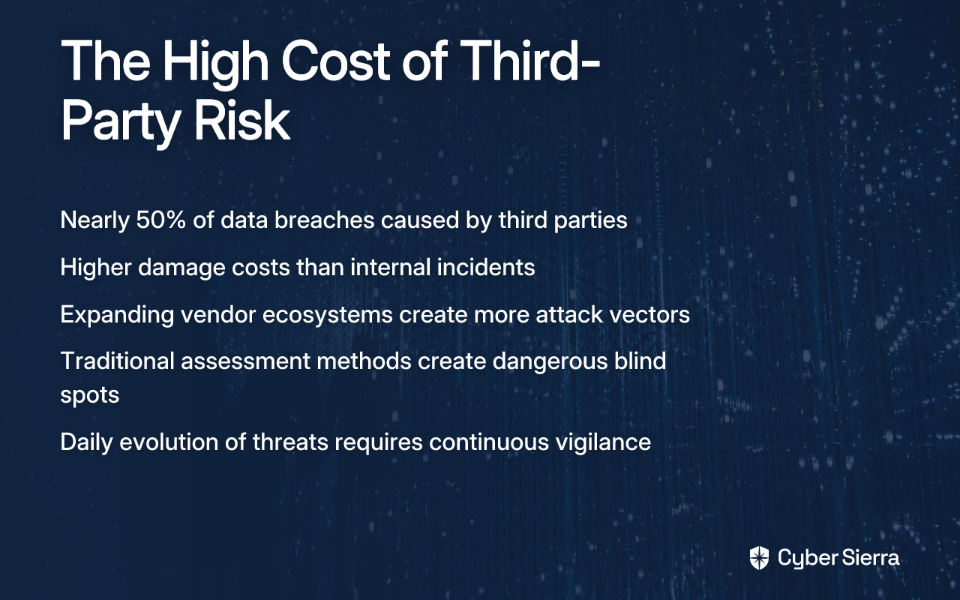
The traditional approach to vendor risk assessments—manual processes, static questionnaires, and annual reviews—is breaking under the weight of modern business realities. As vendor ecosystems expand and threats evolve daily, yesterday's methods create dangerous blind spots and operational bottlenecks.
This article explores how automation, AI, and continuous monitoring are transforming vendor risk assessments from periodic, reactive tasks to continuous, proactive programs. We'll examine key trends, provide a practical blueprint for implementation, and share strategies to overcome common hurdles in automating your Third-Party Risk Management (TPRM) program.
The Breaking Point: Why Manual Vendor Risk Assessments Are Failing
The traditional vendor risk assessment model is reaching a critical breaking point for several reasons:
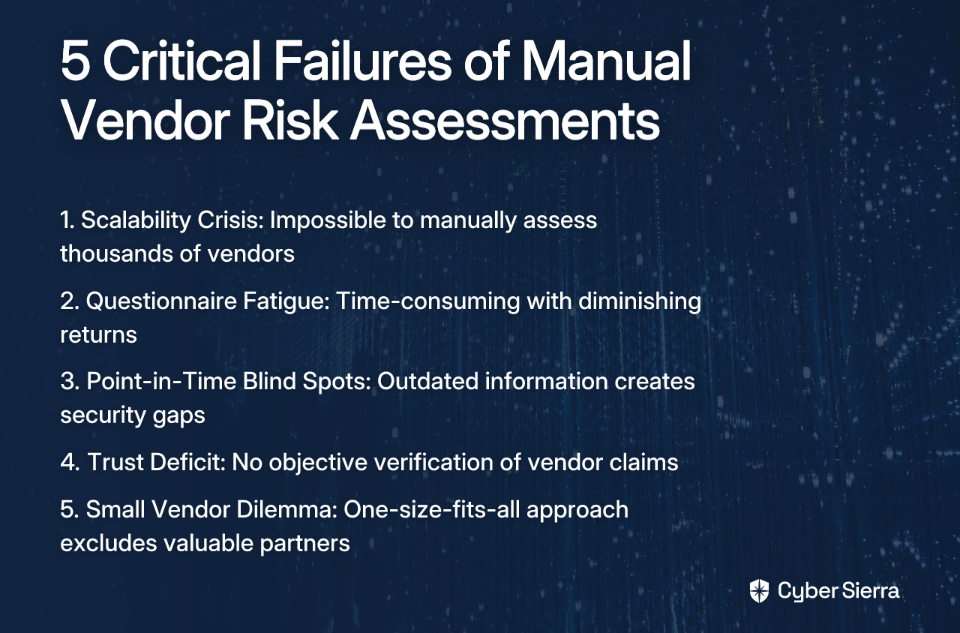
Scalability Crisis
As organizations increasingly rely on SaaS solutions and specialized vendors, security teams face an impossible task. One financial services firm reported managing relationships with over 7,000 third parties—each requiring assessment, monitoring, and periodic re-evaluation. This volume renders manual processes unsustainable, leading to shortcuts, delays, or neglected reviews.
Questionnaire Fatigue
Both assessors and vendors suffer from the burden of lengthy, often generic questionnaires. For vendors, responding to dozens or hundreds of similar yet slightly different questionnaires from customers creates significant overhead. For security teams, reviewing these responses becomes a time sink with diminishing returns.
One financial services firm reduced vendor onboarding time by 50% by moving away from this questionnaire-centric model through automation—a clear indicator of the inefficiency of traditional methods.
Point-in-Time Blind Spots
A completed questionnaire or certification is merely a snapshot that becomes outdated almost immediately. In the dynamic threat landscape of 2024, relying solely on these periodic assessments creates dangerous blind spots between reviews. A vendor could experience a major security incident the day after completing your assessment, and you might not know until your next annual review.
The Trust Deficit & Subjectivity
Self-assessments are inherently subjective. Without objective verification, it's difficult to validate a vendor's claims—fueling the sentiment that you can't be sure they "didn't just lie." This trust deficit undermines confidence in your entire vendor security program.
The Small Vendor Dilemma
Manual processes struggle to handle the nuance of smaller vendors. As one security professional noted, "You may need to do business with a mom and pop setup that cannot obtain certification" because "the cost of attaining such compliance would be cost-prohibitive for them." This forces businesses to either accept unknown risks or forgo potentially valuable partnerships.
The Automation Revolution: Key Trends Reshaping TPRM in 2024
Forward-thinking organizations are embracing three major trends that are transforming vendor risk management from a compliance burden to a strategic advantage:
Trend 1: AI and Machine Learning for Predictive Intelligence
Artificial intelligence is revolutionizing how organizations assess third-party risk. According to EY, risk leaders are using AI to transform TPRM from annual assessments to 24/7 real-time monitoring and predictive analytics.
Practical applications include:
- AI-Driven Risk Scoring: Machine learning algorithms analyze vast datasets to identify patterns and predict potential vulnerabilities before they become incidents.
- Automated Assessment Analysis: AI tools can evaluate vendor responses against historical data and industry benchmarks to identify inconsistencies or red flags that human reviewers might miss.
- Accelerated Response Generation: Tools like UpGuard's AI Autofill help vendors generate detailed questionnaire responses, reducing submission times from weeks to hours while maintaining accuracy.
Trend 2: Continuous Monitoring as the New Standard
The second major shift is from "trust but verify" to "continuously verify." Gartner highlights that continuous monitoring of vendor compliance and risk is becoming standard practice across industries.
This approach involves:
- External Attack Surface Monitoring: Automated systems continuously scan vendors' public-facing infrastructure to detect vulnerabilities, misconfigurations, and emerging threats.
- Digital Footprint Analysis: Monitoring for data leaks, credential exposures, or other security incidents that could impact your data.
- Configuration Change Tracking: Detecting when vendors make significant changes to their security posture or infrastructure that might introduce new risks.
Unlike point-in-time assessments, continuous monitoring provides near real-time visibility into your vendors' security practices, enabling rapid response to emerging threats.
Trend 3: Centralization for a Holistic Risk View
Organizations are consolidating their TPRM efforts to gain a complete understanding of risks across operational silos. EY reports that 57% of companies are now adopting centralized TPRM programs to reduce redundancy and improve efficiency.
This centralization involves:
- Unified Platforms: Integrating TPRM tools with broader Governance, Risk, and Compliance (GRC) platforms.
- Standardized Assessment Methodologies: Establishing consistent frameworks for evaluating vendors against multiple compliance standards (NIST, ISO 27001, PCI DSS, etc.) from a single source of truth.
- Cross-Functional Collaboration: Breaking down silos between procurement, legal, IT, and security to ensure all stakeholders have visibility into vendor risks.
A Practical Blueprint for Automated Vendor Risk Management
Transforming your TPRM program doesn't happen overnight. Here's a practical, step-by-step approach to implementing an automated vendor risk assessment process:
Step 1: Establish a Structured Framework and Tier Your Vendors
Before automating, create a consistent framework for assessing risk:
- Define your organization's risk tolerance and minimum security requirements for vendors.
- Tier vendors by criticality level based on factors like data access, integration depth, and business impact.
- Develop differentiated assessment approaches for each tier—a vendor handling sensitive PII requires more stringent, continuous oversight than a low-risk supplier.
This prioritization ensures you focus your automation efforts where they matter most.
Step 2: Leverage a Modern TPRM Platform
Adopt a platform that moves beyond static data collection to enable continuous assessment and monitoring. Look for key capabilities:
- Automated Assessments & Workflows: The platform should automate vendor onboarding, risk assessments, and remediation tracking. Cyber Sierra's TPRM platform, for example, is designed to simplify this process by automating assessments and streamlining the entire vendor lifecycle.
- Near Real-Time Visibility: Choose solutions offering customizable dashboards for 24/7 visibility into vendor security compliance. This directly addresses the point-in-time assessment flaw in traditional approaches.
- Integration Capabilities: Ensure your platform can integrate with other security tools and data sources to provide a comprehensive view of vendor risk.
Step 3: Move Beyond Questionnaires to Continuous Evidence
The goal is objective proof rather than self-reported compliance:
- Implement Continuous Control Monitoring (CCM) to automate the collection of evidence that validates security controls. Platforms like Cyber Sierra's CCM module build a central controls repository, automate control testing, and detect exceptions in real-time.
- Request a Software Bill of Materials (SBOM) from vendors to gain visibility into their software components and potential vulnerabilities. This approach, recommended by security professionals on Reddit, provides deeper insight than generic questionnaires.
- Establish automated monitoring of vendors' external attack surfaces to detect potential vulnerabilities before they can be exploited.
Step 4: Foster Data-Driven Collaboration
Use the objective insights from your platform to have productive conversations with vendors about remediation:
- Present vendors with clear, data-driven reports on specific vulnerabilities rather than debating subjective questionnaire answers.
- Establish collaborative workflows that make it easy for vendors to address identified issues and provide verification of remediation.
- Create a feedback loop where vendors can contribute to improving your assessment process, making it more efficient and effective for both parties.

Overcoming Common Hurdles in VRA Automation
As with any transformation, automating vendor risk assessments comes with challenges:
Data Readiness and Expertise
According to EY, a primary barrier to AI adoption in risk management is a lack of data readiness. Organizations must:
- Clean and structure their vendor data before automation can be effective.
- Invest in training security teams to effectively leverage advanced tools.
- Start with manageable pilot projects before scaling to the entire vendor ecosystem.
Fragmented Ownership & Organizational Silos
Effective TPRM requires enterprise-level coordination:
- Secure buy-in from procurement, legal, IT, and security by demonstrating how automation benefits each function.
- Establish clear governance structures that define roles and responsibilities across departments.
- Implement communication channels that ensure all stakeholders have visibility into vendor risk information.
Selecting the Right Technology Partner
The market is crowded with point solutions that address specific aspects of TPRM:
- Look for unified platforms that break down silos rather than creating new ones.
- Evaluate solutions that integrate TPRM, GRC, CCM, and Threat Intelligence to provide a single source of truth.
- Consider platforms like Cyber Sierra that offer comprehensive capabilities rather than requiring you to stitch together multiple disparate tools.
Conclusion: Moving from Checkbox Compliance to Continuous Assurance
The complexity and risk of modern supply chains have rendered manual, periodic vendor assessments obsolete. The future of TPRM lies in an intelligence-driven approach powered by automation, AI, and continuous monitoring.
This shift not only strengthens your security posture but also drives significant efficiency gains, reduces compliance burdens, and enables faster, more secure business innovation. By implementing the blueprint outlined in this article, you can transform vendor risk assessments from a point-in-time checkbox exercise to a continuous, data-driven program that provides real security assurance.
Take a critical look at your current vendor risk assessment process. Where are the gaps? What blind spots exist between assessments? How much time is wasted on manual questionnaire reviews? Then explore how a unified automation platform can help you build a more resilient and proactive defense against third-party risk.
The vendors you trust with your data and operations shouldn't be your biggest security vulnerability. With automated, continuous assessment, they don't have to be.
Frequently Asked Questions
Why are manual vendor risk assessments failing?
Manual vendor risk assessments are failing primarily because they are not scalable, create dangerous security blind spots between reviews, and rely on subjective, unverified information from questionnaires. As businesses partner with hundreds or even thousands of vendors, manual processes become unsustainable, leading to "questionnaire fatigue." Furthermore, a manual assessment is just a point-in-time snapshot; a vendor's security posture can change overnight, but you wouldn't know until the next annual review, leaving your organization exposed.
What is automated vendor risk assessment?
Automated vendor risk assessment is the use of modern technology, including AI and specialized platforms, to continuously monitor, analyze, and manage the security risks posed by third-party vendors in near real-time. It replaces periodic, manual tasks like sending spreadsheets with a dynamic, data-driven process. This includes automating questionnaire analysis, continuously scanning a vendor's external attack surface for vulnerabilities, and using AI to predict potential risks, transforming Third-Party Risk Management (TPRM) from a reactive to a proactive security function.
What are the key benefits of automating vendor risk assessments?
The key benefits of automating vendor risk assessments are enhanced security through continuous visibility, improved operational efficiency by reducing manual work, better scalability to manage a growing number of vendors, and more objective, data-driven decision-making. Automation eliminates the point-in-time blind spots inherent in annual reviews, providing real-time alerts on emerging threats. It can cut vendor onboarding time significantly and replace subjective self-assessments with objective evidence, building a more resilient digital supply chain.
How does continuous monitoring improve vendor risk management?
Continuous monitoring improves vendor risk management by providing a near real-time view of a vendor's security posture, moving beyond the limitations of static, point-in-time questionnaires. Instead of relying on a vendor's self-reported answers, continuous monitoring tools automatically scan for objective evidence. This includes monitoring their external attack surface for new vulnerabilities, tracking configuration changes, and detecting data leaks. This "continuously verify" approach allows you to identify and respond to threats as they emerge.
What is the first step to implementing an automated TPRM program?
The first step to implementing an automated TPRM program is to establish a structured risk framework by defining your organization's risk tolerance and tiering your vendors based on their criticality. Before you can automate effectively, you need a clear strategy. Start by identifying which vendors have access to your most sensitive data and pose the greatest business impact if breached. Group them into tiers (e.g., Critical, High, Medium, Low) to prioritize your automation efforts and apply the most rigorous monitoring to the vendors that matter most.
How can you manage risk for smaller vendors without creating excessive compliance burdens?
You can effectively manage risk for smaller vendors by adopting a tiered, risk-based approach where the assessment's intensity matches the vendor's criticality. Instead of sending a one-size-fits-all assessment, classify smaller, low-risk partners into a separate tier. For these vendors, you can use a lightweight questionnaire or focus on non-intrusive continuous external monitoring, which requires no effort on their part. This ensures you apply the right level of scrutiny without overwhelming valuable partners.
