10 Automated Regulatory Compliance Tools for Cybersecurity in 2026

Join thousands of professionals and get the latest insight on Compliance & Cybersecurity.
Summary
- Data breaches can cause companies to underperform by over 15%, making manual compliance for frameworks like SOC 2 and ISO 27001 an unsustainable risk.
- Effective compliance tools move beyond simple checklists by offering Continuous Control Monitoring (CCM) to provide ongoing visibility into your security posture.
- When choosing a tool, evaluate its tech stack integrations, user experience, and total cost of ownership to ensure it aligns with your strategic security goals.
- For a unified approach, Cyber Sierra's GRC platform integrates compliance, continuous monitoring, and third-party risk management to transform security from a periodic task into a resilient program.
In the ever-evolving landscape of cybersecurity, organizations face a paradox: more compliance tools than ever before, yet the same fundamental challenges persist. As one cybersecurity professional aptly noted, "Compliance != security for sure." Many tools have been criticized as merely "glorified task managers" that fail to address the core issue of actually being secure.
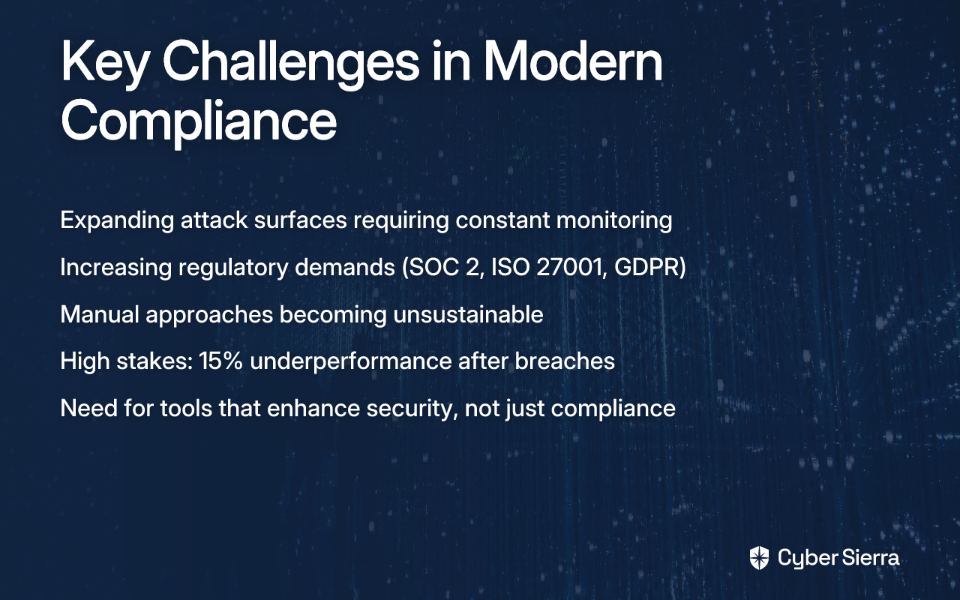
With expanding attack surfaces and increasing regulatory demands (SOC 2, ISO 27001, GDPR, etc.), manual compliance approaches have become virtually impossible. The stakes couldn't be higher – companies that experience data breaches underperform by more than 15% on average over three years, with over 5 billion records exposed in recent breaches.
This article cuts through the noise to identify 10 automated regulatory compliance tools that not only streamline audits but genuinely contribute to stronger, more resilient cybersecurity programs in 2026.
Why Automation is Non-Negotiable (But Not a Silver Bullet)
Shifting from manual to automated compliance delivers several critical benefits, according to research from Cynomi:
- Reduced Manual Overhead: Freeing security teams from what many describe as the "onerous" task of manual evidence compilation.
- Real-Time Regulatory Tracking: Keeping pace with constantly evolving frameworks like ISO 27001, SOC 2, and HIPAA.
- Consistent and Audit-Ready Documentation: Eliminating the pre-audit scramble that consumes resources.
- Scalable Workflows: Essential for organizations managing multiple compliance frameworks simultaneously.
However, as many practitioners have experienced, automation tools come with "a steep learning curve" and still require significant internal resources to configure and maintain. The most effective tools enhance – rather than simply automate – existing security strategies.
Key Features That Separate a "Checklist" Tool from a "Security" Tool
When evaluating automated regulatory compliance platforms, look beyond basic features to these advanced capabilities:
- Continuous Control Monitoring (CCM): Beyond point-in-time checks, this provides ongoing visibility into compliance status with real-time alerts.
- AI-Powered Framework Crosswalking: Modern tools use AI and Natural Language Processing to analyze control intent and identify overlaps across frameworks, reducing redundant work.
- Automated Evidence Collection: Deep integrations with your tech stack (cloud providers, version control, HR systems) to automate proof collection.
- Integrated GRC, CCM, and TPRM: The most advanced solutions provide unified platforms for Governance, Risk, and Compliance (GRC), Continuous Control Monitoring (CCM), and Third-Party Risk Management (TPRM).
- Automated Cyber Risk Quantification: The ability to translate security gaps into financial impact, helping justify security investments and prioritize remediation.
- Executive Risk Intelligence Dashboards: At-a-glance visibility for CISOs and boards, connecting security posture to business objectives.
Top 10 Automated Regulatory Compliance Tools for 2026
1. Cyber Sierra
Overview: Cyber Sierra offers an AI-enabled cybersecurity platform designed to move organizations from periodic, manual checks to a proactive, automated, and continuous security posture. It directly addresses the need for an integrated solution that combines compliance with genuine risk management.
Key Features:
- Continuous Control Monitoring (CCM): Builds a central controls repository with near real-time updates and manages controls across multiple frameworks (NIST, ISO 27001, PCI DSS).
- Third-Party Risk Management (TPRM): Automates vendor assessments and provides 24/7 visibility into vendor security compliance, moving beyond point-in-time questionnaires.
- Governance, Risk & Compliance (GRC): Automates data collection, risk assessments, and reporting for SOC2, ISO 27001, HIPAA, and more, making enterprises audit-ready.
- Threat Intelligence: Provides a comprehensive security scorecard through network and cloud vulnerability scanning.
- Employee Security Training: Strengthens the "human firewall" with interactive training and simulated phishing campaigns.
Best For: Enterprises and high-growth companies in regulated industries (BFSI, HealthTech, Technology) that need a unified platform to manage GRC, CCM, and TPRM and bridge the gap between compliance and security.
Strengths: A truly integrated suite that prevents silos between different security functions. The platform's focus on automation, continuity, and intelligence helps mature a security program beyond simple audit preparation.
Limitations: The comprehensive nature of the platform may have a higher initial implementation cost and be more extensive than what a small startup needs for a single, simple framework.
2. Vanta
Overview: A popular compliance automation platform known for its focus on helping startups and tech companies achieve certifications like SOC 2 and ISO 27001.
Key Features: Continuous monitoring, automated evidence collection, extensive integration library, policy templates, and auditor partnership programs.
Best For: Startups and SMBs looking for a fast, streamlined path to their first compliance certification.
Strengths: User-friendly interface and strong automation for evidence gathering, which users find valuable as "manually compiling evidence now seems way too onerous."
Limitations: Some users feel it can lead to a "checkbox" approach if not paired with a strong internal security program. May lack the deep GRC and enterprise risk management features of other platforms.
3. Drata
Overview: A direct competitor to Vanta, Drata offers real-time control monitoring and a trust center to showcase security posture to customers.
Key Features: Real-time control monitoring, over 75 integrations, risk management module, audit hub for seamless auditor collaboration.
Best For: Tech companies and enterprises that need continuous audit readiness and a way to build customer trust.
Strengths: Extensive integrations and a strong focus on maintaining continuous compliance.
Limitations: Similar to Vanta, it is often seen as primarily a compliance tool, and users have reported inconsistent experiences, with some switching between platforms. Limited in-depth third-party risk capabilities compared to specialized tools.
4. UpGuard
Overview: A platform that excels in third-party risk management and attack surface monitoring, providing security ratings to quantify risk.
Key Features: Third-party risk identification, continuous attack surface monitoring, security questionnaires for frameworks like GDPR and PCI DSS.
Best For: Organizations with a significant supply chain or vendor ecosystem where third-party risk is a primary concern.
Strengths: Excellent visibility into external risks and a user-friendly interface. Strong customer support.
Limitations: Some users have reported delays in the platform acknowledging remediated risks. Its core strength is TPRM, so it may be less comprehensive for internal GRC needs.
5. Hyperproof
Overview: An enterprise-grade compliance operations platform focused on advanced orchestration and risk-based prioritization.
Key Features: Advanced compliance orchestration, risk-based prioritization tools, multi-framework mapping, automated evidence collection.
Best For: Mature enterprises managing complex compliance landscapes across multiple frameworks and business units.
Strengths: Powerful for managing compliance at scale and providing risk-based insights for prioritization.
Limitations: May be overly complex for smaller organizations or those new to compliance automation.
6. AuditBoard
Overview: A cloud-based platform that centralizes audit, risk, and compliance management, designed with auditors and compliance officers in mind.
Key Features: Centralized audit and compliance management, automated control testing, risk management, SOX compliance.
Best For: Large businesses and public companies with dedicated internal audit and compliance teams.
Strengths: Enhances collaboration across the three lines of defense and streamlines internal and external audit processes.
Limitations: Primarily focused on the audit and risk management workflow, may not be as developer-centric as other tools.
7. MetricStream
Overview: A comprehensive, enterprise-focused GRC platform that integrates risk, compliance, audit, and cybersecurity functions.
Key Features: Centralized GRC platform, AI-powered continuous control monitoring, regulatory change management, third-party risk management.
Best For: Large, global enterprises needing a unified view of their entire governance landscape.
Strengths: Highly scalable with extensive regulatory coverage. Provides a single source of truth for all GRC activities.
Limitations: Can be complex and costly to implement, making it less suitable for mid-market companies.
8. Secureframe
Overview: An all-in-one security compliance platform that combines automated workflows with personnel and vendor risk management.
Key Features: Automated compliance workflows, vendor risk management, employee security training, policy templates.
Best For: Tech organizations looking for a comprehensive solution that includes employee and vendor management alongside framework compliance.
Strengths: Integrates multiple aspects of a security program into one platform.
Limitations: May not have the depth in each individual module (e.g., TPRM) compared to a specialized best-of-breed tool.
9. LogicGate
Overview: A highly flexible and customizable risk and compliance management platform that allows organizations to build their own workflows.
Key Features: Customizable "Risk Cloud" modules, no-code workflow builder, compliance automation, advanced analytics.
Best For: Organizations with unique or complex compliance processes that don't fit into a standard template.
Strengths: Extreme flexibility allows for tailored risk and compliance programs that reflect the organization's specific profile.
Limitations: The high degree of customization can also mean a steeper learning curve and more effort required for initial setup.
10. Cynomi
Overview: An AI-powered vCISO platform designed specifically for Managed Service Providers (MSPs) and MSSPs to deliver compliance services.
Key Features: AI-powered automated assessments, multi-framework mapping, audit-ready reporting, multi-tenancy for managing multiple clients.
Best For: MSPs and MSSPs that provide security and compliance services to other businesses.
Strengths: Purpose-built for the service provider model with features like multi-tenancy and scalable client onboarding.
Limitations: Not designed for direct use by an in-house security team within a single organization.
How to Choose the Right Automation Tool for Your Organization
When evaluating automated regulatory compliance tools, follow this practical framework, based on guidance from Cynomi:
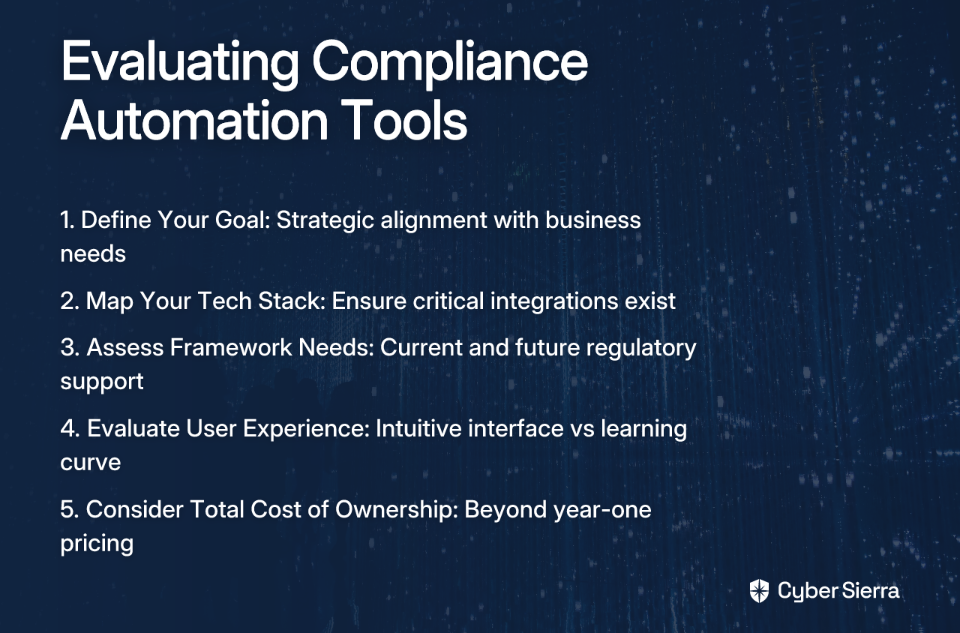
- Define Your Goal: Are you a startup chasing your first SOC 2, or an enterprise building a full GRC program? Your strategic goals dictate the tool you need.
- Map Your Tech Stack: Ensure the platform has robust, pre-built integrations with your critical systems (AWS, Azure, GitHub, Jira, Slack, etc.).
- Assess Framework Needs: Does the tool support all the frameworks you need now (e.g., ISO 27001, PCI DSS) and in the future? Check its adaptability to regulatory changes.
- Evaluate the User Experience: Is the platform intuitive for your team, or will it require dedicated personnel to manage? This addresses the "steep learning curve" pain point many users experience.
- Consider Total Cost of Ownership (TCO): Look beyond the first-year price. Ask about multi-year contracts and support costs to avoid vendors who "pump up the prices after the first year."
Conclusion: From Compliance Automation to Cybersecurity Resilience
The future of compliance isn't just automation; it's integration. The best tools don't just help you pass an audit—they make you more secure. As one cybersecurity professional wisely observed, "The hard part about SOC 2 isn't the automation of collecting evidence. The hard part about SOC 2 is actually being secure."
For organizations ready to build a mature, resilient cybersecurity program that unifies GRC, continuous monitoring, and supply chain risk, an integrated platform is the path forward. Explore how Cyber Sierra's AI-enabled platform can help you move beyond checklists to achieve continuous security and compliance that truly protects your organization in an increasingly complex threat landscape.
Frequently Asked Questions
What is the main purpose of automated regulatory compliance tools?
Automated tools streamline evidence collection and reporting for audits like SOC 2 and ISO 27001. Their primary purpose is to reduce manual overhead, ensure continuous monitoring, and provide a clear, audit-ready trail of compliance activities.
How do I choose between a simple tool and an integrated platform?
Choose based on your organization's maturity. Startups seeking a first certification may prefer a simple tool for speed. Mature enterprises managing multiple risks and frameworks benefit more from an integrated platform that unifies GRC, CCM, and TPRM.
What is Continuous Control Monitoring (CCM) in cybersecurity?
CCM is the automated, ongoing process of testing security controls against compliance requirements. Unlike point-in-time audits, it provides real-time visibility into your security posture, allowing for proactive remediation of compliance gaps.
Can compliance automation tools replace the need for a security team?
No, these tools are designed to augment, not replace, a security team. They automate repetitive tasks, freeing up security professionals to focus on strategic initiatives, risk management, and incident response, which require human expertise.
How do modern tools handle multiple compliance frameworks like SOC 2 and ISO 27001?
Modern tools use AI-powered framework crosswalking to map and identify overlapping controls between different regulations. This prevents duplicating work, as evidence collected for one framework can be automatically applied to satisfy similar requirements in another.
What is the difference between GRC, CCM, and TPRM?
GRC (Governance, Risk, Compliance) is the overall strategy for managing risk. CCM (Continuous Control Monitoring) is the real-time technical validation of controls. TPRM (Third-Party Risk Management) focuses on managing risks from your vendors and suppliers.