



Should You Automate High Risk GRC Processes?


Join thousands of professionals and get the latest insight on Compliance & Cybersecurity.
You've invested heavily in GRC automation tools, hoping to streamline your compliance workflows and reduce manual effort. But when a critical security incident occurs, you discover that your automated system missed a crucial risk signal that a human reviewer would have caught immediately. Now you're facing regulatory scrutiny, potential fines, and loss of customer trust.
This scenario plays out more often than companies care to admit. While GRC automation promises efficiency and scale, organizations become increasingly uncomfortable transferring risk to software as the stakes rise. As one security professional puts it, "Generally, transfer of risk to automation or software is less comfortable as risk/impact increase."
The Automation Paradox in GRC
The global GRC automation market is booming—valued at $48.7 billion in 2023 and projected to reach $179.5 billion by 2032, growing at over 15% annually. This explosive growth highlights both the promise and the pressure to automate governance, risk, and compliance processes.
But there's a fundamental tension at play. As one practitioner bluntly states, "Automation is not the objective. Never was, never will be. Cost saving is." This pragmatic view underscores the real challenge: determining when automation delivers genuine value versus when it introduces unacceptable risks.
This article explores the critical question: When should you automate high-risk GRC processes, and when is human oversight non-negotiable?
Understanding the Risk-Impact Relationship in GRC Automation
Organizations typically become more hesitant to rely on automation as the potential consequences of failure increase. This reluctance stems from legitimate concerns about intelligent automation that go beyond simple task failures:
- Data privacy breaches during AI model development and deployment
- Lack of transparency in how automated systems make decisions
- Cybersecurity vulnerabilities specific to automated systems, including model extraction and data poisoning
- Regulatory scrutiny that intensifies with adoption of advanced automation
A particularly troubling aspect is what security professionals call the verification problem: "Using automation to verify that the automation is working is where it gets unreliable." This creates a verification paradox—if you can't trust the system to check itself, you need independent (often human) verification loops.
The risk classification of a process directly impacts automation decisions. For low-risk activities with clear rules, automation can proceed confidently. But for high-risk processes where flaws in logic could have severe consequences, human oversight becomes essential.
When the Law Steps In: Legal Requirements for Human Oversight
In many high-risk domains, human oversight isn't just a best practice—it's the law. The EU AI Act provides a clear example of this regulatory approach to high-risk automated systems.
Article 14 of the EU AI Act specifically mandates that high-risk AI systems must be designed to allow for effective human oversight to minimize risks to health, safety, and fundamental rights. This requires:
- Oversight measures built into the system by the provider or implemented by the user
- Natural persons overseeing the system must fully understand its capabilities and limitations
- For critical applications (like identity verification), verification by at least two qualified individuals
- Fail-safe mechanisms that allow human operators to intervene immediately
These requirements establish "meaningful human oversight" as more than a passive, procedural formality. It demands active human involvement that genuinely improves decision quality and prevents harm. Organizations building GRC automation strategies must explicitly account for these legal mandates or risk significant penalties.
A Framework for GRC Automation Decisions
Rather than making ad-hoc decisions about what to automate, organizations need a structured approach to evaluate the risks and benefits. Here's a comprehensive framework to guide your automation decisions:
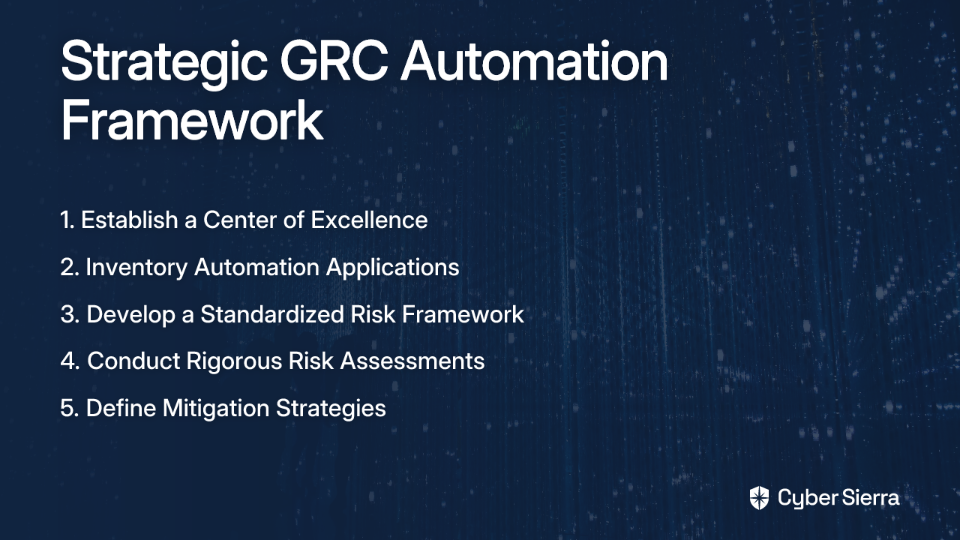
- Establish a Center of Excellence (CoE): Centralize decision oversight for automation initiatives to create a comprehensive view of business processes and associated risks.
- Inventory Automation Applications: Maintain a detailed catalog of all automation tools, their methodologies, and known vulnerabilities. This facilitates risk management and identifies potential synergies.
- Develop a Standardized Risk Framework: Create a consistent process for evaluating, developing, and implementing automation. Identify risks early in the development cycle.
- Conduct Rigorous Risk Assessments:
- Identify all potential risks of automating a specific GRC process
- Evaluate the potential impact of these risks on the organization
- Test for bias and inaccuracy using comprehensive data quality checks
- Assess technical controls review processes for effectiveness
- Define Mitigation and Monitoring Strategies:
- Develop clear strategies to mitigate identified risks
- Implement continuous monitoring with real-time dashboards
- Establish API integrations for seamless data flow between systems
- Include configuration control mechanisms to prevent unauthorized changes
Organizations should be particularly vigilant about common automation pitfalls:
- Over-automating Without Strategy: Automating for automation's sake creates confusion rather than efficiency
- Using Siloed Tools: Fragmented tools that don't integrate lead to higher error risks
- Neglecting Change Management: Failing to get team buy-in undermines even the best technology
- Automation Bias: The tendency to blindly trust automated recommendations without critical thought
Human Adaptability vs. Automation Efficiency
The Clear Benefits of GRC Automation
When implemented strategically, automation delivers significant advantages:
- Dramatic Efficiency Gains: Automation can transform weeks of audit preparation into days. Jeff Wing, VP at Thryv, notes, "Before AuditBoard, all of our internal audit processes were executed manually."
- Comprehensive Testing: Automated systems can test 50,000 transactions compared to a manual sample of just 1,300, providing far more comprehensive coverage.
- Real-Time Monitoring: Automated systems deliver immediate alerts for control failures, dramatically improving response times.
- Enhanced Visibility: Automated dashboards give executives quick access to critical risk and compliance insights through centralized data integration.
- Cost Savings: When properly implemented, automation can yield significant labor savings that justify the software license and implementation costs.
When Human Oversight Outweighs Automation
Despite these benefits, certain scenarios demand human involvement:
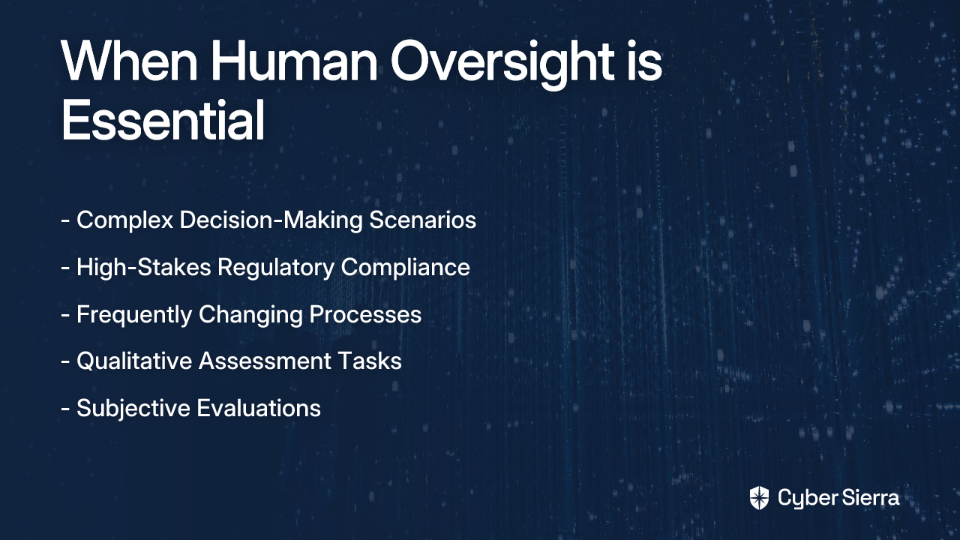
- Complex Decision-Making: Processes requiring nuanced judgment based on experience and context are poor candidates for full automation. As one security professional notes, "A human in the loop is more adaptable. They're faster to identify, find, and fix flaws in logic and implementation."
- High-Stakes Consequences: When errors could lead to severe regulatory compliance failures or data breaches, maintaining human oversight is crucial.
- Dynamic Processes: For workflows that change frequently, the overhead of reconfiguring automation can exceed the benefits. "If the process doesn't change frequently, automation might make sense. But if the automation requires a dev team, config control, etc., the overhead is close to the same."
- Qualitative Assessment: Tasks requiring subjective evaluation, like technical controls review or third-party questionnaires, typically require human judgment. As one practitioner states, "Review of documentation, manual controls review, following up on filled-in questionnaires? Can definitely not be automated."
The Strategic Approach: Finding the Right Balance
The decision isn't a binary choice between full automation and manual processes. The most effective GRC strategy strikes a balance:
- Use automation for data collection, standardized workflows, and initial risk screening
- Reserve human intellect for judgment, strategy, and exception handling
- Implement "human in the loop" designs for high-risk processes
- Conduct periodic cost-benefit analysis to assess automation ROI
Even with automated access reviews, security professionals recommend: "Once a quarter (or year) perform a manual review of all user accounts, compare it to the automated list and confirm any discrepancies." This verification step ensures the automation itself hasn't developed flaws in logic.
Conclusion: Strategic Automation, Not Total Automation
The goal isn't to automate everything but to implement a strategic approach that leverages technology while preserving critical human judgment. As organizations navigate increasing regulatory complexity and evolving threats, the most resilient GRC programs will build what one expert calls an "institutional distrust"—an environment that assumes failure is possible in both human and automated components and designs resilient processes accordingly.
By carefully assessing the risk-impact relationship, respecting legal requirements for human oversight, and applying a structured framework for automation decisions, organizations can achieve the right balance between efficiency and effectiveness in their GRC programs.
Automation improvement should continue until, as one practitioner puts it, "the cost benefit no longer makes sense." The key is knowing exactly where that inflection point lies for each process in your GRC ecosystem.
Frequently Asked Questions
What is the main challenge of GRC automation?
The primary challenge of GRC automation lies in balancing the drive for efficiency and cost savings with the potential for unacceptable risks in high-stakes compliance scenarios. This is often called the "automation paradox." While automation excels at routine, low-risk tasks, organizations become hesitant to transfer risk to software when a failure could lead to severe consequences like data breaches or regulatory fines. The key is to implement automation strategically, not as an end in itself.
When is human oversight essential for automated GRC processes?
Human oversight is essential for automated GRC processes that involve complex decision-making, have high-stakes consequences, or require qualitative, subjective judgment. Automation is highly effective for standardized, rule-based tasks. However, humans are more adaptable and better equipped to handle nuanced situations, identify flaws in logic, and assess qualitative information like third-party questionnaires. For critical processes, a "human in the loop" approach ensures that automated decisions are validated, reducing the risk of errors.
How does the EU AI Act impact GRC automation strategies?
The EU AI Act legally mandates "meaningful human oversight" for high-risk AI systems, which directly impacts how organizations can automate certain GRC functions. Under regulations like Article 14 of the EU AI Act, systems used in critical areas must be designed to allow for effective human intervention. This means a human operator must be able to understand the system's limitations, monitor its performance, and step in to prevent harm. This shifts human oversight from a best practice to a legal requirement.
What are the key benefits of strategically automating GRC tasks?
Strategic GRC automation delivers significant benefits, including dramatic efficiency gains, more comprehensive testing, real-time monitoring, enhanced visibility for leadership, and substantial cost savings. By automating repetitive and data-intensive tasks like evidence collection or testing thousands of transactions, GRC teams can free up valuable time to focus on strategic analysis. Automated dashboards and real-time alerts also improve an organization's ability to respond quickly to control failures and provide executives with up-to-date risk insights.
Can automation completely replace human judgment in GRC?
No, automation cannot completely replace human judgment in GRC because many critical compliance and risk management tasks require nuanced context, strategic thinking, and ethical considerations that current technology cannot replicate. The most effective GRC programs use a hybrid approach. They leverage automation for its strengths in data processing and scale while reserving human intellect for strategy, complex decision-making, and exception handling. The goal is strategic automation that supports and enhances human expertise.
