



The Integration Challenge: Balancing Automation and Human Oversight in Third-Party Risk Management


Join thousands of professionals and get the latest insight on Compliance & Cybersecurity.
You've implemented a robust cybersecurity program within your organization, but something keeps you up at night: your growing network of third-party vendors with access to your systems and data. Despite your internal controls, you realize your security is only as strong as your weakest vendor link. And with 43% of organizations lacking standardized methods to assess vendor cybersecurity postures, you're far from alone in this concern.
As your supply chain grows more complex and IoT devices proliferate throughout your industrial environments, the traditional "check-the-box" approach to vendor assessments feels increasingly inadequate. You need a more sophisticated strategy—one that leverages automation while preserving the crucial human judgment that technology alone cannot replicate.
This growing complexity is creating a perfect storm of risk exposure that threatens even the most security-conscious organizations. The challenge is clear: how do you effectively manage an expanding universe of third-party relationships without drowning in manual processes or placing blind faith in fully automated solutions?
Understanding the Third-Party Risk Management Challenge
Third-party risk management (TPRM) has evolved from a compliance checkbox into a critical component of organizational cybersecurity strategy. According to Hyperproof, several key trends are reshaping TPRM requirements:
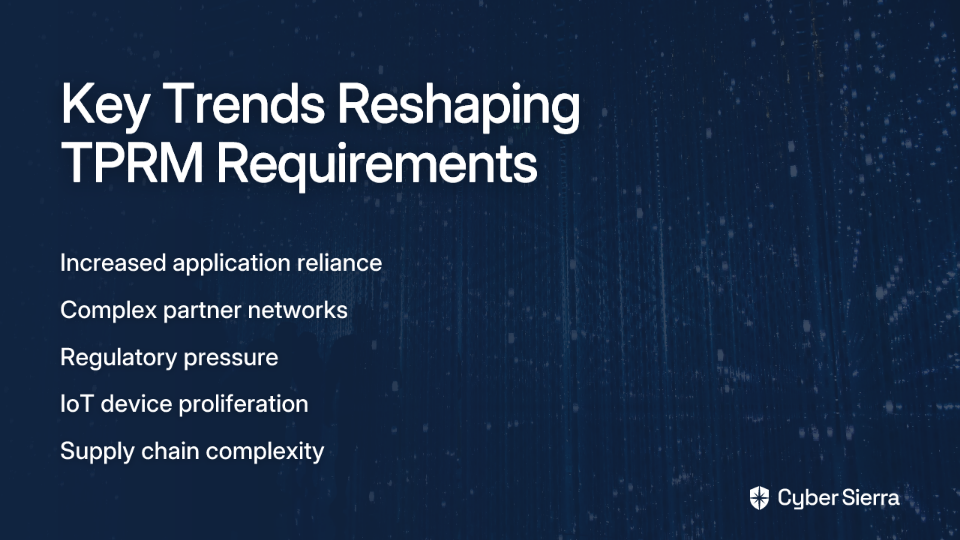
- Increased application reliance: Organizations now depend on a vast ecosystem of third-party applications, dramatically expanding potential attack surfaces.
- Complex partner networks: The typical enterprise collaborates with hundreds or thousands of vendors, contractors, and service providers—each representing a potential vulnerability.
- Regulatory pressure: Government and industry regulations increasingly hold organizations accountable for third-party security failures, adding compliance pressure to security concerns.
These trends create a complex risk landscape where traditional approaches—manual questionnaires, annual reviews, and static assessments—simply cannot scale effectively. The pain is acute: security teams spend countless hours on vendor reviews while still missing critical risks, and leadership struggles to quantify and communicate the actual risk exposure from third-party relationships.
"Difficulty in finding effective risk mitigation standards for third-party vendors" is one of the most common complaints, according to discussions among cybersecurity professionals. Many express "skepticism about the effectiveness of third-party risk management measures" and note a dangerous "reliance on contracts rather than robust risk management for third-party partnerships."
The Automation-Human Oversight Balance
The core challenge in modern TPRM lies in finding the right balance between automation and human judgment. Both elements are essential, yet organizations frequently overemphasize one at the expense of the other.
The Promise and Limits of Automation
Automated vendor assessment tools offer compelling advantages:
- Scalability: Managing hundreds or thousands of vendor relationships becomes feasible.
- Consistency: Every vendor is evaluated against the same criteria with minimal variability.
- Efficiency: Dramatic reduction in manual effort for routine assessments.
- Continuous monitoring: Real-time alerts when vendor risk profiles change.
According to TrustCloud, "Automating vendor assessments is essential to manage increasing complexities and compliance needs." When implemented correctly, automation enables organizations to proactively identify risks, improving both financial and cybersecurity management.
However, automation alone is insufficient. A Reddit discussion on trusting vendor responses highlights a critical concern: "The necessity to trust vendor responses despite potential inadequacies in assessments." Automated tools typically accept vendor-provided information at face value, potentially missing deception or misrepresentation.
The Critical Role of Human Oversight
Human experts bring essential capabilities that technology cannot replicate:
- Context awareness: Understanding the business importance of each relationship.
- Nuanced judgment: Reading between the lines of vendor responses.
- Relationship management: Building trust and encouraging transparency.
- Specialized expertise: Applying domain knowledge to identify subtle red flags.
The most effective TPRM programs maintain what cybersecurity professionals call a "trust but verify" approach—accepting vendor claims while systematically validating critical assertions. As one professional noted, "Always cross-check vendor responses with independent sources or evidence to ensure reliability, especially in regards to sensitive data access."
Implementation Framework for Balanced TPRM
To effectively balance automation with human oversight, organizations should consider this implementation framework:
- Define clear objectives and criteria for vendor assessments based on your specific risk profile.
- Assess existing manual processes to identify inefficiencies and areas suitable for automation.
- Select an automation platform that integrates well with your existing systems and provides customizable workflows.
- Pilot the program with a subset of vendors before full deployment.
- Establish governance structures and processes for human review of automated assessments.
- Train staff on both the technical aspects of the automation platform and the critical thinking skills needed for effective oversight.
This structured approach enables organizations to leverage automation's efficiency while preserving the human judgment essential for truly effective risk management.
Quantifying IoT-Related Cyber Risk Exposure
The proliferation of IoT devices in industrial settings creates unique challenges for third-party risk management. Unlike traditional IT assets, IoT devices often:
- Have limited computing resources for security functions
- Run proprietary firmware with irregular update cycles
- Connect physical systems to digital networks
- Are deployed in hard-to-access locations
- Remain in service for decades rather than years
These characteristics make IoT devices particularly vulnerable to exploitation and difficult to secure through conventional means. According to the Ponemon Institute's report on IoT and third-party risk, 78% of organizations foresee potential data breaches from unsecured IoT devices, and 76% predict distributed denial-of-service (DDoS) attacks originating from compromised devices.
Assessing IoT Risk Exposure
Quantifying IoT risk exposure requires a multifaceted approach that goes beyond traditional IT security frameworks:

- Device Inventory and Classification: Maintain an accurate inventory of all IoT devices, categorizing them by function, connectivity, access privileges, and potential impact if compromised.
- Vulnerability Assessment: Regularly scan devices for known vulnerabilities, including firmware versions, default credentials, and insecure protocols.
- Network Behavior Analysis: Monitor network traffic patterns for anomalies that might indicate compromise or misuse.
- Physical Security Evaluation: Assess the physical protection of devices against tampering or unauthorized access.
- Supply Chain Risk Assessment: Evaluate the security practices of device manufacturers, from design and development to maintenance and support.
Organizations should develop a comprehensive risk scoring methodology that considers these factors and assigns appropriate weights based on their specific operational context. This enables quantitative comparison of risks across different device types and manufacturers.
Implementing IoT Security Controls
Based on discussions among cybersecurity professionals on Reddit, two control strategies stand out as particularly effective for managing IoT security risks:
- Network Segmentation: "Network Segmentation is going to be a key component in your security posture as you are limited on what type of applications or configurations you can make to many IoT devices to patch, update, or secure them." By isolating IoT devices on separate network segments with strictly controlled access, organizations can limit the potential impact of a compromised device.
- Secure Boot: "Some kind of Secure Boot to prevent anyone other than you to run a bootloader or kernel that you have not signed. It's using asymmetric cryptography." This ensures that devices only run authorized firmware, reducing the risk of malicious code execution.
Additional controls include intrusion detection systems (IDS) specifically designed for IoT environments, such as Nozomi Networks, which "have robust detections and threat intelligence specifically for IoT, IIoT, and OT environments."
Building an Integrated TPRM Framework
To address the dual challenges of balancing automation with human oversight and managing IoT-related risks, organizations need a comprehensive TPRM framework. According to Hyperproof, such a framework should integrate risk governance, cybersecurity, and compliance into a continuous process.

Key Elements of an Effective TPRM Framework
- Updated Data Maps: Include all third parties to understand exactly what data they access and process. This creates visibility into your entire vendor ecosystem.
- Framework Definition: Establish a clear, repeatable process for vendor risk assessment that scales across your organization.
- Industry Standards Adoption: Leverage established frameworks like SOC 2 (Type 2) and ISO 27001:2022 to structure your assessments and ensure thoroughness.
- Structured Onboarding/Offboarding: Implement rigorous processes to ensure vendors meet security standards before gaining access and are properly deprovisioned when relationships end.
- Continuous Monitoring: Deploy security ratings and monitoring tools to maintain real-time awareness of vendor security postures, rather than relying solely on point-in-time assessments.
- Timely Implementation: Begin using frameworks early in vendor relationships and adapt them as circumstances change.
- Rigorous Vendor Selection: Maintain thorough criteria for vetting vendors before engagement, with security as a primary consideration.
- Clear Contractual Standards: Outline security responsibilities explicitly in contracts, including incident notification requirements, audit rights, and remediation obligations.
Best Practices for Implementation
Based on insights from cybersecurity professionals and industry experts, these best practices can enhance the effectiveness of your TPRM program:
- Have strong and achievable policies: As recommended in Reddit discussions, "Develop clear and realistic policies that dictate security standards for working with third-party vendors. This may include minimum certification standards such as SOC2 or ISO27001."
- Look beyond compliance: "It's important to host a sanity check on how much exposure to risk remains in areas that regulatory compliance is not able to address." Compliance with standards is necessary but not sufficient for comprehensive risk management.
- Conduct regular due diligence: Implement ongoing vendor performance reviews to identify emerging risks before they materialize into security incidents.
- Develop internal audit processes: Conduct your own audits to identify risks before external examinations reveal them, allowing for proactive remediation.
Conclusion
Third-party risk management sits at the intersection of cybersecurity, business operations, and regulatory compliance. As organizations increasingly depend on external partners and adopt IoT technologies, the need for sophisticated, balanced approaches to TPRM grows more urgent.
By developing frameworks that combine automation's efficiency with human judgment's nuance, organizations can scale their vendor assessment processes without sacrificing effectiveness. Similarly, by implementing specialized controls and monitoring for IoT devices, they can quantify and mitigate the unique risks these technologies introduce.
The most successful TPRM programs share common characteristics: they're comprehensive without being unwieldy, adaptable to changing circumstances, and grounded in a clear understanding of business objectives. They balance technological solutions with human expertise, and they recognize that security is not a one-time achievement but an ongoing process.
As you refine your own approach to third-party risk management, remember that perfect security is unattainable. The goal is to implement reasonable, risk-based controls that enable your organization to leverage the benefits of vendor relationships and IoT technologies while maintaining an acceptable level of security. As one cybersecurity professional aptly noted, there are "no perfect solutions, only varying degrees of effectiveness."
By adopting the balanced approach outlined in this article, you can dramatically improve your organization's third-party risk posture and sleep a little easier knowing that you've transformed your vendor relationships from potential vulnerabilities into well-managed components of your overall security strategy.
Frequently Asked Questions
What is Third-Party Risk Management (TPRM) and why has it become so critical?
Third-Party Risk Management (TPRM) is the process of identifying, assessing, and mitigating risks associated with an organization's use of third-party vendors, suppliers, and partners. It has become critical due to increased reliance on third-party applications, complex partner networks, growing regulatory pressure, and the proliferation of IoT devices, all of which expand an organization's attack surface and potential vulnerabilities.
Why is a balance between automation and human oversight essential for effective TPRM?
A balance between automation and human oversight is essential in TPRM because while automation offers scalability, consistency, and efficiency for routine assessments, human judgment is irreplaceable for context awareness, nuanced decision-making, and verifying vendor-provided information. Automation alone can miss deception or misrepresentation, while purely manual processes cannot scale to manage the vast number of modern vendor relationships effectively.
How can organizations quantify and manage cyber risks associated with third-party IoT devices?
Organizations can quantify and manage IoT-related cyber risks by first creating a comprehensive device inventory and classification, conducting regular vulnerability assessments, analyzing network behavior for anomalies, evaluating physical security, and assessing the supply chain risks of these devices. Effective management strategies include network segmentation to isolate IoT devices and limit potential breach impact, and implementing secure boot processes to ensure firmware integrity and prevent unauthorized code execution.
What are the core components of a comprehensive TPRM framework?
The core components of a comprehensive TPRM framework include: maintaining updated data maps to understand third-party data access; defining a clear, repeatable, and scalable vendor risk assessment process; adopting industry standards (like SOC 2 or ISO 27001); implementing structured vendor onboarding and offboarding procedures; enabling continuous monitoring of vendor security postures; establishing clear contractual security standards and responsibilities; and maintaining rigorous vendor selection criteria.
What are the first steps an organization should take to improve its TPRM program?
The first steps to improving a TPRM program involve defining clear objectives and criteria for vendor assessments tailored to your organization's specific risk profile. Next, assess existing manual processes to identify inefficiencies and areas suitable for automation. Concurrently, develop and enforce strong, achievable policies that dictate security standards for all third-party collaborations, including minimum certification requirements.
How often should vendor risk assessments be performed?
Vendor risk assessments should incorporate continuous monitoring rather than being solely point-in-time events to maintain real-time awareness of vendor security postures. While comprehensive, in-depth reviews might be conducted annually or biennially based on vendor criticality and risk level, ongoing monitoring tools and processes should be active to dynamically detect changes in a vendor's risk profile. Critical vendors or those with access to sensitive data should be assessed more frequently and rigorously.
