



7 Best Agentic GRC Platforms in 2026 (and What Makes Them Actually Agentic)

Join thousands of professionals and get the latest insight on Compliance & Cybersecurity.
Summary
- The key difference in GRC platforms is autonomy: agentic AI executes entire workflows, while copilots only assist humans. Most vendors engage in "agent washing," rebranding assistive tools as autonomous AI.
- To identify a true agentic GRC platform, ask vendors for production data showing autonomous workflow execution, not just demos of AI-assisted features.
- Agentic AI solves the core GRC challenge of understaffed teams by automating entire tasks like evidence reviews and vendor assessments, not just making analysts incrementally faster.
- Cyber Sierra's AI Analysts deliver genuinely autonomous GRC, proven in production to significantly speed up evidence reviews and vendor assessments.
GRC teams are chronically understaffed. The backlog of risk assessments, vendor reviews, and control audits never shrinks. Now, boards are demanding AI, but nearly every GRC vendor has relabeled their product as "AI-powered" without changing what the software actually does.
Analysts have flagged this as "agent washing," where AI branding is applied to features that are, at best, sophisticated automation or chat-based copilots.
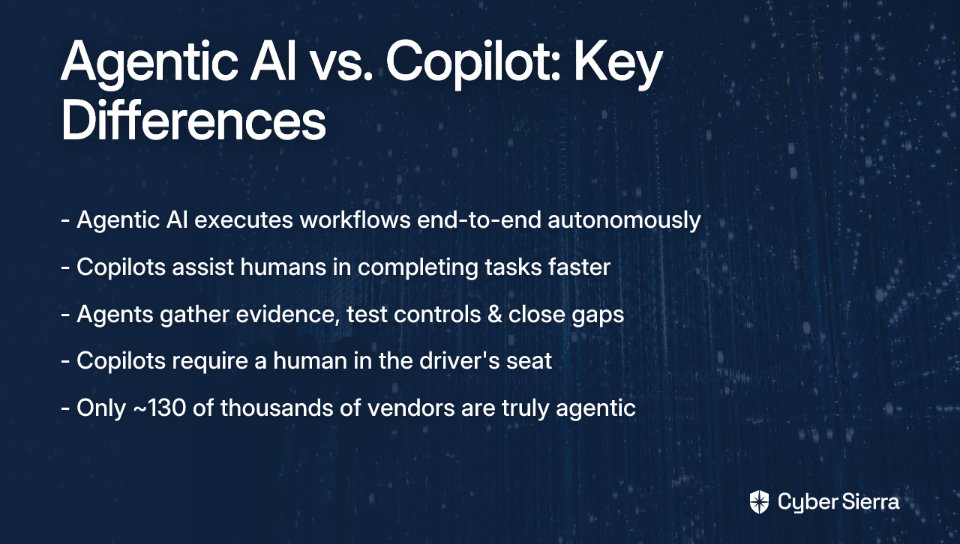
The distinction between an agentic GRC platform and a copilot matters. An agentic GRC platform deploys AI systems that execute entire compliance workflows end-to-end: gathering evidence, testing controls, identifying gaps, and generating findings.
A copilot helps a human do that work faster. An AI Analyst does the work, with the human in an oversight role. The seven platforms below are assessed on what they actually do, not what their press releases claim.
7 Best Agentic GRC Platforms
The platforms below were selected based on the depth of their AI autonomy, enterprise deployment track record, and verifiable performance data. If a platform's AI cannot execute a workflow without a human in the driver's seat, it is categorized as a copilot, not an agent.
1. Cyber Sierra
Cyber Sierra is the most genuinely agentic GRC platform on this list. It is built around live AI Analysts deployed across three core GRC domains: Cyber GRC, Continuous Controls Monitoring (CCM), and Third-Party Risk Management (TPRM).
These are not chatbots or recommendation engines. Each AI Analyst is designed to autonomously execute a specific high-stakes workflow from end to end.
What Makes It Genuinely Agentic
Cyber Sierra's AI Analysts include purpose-built agents for Gap Assessment, Evidence Auditing, Controls Break Detection, and TPRM Due Diligence, among others. Each analyst operates within a Context Graph, a unified knowledge graph of the organization's policies, controls, assets, and evidence.
This grounding helps prevent the hallucinations and false positives that can make AI outputs untrustworthy in compliance contexts.
The architecture also addresses a concern raised repeatedly by enterprise security teams: data sovereignty. Unlike most agentic GRC platforms that rely on shared cloud infrastructure, Cyber Sierra deploys in the customer's own cloud environment and supports any large language model, including open-source and air-gapped models. No customer data is used to train external models.
Verified Performance
In enterprise deployments, Cyber Sierra's AI Analysts have been shown to accelerate core GRC workflows. This is the performance benchmark that separates a true agentic GRC platform from a tool with an AI label.
The platform automates evidence reviews at scale, reduces the time required for vendor assessments, and shortens risk-assessment cycles. GRC teams shift their focus from manual data collection to strategic risk management.
Industry Recognition
Cyber Sierra was recognized as a Sample Vendor in the Gartner® Hype Cycle™ for Cyber-Risk Management, 2024. It was also selected for Singapore's IMDA Spark Programme, a validation for enterprise technology deployment. The CCM module automates continuous control testing at a cadence that manual teams cannot match.
Best for: Large enterprises in financial services, government, and defense with mature GRC programs that need genuine AI autonomy at scale.
Key limitation: Focused on core GRC domains. Organizations seeking a single platform to also cover ESG reporting or business continuity management may need supplementary tools.
2. ServiceNow IRM
ServiceNow's Integrated Risk Management suite runs on the same platform that manages IT service operations for many Global 2000 enterprises. For organizations where ServiceNow is already the system of record for incidents, changes, and assets, IRM offers a logical consolidation point for GRC data.
It is not an agentic GRC platform, but it is a widely deployed GRC workflow system worth understanding.
AI Claims vs. Reality
ServiceNow's AI layer, branded "Now Assist," is a capable copilot. It summarizes risk records, recommends response actions, and generates draft reports. What it does not do is execute GRC workflows autonomously. A risk assessment still requires a human analyst to review findings, make determinations, and close tasks. The AI surfaces and recommends; the analyst acts.
Extracting meaningful value from ServiceNow IRM can require a substantial engagement with a certified system integrator. The platform's configurability is genuine, but native out-of-the-box GRC functionality requires considerable setup before it becomes operational.
Best for: Enterprises deeply invested in the ServiceNow platform that want GRC data consolidated with ITSM operations.
Key limitation: AI is assistive, not agentic GRC-grade. Total Cost of Ownership is high, and value realization depends heavily on SI expertise and setup time.
3. OneTrust
OneTrust built its market position on privacy compliance, particularly GDPR and CCPA. It has since expanded into a broader GRC, ethics, and ESG platform with a wide module library. For teams primarily focused on privacy, it offers depth. As an agentic GRC platform, it does not qualify — and the AI features confirm why.
AI Claims vs. Reality
OneTrust's AI features are concentrated in its privacy modules, where they assist with data discovery and classification. These are assistive functions. The AI does not autonomously execute GRC workflows.
Users on Reddit have noted that "OneTrust is lacking in terms of automation quite a bit," and setup typically requires extensive external consulting support.
The pricing model is a material concern for enterprise buyers. Customers on Gartner Peer Insights have documented renewal price increases of 22–59%, which affects total cost planning for multi-year contracts.
Best for: Global enterprises where privacy compliance (GDPR, CCPA, LGPD) is the primary GRC driver and breadth of privacy-specific tooling is the priority.
Key limitation: AI is not agentic GRC-grade and does not execute workflows autonomously. Pricing volatility at renewal creates budget planning risk.
4. MetricStream
MetricStream is one of the oldest names in enterprise GRC. It has a large installed base across banking, insurance, and healthcare, and its process maturity reflects years of iteration with regulated-industry customers. Like most legacy GRC tools, it is built for human-driven workflows rather than agentic GRC execution, and its AI layer reflects that design.
AI Claims vs. Reality
MetricStream offers AI-assisted risk prediction and some automation of routine tasks. But the platform is frequently described by practitioners as a set of "Lego pieces requiring developer help." Configuring it to match an organization's operational environment demands substantial internal technical resources.
This maps directly to the frustration practitioners express that GRC tools often require heavy customization to fit their environment.
The AI layer adds value at the margins but does not change the core problem. Compliance workflows still require human analysts to execute them.
Best for: Large regulated enterprises with substantial internal IT capacity and a need for deeply customizable GRC process frameworks.
Key limitation: Steep learning curve, high setup cost, and AI functionality that is assistive rather than autonomous. Configuration complexity slows deployment and increases dependency on specialized developers.
5. Hyperproof
Hyperproof is a cloud-native compliance operations platform that has earned recognition for a cleaner, more intuitive user experience than legacy GRC tools. It targets compliance-focused teams managing certification programs like SOC 2, ISO 27001, and HIPAA. It is not an agentic GRC platform, but it is one of the better-designed tools in the assistive tier.
AI Claims vs. Reality
Hyperproof includes AI-assist features that suggest evidence-to-control mappings and reduce some manual tagging effort. These are useful productivity features for compliance operations teams. They are not autonomous agents. A compliance analyst still drives the evidence collection process, reviews the suggestions, and makes the final determination on control satisfaction.
The platform also has recognized gaps in analytics depth and dashboard customization. For GRC programs that require complex, multi-dimensional risk reporting, these limitations become meaningful constraints.
Best for: Growth-stage and mid-market organizations managing SOC 2, ISO 27001, or similar certifications who prioritize ease of use and clean workflow management.
Key limitation: No agentic GRC execution. Limited analytics depth and dashboard flexibility make it a difficult fit for enterprise-scale GRC programs with complex reporting requirements.
6. AuditBoard
AuditBoard was built for internal audit teams and has maintained that focus as its core strength. It handles audit planning, fieldwork management, issue tracking, and SOX compliance workflows with a level of specificity that generalist agentic GRC platforms often include but rarely match in this domain. Its AI layer is copilot-grade, not agentic GRC-grade.
AI Claims vs. Reality
AuditBoard's AI capabilities are positioned as a copilot for auditors. The tools assist with summarizing fieldwork notes, drafting findings, and suggesting test steps.
User reviews on Gartner Peer Insights frequently describe the AI features as "underdeveloped." This reflects broader practitioner sentiment: "we are a ways off from good AI for auditing." The AI helps auditors work, but it does not perform audits.
Best for: Internal audit departments managing SOX compliance and operational audits who need a purpose-built platform for audit lifecycle management.
Key limitation: AI is early-stage and assistive, not agentic GRC-grade. The platform's depth is concentrated in internal audit, with limited capability in broader cyber risk management, TPRM, and continuous controls monitoring.
7. Anecdotes
Anecdotes is built around a "Compliance Fabric" architecture. Its primary differentiator is data integration: the platform connects to hundreds of enterprise systems to pull compliance data into a unified GRC context. For organizations struggling with fragmented compliance data across dozens of tools, this integration layer is genuinely valuable — though it stops short of agentic GRC execution.
AI Claims vs. Reality
Anecdotes explicitly markets its AI as a "Compliance Copilot." Its ChatGRC feature allows users to query compliance data conversationally, and its Agent Studio enables no-code workflow automations based on predefined triggers. These are well-executed assistive features.
The AI makes it faster for a human to find and act on information. It does not replace the analytical work that a human expert performs after reviewing that information.
The distinction matters: Anecdotes excels at aggregating and surfacing compliance data. What happens after the data surfaces — the analysis, judgment, and decision — remains in the hands of the human user.
Best for: Technology-forward organizations with numerous data sources and a need to unify compliance data from a wide range of tools.
Key limitation: AI is fundamentally assistive. The platform is strong at data collection and presentation but does not deliver the autonomous execution that characterizes a true agentic GRC platform.
How to Identify a Truly Agentic GRC Platform
Choosing the right agentic GRC platform in a market full of "agent washing" comes down to separating assistive AI from autonomous AI. A copilot makes your team faster; a true agentic GRC platform executes entire workflows while your team oversees strategy.
When evaluating any agentic GRC platform, demand proof, not just promises. Ask vendors for production data showing their AI executing a complete workflow — like a vendor assessment or evidence review — end-to-end, without a human in the driver's seat. True agentic GRC tools solve the core problem of understaffed teams by taking on entire tasks, not just nudging analysts along.
The definitive test: ask a vendor, "Can your AI complete a full evidence audit and generate the findings report without manual intervention?" Their answer will tell you everything.
Cyber Sierra's AI Analysts bring autonomous execution to GRC workflows. Book a demo to see how this approach fits your current process.
Frequently Asked Questions
What is the difference between an agentic GRC platform and a copilot?
The key difference is autonomy. An agentic platform autonomously executes entire GRC workflows like evidence collection and control testing. A copilot assists a human user who must still drive the process step-by-step. An agent does the work; a copilot helps you do the work faster.
Why is agentic AI important for modern GRC programs?
Agentic AI addresses the core GRC problem: overwhelming workloads with limited staff. By automating entire workflows, an agentic GRC platform allows teams to scale capacity, reduce risk assessment backlogs, and shift focus from manual tasks to strategic risk decisions. No copilot can do that at the same scale.
What tasks can an agentic GRC platform automate?
A true agentic GRC platform can fully automate high-volume, evidence-based tasks from end to end. This includes continuous controls monitoring, evidence auditing, gap assessments against security frameworks, third-party risk management (TPRM) due diligence, and compliance reporting.
Are there risks to using autonomous AI for GRC?
Yes, risks include inaccurate outputs (hallucinations) and data privacy concerns. Leading agentic GRC platforms mitigate this by grounding AI in a knowledge graph of your specific policies and controls, and by deploying within your own cloud environment to protect data sovereignty.
How can you tell if a GRC tool is genuinely agentic?
Ask the vendor for live production data, not just demos. The definitive test: can the AI execute a full workflow — such as a vendor assessment — without a human driving each step? If it requires constant input and approval, it is an assistive copilot, not an agentic GRC platform.
Which GRC platforms are considered truly agentic?
Cyber Sierra is the only agentic GRC platform on this list with verified production results. Other tools offer valuable AI-powered assistance but do not deliver the end-to-end autonomous execution that defines a true agentic GRC platform.
