



Top AI-Driven Continuous Monitoring Tools for CISOs in 2025


Join thousands of professionals and get the latest insight on Compliance & Cybersecurity.
Sarah Chen stared at her dashboard in frustration. An alert about a potential vendor breach flashed red while her calendar reminded her of the upcoming PCI DSS audit. Her compliance manager David was buried in spreadsheets, chasing evidence for ISO 27001 certification. Meanwhile, Ben from Third-Party Risk Management was drowning under hundreds of vendor questionnaires with no standardized way to assess their responses.
If this scenario sounds painfully familiar, you're not alone.
The End of Spreadsheet Compliance
"If only I could thin down the herd of vendors and find solutions backed by real experience," is a common refrain among security leaders. The challenge isn't just finding tools—it's finding the right ones that solve your specific pain points without requiring a complete infrastructure overhaul.
The stark reality? Large organizations spend up to 10% of their total IT budget on compliance activities, often with little to show for it beyond point-in-time snapshots that are outdated before the audit report is even finalized.
Enter the era of the "Augmented CISO"—where artificial intelligence doesn't replace human expertise but dramatically enhances it by automating the tedious, manual work of continuous compliance monitoring.
This article cuts through the marketing noise to compare the top AI-driven platforms that help security leaders:
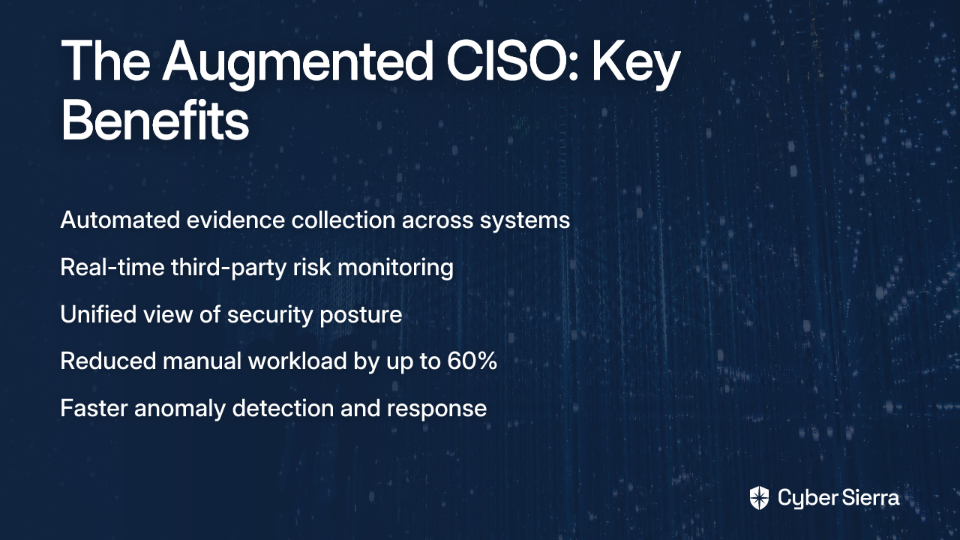
- Automate evidence collection across disparate systems
- Continuously monitor third-party risks in real time
- Create a unified, always-current view of their security posture
Why Continuous Monitoring is the New Standard for 2025
Traditional compliance approaches are fundamentally broken. Point-in-time assessments—those screenshots, log exports, and configuration reviews—create a false sense of security. They're outdated the moment they're captured and utterly inadequate for modern cloud environments.
Gartner defines Continuous Controls Monitoring (CCM) as technology that "reduces business losses and audit costs by continuously monitoring controls in financial and other business processes." But in 2025, with the integration of AI, CCM has evolved beyond simple automation into intelligent assurance.
AI-driven continuous monitoring can reduce manual audit workloads by up to 60%, freeing security teams to focus on strategic initiatives instead of chasing evidence.
The AI Advantage:
- Dynamic Anomaly Detection: AI-driven tools establish baselines of normal activity and use machine learning to detect deviations. This reduces the mean time to detect incidents by over 7 minutes—critical time for security operations teams.
- Intelligent Risk Assessment: Rather than treating all vulnerabilities equally, AI helps prioritize them based on potential impact to regulatory compliance and critical business assets.
- Automated Root Cause Analysis: By correlating data from SIEMs, cloud logs, and EDRs, AI can pinpoint the source of a control failure, drastically reducing troubleshooting time for security teams.
The growing regulatory landscape (DORA, NIS2, GDPR) and the expansion of cloud environments and supply chains have made continuous monitoring not just a nice-to-have but an operational necessity.
The CISO's Checklist: 5 Must-Have Features in an AI Monitoring Platform
Before diving into specific tools, let's establish what makes a truly effective AI-driven continuous monitoring platform in 2025:
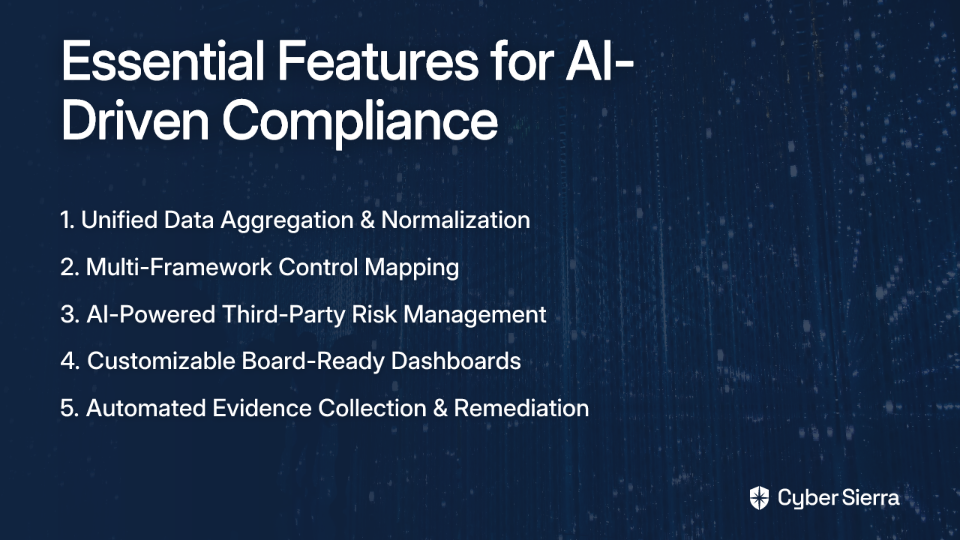
1. Unified Data Aggregation & Normalization
A platform's value is directly proportional to the data it can ingest. Look for solutions with pre-built, agentless connectors for your entire security stack:
- SIEM solutions (Splunk, Microsoft Sentinel)
- EDR platforms (CrowdStrike, SentinelOne)
- Vulnerability Management tools (Qualys, Tenable)
- CSPM solutions (Wiz, Prisma Cloud)
- ITSM platforms (ServiceNow, Jira)
Panaseer's approach of using "intelligent data connectors to collect, normalize, and correlate data" represents the gold standard here—allowing for a comprehensive view without requiring additional agents or complex deployments.
2. Multi-Framework Control Mapping & Management
For compliance managers like David, manually mapping controls across frameworks is a nightmare. Your platform should provide:
- Out-of-the-box mappings for major frameworks (NIST CSF, ISO 27001, PCI DSS, HIPAA, GDPR)
- Ability to customize and map internal policies
- Automated evidence collection linked directly to specific control requirements
Platforms like CyberSaint's CyberStrong specialize in framework alignment and evidence collection, turning months of manual work into automated processes.
3. AI-Powered Third-Party Risk Management (TPRM)
For third-party risk managers like Ben and privacy officers like Anjali, modern TPRM must go beyond static questionnaires:
- Real-time security ratings integration from services like BitSight and SecurityScorecard
- AI-driven assessment of vendor responses to identify inconsistencies and red flags
- Automatic mapping of vendor risks to compliance obligations
- Continuous monitoring for changes in vendor security posture
4. Customizable, Board-Ready Dashboards
CISO Sarah needs to translate complex security metrics into business language for the board. The ideal platform should offer:
- Customizable dashboards that aggregate granular control data into high-level business metrics
- Risk quantification capabilities that translate technical risks into financial impact
- Historical trending to show improvement over time
- The ability to drill down from high-level metrics to underlying evidence
Panaseer's "Scorecard Presentation" exemplifies this approach by converting complex cybersecurity data into easily understandable metrics for non-technical stakeholders.
5. Automated Evidence Collection & Remediation Workflows
The "continuous" in continuous monitoring hinges on automation. Your platform should:
- Automatically pull evidence from source systems on a scheduled or real-time basis
- Link evidence directly to specific controls and compliance requirements
- Create tickets in your existing workflow tools (Jira, ServiceNow) when controls fail
- Track remediation efforts to closure
- Maintain an audit trail of all control testing and remediation activities
A Curated List of Top Tools for 2025
Based on the features above, here's a categorized list of the leading AI-driven continuous monitoring platforms for 2025:
Category 1: Comprehensive GRC & Continuous Controls Monitoring
Panaseer
- Strengths: Exceptional cyber asset management as the foundation for monitoring. Creates a unified inventory and provides board-level metrics using agentless data connectors.
- Ideal For: CISOs like Sarah who need a single source of truth about assets and control effectiveness for reporting upwards.
- Consideration: Best suited for larger enterprises with mature security programs.
CyberSaint (CyberStrong)
- Strengths: AI-powered automation for continuous compliance. Integrates real-time telemetry to validate control effectiveness against frameworks like NIST and ISO 27001. Strong risk quantification capabilities.
- Ideal For: Compliance managers like David and internal auditors like Kenichi who need to automate manual evidence gathering.
- Consideration: Implementation requires clear mapping of your security program to standard frameworks.
Category 2: AI-Powered Observability for Security Operations
Coralogix
- Strengths: Built for complex cloud-native environments. Excels at dynamic anomaly detection and automated root cause analysis. Offers AI-SPM (Security Posture Management).
- Ideal For: Security analysts like Priya who need deep visibility to detect configuration drift and investigate control failures in real-time.
- Consideration: Strongest for organizations with significant cloud footprints.
Datadog / New Relic
- Strengths: Comprehensive observability platforms with strong security modules. Powerful for organizations already invested in their ecosystem.
- Consideration: Can have complex pricing models and may require significant configuration compared to more specialized security tools.
Category 3: Specialized Third-Party Risk Management
OneTrust Vendorpedia
- Strengths: Market leader with deep AI-powered assessment capabilities and continuous monitoring. Extensive templates and workflow automation. Strong privacy focus for managing DPIAs and DPAs.
- Ideal For: TPRM managers like Ben and DPOs like Anjali at large organizations with complex vendor landscapes.
- Consideration: It can be costly with a steep learning curve for smaller teams.
UpGuard Vendor Risk / LogicGate Risk Cloud
- Strengths: More agile and customizable. UpGuard is known for real-time scoring and fast implementation. LogicGate offers no-code risk automation with highly customizable workflows.
- Ideal For: Organizations that need powerful but more flexible and potentially more cost-effective TPRM solutions.
- Consideration: May require more configuration to achieve the same depth as enterprise solutions.
Best Practices for Implementing Your Continuous Monitoring Strategy
Selecting the right tool is just the beginning. Here are key best practices for success:
1. Set Clear Objectives
define SMART goals for your implementation. Start with a specific pain point: "Automate evidence collection for our next PCI audit" or "Reduce vendor onboarding time by 30%."
2. Standardize on a Foundational Framework
Adopt a standard like NIST CSF as your baseline. This provides a common language for controls across security, IT, and audit teams, making automation more effective.
3. Integrate, Don't Rip-and-Replace
Your CCM platform should be a "manager of managers" that integrates with existing tools. Focus on solutions that enhance rather than duplicate your current workflows.
4. Foster a Culture of Continuous Assurance
As highlighted in the "Augmented CISO" article, the technology is just one piece. The goal is a cultural shift where security and compliance are continuous, collaborative processes, not annual fire drills.
Becoming the Augmented CISO
In 2025, the most effective CISOs aren't those with the largest teams or budgets—they're the ones who leverage AI to transform security from a reactive, compliance-driven cost center into a proactive, risk-aware business enabler.
As regulatory pressures mount and security landscapes grow more complex, manual spreadsheet-based approaches become increasingly untenable. AI-driven continuous monitoring isn't just about efficiency—it's about gaining visibility that was previously impossible with manual approaches.
Stop chasing spreadsheets. Start by identifying your most acute "hair on fire" problem—whether it's audit preparation, vendor risk, or real-time control validation—and explore a platform that can solve it. This is your first step to becoming an Augmented CISO in 2025.
Frequently Asked Questions
What is AI-driven continuous compliance monitoring?
AI-driven continuous compliance monitoring is an approach that uses artificial intelligence to automatically and perpetually test and validate security controls against regulatory frameworks like ISO 27001, PCI DSS, and NIST CSF. Unlike traditional point-in-time audits, which provide a snapshot of compliance, this method offers a real-time, dynamic view of an organization's security posture, significantly reducing manual effort and improving accuracy.
How does AI enhance traditional compliance processes?
AI enhances traditional compliance by automating evidence collection, detecting anomalies in real-time, and intelligently prioritizing risks. Machine learning algorithms can analyze vast amounts of data from various security tools (like SIEMs, EDRs, and cloud logs) to identify control failures and potential threats far faster than human teams. This transforms compliance from a manual, periodic activity into a proactive, continuous process, freeing up security professionals to focus on strategic risk management.
What are the most important features to look for in a continuous monitoring platform?
The most critical features include unified data aggregation with pre-built connectors for your existing security stack, multi-framework control mapping (e.g., NIST, ISO), AI-powered third-party risk management, customizable board-ready dashboards, and automated remediation workflows. A platform's ability to ingest and normalize data from all your systems without requiring new agents is a key differentiator for achieving a single, accurate view of your security posture.
How do I get started with implementing a continuous monitoring strategy?
The best way to start is by setting clear, specific objectives and focusing on a single, high-priority pain point. Instead of a complete overhaul, identify a pressing issue, such as "automating evidence collection for our upcoming PCI audit." Then, select a foundational framework like the NIST CSF to standardize your controls and choose a tool that integrates with your existing security ecosystem to solve that specific problem first.
Will AI replace the jobs of compliance and security professionals?
No, AI is not expected to replace compliance and security professionals but rather to augment their capabilities. The concept of the "Augmented CISO" highlights this partnership, where AI handles the repetitive, data-intensive tasks of monitoring and evidence collection. This allows human experts to dedicate their time to more strategic functions like risk analysis, incident response planning, and communicating security posture to business leaders.
