



9 Best Audit and Risk Management Software for Security Teams

Join thousands of professionals and get the latest insight on Compliance & Cybersecurity.
Summary
- Manual audit preparation is slow, tedious, and leaves dangerous security gaps between assessments.
- The solution is to adopt Continuous Security Monitoring (CSM), which automates evidence collection and provides real-time risk visibility.
- This guide evaluates 9 top audit and risk management tools based on automation, compliance coverage, and visibility to help you choose the right one.
- Cyber Sierra’s GRC platform excels at this by automating control monitoring and risk assessments, keeping you perpetually audit-ready.
If you're on a security or compliance team, this scenario will feel familiar: it's audit season, and you're "chasing down random spreadsheets," firing off endless email chains to collect evidence, and manually cross-referencing controls across three different frameworks — all at once. The manual documentation and endless back-and-forth bogs everything down before you even get started.
The real problem isn't a lack of effort — it's a structural one. Disconnected tools, spreadsheet-based risk registers, and point-in-time audits create blind spots that leave your organization exposed between review cycles. What modern security teams actually need is a shift toward Continuous Security Monitoring (CSM), which UpGuard defines as "the process of automating the monitoring of information security controls, vulnerabilities, and cyber threats to support organizational risk management decisions."
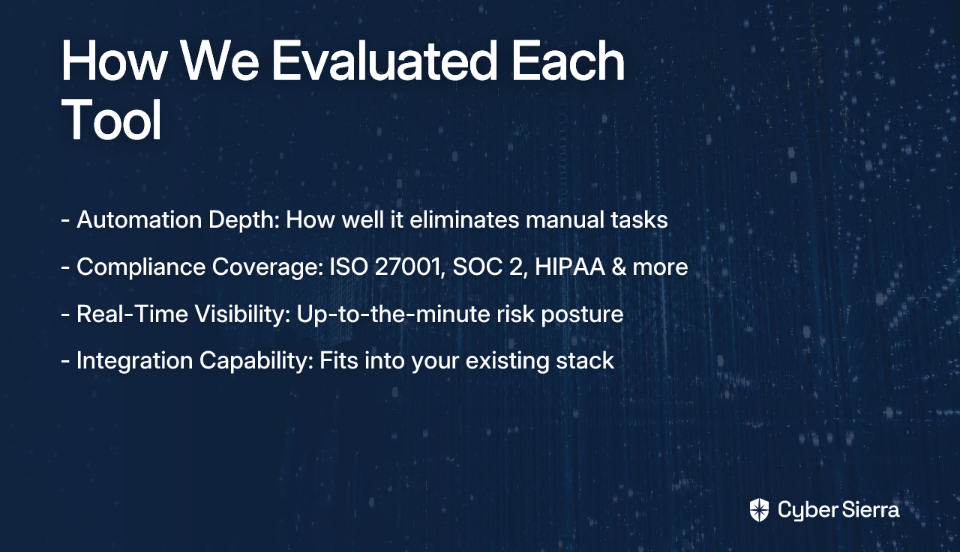
That shift is exactly what the best audit and risk management software enables. This guide evaluates 9 leading solutions across four criteria that matter most to security teams:
- Automation Depth: How effectively does it eliminate manual tasks?
- Compliance Framework Coverage: How many standards (ISO 27001, SOC 2, HIPAA, etc.) does it support?
- Real-Time Visibility: Does it give you an up-to-the-minute view of your risk posture?
- Integration Capability: How well does it slot into your existing tech stack?
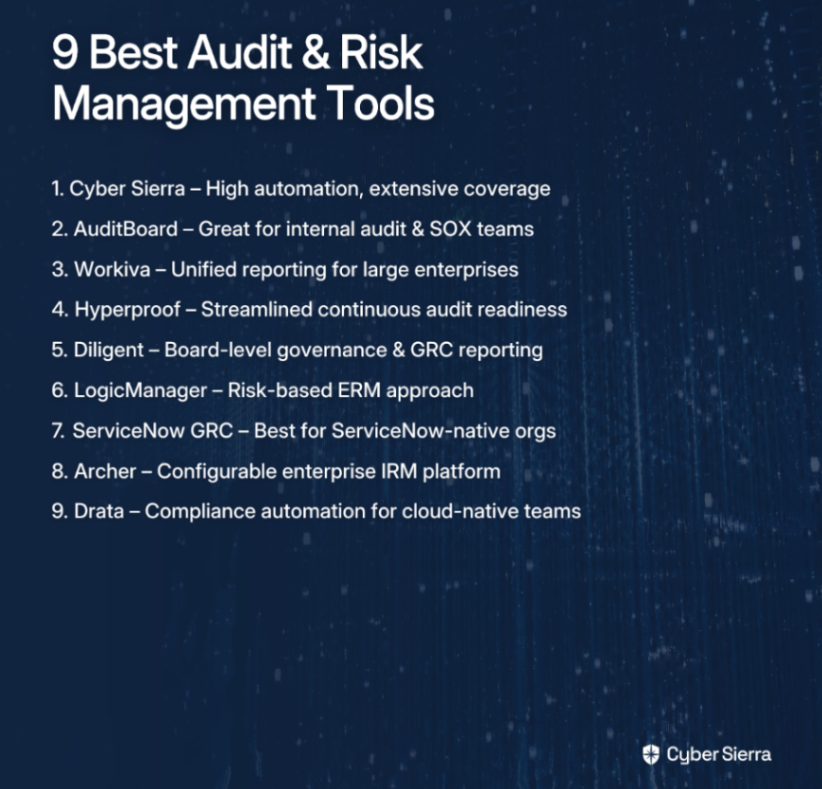
1. Cyber Sierra
Best For: Enterprises that need to move beyond point-in-time audits toward continuous, AI-driven control monitoring and proactive risk management.
Cyber Sierra's platform is purpose-built to address the exact frustrations security teams voice most. As one auditor noted on Reddit, the biggest drag is the "tedious and time-consuming" manual documentation. Rather than being a checkbox tool, Cyber Sierra is designed to instill automation, continuity, and intelligence into your entire security program.
Automation Depth
Rating: High
Cyber Sierra automates data collection, risk assessments, control testing, and reporting end-to-end. Its GRC module generates comprehensive reports and maintains detailed audit trails automatically — cutting the manual groundwork that typically consumes weeks of a compliance team's time.
Compliance Framework Coverage
Rating: Extensive
Supports SOC 2, ISO 27001, GDPR, HIPAA, PCI DSS, NIST, and custom controls out of the box. This is a critical differentiator for organizations managing multiple regulatory requirements simultaneously.
Real-Time Visibility
Rating: Yes
The Continuous Control Monitoring module provides near real-time visibility into the effectiveness of every security control. It builds a centralized control repository, detects exceptions and anomalies as they surface, and delivers actionable risk intelligence — giving you a single source of truth rather than a quarterly snapshot.
Integration Capability
Rating: High
Designed to plug into existing security and IT environments to centralize data streams and streamline workflows.
Standout Features:
- CCM. Continuously validates security controls rather than waiting for the next audit cycle.
- TPRM. Automates vendor assessments and provides 24/7 visibility into vendor security compliance, addressing third-party blind spots.
- Threat Intelligence. Performs network and cloud vulnerability scanning for a proactive, outside-in view of your attack surface.
- Employee Security Training. Runs simulated phishing campaigns and interactive modules to strengthen your human firewall.
- Cyber Insurance. Streamlines the application process with automated documentation and real-time posture insights for insurers.
2. AuditBoard
Best For: Internal audit and SOX compliance teams who need a collaborative, user-friendly platform.
AuditBoard is one of the more widely adopted audit management tools, particularly in organizations where internal audit, risk, and compliance teams need a shared workspace. Its intuitive UI simplifies complex audit processes and fosters cross-departmental collaboration.
Automation Depth
Rating: Moderate
Streamlines manual workflows for audit planning and execution, though some users on Reddit flag its high cost and inconsistent customer support as notable friction points.
Compliance Framework Coverage
Rating: Basic
Strong core focus on SOX, with capabilities extending to other risk and compliance frameworks.
Real-Time Visibility
Rating: Strong
Intuitive dashboards track audit progress, open issues, and remediation status at a glance.
Integration Capability
Rating: Good
Connects with a range of business systems to pull relevant data into audit workflows.
3. Workiva
Best For: Large enterprises in finance, risk, and compliance that need to connect siloed data into a unified reporting source.
Workiva excels at linking financial reporting, audit, and risk management data into a single cloud-based platform. It's especially strong for organizations dealing with complex data reconciliation across multiple departments. That said, users have noted latency issues and a "clunky interface," alongside a high degree of customization required to get full value.
Automation Depth
Rating: High
Automates workflows and enforces data consistency across reporting, audit, and risk functions.
Compliance Framework Coverage
Rating: Extensive
Deep SOX capabilities, with adaptability to broader GRC frameworks.
Real-Time Visibility
Rating: Yes
Data connections update linked documents in real time across the platform.
Integration Capability
Rating: High
Strong integrations with ERPs, GRC systems, and spreadsheet workflows.
4. Hyperproof
Best For: Tech-forward companies looking for a streamlined path to continuous audit readiness.
Hyperproof breaks down compliance requirements into manageable tasks, automates evidence collection, and keeps teams on track between audit cycles. It's a strong choice for organizations that want to move from reactive fire-fighting to a sustainable state of compliance.
Automation Depth
Rating: High
Automated evidence collection and task management reduce the manual burden significantly.
Compliance Framework Coverage
Rating: Moderate
Covers SOC 2, ISO 27001, PCI DSS, and HIPAA, with a growing framework library.
Real-Time Visibility
Rating: Yes
Dashboards offer clear snapshots of compliance posture and control health.
Integration Capability
Rating: Moderate
Connects with cloud services, ticketing systems, and developer tooling.
5. Diligent One Platform
Best For: Organizations that need integrated GRC with strong board-level governance and executive reporting.
Diligent offers a broad suite of tools spanning internal audit, compliance tracking, and regulatory management — all designed with governance oversight in mind. It's a solid pick for enterprises where GRC reporting needs to flow up to board level. However, some users have flagged usability challenges that complicate effective audit follow-ups.
Automation Depth
Rating: Medium
Workflow automation covers compliance tracking and audit management, though day-to-day usability can vary.
Compliance Framework Coverage
Rating: Extensive
Wide GRC coverage from internal audit to regulatory standards.
Real-Time Visibility
Rating: Yes
Comprehensive monitoring dashboards suited for executive and board oversight.
Integration Capability
Rating: Moderate
Works well within governance and board management ecosystems.
6. LogicManager
Best For: Organizations prioritizing a risk-based approach to audit and compliance, with a focus on Enterprise Risk Management (ERM).
LogicManager reframes auditing as a strategic function rather than a paperwork exercise. It helps teams build a risk-based governance framework, maintain an Audit Universe Inventory, and map risks to controls effectively — giving audit programs real strategic teeth.
Automation Depth
Rating: High
Strong automation for risk assessments, control testing, and reporting workflows.
Compliance Framework Coverage
Rating: Strong
Multi-framework support built around ERM principles.
Real-Time Visibility
Rating: Excellent
Customizable dashboards and reports support both team collaboration and C-suite reporting.
Integration Capability
Rating: Good
Connects with core business systems for a cohesive risk picture.
7. ServiceNow GRC
Best For: Companies already running on ServiceNow that want to extend IT service management into a full GRC program.
ServiceNow GRC embeds governance, risk, and compliance processes directly into existing IT workflows. For ServiceNow-native organizations, this creates unparalleled efficiency by eliminating the need to maintain separate tools for IT operations and compliance. Its powerful workflow engine automates compliance tasks, risk assessments, and incident response at scale.
Automation Depth
Rating: High
Leverages the ServiceNow workflow engine to automate GRC tasks end to end.
Compliance Framework Coverage
Rating: Comprehensive
Deep IT compliance framework support, tightly integrated with IT operations data.
Real-Time Visibility
Rating: Enhanced
A unified data source across IT, security, and risk powers real-time dashboards.
Integration Capability
Rating: Excellent
Native ServiceNow integration is the platform's defining advantage.
8. Archer
Best For: Mature enterprises seeking a highly configurable, enterprise-grade Integrated Risk Management (IRM) platform.
Archer is built for organizations with complex, multi-layered risk environments. Its audit management solution promotes efficiency through risk-based planning and automated issue tracking, though it typically requires significant configuration investment to get right. Its real strength lies in its flexibility for organizations with mature, well-defined risk programs.
Automation Depth
Rating: Medium
Risk-based audit planning and automated issue tracking, but configuration overhead can slow deployment.
Compliance Framework Coverage
Rating: Moderate
Adaptable to various frameworks, requiring customization for specific needs.
Real-Time Visibility
Rating: Yes
Intuitive dashboards and reports deliver clear risk and compliance metrics.
Integration Capability
Rating: Moderate
Third-party integrations create a cohesive risk management environment.
9. Drata
Best For: Startups and cloud-native companies laser-focused on achieving SOC 2, ISO 27001, or HIPAA compliance through deep automation.
Drata takes a "compliance-as-code" approach, making it a favorite for engineering-led teams that want to bake audit readiness into their existing cloud infrastructure. It integrates directly with AWS, GCP, Azure, HR systems, and more to automate evidence collection continuously. As noted in UpGuard's TPRM review, Drata stands out for its depth of technical integrations within its target framework set.
Automation Depth
Rating: High
Deep, native integrations with cloud and SaaS tools automate the bulk of evidence collection.
Compliance Framework Coverage
Rating: Moderate
Specialized in SOC 2, ISO 27001, HIPAA, and a growing set of tech-focused frameworks.
Real-Time Visibility
Rating: Moderate
Continuous monitoring of controls within its supported frameworks.
Integration Capability
Rating: Limited
Excellent within its defined integration set, but less suited for broad enterprise GRC needs.
Comparison Summary: 9 Best Audit and Risk Management Software
| Software | Automation Depth | Compliance Coverage | Real-Time Visibility | Integration Capability |
|---|---|---|---|---|
| Cyber Sierra | High | Extensive | Yes | High |
| AuditBoard | Moderate | Basic | Strong | Good |
| Workiva | High | Extensive | Yes | High |
| Hyperproof | High | Moderate | Yes | Moderate |
| Diligent | Medium | Extensive | Yes | Moderate |
| LogicManager | High | Strong | Excellent | Good |
| ServiceNow GRC | High | Comprehensive | Enhanced | Excellent |
| Archer | Medium | Moderate | Yes | Moderate |
| Drata | High | Moderate | Moderate | Limited |
From Audit Chaos to Continuous Compliance
Choosing the right audit management tool isn't just about surviving the next assessment. It's about shifting your security program from a reactive, point-in-time scramble to a proactive, always-on asset.
The path forward is clear:
- Automate evidence collection. Stop chasing spreadsheets and manually testing controls. Let software do the heavy lifting so you can focus on strategy.
- Embrace continuous monitoring. Ditch quarterly snapshots for a real-time, 24/7 view of your security posture. This closes the dangerous gaps left by periodic audits.
Your first step today is simple: identify the single most time-consuming task from your last audit. That bottleneck is the perfect place to start automating.
When you’re ready to see how a purpose-built platform can eliminate that bottleneck and provide a single source of truth for your entire risk posture, see how Cyber Sierra helps teams become perpetually audit-ready. Book a personalized demo.
Frequently Asked Questions
What is audit and risk management software?
Audit and risk management software helps organizations automate compliance tasks, monitor security controls, and streamline audit preparation. It centralizes evidence, tracks risks, and replaces manual spreadsheets, enabling a shift from point-in-time audits to continuous compliance.
Why is continuous security monitoring important for compliance?
Continuous Security Monitoring (CSM) provides real-time visibility into your security posture, unlike periodic audits. This proactive approach helps you detect and remediate control failures as they happen, significantly reducing risk and ensuring you are always audit-ready.
How do I choose the right audit management tool?
To choose the right tool, evaluate its automation depth, compliance framework coverage, real-time visibility, and integration capabilities. Also consider your company size, specific compliance needs (e.g., SOC 2, SOX), and existing tech stack to ensure the software fits your unique requirements.
What is the difference between GRC and audit management software?
Audit management software is typically a component of a broader Governance, Risk, and Compliance (GRC) platform. While audit tools focus on streamlining audit workflows, GRC platforms offer a more holistic solution for managing organizational risk, policies, and regulatory compliance.
How does this software automate evidence collection?
This software automates evidence collection by integrating directly with your company's systems, such as cloud providers (AWS, Azure), HR platforms, and developer tools. It continuously pulls data like configurations and user access logs to validate security controls without manual intervention.
