



Top 10 Compliance Frameworks Every CISO Should Know in 2025


Join thousands of professionals and get the latest insight on Compliance & Cybersecurity.
Summary
- While compliance is mandatory, it doesn't guarantee security; frameworks like NIST CSF and ISO 27001 should be used as strategic tools to build a truly resilient security posture.
- Key frameworks for 2025 include NIST CSF 2.0, ISO 27001, SOC 2, and GDPR, with NIST's new "Govern" function emphasizing cybersecurity as a board-level enterprise risk.
- To move beyond periodic audits, organizations must shift to Continuous Control Monitoring (CCM) to automate evidence collection and gain real-time visibility into their security posture.
- Automating compliance across multiple frameworks is crucial for efficiency, and platforms like Cyber Sierra's GRC module can simplify this by automating data collection and enabling continuous monitoring.
You've checked all the compliance boxes, yet your organization still suffered a data breach. Sound familiar?
"Security does not equal compliance" has become a mantra among seasoned CISOs for good reason. As many security leaders have painfully discovered, being compliant doesn't guarantee you're secure - and with the expanding threat landscape of 2025, this distinction has never been more critical.
Beyond "Checklist Compliance"
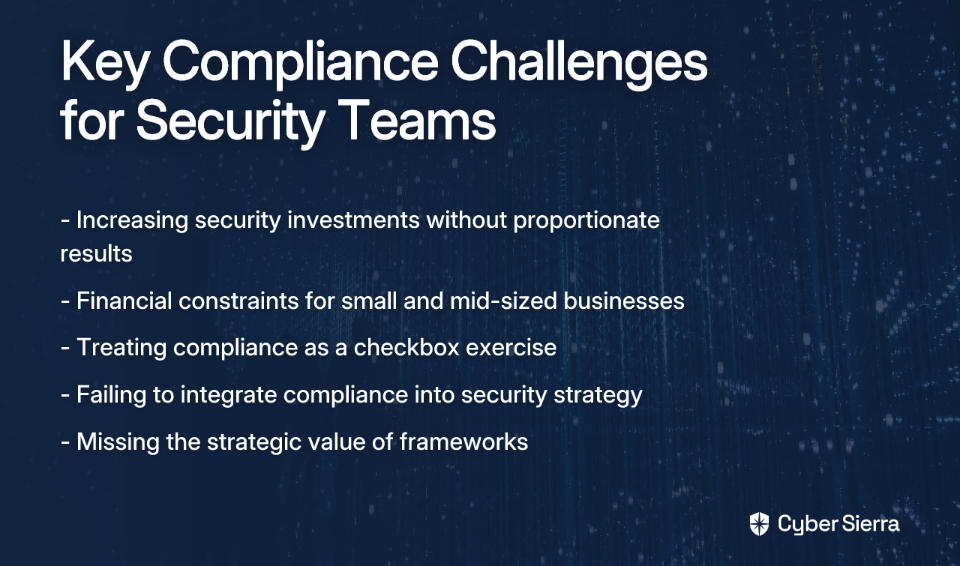
The frustration is real. Organizations continue to increase their security investments without seeing a proportionate reduction in breaches. Small and mid-sized businesses struggle to afford fancy compliance tools yet face the same regulatory pressures as enterprises. And too often, security teams find themselves treating compliance as a mere checkbox exercise rather than integrating it into their overall security strategy.
But here's the paradigm shift: compliance frameworks aren't just bureaucratic hurdles to overcome. When approached strategically, they provide the foundation for building a resilient security posture – one that can withstand the sophisticated threats of 2025 and beyond.
The Strategic Value of Compliance: More Than Just a Mandate
Before diving into specific frameworks, it's important to understand why compliance matters beyond avoiding regulatory penalties:
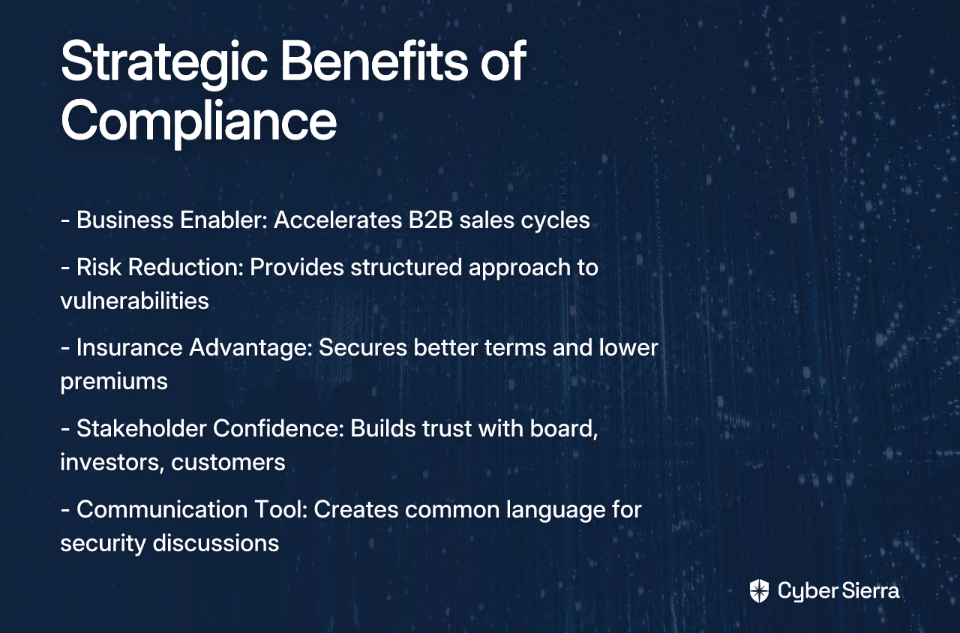
- Business Enabler: Strong compliance postures accelerate sales cycles, especially in B2B contexts where SOC 2 or ISO 27001 certification is often a prerequisite for partnerships.
- Risk Reduction: Frameworks provide a structured approach to identifying and addressing vulnerabilities before they're exploited.
- Insurance Advantage: Organizations with robust compliance programs often secure better cyber insurance terms and lower premiums.
- Stakeholder Confidence: Board members, investors, and customers all gain confidence from knowing your organization adheres to recognized standards.
For CISOs, frameworks also provide a common language to communicate risks to the board and justify security investments. They help transform security from a cost center to a strategic business enabler.
The Top 10 Compliance Frameworks for 2025
1. NIST Cybersecurity Framework (CSF) 2.0
What it is: A voluntary framework developed by the U.S. National Institute of Standards and Technology that has evolved into the de facto global standard for cybersecurity risk management.
Who it applies to: Organizations across all sectors, though particularly relevant for critical infrastructure and government contractors.
Key updates for 2025: The CSF 2.0 introduces a crucial sixth core function - Govern - to complement the original five (Identify, Protect, Detect, Respond, Recover). This new function emphasizes that cybersecurity is a major source of enterprise risk that requires board-level attention and integration with broader risk management processes.
Why it matters: The NIST CSF provides a comprehensive, flexible framework that organizations of any size can adapt to their specific needs. It's often the starting point for building a security program and serves as the foundation for many other frameworks.
2. ISO/IEC 27001
What it is: The international standard for information security management systems (ISMS), providing a systematic approach to managing sensitive information.
Who it applies to: Any organization seeking international recognition for its information security practices, particularly those operating globally or in regulated industries.
Key principles: ISO 27001 requires organizations to identify information assets, assess risks systematically, and implement appropriate controls from Annex A (which aligns with ISO 27002). It follows the Plan-Do-Check-Act cycle to ensure continuous improvement.
Why it matters: ISO 27001 certification demonstrates to partners and customers worldwide that your organization takes information security seriously and has implemented internationally recognized best practices.
3. SOC 2 (System and Organization Controls 2)
What it is: An auditing standard developed by the American Institute of CPAs (AICPA) specifically for service organizations that store customer data in the cloud.
Who it applies to: SaaS providers, cloud computing services, data centers, and any B2B company handling customer data.
Key principles: SOC 2 is built on five "Trust Services Criteria": Security, Availability, Processing Integrity, Confidentiality, and Privacy. Organizations can choose which criteria are relevant to their services, making it a flexible framework.
Why it matters: A SOC 2 report has become a non-negotiable requirement in vendor security assessments. Without it, B2B technology companies often find themselves locked out of enterprise sales opportunities.
4. GDPR (General Data Protection Regulation)
What it is: The European Union's comprehensive data protection and privacy regulation.
Who it applies to: Any organization worldwide that processes the personal data of EU residents, regardless of where the organization is based.
Key principles: GDPR enforces strict rules on data subject rights (including the right to be forgotten), requires explicit consent for data processing, mandates breach notifications within 72 hours, and requires data protection impact assessments for high-risk processing.
Why it matters: With fines of up to €20 million or 4% of global annual turnover (whichever is higher), GDPR has teeth. Beyond financial penalties, non-compliance can result in reputational damage and loss of customer trust.
5. PCI DSS (Payment Card Industry Data Security Standard)
What it is: A set of security standards created to ensure that all companies that accept, process, store, or transmit credit card information maintain a secure environment.
Who it applies to: Any organization handling branded credit cards from major card schemes (Visa, Mastercard, American Express, Discover, JCB).
Key principles: PCI DSS mandates technical controls like network segmentation, encryption of cardholder data, regular vulnerability scanning, and strong access control measures. Version 4.0 (the latest) places greater emphasis on authentication, encryption, and security testing.
Why it matters: Beyond contractual obligations with payment processors, PCI DSS compliance helps protect your organization from data breaches and the resulting financial and reputational damage. Non-compliance can result in monthly fines, increased transaction fees, or loss of card processing privileges.
6. HIPAA (Health Insurance Portability and Accountability Act)
What it is: U.S. legislation that provides data privacy and security provisions for safeguarding protected health information (PHI).
Who it applies to: Healthcare providers, health plans, healthcare clearinghouses ("covered entities"), and their business associates who handle PHI.
Key principles: HIPAA comprises Privacy, Security, and Breach Notification Rules that govern the use and disclosure of PHI, require appropriate administrative, physical, and technical safeguards, and mandate notification procedures for breaches.
Why it matters: HIPAA violations can result in penalties ranging from $100 to $50,000 per violation (with an annual cap of $1.5 million), making compliance essential for organizations in the healthcare ecosystem.
7. CMMC (Cybersecurity Maturity Model Certification)
What it is: A framework designed to protect Federal Contract Information (FCI) and Controlled Unclassified Information (CUI) within the U.S. Department of Defense (DoD) supply chain.
Who it applies to: Defense contractors and subcontractors seeking to work with the DoD.
Key principles: CMMC 2.0 has streamlined the model to three levels (Foundational, Advanced, and Expert) based on the sensitivity of information handled. It incorporates all requirements from NIST SP 800-171 and introduces additional practices for higher levels.
Why it matters: CMMC certification is becoming a mandatory requirement for winning and maintaining DoD contracts, making it essential for defense suppliers and adjacent industries.
8. FISMA (Federal Information Security Modernization Act)
What it is: U.S. legislation requiring federal agencies to develop, document, and implement agency-wide programs to provide information security.
Who it applies to: U.S. federal agencies and organizations that support federal information systems.
Key principles: FISMA requires agencies to inventory their information systems, categorize them by risk level, implement security controls (typically based on NIST SP 800-53), conduct regular assessments, and report on security posture.
Why it matters: For vendors serving federal agencies, FISMA compliance opens doors to government contracts. The framework also provides a comprehensive approach to security that organizations outside the federal sphere can adapt to their needs.
9. COBIT (Control Objectives for Information and Related Technologies)
What it is: A framework created by ISACA for IT governance and management practices.
Who it applies to: Enterprises seeking to align their IT strategies with business objectives and improve IT governance.
Key principles: COBIT 5/2019 focuses on five key principles: meeting stakeholder needs, covering the enterprise end-to-end, applying a single integrated framework, enabling a holistic approach, and separating governance from management.
Why it matters: COBIT helps organizations bridge the gap between technical issues, business risks, and control requirements. It's particularly valuable for CISOs seeking to demonstrate the business value of security investments to their boards.
10. Emerging AI Governance Frameworks
What it is: A new category of regulations and standards focused on the ethical use, transparency, and accountability of AI systems.
Who it applies to: Any organization developing or deploying artificial intelligence, especially in high-stakes sectors like finance, healthcare, and government.
Key principles: While still evolving, these frameworks typically focus on explainability (how AI models make decisions), fairness (preventing algorithmic bias), and privacy (protecting data used to train and operate AI systems).
Why it matters: As organizations increasingly deploy AI for security operations and business functions, CISOs must collaborate with legal and data science teams to establish governance policies that ensure these systems operate ethically and securely. Regulatory bodies worldwide are rapidly developing AI-specific requirements that will impact how organizations deploy these technologies.
From Compliance to Resilience: Automating Your Program
The challenge for many CISOs isn't understanding these frameworks—it's operationalizing them efficiently. Manual evidence collection is time-consuming, prone to error, and only provides a "snapshot" for an audit, while the real security posture can drift immediately after.
The solution is Continuous Control Monitoring (CCM), which transforms compliance from periodic checks to ongoing, automated verification of security controls.
Platforms like Cyber Sierra's Governance, Risk & Compliance (GRC) module are designed to tackle this complexity head-on by automating data collection and risk assessments across multiple frameworks like SOC 2, ISO 27001, and HIPAA. Their Continuous Control Monitoring (CCM) platform provides ongoing visibility into security controls, building a central repository that updates in near real-time and detects exceptions and anomalies as they happen.
Emerging Compliance Trends CISOs Must Watch
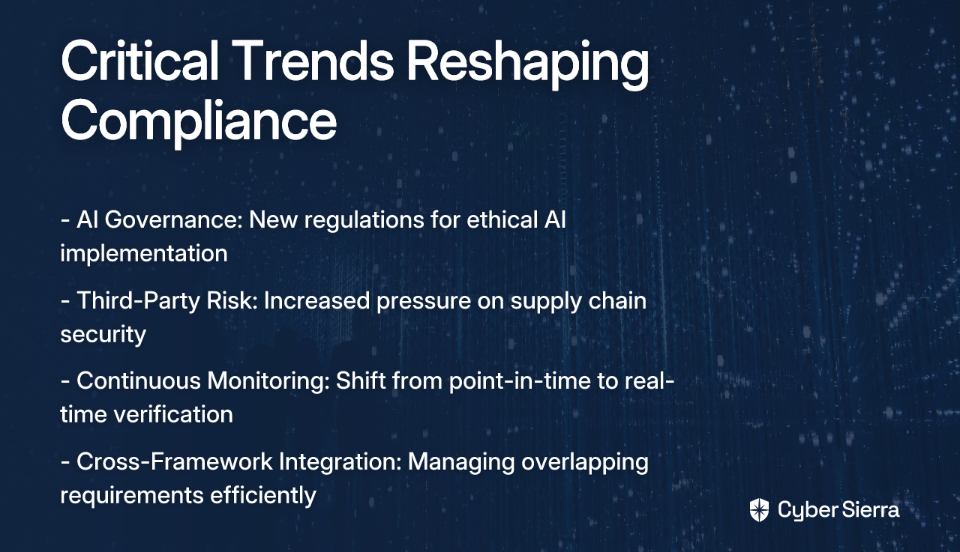
Beyond the established frameworks, CISOs should monitor two critical trends in the compliance landscape:
AI Governance: As AI systems become integral to business operations, regulatory bodies are developing specific requirements for their ethical use. CISOs must work with legal and data science teams to establish governance policies for AI use, particularly for technologies like Retrieval-Augmented Generation (RAG).
Third-Party Risk Management (TPRM): Compliance doesn't stop at your organization's boundaries. Regulators are putting increased pressure on managing supply chain risk, and modern solutions like Cyber Sierra's TPRM platform can help automate vendor assessments and provide continuous monitoring of third-party security postures.
Building a Future-Proof Compliance Strategy
The frameworks discussed provide essential blueprints, but as many security leaders have learned the hard way, a framework is ineffective without skilled personnel and a deep understanding of your organization's unique threat model.
The goal for CISOs in 2025 isn't just to "check the box" but to build a culture of security. This means using frameworks to establish a strong baseline, then layering on proactive measures, employee training, and continuous monitoring.
By embracing automation and a continuous compliance mindset, CISOs can free their teams from manual tasks to focus on what truly matters: reducing risk and building a resilient enterprise ready to face tomorrow's threats.
Frequently Asked Questions
What is the difference between being compliant and being secure?
Being compliant means you meet the specific requirements of a standard or regulation, while being secure means your organization has robust defenses against actual cyber threats. Compliance provides a strong foundation, but true security requires a proactive, risk-based strategy that goes beyond "checking the box" to address your unique threat landscape.
How do I choose the right compliance framework for my organization?
The right framework depends on your industry, geography, and customer requirements. A good starting point is to identify mandatory regulations (like HIPAA for healthcare or GDPR for EU data). For B2B technology companies, SOC 2 is often a key sales enabler. The NIST CSF is an excellent, flexible framework for any organization looking to establish a comprehensive security program.
Why is NIST CSF 2.0 a significant update for 2025?
The most significant update in NIST CSF 2.0 is the addition of the "Govern" function. This new function formally establishes that cybersecurity is a primary source of enterprise risk that requires board-level oversight and strategic decision-making. It elevates cybersecurity from a purely technical issue to a core component of business governance.
How can small businesses manage cybersecurity compliance?
Small businesses can manage compliance effectively by prioritizing frameworks based on business risk, starting with a flexible standard like NIST CSF, and leveraging automation. GRC and Continuous Control Monitoring (CCM) platforms can level the playing field by automating evidence collection and monitoring, reducing the manual workload on smaller teams.
What is Continuous Control Monitoring (CCM)?
Continuous Control Monitoring (CCM) is an automated process that continuously verifies the effectiveness of your security controls in near real-time. It is important because it transforms compliance from a periodic audit into an ongoing, dynamic process, providing an accurate, up-to-date view of your security posture and helping you detect gaps as they emerge.
How can I manage multiple overlapping compliance frameworks efficiently?
Managing overlapping frameworks is best done by mapping controls from different standards to a single, unified control set. Many frameworks (like ISO 27001 and SOC 2) share common requirements for areas like access control and encryption. By implementing a control once and mapping it to multiple frameworks, you can "comply once, report many," which is a core feature of modern GRC platforms.
