



Top 10 Continuous Monitoring Platforms That Actually Reduce Security Incidents

Join thousands of professionals and get the latest insight on Compliance & Cybersecurity.
Summary
- Traditional periodic security checks are reactive and inadequate, leaving organizations vulnerable to costly breaches and regulatory fines.
- Continuous monitoring provides the real-time visibility needed to shift from a reactive to a proactive security posture, identifying and addressing threats before they cause damage.
- When choosing a platform, prioritize features like real-time alerting, automated remediation, broad compliance coverage, and deep integrations.
- Cyber Sierra’s Continuous Control Monitoring platform helps automate compliance and risk management, keeping you audit-ready while proactively reducing security incidents.
You've set up a robust security program. You've implemented the right controls. You've passed your audits. Yet month after month, you're seeing the same security issues flagged, your technical debt keeps climbing, and each major audit creates a stressful scramble for your team.
Sound familiar? You're not alone.
In today's dynamic threat landscape, traditional periodic security checks have become woefully inadequate. They're reactive, leaving security teams perpetually playing catch-up, especially in complex cloud-centric environments where the attack surface constantly evolves.
The game-changer? Continuous monitoring platforms that don't just alert you to problems but actively help reduce security incidents through automation, remediation, and actionable intelligence.
This guide evaluates 10 leading continuous monitoring platforms based on their proven ability to reduce security incidents, organized by industry focus and judged on practical criteria that separates marketing hype from actual results.
What is Continuous Monitoring and Why Is It a Game-Changer for Incident Reduction?
Continuous monitoring is an ongoing, real-time process of collecting, analyzing, and acting on data across IT environments to detect and address threats before they cause damage. Unlike periodic assessments that collect data at intervals (leaving dangerous blind spots), continuous monitoring provides uninterrupted visibility into your security posture.
The stakes of inadequate monitoring couldn't be higher:
- Financial Impact: The Equifax data breach cost over $700 million – a catastrophe that continuous monitoring could have prevented by identifying the unpatched vulnerability.
- Regulatory Penalties: GDPR violations can result in fines up to €20 million or 4% of annual revenue, with similar penalties under other frameworks.
- Reputational Damage: The long-term loss of customer trust after a preventable breach can devastate even established brands.
Our Evaluation Criteria: Separating Signal from Noise
We've evaluated these platforms based on outcomes rather than feature lists, focusing on four critical capabilities:

- Real-time Alerting & Automated Response: Not just detecting threats instantly but triggering automated responses or providing clear remediation guidance.
- Compliance Framework Coverage: Support for essential frameworks like SOC 2, ISO 27001, HIPAA, PCI DSS, NIST, and GDPR, with pre-configured controls to simplify audit readiness.
- Integration Depth: Seamless compatibility with existing security tools, cloud infrastructure (AWS, Azure, GCP), and IT systems to provide a unified view without creating new silos.
- Actionable Intelligence & Remediation: The ability to transform raw data into prioritized, data-driven insights that guide remediation efforts and prevent "alert fatigue."
The Top 10 Continuous Monitoring Platforms for 2024
For Comprehensive Compliance & Automated Remediation (Tech, BFSI, HealthTech)
1. Cyber Sierra
Best for: Enterprises seeking a unified AI-enabled platform to automate GRC, Continuous Control Monitoring (CCM), and risk management.
How it Reduces Incidents: Cyber Sierra transforms security from periodic checks to continuous, automated monitoring. Its CCM module automates control testing and validation for frameworks like SOC 2, ISO 27001, and HIPAA, providing near real-time visibility into your security posture. This directly addresses the "pre-audit scramble" by making you audit-ready 24/7. The Threat Intelligence module performs proactive Attack Surface Management and vulnerability scanning to identify risks before they're exploited.
Key Features:
- Builds a central controls repository with real-time updates
- Manages multiple compliance frameworks from a single dashboard
- Delivers actionable risk intelligence for data-driven remediation
- Includes modules for Third-Party Risk Management (TPRM) and Employee Security Training to address supply chain and human-vector risks
2. Splunk
Best for: Organizations with mature security operations that need powerful, large-scale log management and Security Information and Event Management (SIEM) capabilities.
How it Reduces Incidents: Ingests and analyzes massive volumes of machine data from across the IT environment in real-time. This allows security teams to correlate disparate events, detect complex attack patterns, and investigate incidents with deep forensic detail.
Key Features: Real-time log analysis, security analytics, IT infrastructure monitoring, customizable dashboards.
3. MetricStream
Best for: Managing compliance and risk specifically within cloud-centric environments.
How it Reduces Incidents: Focuses on automatically monitoring cloud entities (like S3 buckets, security groups) to ensure they adhere to corporate policies and compliance standards, preventing common cloud misconfigurations that lead to breaches.
Key Features: Automated monitoring of cloud infrastructure, policy adherence checks, GRC workflows.
For Security Posture & Vulnerability Management (Primarily Tech)
4. Panaseer
Best for: Organizations wanting a data-driven, measurable view of their security posture and control effectiveness.
How it Reduces Incidents: Aggregates data from all existing security tools to provide a single, trusted view of assets and controls. It automates vulnerability analysis and identifies gaps (e.g., servers missing EDR) to ensure security coverage is complete and effective.
Key Features: Continuous Controls Monitoring, automated security reporting, security posture metrics.
5. XM Cyber
Best for: Enterprises with complex hybrid-cloud environments needing to prioritize remediation based on attacker perspectives.
How it Reduces Incidents: Goes beyond vulnerability scanning by continuously modeling potential attack paths from breach points to critical assets. This allows teams to focus on fixing the "choke points" that would have the biggest impact on disrupting an attack.
Key Features: Attack path management, breach and attack simulation, unified cyber risk posture.
For GRC & Internal Controls (Finance, Healthcare, Regulated Industries)
6. Hyperproof
Best for: Teams needing to automate the testing and monitoring of a wide range of internal controls beyond just technical ones.
How it Reduces Incidents: Automates evidence collection for controls related to user access reviews, security training completion, and policy acknowledgments. This ensures that foundational security hygiene practices are consistently maintained, reducing risks from human error and insider threats.
Key Features: Broad control coverage (technical, administrative), automated evidence collection, compliance operations platform.
7. Pathlock
Best for: Organizations in financial services or those heavily reliant on ERP systems like SAP and Oracle.
How it Reduces Incidents: Specializes in monitoring user activity and transactions within critical business applications. It detects segregation of duties (SoD) violations, unauthorized configuration changes, and suspicious financial activity in real-time to prevent internal fraud and data exfiltration.
Key Features: Transaction monitoring, SoD analysis, application access governance.
8. Quod Orbis
Best for: Organizations looking to streamline internal audit processes and tie them directly to asset management.
How it Reduces Incidents: Provides a clear link between cyber assets, their vulnerabilities, and the controls meant to protect them. It automates the collection of audit evidence, ensuring that security gaps are not only identified but also tracked through to mitigation.
Key Features: Cyber asset management, automated audit workflows, vulnerability mitigation tracking.
For Third-Party & Network Risk Management (All Industries)
9. Atlas Systems (ComplyScore)
Best for: Enterprises needing to continuously monitor the security and compliance posture of their third-party vendors.
How it Reduces Incidents: Uses an AI-based TPRM platform to provide 24/7 monitoring of vendor ecosystems. It sends real-time alerts for compliance breaches or security incidents within the supply chain, allowing organizations to act before a vendor's problem becomes their own breach.
Key Features: AI-powered continuous vendor monitoring, automated risk assessments, audit and reporting transparency.
10. FireMon
Best for: Organizations needing to maintain strict compliance and security for their complex network infrastructure and firewalls.
How it Reduces Incidents: Continuously monitors network security device configurations and rulesets for policy violations, unnecessary access, and misconfigurations. This prevents unauthorized network pathways from being opened and ensures critical segmentation policies remain intact.
Key Features: Real-time policy compliance monitoring, firewall rule analysis, network security policy management.
Beyond the Platform: Building a Successful Continuous Monitoring Strategy
While selecting the right continuous monitoring platform is crucial, technology is only part of the equation. To maximize effectiveness:
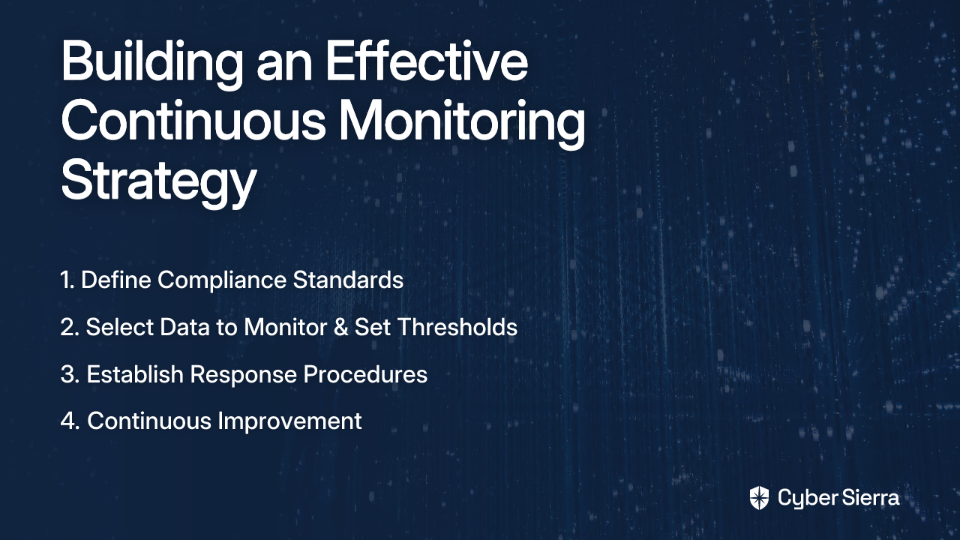
- Define Compliance Standards: Establish baseline regulatory requirements and standards (e.g., NIST, HIPAA) to ensure your monitoring aligns with your compliance obligations.
- Select Data to Monitor & Set Thresholds: Pick relevant data sources and technologies (e.g., SIEM for logs) and define what constitutes an alert. This is crucial for avoiding alert fatigue and ensuring focus on meaningful events.
- Establish Response Procedures: Prepare documented processes for how to react when threats are detected. Without clear action plans, even the best monitoring becomes a wasted investment.
- Continuous Improvement: Utilize insights from your monitoring to refine policies and adapt to regulatory changes, ensuring your security posture evolves alongside the threat landscape.
From Reactive Compliance to Proactive Security with Cyber Sierra
True security isn't about passing an annual audit; it's about building a resilient, proactive defense that reduces incidents before they impact your business. Continuous monitoring platforms are essential tools for making that shift from reactive to proactive security management.
For organizations seeking to eliminate the pre-audit scramble while meaningfully reducing security incidents, Cyber Sierra provides a uniquely integrated platform that connects Continuous Control Monitoring with GRC, TPRM, and Threat Intelligence. It doesn't just find problems; it automates compliance processes and streamlines remediation, freeing your team to focus on strategic security initiatives.
The growing technical debt from unaddressed vulnerabilities, the month-after-month recurrence of the same security issues, and the stress of preparing for major audits are all symptoms of an outdated, reactive approach to security. By implementing a comprehensive continuous monitoring strategy with a platform that fits your specific industry needs, you can break this cycle and move toward a more mature, proactive security posture.
Frequently Asked Questions
What is continuous security monitoring?
Continuous security monitoring is the real-time, ongoing process of detecting, analyzing, and responding to security threats across your IT environment. Unlike traditional periodic checks that create security blind spots, it provides uninterrupted visibility, allowing you to identify and address vulnerabilities before they can be exploited.
How does continuous monitoring help reduce security incidents?
Continuous monitoring reduces security incidents by shifting your security posture from reactive to proactive. It automatically identifies vulnerabilities, misconfigurations, and suspicious activities in real-time, triggering automated responses or providing immediate remediation guidance. This prevents threats from escalating into costly data breaches.
What are the key features to look for in a continuous monitoring platform?
The most effective continuous monitoring platforms offer four key capabilities: real-time alerting with automated response, comprehensive compliance framework coverage (like SOC 2, ISO 27001), deep integration with your existing tech stack, and the ability to provide actionable intelligence for prioritized remediation.
Why is continuous monitoring crucial for compliance with frameworks like SOC 2 and ISO 27001?
Continuous monitoring is crucial for compliance because it automates the process of testing controls and collecting evidence, ensuring you are audit-ready 24/7. Instead of a last-minute scramble, it provides a real-time, verifiable view of your adherence to standards like SOC 2 and ISO 27001, making audits smoother and more accurate.
Can continuous monitoring replace the need for annual security audits?
No, continuous monitoring does not replace formal security audits, but it significantly enhances and simplifies them. It provides the ongoing assurance and evidence that auditors require, transforming the audit from a stressful, time-consuming event into a straightforward validation of your already-established security posture.
How can our organization get started with a continuous monitoring strategy?
To start with a continuous monitoring strategy, first define your compliance requirements and security standards. Next, identify the critical data and systems to monitor and set clear alert thresholds. Finally, establish documented response procedures and commit to continuously improving your security policies based on the insights you gather.
Stop the pre-audit scramble and start proactively reducing incidents. See how Cyber Sierra creates a single source of truth for your security and compliance posture. Book a free demo today.
