



10 Best Leaked Credentials Monitoring Tools for Enterprise Security Teams


Join thousands of professionals and get the latest insight on Compliance & Cybersecurity.
Summary
- With over 24 billion stolen credentials circulating on the dark web, credential theft is a primary vector for enterprise breaches, rendering manual security checks obsolete.
- Effective monitoring tools must provide real-time alerts from comprehensive sources like stealer logs and dark web forums, not just historical breach databases.
- The key to an effective strategy is automating remediation by integrating monitoring tools with your security ecosystem (SIEM/SOAR) to trigger instant password resets and session terminations.
- To move from reactive alerts to proactive security, enterprises can use a Continuous Control Monitoring (CCM) platform to automate risk management, ensure compliance, and turn threat intelligence into action.
You've just received an alert—one of your employees' credentials has been found in a dark web forum. But is this information actionable? How recent is the exposure? And most importantly, what automated steps can your security team take to neutralize the threat before attackers exploit it?
With over 24 billion stolen credentials circulating on the dark web and an 84% increase in phishing emails delivering infostealers, credential theft has become the primary vector for enterprise breaches. The sheer scale of this threat has rendered traditional point-in-time checks obsolete.
Today's enterprise security demands continuous monitoring of leaked credentials with automated remediation workflows—because in the race between attackers and defenders, minutes matter.
What to Look For: Key Criteria for Evaluating Credential Monitoring Tools
Before diving into specific solutions, let's establish the essential features that differentiate basic credential checkers from enterprise-grade monitoring platforms. When evaluating leaked credentials monitoring for enterprises, demand these critical capabilities:
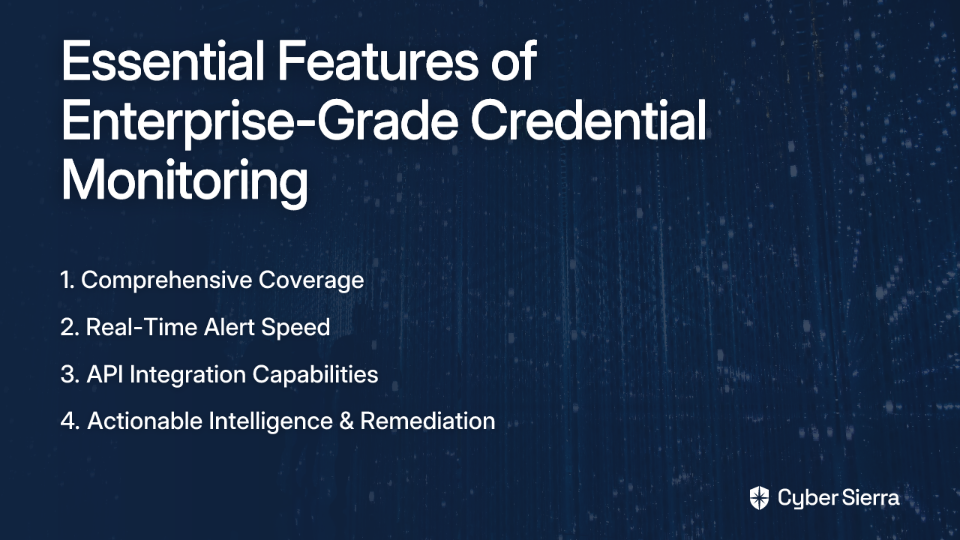
1. Comprehensive Coverage
Effective monitoring extends far beyond public breach databases:
- Stealer Log Monitoring: Real-time access to fresh credentials from prevalent infostealer malware like LummaC2, RedLine, Vidar, and Raccoon—where the most valuable credentials appear first
- Dark Web & Criminal Marketplaces: Coverage of closed-access forums and marketplaces where credentials are traded
- Third-Party Breach Data: Access to historical and recent third-party breaches to prevent credential stuffing attacks
2. Real-Time Alert Speed
The value of stolen credentials is highest immediately after theft. Enterprise solutions should deliver actionable alerts within minutes, not days—enabling your team to take swift action before attackers can capitalize on the exposure.
3. API Integration Capabilities
To move beyond simple alerts to automated security hygiene, your monitoring solution should offer:
- RESTful API: For seamless integration with your existing security ecosystem (SIEM, SOAR, EDR)
- Webhook Support: To trigger automated workflows like password resets and session revocation
4. Actionable Intelligence & Remediation
Top-tier solutions provide context, not just raw data:
- Password Validation: Tools that can verify if a user's actual password was exposed, not just the hash
- Remediation Workflows: Native capabilities or integrations that streamline incident response
- Risk Scoring: Contextual assessment of exposure severity to prioritize response efforts
With these criteria in mind, let's explore the top leaked credentials monitoring tools that deliver enterprise-grade protection.
Top 10 Leaked Credential Monitoring Tools for 2024
1. Cyber Sierra
Overview: Cyber Sierra transcends basic monitoring to deliver a comprehensive platform for automated credential risk management. While specialized tools detect leaks, Cyber Sierra's AI-enabled platform operationalizes the response, moving security from periodic checks to proactive, near real-time risk management.
Core Strengths:
- Continuous Control Monitoring (CCM): Provides ongoing, automated visibility into security controls related to user access and credentials with real-time anomaly detection
- Automated Remediation Workflows: Orchestrates the response to credential exposures through centralized control repositories and actionable intelligence
- GRC Integration: Directly ties credential risk management to compliance frameworks like NIST, ISO 27001, and GDPR, demonstrating due diligence to auditors and insurers
- Holistic Security View: Integrates threat intelligence with vendor risk (TPRM) and employee training, addressing credential risk across the enterprise ecosystem
Best For: Enterprises, CISOs, and Compliance Managers who need to move beyond simple detection to an integrated, automated, and audit-ready risk management program.

2. BreachSense
Overview: An API-first platform designed specifically for security teams requiring deep credential coverage and powerful automation capabilities.
Core Strengths:
- Real-time monitoring of stealer logs from LummaC2, RedLine, Vidar, and Raccoon
- Access to data from third-party breaches and ransomware leak sites
- Powerful RESTful API for deep integration with SIEMs and other security tools
Best For: Enterprise security teams, penetration testers, and MSPs that prioritize API-driven automation and deep data access.
3. SpyCloud
Overview: A solution focused on preventing account takeover (ATO) and providing post-infection remediation workflows.
Core Strengths:
- Specializes in recaptured data from breaches and malware infections
- Helps identify compromised devices tied to exposed credentials
- Offers integrated remediation workflows to address ATO incidents
Best For: Large enterprises primarily concerned with preventing customer and employee account takeovers.
4. Flare
Overview: Combines dark web monitoring for compromised credentials with a broader threat intelligence platform.
Core Strengths:
- Provides real-time alerts alongside wider threat context
- Monitors technical leakage, including secrets and API keys exposed on public sites like GitHub
- Offers comprehensive digital risk protection beyond just credential monitoring
Best For: Security teams that need broader visibility into their organization's digital risk beyond just credentials.
5. ZeroFox
Overview: A digital risk protection platform that offers credential monitoring as part of a wider suite of services.
Core Strengths:
- Combines credential monitoring with brand protection, social media monitoring, and takedown services
- Provides protection against impersonation attempts that could lead to credential harvesting
- Offers managed services for organizations with limited security resources
Best For: Organizations with a significant public and social media presence that face brand-impersonation and phishing threats.
6. Recorded Future
Overview: An enterprise-grade, premium threat intelligence platform that includes credential monitoring capabilities.
Core Strengths:
- Uses machine learning to collect, analyze, and prioritize a massive amount of threat data from technical, open, and dark web sources
- Provides rich context about threat actors and their tactics
- Delivers intelligence through a comprehensive portal and robust API
Best For: Large enterprises with mature security programs and dedicated threat intelligence teams.
7. Flashpoint
Overview: Delivers business risk intelligence by combining technology with human analysis of dark web communities.
Core Strengths:
- Deep insights from human intelligence (HUMINT) and analyst expertise on closed forums and illicit communities
- Specialized in financial sector threats and criminal activities
- Offers broader intelligence beyond credential monitoring
Best For: Organizations in finance, government, and other sectors facing highly targeted threats.
8. HackNotice
Overview: A service focused on breach awareness and security training, offering basic credential leak notifications.
Core Strengths:
- Simple setup and affordable pricing for breach alerts
- Ties leak notifications to employee security training modules
- User-friendly interface for non-technical staff
Best For: SMBs that need a foundational level of breach awareness without the complexity of an enterprise platform.
9. Have I Been Pwned (HIBP)
Overview: A free, well-respected service for checking if an email address has been compromised in public data breaches.
Core Strengths:
- Free for individual use and offers a domain monitoring API for organizations
- Excellent source for historical, publicly disclosed breach data
- Trusted resource maintained by respected security researcher Troy Hunt
Best For: Individuals and organizations needing a basic, free layer of breach checking for well-known incidents. It is not a real-time dark web monitor.
10. ID Agent (A Kaseya Company)
Overview: A dark web monitoring solution primarily targeted at Managed Service Providers (MSPs).
Core Strengths:
- Designed with white-labeling and multi-tenancy features for MSPs to offer monitoring to their clients
- Includes employee security training components
- Integrates with Kaseya's broader IT management platform
Best For: MSPs looking to add dark web monitoring as a service for their SMB customers.
How to Implement an Effective Credential Monitoring Strategy
Having the right tools is only half the battle—implementing an effective monitoring strategy is equally important. Here's how to get started:
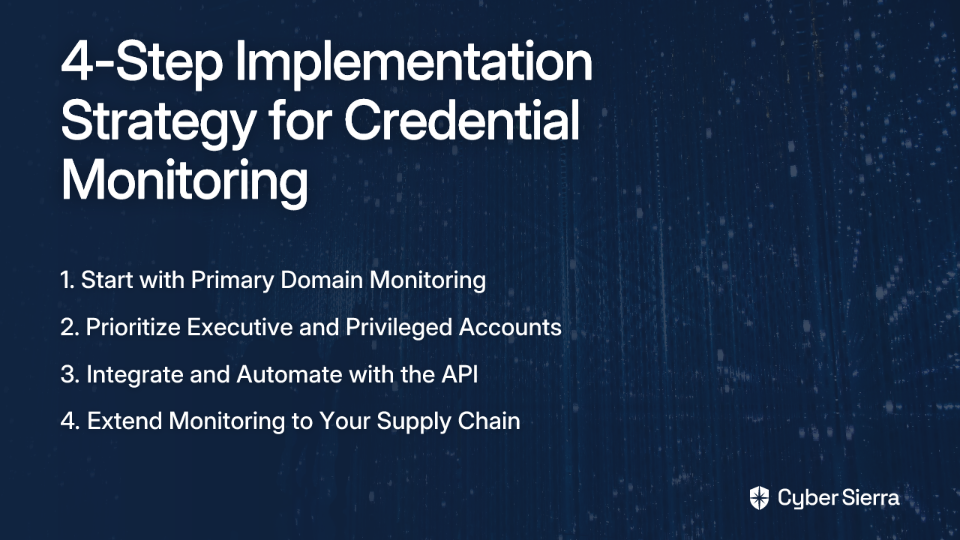
Step 1: Start with Primary Domain Monitoring
Configure your chosen tool to monitor all credentials associated with your primary corporate email domains (e.g., yourcompany.com). This foundational step ensures you're notified whenever corporate credentials appear in breaches or dark web forums.
Step 2: Prioritize Executive and Privileged Accounts
Identify high-value targets within your organization—executives, system administrators, and finance personnel. These accounts are often specifically targeted and require heightened scrutiny and more aggressive remediation workflows.
Step 3: Integrate and Automate with the API
Connect your monitoring tool's API to your SIEM or SOAR platform to enable automated workflows that reduce response time from hours to seconds:
Example Workflow:
- Alert is received for a compromised credential via API
- A ticket is automatically created in your ITSM (e.g., Jira, ServiceNow)
- A script is triggered to force a password reset for the user in Active Directory/Okta
- The user's active sessions are revoked
- The security team is notified of the automated action taken
Step 4: Extend Monitoring to Your Supply Chain
Monitor the domains of your critical third-party vendors. A breach at a key supplier can expose your data or provide an entry point into your network. This aligns with a comprehensive Third-Party Risk Management (TPRM) program, which is increasingly essential as supply chain attacks become more common.
According to Verizon's Data Breach Investigation Report, approximately 60% of breaches begin with stolen credentials. By implementing a robust monitoring strategy, you can significantly reduce this attack vector.
Move Beyond Alerts to Automated Security Hygiene
The fundamental challenge with leaked credentials isn't detection—it's the time gap between discovery and remediation. Traditional alert-based approaches create a critical window of vulnerability that attackers can exploit.
Leading security programs are now shifting from reactive alert-and-remediate models to proactive frameworks built on Continuous Control Monitoring (CCM). This approach doesn't just tell you there's a fire; it helps you build a fireproof house and automates the sprinkler system.
This is where platforms like Cyber Sierra excel. By integrating threat intelligence with automated remediation workflows and continuous compliance monitoring, Cyber Sierra transforms credential risk management from a reactive process into a proactive security program.
The most effective enterprise security teams recognize that leaked credentials are symptoms of broader security hygiene issues. By implementing a continuous control monitoring approach, you can:
- Reduce response time from hours to seconds through automated workflows
- Demonstrate compliance with frameworks like NIST, ISO 27001, and GDPR
- Improve security posture by addressing root causes, not just symptoms
- Decrease analyst fatigue by eliminating manual remediation tasks
As threats evolve and attackers become more sophisticated, the traditional approach of manually responding to credential leaks becomes increasingly untenable. Enterprise security teams must shift from playing whack-a-mole with individual leaks to implementing comprehensive, automated security hygiene programs.
The tools highlighted in this article represent different approaches to credential monitoring, from specialized detection platforms to comprehensive security suites. Cyber Sierra's approach stands out for enterprises seeking not just to detect leaks but to build a resilient, automated security program that transforms threat intelligence into action.
By implementing a robust leaked credentials monitoring program with automated remediation workflows, you can significantly reduce one of the most common attack vectors while freeing your security team to focus on more strategic initiatives.
Ready to build a proactive defense against credential compromise? Explore Cyber Sierra's Continuous Control Monitoring (CCM) platform to see how you can automate risk management, ensure compliance, and turn threat intelligence into action.

Frequently Asked Questions (FAQ)
What is leaked credential monitoring?
Leaked credential monitoring is the continuous process of scanning the dark web, criminal forums, and breach databases for employee or customer credentials that have been stolen or exposed. Unlike one-time checks, this proactive security measure provides real-time alerts when credentials appear in stealer logs or illicit marketplaces, allowing organizations to neutralize threats before they lead to a breach.
Why is continuous monitoring for leaked credentials so important?
Continuous monitoring is crucial because stolen credentials are the primary vector for enterprise data breaches, often leading to account takeover, ransomware, and data exfiltration. With billions of credentials circulating on the dark web, continuous monitoring allows security teams to close the critical time gap between when a credential is exposed and when an attacker can exploit it, making it a foundational part of modern security hygiene.
What is the difference between dark web monitoring and public breach databases?
The primary difference is speed and scope. Dark web monitoring tools actively scan criminal sources like stealer logs and private forums in near real-time, while public breach databases like Have I Been Pwned typically only list data from large, publicly disclosed breaches, often with a significant time lag. Enterprise-grade solutions provide access to the freshest credentials, enabling proactive defense.
How quickly should we act on a leaked credential alert?
You should act immediately, ideally within minutes. The value of a stolen credential is highest right after exposure, and automated attacks can exploit it in seconds. This is why automated remediation is so critical; integrating a monitoring tool with your security systems to trigger automatic password resets and session terminations reduces response time from hours to seconds.
How can our organization automate the response to a credential leak?
You can automate the response by integrating your credential monitoring tool's API with your Identity and Access Management (IAM) and Security Orchestration, Automation, and Response (SOAR) platforms. A typical automated workflow involves the tool sending an API alert that triggers a script to force a password reset, revoke active user sessions, and create a ticket in your ITSM system, ensuring a swift and consistent response without manual intervention.
What are 'stealer logs' and why are they a critical data source?
Stealer logs are collections of data stolen by infostealer malware (like RedLine or LummaC2) from infected computers. They are a critical data source because they contain fresh, often active credentials, session cookies, and other sensitive information that has not yet been widely circulated. Monitoring stealer logs gives security teams the earliest possible warning that a credential has been compromised.
Related Articles:
