



9 Best Cybersecurity Compliance Automation Tools for Enterprises


Join thousands of professionals and get the latest insight on Compliance & Cybersecurity.
Summary
- Manual compliance is unsustainable, with nearly 70% of companies managing six or more frameworks, consuming up to 50% of security team resources.
- Shifting from point-in-time audits to Continuous Control Monitoring (CCM) provides 24/7 visibility, allowing teams to proactively fix issues before they become audit failures.
- The most effective compliance automation tools unify Governance, Risk, and Compliance (GRC), CCM, and Third-Party Risk Management (TPRM) into a single platform like Cyber Sierra to eliminate fragmented solutions and reduce audit prep time.
This is the reality for thousands of enterprise security teams today. And it's not just one audit for one framework — it's six, seven, or eight frameworks running simultaneously.
According to Coalfire's 2023 Securealities Report, almost 70% of service organizations needed to demonstrate compliance with at least six different frameworks in 2023. Managing that manually means compliance-related tasks alone can consume 30–50% of a security team's total resources, according to Seceon. A single SOC 2 audit can require 6–12 months of evidence collection before the audit even begins — and the stakes are high. Research shows that 71% of consumers would abandon a business that mishandled their data, making compliance directly tied to customer trust and revenue.
The bottom line? Spreadsheets, quarterly check-ins, and screenshot marathons are no longer viable. Cybersecurity compliance automation has moved from a nice-to-have to an absolute business imperative.
This article breaks down the 9 best compliance automation tools for enterprises, evaluated on the criteria that actually matter to practitioners: multi-framework support, continuous vs. point-in-time monitoring, TPRM integration, and how fast you can get audit-ready.
Why Continuous Control Monitoring Beats Point-in-Time Audits
If you've ever sat on a two-hour call with an engineer, trying to get them to locate a specific configuration file and take a timestamped screenshot for an upcoming audit, you already know the pain. As one seasoned security professional put it on Reddit: "The most painful part of an audit is typically evidence gathering. You end up on long calls with engineers who may or may not speak GRC and hope they remember where to find a config and take a screenshot with a time stamp. It's painful and sucks up a lot of time, especially when you're running lean teams."
Before diving into the tools, it's worth understanding the fundamental divide in compliance monitoring approaches.
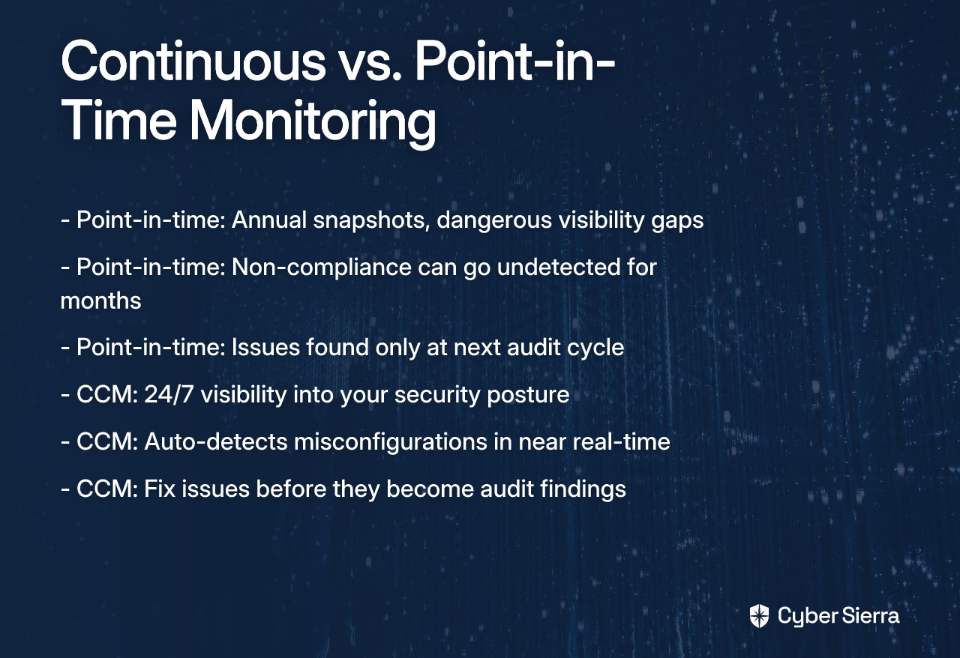
Point-in-time auditing is the traditional model: an annual or quarterly "snapshot" of your compliance posture. While it's lower in initial cost, it creates dangerous visibility gaps. Your organization could be non-compliant for months between checks — and no one would know until the next audit. As Vanta explains, this approach exposes organizations to significant risk during the intervals between assessments.
Continuous Control Monitoring (CCM), by contrast, provides 24/7 visibility into your security posture. It automatically detects misconfigurations, control failures, and compliance deviations in near real-time — so your team can fix issues before they become audit findings or security incidents. For enterprise teams who want "fewer decisions and less risk," as one Reddit user put it, CCM is the only defensible approach.
For any enterprise managing complex regulatory requirements across multiple frameworks, continuous monitoring isn't a premium feature — it's the foundation.
The 9 Best Cybersecurity Compliance Automation Tools for Enterprises
Here are the top platforms that help enterprise teams automate compliance, streamline audit preparation, and build a more defensible security posture.
1. Cyber Sierra
Best For: Enterprises needing a single, unified platform for GRC, Continuous Control Monitoring (CCM), and Third-Party Risk Management (TPRM).
Cyber Sierra's AI-enabled platform stands apart from every other tool on this list because it doesn't ask you to choose between compliance automation, vendor risk management, and continuous monitoring. You get all three — fully integrated — in a single pane of glass.
Feature Snapshot:
- Continuous Control Monitoring (CCM). Builds a central controls repository with near real-time updates, automates control testing and validation, and detects exceptions and anomalies as they happen — not weeks later.
- Unified GRC. Manages multiple compliance frameworks — SOC 2, ISO 27001, NIST, HIPAA, PCI DSS, GDPR — plus custom controls, from one dashboard. Automated data collection, risk assessments, and comprehensive audit trails dramatically cut prep time.
- Integrated TPRM. Automates the full vendor risk lifecycle — onboarding, assessment, and continuous monitoring — providing near real-time, 24/7 visibility into vendor security compliance. No more manual questionnaire pileups.
- Threat Intelligence. Provides network and cloud vulnerability scanning, a security scorecard, and an outside-in view of your attack surface to support proactive remediation.
Why It's #1: Most tools on this list are excellent point solutions. They do GRC, or they do TPRM, or they do monitoring. Cyber Sierra eliminates the fragmentation by unifying all of these into one platform. This directly addresses a major pain for lean security teams — managing and maintaining multiple, disjointed tools is itself a compliance burden. With Cyber Sierra, there's a single source of truth for:
- All controls
- All vendor risks
- All frameworks
This enables a truly proactive and defensible security program.
2. Drata
Best For: Fast-growing, cloud-native companies seeking deep integrations and rapid audit readiness.
Drata is a strong compliance automation platform with a well-earned reputation for making SOC 2 and ISO 27001 audits significantly less painful. Its continuous monitoring capabilities and broad SaaS integrations make it a popular choice among tech-forward teams.
Feature Snapshot:
- Automates evidence collection through native integrations with AWS, Azure, GCP, GitHub, and hundreds of SaaS tools.
- Provides continuous compliance monitoring with automated alerts when controls drift out of compliance.
- Delivers a polished, user-friendly experience designed for fast adoption.
- Supports multiple frameworks including SOC 2, ISO 27001, HIPAA, and PCI DSS.
Limitation to Consider: Drata is primarily a GRC and compliance automation tool. Enterprises that also need robust TPRM or integrated threat intelligence will need to layer on additional solutions.
3. Vanta
Best For: SMEs and growth-stage companies looking for streamlined, fast-track compliance automation.
Vanta has built a loyal following by making compliance automation accessible and fast. With over 700 integrations, it automates a large share of the evidence collection process and provides customizable compliance dashboards that keep security teams — and auditors — on the same page.
Feature Snapshot:
- 400+ integrations to automate security checks across your tech stack.
- Continuous monitoring with real-time alerts for control failures.
- Streamlines audit workflows for SOC 2, ISO 27001, HIPAA, and GDPR.
- Provides a vendor risk management module, though it's less comprehensive than dedicated TPRM platforms.
Limitation to Consider: Vanta shines for smaller, less complex organizations. Larger enterprises with multi-entity structures or deep TPRM requirements may find it less flexible.
4. Secureframe
Best For: Organizations prioritizing rapid implementation and AI-powered cross-framework control mapping.
Secureframe's standout feature is its AI-driven approach to multi-framework compliance. Rather than treating each framework as a separate project, its cross-mapping engine allows a single piece of evidence to satisfy controls across multiple standards — dramatically reducing duplicated work, a major source of compliance fatigue.
Feature Snapshot:
- AI-powered control mapping across frameworks including SOC 2, ISO 27001, NIST, and HIPAA.
- Automates documentation and evidence collection for faster audit readiness.
- Continuous monitoring and real-time compliance alerts.
- Offers a personnel security module for managing security training requirements.
Limitation to Consider: Like Drata and Vanta, Secureframe is primarily a GRC/compliance automation tool and doesn't offer deep-native TPRM functionality.
5. AuditBoard
Best For: Internal audit teams and large enterprises needing a dedicated, enterprise-grade risk management platform.
AuditBoard takes a different angle — it's purpose-built for internal audit, risk, and compliance teams at large enterprises, with strong emphasis on collaboration and executive-level reporting.
Feature Snapshot:
- Comprehensive suite covering audit management, risk management, and compliance.
- Strong reporting and visualization tools for board and executive communication.
- Streamlines collaboration between internal audit, risk, and compliance functions.
- Supports SOX compliance and IT audit workflows in addition to cybersecurity frameworks.
Limitation to Consider: AuditBoard is a premium, enterprise-focused solution with pricing to match. It may be more than necessary for organizations primarily looking for cybersecurity compliance automation.
6. OneTrust
Best For: Global organizations with complex data privacy obligations and a focus on governance.
OneTrust is the market leader in privacy management and a serious contender for organizations operating under GDPR, CCPA, and other data privacy regulations. It has expanded significantly into broader GRC, ethics, and ESG management.
Feature Snapshot:
- Leading privacy management capabilities covering GDPR, CCPA, LGPD, and more.
- Automates data discovery, mapping, and Privacy Impact Assessments (PIAs).
- Offers GRC, third-party risk, and ethics/ESG modules.
- Strong workflow automation for cross-functional compliance processes.
Limitation to Consider: OneTrust's breadth comes with complexity. For teams primarily focused on cybersecurity compliance frameworks rather than data privacy, its feature set may be broader than needed.
7. ServiceNow GRC / TPRM
Best For: Large enterprises already deeply embedded in the ServiceNow ecosystem.
If your organization runs on ServiceNow, its GRC and TPRM modules are a natural extension of infrastructure you already own. ServiceNow's strength is its workflow automation engine and deep enterprise integrations.
Feature Snapshot:
- Centralized TPRM covering the full vendor lifecycle, from onboarding to retirement.
- Integrates with external risk intelligence providers for continuous vendor scoring.
- Powerful workflow automation for assessments, issue tracking, and remediation.
- Unified visibility across IT risk, operational risk, and compliance.
Limitation to Consider: ServiceNow GRC/TPRM is powerful but costly to implement and maintain. It typically requires dedicated administrators and a significant professional services engagement to configure effectively.
8. Archer (RSA Archer)
Best For: Highly regulated industries and large enterprises requiring deep customization and operational risk coverage.
RSA Archer is a legacy leader in the GRC space and remains a go-to for heavily regulated industries like financial services and healthcare, where compliance requirements go well beyond standard cybersecurity frameworks.
Feature Snapshot:
- Highly configurable modules covering IT risk, operational risk, and business resiliency.
- Advanced analytics, risk quantification, and scenario modeling.
- Supports a wide range of frameworks and regulatory requirements.
- Strong audit trail and documentation capabilities for defensible reports.
Limitation to Consider: Archer's power comes with significant implementation complexity and cost. For organizations that don't need its depth of configurability, the overhead can outweigh the benefits.
9. LogicGate Risk Cloud
Best For: Teams that need a flexible, no-code platform to build fully custom GRC workflows.
LogicGate takes a platform-first approach, giving teams a no-code environment to design their own risk and compliance workflows. This makes it uniquely adaptable but also requires more internal investment to configure.
Feature Snapshot:
- No-code workflow builder for creating custom GRC applications and processes.
- Highly flexible risk assessment and control management capabilities.
- Enables cross-functional collaboration across risk, compliance, and operations teams.
- Supports audit management, incident management, and vendor risk use cases.
Limitation to Consider: The flexibility that makes LogicGate powerful also means there's no out-of-the-box experience. Teams without dedicated GRC resources may find the configuration burden significant.
Buyer's Guide: How to Choose the Right Compliance Automation Tool
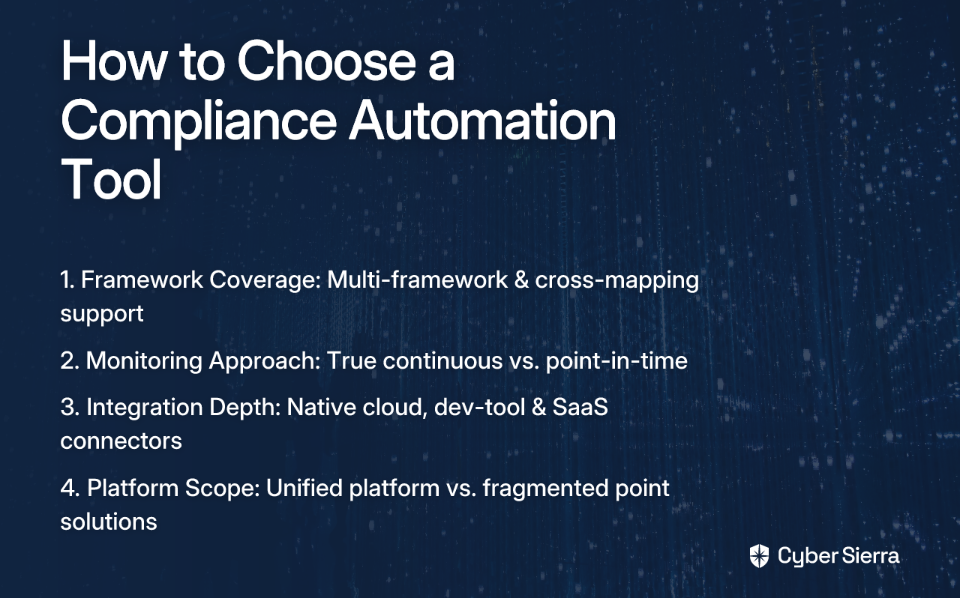
With nine strong options on the table, here's a practical framework to help you evaluate what's right for your enterprise:
Build a Defensible, Automated Compliance Program
The core challenge of enterprise compliance isn’t just passing an audit; it’s the constant, resource-draining effort of managing multiple frameworks with manual processes. Spreadsheet-driven evidence gathering and quarterly check-ins don't just burn out your team—they leave you blind to risks between audit cycles.
To build a truly defensible program, focus on two key shifts:
- Move from point-in-time snapshots to 24/7 visibility. Continuous Control Monitoring (CCM) lets you find and fix issues as they happen, not months later during an audit.
- Unify your compliance stack. Managing separate tools for GRC, vendor risk (TPRM), and monitoring creates fragmented data and wasted effort. A single platform provides one source of truth.
As a next step, calculate the engineering hours your team spent on evidence collection for your last audit. That number is your business case for automation.
When you’re ready to reclaim those hours, see how Cyber Sierra's unified platform helps teams get audit-ready faster, without the fatigue. Book your personalized demo and start building a more resilient security posture today.
Frequently Asked Questions
What is cybersecurity compliance automation?
Cybersecurity compliance automation uses software to continuously monitor security controls, collect evidence, and manage tasks for frameworks like SOC 2 and ISO 27001. It replaces manual processes like spreadsheets and screenshots, saving significant time and reducing human error during audits.
Why is continuous control monitoring (CCM) important for compliance?
Continuous control monitoring (CCM) is crucial because it provides 24/7 visibility into your security posture, unlike point-in-time audits that create dangerous visibility gaps. CCM automatically detects misconfigurations in near real-time, allowing you to fix issues before they become audit findings.
How do compliance automation tools handle multiple frameworks?
Compliance automation tools handle multiple frameworks using a central control repository and cross-mapping. A single control test or piece of evidence can be mapped to satisfy requirements across several standards (e.g., SOC 2, ISO 27001, NIST), eliminating redundant work and streamlining audit prep.
What are the key features to look for in a compliance automation tool?
The key features to look for are multi-framework support, true continuous control monitoring, deep integrations with your tech stack, and a unified platform scope. An ideal tool combines Governance, Risk, and Compliance (GRC), CCM, and Third-Party Risk Management (TPRM) to avoid fragmented solutions.
Can compliance be fully automated?
No, compliance cannot be fully automated, but its most tedious components can. Automation excels at evidence collection, control testing, and continuous monitoring. However, human oversight remains essential for risk assessment, strategic decision-making, and addressing complex control exceptions.
