7 Cybersecurity Maturity Assessment Frameworks Compared for 2026

Join thousands of professionals and get the latest insight on Compliance & Cybersecurity.
Summary
- Choosing the right cybersecurity framework—like NIST for flexibility or ISO 27001 for global recognition—depends on your specific industry, regulatory needs, and business goals.
- These models help justify security investments by translating risk into a business context, especially when the average data breach costs $4.45 million.
- The first step to implementation is a maturity assessment to benchmark your current posture, identify gaps, and build a prioritized improvement roadmap.
- Managing multiple frameworks requires automation, and a platform like Cyber Sierra's GRC solution simplifies this by unifying standards and enabling continuous control monitoring.
Choosing the right cybersecurity maturity assessment framework can feel like navigating a maze. With acronyms like NIST, CMMC, and ISO flying around, it's easy to get overwhelmed. You need a model that's adaptable, provides useful feedback, and doesn't require a team of experts just to understand the getting-started guide.
The good news? You're not alone in this challenge. The even better news? This comprehensive guide will help you cut through the confusion and identify the framework that best aligns with your organization's needs—or show you how to manage multiple frameworks simultaneously.
What Are Cybersecurity Maturity Models?
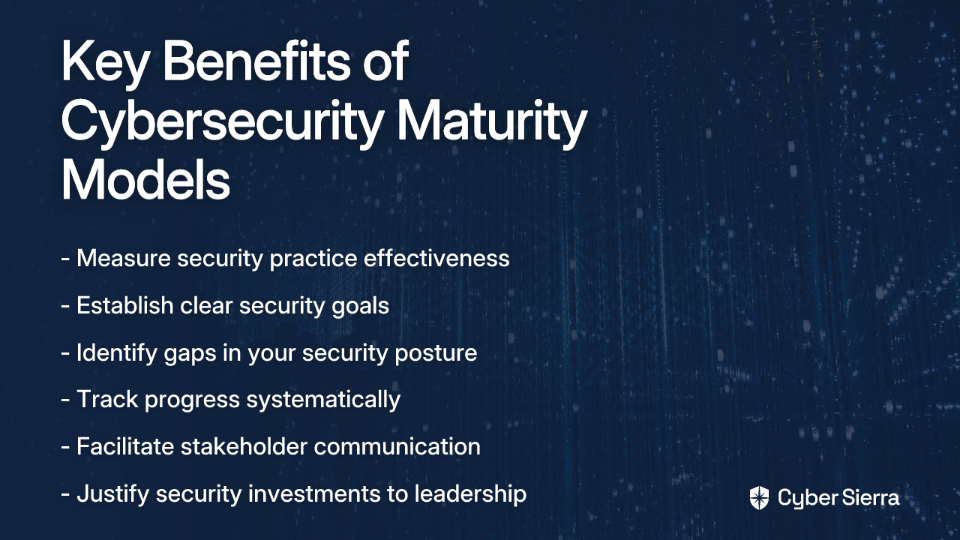
Cybersecurity maturity models are frameworks designed to measure the effectiveness of your security practices, establish clear security goals, and provide a structured approach to identifying gaps and tracking progress. They facilitate clearer communication about risks to stakeholders and help justify security investments to leadership.
As we look toward 2026, these seven frameworks stand out as the most relevant options for organizations seeking to assess and improve their cybersecurity posture:
1. NIST Cybersecurity Framework (CSF)
Overview: Developed by the U.S. National Institute of Standards and Technology, the NIST CSF is a voluntary and highly flexible framework designed to provide a common language and structure for managing cybersecurity risk.
Industry Applicability: Originally created for U.S. critical infrastructure, it's now widely adopted by organizations of all sizes and sectors globally due to its adaptability.
Structure: NIST CSF is organized around five core functions: Identify, Protect, Detect, Respond, and Recover. The latest version (CSF 2.0, released in 2024) adds a sixth function: Govern, emphasizing the importance of cybersecurity governance.
Strengths:
- Flexibility to tailor to any organization's specific needs and risk profile
- Cost-effective (the framework itself is free to use)
- Comprehensive coverage of the entire lifecycle of a cybersecurity incident
Weaknesses:
- Lacks formal certification, which may not satisfy external stakeholders
- Can be resource-intensive to implement, especially for smaller businesses
- Its flexibility can make measuring progress difficult without supplementary tools
Implementation Complexity: Low to Medium. NIST CSF allows for self-certification and a self-paced timeline.
2. Cybersecurity Maturity Model Certification (CMMC) 2.0
Overview: A mandatory compliance framework developed by the U.S. Department of Defense (DoD) to protect Controlled Unclassified Information (CUI) within the Defense Industrial Base (DIB) supply chain.
Industry Applicability: Mandatory for any organization that is part of the DoD supply chain.
Structure: CMMC 2.0 is structured into three levels:
- Level 1 (Foundational): Requires 15 basic controls to protect Federal Contract Information (FCI)
- Level 2 (Advanced): Aligns with 110 controls in NIST SP 800-171 to protect CUI
- Level 3 (Expert): Based on NIST SP 800-172 for enhanced protection against Advanced Persistent Threats
Strengths:
- Provides a clear, tiered path to improving security
- Third-party validation adds credibility and assurance
- Directly addresses security across the defense supply chain
Weaknesses:
- Primarily relevant only to the DoD supply chain
- Achieving certification can be expensive and complex due to audit requirements
Implementation Complexity: High, due to its rigorous assessment requirements.
3. ISO/IEC 27001
Overview: An international standard for establishing, implementing, maintaining, and continually improving an Information Security Management System (ISMS).
Industry Applicability: Global and industry-agnostic. Ideal for organizations that need to demonstrate a strong security posture to international clients and partners.
Structure: Focuses on creating a holistic ISMS and includes a set of mandatory clauses plus Annex A with a comprehensive list of security controls. The latest version is ISO 27001:2022.
Strengths:
- Most widely recognized cybersecurity certification globally
- Builds a robust, risk-based security management system
- Certification from an accredited auditor provides high assurance to customers and partners
Weaknesses:
- Significant costs for certification, surveillance audits, and recertification
- Can be less flexible than frameworks like NIST CSF
Implementation Complexity: High. Requires a formal, two-stage external audit process to achieve certification.
4. CIS Controls
Overview: Developed by the Center for Internet Security, this framework provides a prioritized set of defensive actions to protect against the most pervasive cyber threats.
Industry Applicability: Universal. Particularly valuable for organizations looking for a prioritized, hands-on guide to improving security hygiene.
Structure: Consists of 18 top-level Controls with multiple Safeguards categorized into Implementation Groups (IG1, IG2, IG3) based on organizational maturity.
Strengths:
- Prioritized and actionable focus on the most critical security measures
- Offers clear, technical guidance on implementation
- Regularly updated based on real-world attack data
Weaknesses:
- More technically focused with less emphasis on broader governance
- Not a comprehensive management system like ISO 27001
Implementation Complexity: Medium. While the controls are prescriptive, implementing them technically across an organization requires significant effort.
5. FAIR (Factor Analysis of Information Risk)
Overview: A quantitative risk analysis framework that provides a model for understanding, analyzing, and quantifying information risk in financial terms.
Industry Applicability: Any organization seeking to move from qualitative ("high," "medium," "low") risk ratings to quantitative, financial-based risk assessments.
Structure: A taxonomy and methodology for breaking down risk into measurable factors: Loss Event Frequency and Loss Magnitude.
Strengths:
- Translates cybersecurity risk into business-friendly financial terms
- Enables data-driven decisions on security investments
- Complements other frameworks to provide quantitative risk assessment
Weaknesses:
- Requires reliable data and staff skilled in statistical analysis
- Not a control framework—tells you how to measure risk, not which controls to implement
Implementation Complexity: High. Requires specialized training and a significant cultural shift towards data-driven risk management.
6. COBIT (Control Objectives for Information and Related Technologies)
Overview: A framework for the governance and management of enterprise information and technology (I&T), aligning business goals with IT goals and processes.
Industry Applicability: Primarily used by IT auditors, IT managers, and executives in large enterprises to ensure IT governance.
Structure: Based on five core principles and a set of governance and management objectives that bridge the gap between business requirements, technical issues, and security risks.
Strengths:
- Excellent for aligning IT and cybersecurity efforts with business objectives
- Covers the entire enterprise I&T landscape, not just security
- Well-regarded by auditors and helps satisfy regulatory requirements like SOX
Weaknesses:
- Can be very complex and bureaucratic to implement fully
- Broader than a pure cybersecurity framework, may need supplementation
Implementation Complexity: High, due to its comprehensive and governance-heavy nature.
7. C2M2 (Cybersecurity Capability Maturity Model)
Overview: Developed by the U.S. Department of Energy (DOE) in partnership with the private sector to help organizations evaluate and improve cybersecurity capabilities.
Industry Applicability: Created for the energy sector but applicable to any critical infrastructure or industrial control system (ICS) environment.
Structure: Organized into 10 domains with four Maturity Indicator Levels (MILs) from MIL0 (Incomplete) to MIL3 (Managed) across over 350 practices.
Strengths:
- Provides a detailed roadmap for improving specific cybersecurity domains
- Excellent for benchmarking current capabilities and planning improvements
Weaknesses:
- Tailored for the energy/critical infrastructure sector
- The large number of practices can be overwhelming to assess
Implementation Complexity: Medium to High, requiring detailed self-assessment against numerous practices.
Decision Matrix: Choosing Your Framework
| Feature | NIST CSF | CMMC 2.0 | ISO 27001 | CIS Controls | FAIR | COBIT | C2M2 |
|---|---|---|---|---|---|---|---|
| Primary Focus | Risk Management | Protecting CUI/FCI | Information Security Management System | Prioritized Technical Controls | Quantitative Risk Analysis | IT Governance | Capability Maturity |
| Industry | Universal | DoD Supply Chain | Universal (Global) | Universal | Universal | Large Enterprises | Energy / Critical Infrastructure |
| Compliance Type | Voluntary | Mandatory (for DIB) | Voluntary (Certification) | Voluntary | Voluntary | Voluntary | Voluntary |
| Complexity | Low-Medium | High | High | Medium | High | High | Medium-High |
| Cost | Free (Framework) | High (Audits) | High (Audits) | Free (Framework) | Training Costs | Training/Implementation | Free (Framework) |
| Key Benefit | Flexible & Adaptable | DoD Contract Eligibility | International Recognition | Actionable & Prioritized | Financial Risk View | Business/IT Alignment | Detailed Maturity Roadmap |
The Modern Approach: Managing Multiple Frameworks Simultaneously
In today's complex regulatory landscape, many organizations don't have the luxury of choosing just one framework. A healthcare technology company might need to comply with HIPAA, implement ISO 27001 for international clients, and use NIST CSF as its overarching risk management guide.
Managing these disparate requirements with spreadsheets is a recipe for compliance fatigue and security gaps. Instead of wrestling with multiple frameworks independently, a unified Governance, Risk, and Compliance (GRC) platform can harmonize them.
This is where a platform like Cyber Sierra's GRC solution transforms compliance from a burden into a strategic advantage. Cyber Sierra's platform eliminates the "either/or" choice by providing a single source of truth for all your compliance needs:
- Multi-Framework Management: The platform supports major frameworks like SOC2, ISO 27001, GDPR, HIPAA, and PCI DSS out-of-the-box and allows for custom controls, directly addressing the need to manage multiple standards.
- Continuous Control Monitoring (CCM): Instead of periodic, manual evidence gathering, Cyber Sierra's CCM module offers ongoing, near real-time visibility into your security controls. It automates testing and validation, detecting exceptions before they become audit findings.
- Automated Evidence Collection: By automating data collection and risk assessments, the platform enables you to move from a reactive to a proactive security posture, addressing risks as they emerge.
A Practical Roadmap to Implementation
No matter which framework you choose (or if you're managing multiple), the implementation journey follows a similar path:
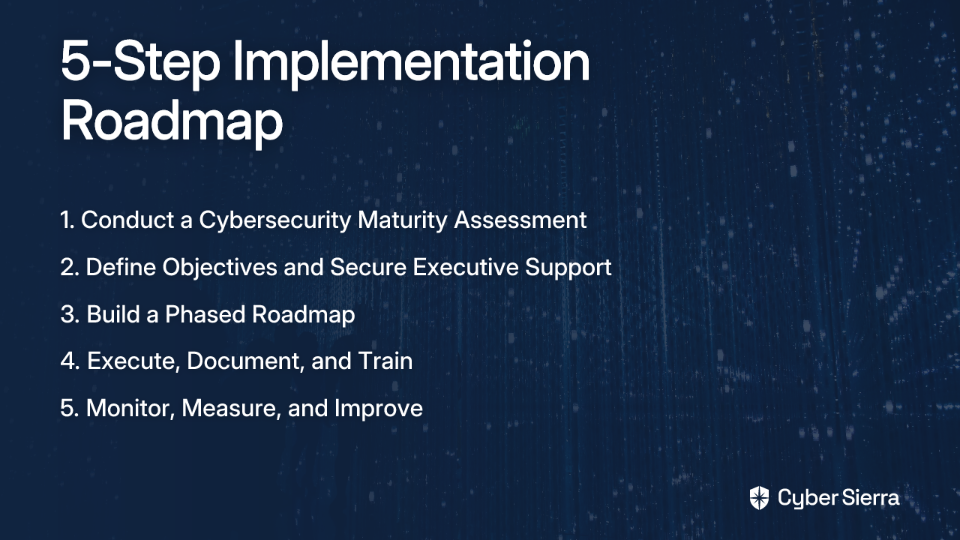
Step 1: Conduct a Cybersecurity Maturity Assessment
Use your chosen framework to assess your current security posture. Identify where you are and where you need to be. This foundational step helps spot gaps and areas for improvement.
Step 2: Define Objectives and Secure Executive Support
Establish clear goals. Are you aiming for a specific CMMC level or ISO certification? Frame the initiative as a business enabler. Use statistics like "the average cost of a data breach is $4.45 million" to demonstrate value to leadership.
Step 3: Build a Phased Roadmap
Create an action plan to address the identified gaps. Prioritize high-impact areas first. Assign ownership for each task and set realistic timelines.
Step 4: Execute, Document, and Train
Implement the necessary controls and process changes. Document everything—this is critical for audits and ongoing management. Conduct employee training to ensure everyone understands their role in the new security processes.
Step 5: Monitor, Measure, and Improve
Continuously monitor your controls to ensure they're working effectively. Use maturity models and metrics to track progress. Remember that cybersecurity is not a one-time project; adjust your strategy as the threat landscape evolves.
Unify Your Compliance and Elevate Your Security Posture
Selecting the right framework provides the blueprint for a strong security program. But a blueprint is only as good as its execution. The real challenge—and opportunity—lies in moving beyond static checklists to a dynamic, continuous, and automated approach to security and compliance.
The future of cybersecurity maturity assessment isn't about choosing a single framework. It's about efficiently managing multiple frameworks through automation and continuous monitoring. This approach not only reduces compliance overhead but also provides a more accurate, real-time view of your security posture.
Frequently Asked Questions (FAQ)
What is the difference between NIST CSF and ISO 27001?
The primary difference is that NIST CSF is a flexible, voluntary risk management framework, while ISO 27001 is a formal, certifiable international standard for an Information Security Management System (ISMS). NIST CSF provides a common language and structure that can be adapted to any organization without a formal certification process. In contrast, ISO 27001 requires a rigorous external audit to achieve certification, which provides a high level of assurance to international partners and customers.
How do I choose the right cybersecurity framework for my business?
To choose the right framework, you should evaluate your organization's specific industry, regulatory requirements, risk profile, and business objectives. Consider key factors such as whether you are part of a specific supply chain (like the DoD, which requires CMMC), if you need international recognition (favoring ISO 27001), or if you need a flexible, adaptable starting point (like NIST CSF).
Which cybersecurity framework is best for small businesses?
For small businesses, the NIST Cybersecurity Framework (CSF) and CIS Controls are often the most practical and effective starting points. NIST CSF is highly flexible and free to use, allowing small businesses to adopt security best practices without the high cost of a formal certification. The CIS Controls offer a prioritized, actionable list of technical safeguards that can help small teams focus on the most critical defenses first.
What is the first step in implementing a cybersecurity framework?
The first step in implementing any cybersecurity framework is to conduct a comprehensive maturity assessment. This initial assessment involves using the chosen framework to benchmark your current security posture against its controls and requirements. This process helps you identify existing gaps and create a baseline from which you can build a prioritized roadmap for improvement.
Can an organization use multiple cybersecurity frameworks?
Yes, many organizations use multiple cybersecurity frameworks simultaneously to meet diverse regulatory and business needs. For example, a company might use NIST CSF as its foundational risk management guide while implementing ISO 27001 to satisfy international client requirements. Modern GRC platforms are designed to harmonize these different requirements and automate control mapping to avoid duplication of effort.
How often should a cybersecurity maturity assessment be performed?
A cybersecurity maturity assessment should be performed at least annually or whenever significant changes occur in your organization or the threat landscape. While an annual assessment is a common best practice, continuous monitoring is the ideal. The threat landscape is constantly evolving, so regularly reassessing your maturity ensures your security program remains effective and aligned with your current risk profile.