



9 Best Risk Management Tools for Enterprises (Beyond Generic ERM)


Join thousands of professionals and get the latest insight on Compliance & Cybersecurity.
Summary
- Most enterprise risk management (ERM) tools focus on compliance and audits, failing to address the dynamic nature of modern cybersecurity threats.
- The best risk management tools are domain-specific; select a solution tailored to your primary challenge, whether it's cybersecurity, operational resilience, or financial compliance.
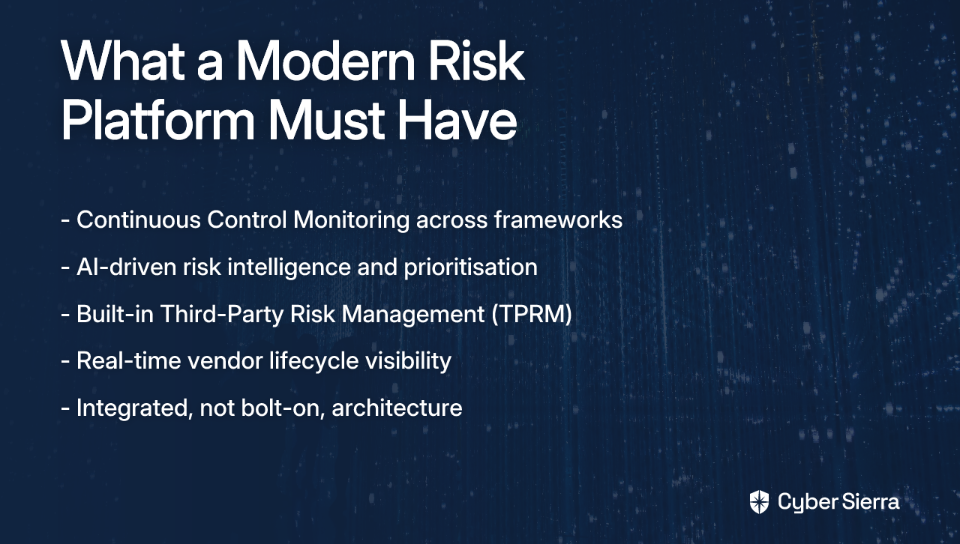
- To effectively manage cyber risk, enterprises need platforms with continuous monitoring, AI-driven intelligence, and integrated third-party risk management (TPRM).
- Cyber Sierra provides an integrated platform that unifies these capabilities, moving security from reactive compliance to proactive, real-time risk management.
If you've spent any time evaluating enterprise risk management software, you know the market is overwhelming. Dozens of platforms promise to "unify your risk posture" and "automate compliance," but many risk professionals find these tools miss the mark.
For teams building a risk program from the ground up, the real need isn't for "executive-ready dashboards." It's for foundational tools that help manage risk, not just report on it. Many GRC platforms seem obsessed with compliance and audit automation, failing to address the day-to-day reality of risk management.
Here's the bigger problem: even the tools that do address enterprise risk broadly tend to underinvest in the fastest-growing risk category of all — cybersecurity. According to Gartner, the IT vendor risk management and cybersecurity risk space is evolving faster than traditional ERM platforms can keep up with, leaving CISOs, Compliance Managers, and IT leaders forced to stitch together point solutions that were never designed to work together.
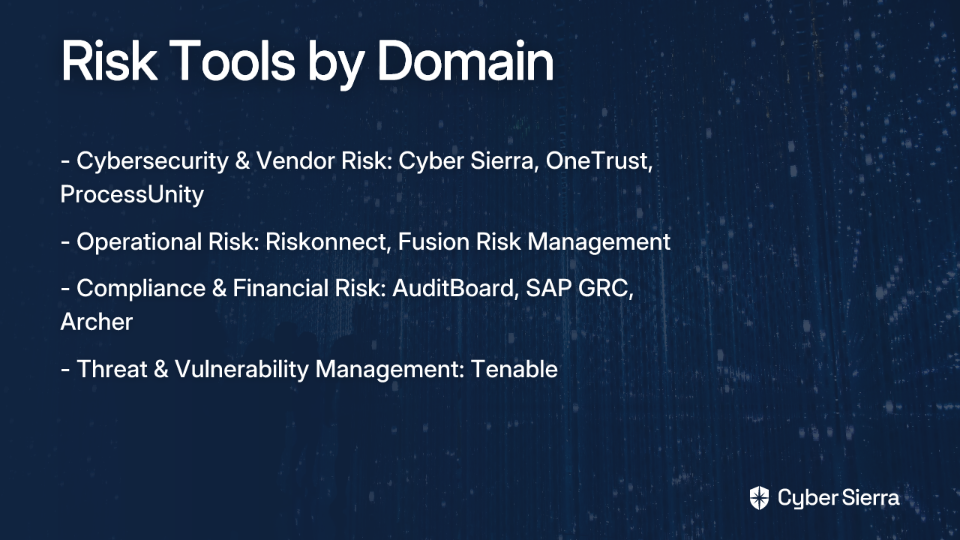
This article cuts through the noise. Instead of a generic list of ERM platforms, we've organized the best risk management tools for enterprises by specific risk domain — cybersecurity & vendor risk, operational risk, and compliance & financial risk — so you can find the right fit for your role and your most urgent challenges.
Cybersecurity & Vendor Risk Management
These tools are purpose-built for security and third-party risk — the domain where threats evolve fastest and generic ERM platforms fall shortest.
1. Cyber Sierra — Best for Integrated Cybersecurity, Vendor Risk & Compliance Automation
Cyber Sierra is an AI-enabled cybersecurity platform designed to move enterprises from periodic, manual risk checks to proactive, near real-time risk management. It directly addresses what most GRC tools miss: the operational, day-to-day work of actually managing cybersecurity risk — not just reporting on it.
Key Features:
- Continuous Control Monitoring (CCM): Operationalizes the NIST SP 800-137 framework by building a centralized controls repository with near real-time updates. It detects exceptions and anomalies as they happen, delivers actionable risk intelligence, and manages controls across frameworks including NIST, ISO 27001, and PCI DSS — eliminating the manual evidence-gathering scramble before every audit.
- Third-Party Risk Management (TPRM): Automates the entire vendor lifecycle — from onboarding and due diligence through continuous monitoring. Instead of relying on point-in-time questionnaires that go stale the moment a vendor submits them, Cyber Sierra provides 24/7 visibility into vendor security compliance and prioritizes your vendor inventory by actual risk level.
- Threat Intelligence: Performs outside-in network and cloud vulnerability scanning to identify attack surface exposure before it becomes an incident, with a security scorecard that gives CISOs a holistic view of their organization's posture.
Why It Stands Out: Cyber Sierra is one of the few platforms where Continuous Control Monitoring, TPRM, and AI-driven threat intelligence are genuinely integrated under one roof — not bolted together through acquisitions. For enterprises tired of compliance theater and looking for a true single source of truth for their cybersecurity risk program, it's the strongest starting point on this list.
2. OneTrust — Best for Data Privacy and Digital Risk Management
OneTrust is a widely recognized platform with deep expertise in privacy regulation compliance (GDPR, CCPA, and beyond). It centralizes vendor risk assessments, automates privacy impact assessments, and streamlines vendor onboarding workflows.
Why It Stands Out: If your primary risk driver is customer data protection and regulatory privacy compliance, OneTrust's depth in that specific domain is hard to match. It's less strong as a holistic cybersecurity risk platform but excels where data governance is the core concern.
3. ProcessUnity — Best for Dedicated TPRM Programs
ProcessUnity focuses exclusively on third-party risk, offering structured metrics and automated workflows to assess and monitor vendor risk at scale.
Why It Stands Out: For organizations whose primary risk management challenge is a large, complex vendor ecosystem, ProcessUnity provides a focused and mature TPRM engine. Unlike broader platforms, every feature is built around the vendor risk lifecycle.
Operational Risk Management
This category of tools focuses on business continuity, operational resilience, and ensuring the organization can withstand disruptions.
4. Riskonnect — Best for Comprehensive, All-in-One ERM
Riskonnect provides a broad ERM platform covering operational, compliance, and financial risk in one place. It includes pre-built templates for a wide range of risk types, real-time incident capture, and alignment with ISO and GDPR frameworks.
Why It Stands Out: A strong choice for large enterprises that need to consolidate multiple, siloed risk programs into a single governance structure. Its breadth is both its strength and its limitation — excellent for operational and enterprise risk, but not a specialist in cybersecurity.
5. Fusion Risk Management — Best for Business Continuity and Operational Resilience
Fusion Risk Management is purpose-built for organizations that need to plan for and recover from disruptions. Its modules cover business continuity planning, disaster recovery orchestration, and crisis management.
Why It Stands Out: In industries where uptime is existential — financial services, healthcare, critical infrastructure — Fusion's tight focus on operational resilience makes it a go-to. It's not a cybersecurity tool, but its strength in continuity planning complements a broader risk management stack.
Compliance & Financial Risk Management
For organizations where regulatory compliance, internal controls, and audit trails are the primary drivers, these platforms offer specialized workflows.
6. AuditBoard — Best for Audit, Internal Controls, and SOX Compliance
AuditBoard offers a user-friendly interface tailored for audit and compliance teams managing SOX requirements, internal control testing, and regulatory workflows.
Why It Stands Out: Its clean, intuitive design makes it a favorite among internal audit and finance teams. It's not a full-spectrum risk management tool, but for organizations where SOX compliance and internal audit management are the primary drivers, AuditBoard delivers a focused, well-designed solution.
7. SAP GRC — Best for SAP-Integrated Enterprises
SAP GRC provides governance, risk, and compliance management directly within the SAP ecosystem, integrating access controls, process controls, and regulation management with existing SAP business applications.
Why It Stands Out: If your organization runs on SAP, the native integration reduces duplication and streamlines compliance workflows. Outside the SAP ecosystem, however, the platform's complexity and cost make it a harder sell.
8. Archer (RSA) — Best for Mature, Large-Scale GRC Programs
The Archer Suite is a long-standing GRC leader offering a highly configurable, integrated platform for risk management, audit management, compliance, and incident handling.
Why It Stands Out: Archer provides a systematic, top-down approach to enterprise GRC that suits organizations with mature programs and complex, multi-framework regulatory obligations. It's feature-rich but demands significant implementation investment, making it better suited for large enterprises with dedicated risk teams.
Proactive Threat & Vulnerability Management
While not full GRC suites, specialized vulnerability management tools are a critical component of a proactive risk management strategy.
9. Tenable Vulnerability Management — Best for Continuous Vulnerability Scanning
Tenable Vulnerability Management is a cloud-based platform that continuously scans all IT assets, identifies vulnerabilities, and prioritizes them based on actual risk exposure — not just CVSS scores.
Why It Stands Out: Tenable moves beyond checkbox scanning by providing context on which vulnerabilities represent the greatest real-world threat, helping security teams direct remediation efforts where they matter most. It's a specialized tool best used in conjunction with a broader risk management platform like Cyber Sierra rather than as a standalone GRC solution.
Comparison Table: Key Features Across Top Platforms
When evaluating risk management tools for enterprises, three capabilities separate modern, proactive platforms from legacy compliance tools: continuous monitoring, AI-driven insights, and built-in TPRM. Here's how the top tools stack up:
| Tool | Continuous Monitoring | AI-Driven | TPRM Built-In |
|---|---|---|---|
| Cyber Sierra | ✅ Yes | ✅ Yes | ✅ Yes |
| Riskonnect | ✅ Yes | ✅ Yes | ✅ Yes |
| OneTrust | ✅ Yes | ❌ No | ✅ Yes |
| ProcessUnity | ❌ No | ❌ No | ✅ Yes |
| Fusion Risk Management | ⚠️ Varies | ❌ No | ⚠️ Varies |
| AuditBoard | ❌ No | ❌ No | ❌ No |
| SAP GRC | ⚠️ Varies | ❌ No | ⚠️ Varies |
| Archer | ❌ No | ❌ No | ✅ Yes |
| Tenable | ✅ Yes | ❌ No | ❌ No |
Cyber Sierra is the only platform on this list that delivers all three natively — continuous control monitoring, AI-powered risk intelligence, and a fully integrated TPRM module — in a single, unified platform designed specifically for cybersecurity risk.
Shift From Reporting Risk to Managing It
Choosing the right risk management tool isn't about finding the prettiest dashboard; it's about shifting your approach from reactive compliance to proactive defense. The old way of periodic audits and stale vendor questionnaires is no longer enough to keep pace with modern cyber threats.
To make a real impact on your security posture, focus on these core takeaways:
- Prioritize continuous visibility. You can't manage what you only measure once a year. Real-time control monitoring and attack surface scanning are now essential.
- Integrate your vendor risk. Your security is only as strong as your supply chain. A built-in TPRM provides a single source of truth, eliminating dangerous blind spots.
Here’s a simple next step you can take today: Pick one critical third-party vendor. Can you confidently say you have a clear, objective view of their security posture right now, beyond their initial onboarding questionnaire?
If that question gives you pause, it’s time to see how a modern platform provides the answer. See Cybersierra in action and learn how to move from documenting risk to actively managing it.
Frequently Asked Questions
What is the difference between enterprise risk management (ERM) and cybersecurity risk management?
Enterprise risk management (ERM) is a broad practice covering all business risks, while cybersecurity risk management focuses specifically on digital threats and IT vulnerabilities. Dedicated cyber tools offer the continuous monitoring needed for the fast-evolving digital threat landscape.
Why are traditional GRC tools often insufficient for managing cybersecurity risk?
Traditional GRC tools are often insufficient because they are designed for periodic compliance audits, not the real-time nature of cybersecurity threats. They typically lack the continuous control monitoring and integrated threat intelligence required to manage risk proactively.
What is continuous control monitoring (CCM) and why is it important?
Continuous Control Monitoring (CCM) is the automated process of validating security controls in near real-time. It replaces manual, periodic audits with constant visibility, allowing organizations to detect and remediate security gaps as they occur, not months later.
How should an enterprise choose the right risk management tool?
An enterprise should choose a tool by first identifying its most urgent risk domain, such as cybersecurity, operational resilience, or financial compliance. For cybersecurity, prioritize platforms with integrated features like continuous monitoring, TPRM, and AI-driven intelligence.
What is third-party risk management (TPRM)?
Third-Party Risk Management (TPRM) is the process of identifying and mitigating risks associated with third-party vendors and partners. Modern TPRM involves continuously monitoring a vendor's security posture, not just relying on point-in-time questionnaires.
Why is an integrated risk management platform better than separate point solutions?
An integrated platform is better because it provides a single source of truth, eliminating data silos and correlating risks across domains. This unified view helps teams make informed decisions and respond faster than when stitching together data from disconnected tools.
