



9 Best Governance Risk Compliance Tools for Enterprises in 2026

Join thousands of professionals and get the latest insight on Compliance & Cybersecurity.
Summary
- Fragmented GRC processes that rely on spreadsheets and disconnected tools create significant security blind spots and operational inefficiencies.
- Modern GRC platforms are moving from periodic checks toward continuous, automated monitoring to provide a real-time view of an organization's risk posture.
- When evaluating tools, prioritize deep automation, multi-framework support (SOC 2, ISO 27001), and integrated Third-Party Risk Management (TPRM).
- For a truly unified approach, platforms like Cyber Sierra integrate GRC, Continuous Control Monitoring, and TPRM to eliminate gaps and streamline compliance.
Right now, somewhere in your organization, a compliance manager is copying control evidence into a spreadsheet. A vendor risk analyst is chasing down a questionnaire that's been sitting unanswered for three weeks. And a CISO is trying to reconcile risk data from four different tools — none of which talk to each other.
This is the reality of enterprise GRC in 2026: a patchwork of standalone audit platforms, disconnected vendor portals, and stubbornly persistent spreadsheets that creates dangerous blind spots. It's not just inefficient — it's a liability. When your control monitoring is point-in-time, your vendor assessments are static, and your risk data lives in siloed systems, you will miss things that matter.
That's a fair warning: no tool can fix a broken process. But once you have a solid strategy, you need a platform that can actually execute it — continuously, automatically, and without requiring your team to babysit it around the clock.
The GRC landscape has matured. Today's best platforms don't just track compliance checkboxes — they unify risk and controls into a single continuous view, using AI to surface what needs attention before auditors, attackers, or regulators do.
This article cuts through the noise and evaluates 9 of the best governance risk compliance tools for enterprises in 2026, using a consistent rubric so the comparison is editorial, not promotional.
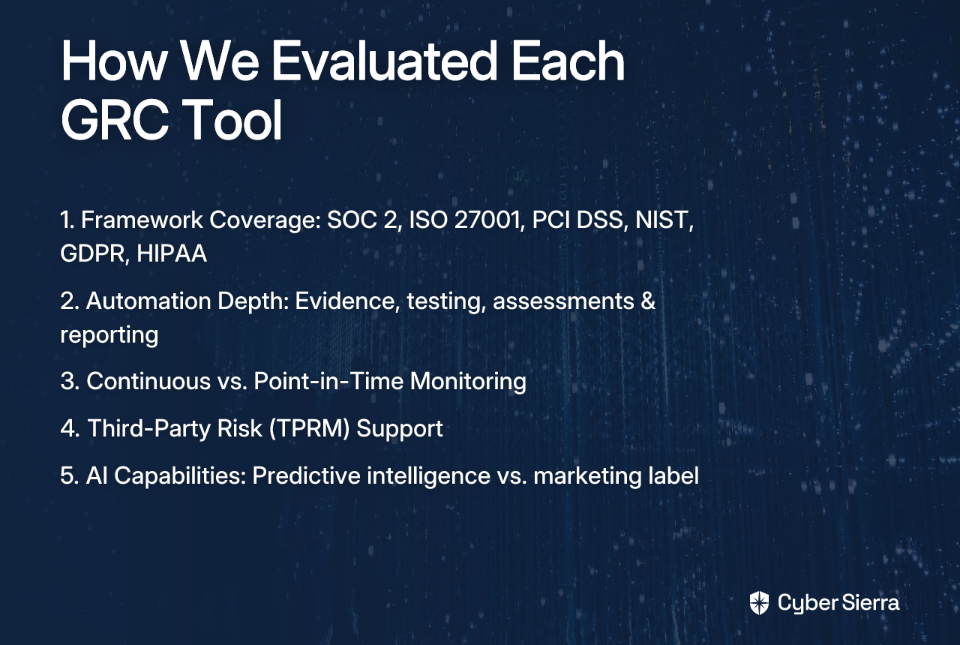
How We Evaluated the Top GRC Tools
Every tool on this list was evaluated against the same five criteria. This ensures you can compare apples to apples:
- Framework Coverage: Does it support SOC 2, ISO 27001, PCI DSS, NIST, GDPR, HIPAA, and custom controls out of the box?
- Automation Depth: Does it automate evidence collection, control testing, risk assessments, and reporting — or just assist?
- Continuous Monitoring vs. Point-in-Time: Does it offer real-time visibility and alerting, or does it capture a snapshot during audit season? As one practitioner noted on Reddit, the ideal tool "catches issues and just works without us having to keep an eye on it the whole time."
- Third-Party Risk Support (TPRM): Does it go beyond static questionnaires to continuously monitor vendor security posture?
- AI Capabilities: Does it use AI for predictive intelligence, policy mapping, or intelligent prioritization — or is "AI" just a marketing label?
The 9 Best GRC Tools for a Unified Strategy in 2026
1. Cyber Sierra
Overview: Cyber Sierra is an AI-enabled cybersecurity platform built for security-first enterprises that need GRC, Continuous Control Monitoring (CCM), and Third-Party Risk Management (TPRM) unified in a single platform. Rather than bolting together separate tools, Cyber Sierra is purpose-built to move organizations from periodic, manual compliance checks toward proactive, near real-time risk management.
- Framework Coverage: Manages SOC 2, ISO 27001, GDPR, HIPAA, PCI DSS, NIST, and custom controls — all from one dashboard. No need to maintain separate tooling per framework.
- Automation Depth: Automates data collection, control testing and validation, risk assessments, policy management, and generates detailed audit trails with comprehensive reports — significantly reducing the manual effort that leads to audit fatigue.
- Continuous Monitoring: The dedicated CCM module provides ongoing, near real-time visibility into security controls, detects anomalies and exceptions as they occur, and delivers actionable risk intelligence. This is a genuine shift from compliance as a periodic event to compliance as a continuous discipline.
- Third-Party Risk Support: The TPRM module automates vendor assessments and onboarding, prioritizes vendors by risk level, and provides 24/7 visibility into vendor security compliance — moving well beyond point-in-time questionnaires.
- AI Capabilities: Leverages AI for predictive risk intelligence and NLP-assisted policy mapping, enabling proactive gap management rather than reactive fire-fighting. Users describe the AI features as "precise" — not flashy, but genuinely useful.
- Ideal For: CISOs and Compliance Managers in regulated industries (BFSI, HealthTech, Manufacturing, Retail, Technology) who are managing multiple frameworks, a vendor ecosystem, and internal controls — and need it all visible from one place. Particularly strong for smaller GRC teams managing large infrastructure footprints.
2. MetricStream
Overview: MetricStream is one of the most recognized names in enterprise GRC, offering a deeply connected suite that integrates risk, compliance, audit, and cybersecurity management.
- Framework Coverage: Supports an extensive range of regulatory frameworks and internal risk models, making it suitable for complex, multi-geography enterprises.
- Automation Depth: AI-powered continuous control monitoring, risk quantification, and low-code/no-code customization options for tailored workflows.
- Continuous Monitoring: Available as part of its broader enterprise suite, with strong analytics and dashboarding capabilities.
- Third-Party Risk Support: Robust vendor and third-party risk modules with deep integration across the platform.
- AI Capabilities: Uses AI and analytics to improve risk response times and automate risk prioritization.
- Ideal For: Large enterprises with significant budgets, complex organizational structures, and mature GRC programs that need a highly extensive, connected solution.
3. OneTrust
Overview: OneTrust began as a privacy management platform and has since expanded into a comprehensive GRC and compliance automation tool with strong regulatory coverage.
- Framework Coverage: Deep support for privacy-centric frameworks like GDPR and CCPA, alongside standard security frameworks including ISO 27001 and SOC 2.
- Automation Depth: Automated data discovery, classification, regulatory change management, and extensive partner data feeds.
- Third-Party Risk Support: Comprehensive vendor management and reporting capabilities, particularly strong for privacy-related due diligence.
- AI Capabilities: AI-powered regulatory change tracking and data mapping.
- Ideal For: Enterprises where privacy and data governance are primary GRC drivers — especially those navigating GDPR, CCPA, or cross-border data compliance.
4. RSA Archer
Overview: RSA Archer is a veteran in the governance risk compliance tools market, known for its power and flexibility. As one Reddit commenter noted, "Archer is expensive, so if you have a large company with a large budget and complex infosec requirements, this might be the tool for you."
- Framework Coverage: Highly customizable to support virtually any compliance framework or internal risk model.
- Automation Depth: Intelligent control testing and risk prioritization, though implementation can be resource-intensive.
- Third-Party Risk Support: Comprehensive third-party governance capabilities baked into the platform.
- AI Capabilities: Analytics and reporting features, though AI capabilities are less prominent compared to newer entrants.
- Ideal For: Large enterprises with a significant budget and bespoke GRC requirements who need a battle-tested, highly configurable solution.
5. LogicGate (by Riskonnect)
Overview: LogicGate is a flexible, no-code GRC platform that lets teams build tailored risk and compliance workflows through a drag-and-drop interface — a welcome alternative to rigid, template-driven tools.
- Framework Coverage: Highly adaptable to support various frameworks and unique organizational processes.
- Automation Depth: Users can automate their specific workflows without engineering support, making it practical for teams with unique compliance processes.
- AI Capabilities: Robust analytics engine for actionable risk insights and reporting.
- Ideal For: Organizations frustrated by rigid GRC templates that don't fit their structure, and who need the flexibility to build compliance workflows that mirror how their teams actually work.
6. Vanta
Overview: Vanta is a compliance automation platform that has earned strong traction among tech-forward companies, particularly those pursuing SOC 2 or ISO 27001 for the first time.
- Framework Coverage: SOC 2, ISO 27001, HIPAA, GDPR, and other frameworks commonly prioritized by SaaS and technology companies.
- Automation Depth: Excellent automation for evidence collection through native integrations with cloud services like AWS, GCP, and popular SaaS tools — significantly reducing audit prep time.
- Continuous Monitoring: Ongoing compliance checks with automated alerts when controls go out of sync.
- Third-Party Risk Support: Expanding TPRM capabilities for vendor tracking, though not its core strength.
- Ideal For: Startups and SMBs focused on achieving and maintaining compliance certifications efficiently, especially those with significant cloud infrastructure.
7. Panorays
Overview: Panorays is a specialized TPRM platform that combines automated security questionnaires with continuous external attack surface monitoring of vendors.
- Third-Party Risk Support: Its core strength. Panorays lets you validate whether a vendor has actually patched a vulnerability by cross-referencing their external exposure — directly addressing what practitioners say they need: "Check if a vendor says they've patched X, you can see if that's reflected in their external exposure."
- Continuous Monitoring: Real-time vendor risk insights with continuous external monitoring.
- AI Capabilities: Uses AI to contextualize risk scores and prioritize which vendors need immediate attention.
- Ideal For: Organizations managing a large, complex vendor ecosystem where supply chain risk is a primary concern and point-in-time questionnaires are clearly insufficient.
8. SecurityScorecard
Overview: SecurityScorecard is best known for its security ratings platform, providing intuitive A-F grades across ten risk factor categories for any organization.
- Third-Party Risk Support: Simple, standardized risk ratings that make vendor security posture easy to communicate to non-technical stakeholders.
- Continuous Monitoring: Continuously monitors the external attack surface of an organization and its vendors.
- Ideal For: Organizations that need clear benchmarks for communicating cyber risk across business lines, and want an accessible way to initiate and scale third-party risk oversight.
9. AuditBoard
Overview: AuditBoard is a collaborative, user-friendly platform designed to streamline internal audit, risk management, and compliance operations.
- Framework Coverage: Supports a broad range of audit and compliance frameworks including SOX, ISO 27001, and general enterprise risk.
- Automation Depth: Automated audit workflows and task management that improve team productivity and reduce manual coordination overhead.
- Usability: Known for its intuitive interface that simplifies adoption across compliance and internal audit teams.
- Ideal For: Internal audit and compliance teams looking for a collaborative platform to manage audits, SOX compliance, and risk documentation with minimal friction.
Making the Right Choice: A GRC Tool Decision Matrix
The best governance risk compliance tool depends entirely on your organization's maturity, priorities, and the specific gaps you're trying to close. Use this matrix to map your situation to the right solution:
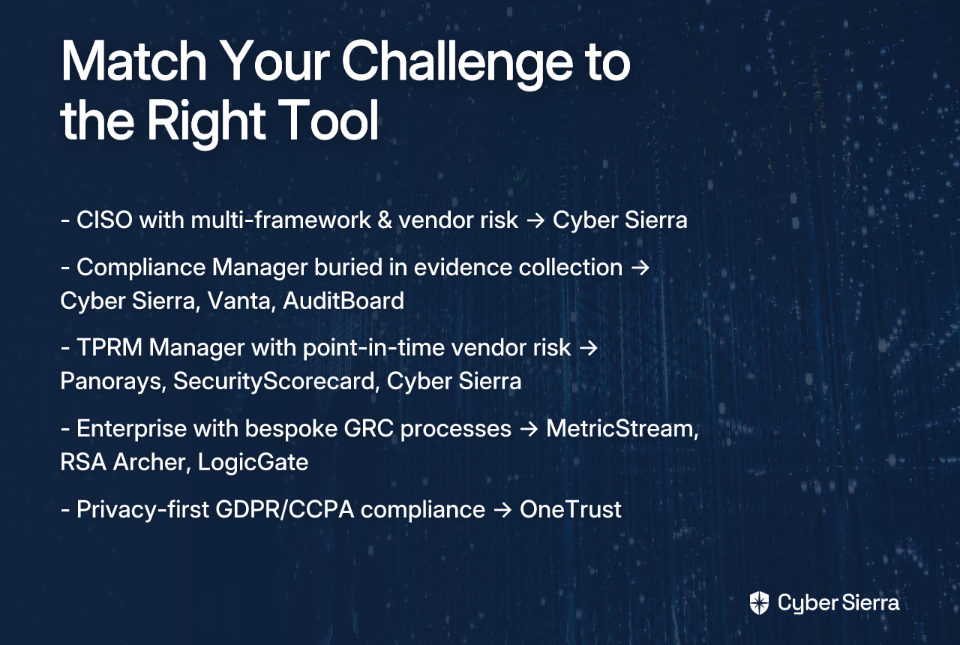
| Buyer Profile & Core Challenge | Key Features to Prioritize | Recommended Tools |
|---|---|---|
| CISO managing SOC 2, ISO 27001, and vendor risk simultaneously. Needs a single source of truth across frameworks, vendors, and internal controls. | Unified GRC + CCM + TPRM; Multi-framework support; Continuous monitoring; Strong automation; AI-powered risk intelligence. | Cyber Sierra |
| Compliance Manager drowning in manual evidence collection. Needs to get audit-ready faster without hiring more people. | Deep automation for evidence collection; Continuous control monitoring; Detailed audit trails; Pre-built framework templates. | Cyber Sierra, Vanta, AuditBoard |
| TPRM Manager overwhelmed by vendor questionnaires and point-in-time assessments. Needs proactive, ongoing vendor oversight. | Continuous vendor monitoring; External attack surface scanning; Automated questionnaire workflows; Transparent risk scoring. | Panorays, SecurityScorecard, Cyber Sierra |
| Large enterprise with complex, bespoke processes and a mature GRC program. Needs deep configurability and enterprise-grade integrations. | Low-code/no-code customization; Extensive integration ecosystem; Advanced risk quantification; Audit history depth. | MetricStream, RSA Archer, LogicGate |
| Privacy-first enterprise navigating GDPR, CCPA, or cross-border compliance. Needs regulatory change management and data governance. | Automated regulatory tracking; Data discovery and mapping; Partner data feeds; Privacy framework depth. | OneTrust |
From Scattered Spreadsheets to Strategic Security
The reality of modern GRC isn't a lack of effort; it's a lack of a unified view. When your risk data lives in spreadsheets, vendor assessments are static, and control monitoring is a once-a-year event, you're constantly reacting to yesterday's problems.
The shift to a strategic GRC program hinges on two core principles:
- Continuous visibility over point-in-time snapshots. You need to see and address control gaps as they happen, not just during audit season.
- Deep automation over manual evidence chasing. Your team’s time is better spent on managing risk, not copy-pasting data for auditors.
As a practical first step, identify the single biggest time-sink in your current audit process. Is it chasing down evidence from engineers? Or manually reconciling vendor security questionnaires? Pinpointing this bottleneck is the start of building your business case for a better system.
When you’re ready to see how a unified platform eliminates these bottlenecks for good, book a Cyber Sierra demo. See how to automate your biggest compliance headaches and get back to focusing on security.
Frequently Asked Questions
What is a GRC tool and why do I need one?
A GRC tool centralizes governance, risk, and compliance activities. You need one to replace manual spreadsheets, automate evidence collection, and gain a unified, real-time view of your risk posture, which reduces blind spots and audit fatigue.
How do I choose the right GRC tool for my company?
Choose a GRC tool by evaluating your company's specific needs, such as the compliance frameworks you manage, your reliance on third-party vendors, and your GRC program's maturity. The right tool should align with your core challenges, whether it's automation, vendor risk, or custom workflows.
What is the difference between continuous monitoring and point-in-time compliance?
Continuous monitoring provides real-time visibility into your controls, alerting you to issues as they happen. In contrast, point-in-time compliance only captures a snapshot during an audit period, which can leave dangerous gaps where risks can go undetected.
Can a GRC tool manage third-party risk (TPRM)?
Yes, many modern GRC platforms include robust Third-Party Risk Management (TPRM) modules. These go beyond static questionnaires to offer continuous vendor monitoring, automated assessments, and risk scoring, giving you a proactive view of your supply chain security.
How does AI help in GRC platforms?
AI in GRC platforms automates tasks like evidence collection, maps controls across different frameworks, and provides predictive risk intelligence. This helps prioritize critical threats and reduces manual effort, allowing your team to focus on strategic risk management.
What are the most important frameworks a GRC tool should support?
An effective GRC tool should support key frameworks like SOC 2, ISO 27001, PCI DSS, NIST, GDPR, and HIPAA out of the box. The best platforms also allow you to manage custom internal control frameworks, ensuring all your compliance needs are met in one place.
