



Hyperproof vs LogicGate vs Cyber Sierra: Which GRC Platform Wins for Mid-Market?


Join thousands of professionals and get the latest insight on Compliance & Cybersecurity.
Summary
- Mid-market companies often face a "GRC dilemma," needing a powerful compliance platform without the six-figure price tag and lengthy implementation timeline of enterprise solutions.
- Key features to look for include multi-framework support, true continuous monitoring, integrated vendor risk management, and rapid deployment that doesn't require a dedicated team.
- A comparison of top platforms reveals Hyperproof's strength in framework quantity, LogicGate's in workflow customization, and Cyber Sierra's focus on an all-in-one approach.
- For teams seeking to avoid the complexity of multiple tools, an integrated platform like Cyber Sierra offers a unified solution for GRC, vendor risk, and continuous monitoring.
You've outgrown spreadsheets. You know it. Your auditors know it. But every time you evaluate an enterprise GRC platform like Archer or AuditBoard, the demo ends with a six-figure quote, a 9-month implementation timeline, and the quiet realization that you'd need to hire two more people just to run the tool.
And yet, doing nothing — or patching together quarterly spreadsheet reviews and calendar reminders — isn't a real compliance program either.
This is the mid-market GRC dilemma: you need a serious, scalable governance, risk, and compliance platform that handles multiple frameworks, continuous monitoring, and vendor risk. You just don't have a dedicated implementation team, a seven-figure software budget, or 12 months to spare.
This article gives you an honest, structured comparison of three GRC platforms that actually target your segment: Cyber Sierra, Hyperproof, and LogicGate. We'll break down each one across the criteria that matter most to mid-market security and compliance teams — and close with a decision matrix to help you choose.
The Mid-Market GRC "Goldilocks" Problem
Mid-market companies — typically 200 to 2,000 employees — are in a uniquely uncomfortable position. They're complex enough to face real regulatory pressure (SOC 2, ISO 27001, GDPR, HIPAA, PCI DSS), yet lean enough that they can't absorb the operational overhead of enterprise-grade GRC tooling. As one frustrated security leader put it on Reddit, "The major enterprise options are slow, expensive, and way too much unless you're Fortune 500 scale."
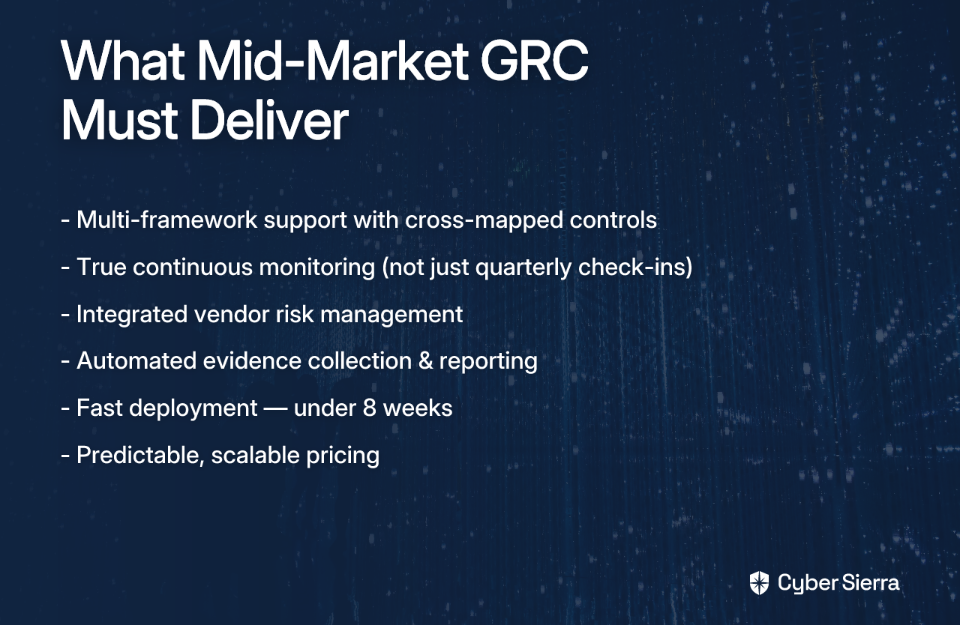
What does the right GRC platform actually need to do for a company at this stage?
- Support multiple frameworks without duplicating work. Cross-mapping controls across SOC 2, ISO 27001, and NIST shouldn't require starting from scratch each time.
- Deliver true continuous monitoring. As one cybersecurity professional noted, most small teams never achieve real continuous compliance — they break audit work into quarterly check-ins instead. The right tool automates this gap.
- Integrate vendor risk management. Supply chain risk isn't a separate workstream; it's core to your compliance posture.
- Automate evidence collection and reporting. Audit fatigue is real. GRC automation reduces manual effort and keeps you audit-ready year-round — not just in the weeks before an assessment.
- Deploy quickly, without professional services. If implementation takes longer than 8 weeks, you've already missed a quarter.
- Price predictably. As one user warned about Hyperproof specifically: it "gets pricey as you scale."
With that framework in mind, let's look at the three contenders.
The Contenders
- Cyber Sierra — An AI-enabled, integrated platform combining GRC, Continuous Control Monitoring, Third-Party Risk Management, and Threat Intelligence in a single system. Built specifically for mid-market teams that want robust security and compliance without enterprise-level overhead.
- Hyperproof — A compliance operations platform known for its polished UI, large framework library (140+), and strong evidence automation integrations.
- LogicGate — A flexible GRC platform (marketed as "Risk Cloud") built around highly customizable workflow automation for risk and compliance processes.
Head-to-Head Comparison
We'll evaluate each platform across six key criteria relevant to mid-market teams.
1. Supported Compliance Frameworks
Hyperproof has the broadest framework library on the market — over 140 frameworks — making it the strongest option if you operate across multiple jurisdictions or niche regulatory environments. Cross-mapping between frameworks reduces duplicated effort.
LogicGate covers major frameworks like ISO 27001 and NIST, but its real strength is the ability to build fully custom control sets. If your industry has bespoke requirements that don't map neatly to a standard framework, LogicGate can accommodate them.
Cyber Sierra comes pre-loaded with the frameworks most critical for mid-market tech and regulated industries: SOC 2, ISO 27001, GDPR, HIPAA, and PCI DSS. Its cross-framework mapping ensures that a control verified once counts across multiple standards — reducing redundant evidence collection from day one.
2. Continuous Control Monitoring (CCM) Capability
Hyperproof provides solid CCM by connecting directly to cloud services like AWS and Okta to automatically pull evidence. Customers like Appian have reportedly saved 350+ hours per year on audit prep. That said, its CCM is primarily evidence-collection focused — it confirms that documentation exists, rather than continuously validating that controls are actually operating.
LogicGate's monitoring is workflow-driven — it can trigger review tasks on a schedule, but it doesn't perform continuous technical validation of controls natively.
Cyber Sierra takes a more advanced approach with its CCM module: near real-time control validation, automated testing, exception detection, and a central controls repository that updates continuously. This moves beyond "did we collect the evidence?" to "is the control actually working right now?" — a critical distinction for teams trying to stay ahead of audits rather than scramble for them.
3. Third-Party Risk Management (TPRM) Depth
Hyperproof offers basic TPRM — you can track vendor information and store compliance artifacts, but it lacks the depth needed for end-to-end vendor lifecycle management. If you're managing a complex supply chain, you'll likely need a separate TPRM tool alongside it.
LogicGate does better here. Its workflow engine can be configured to build structured vendor onboarding, risk assessment, and ongoing review processes. It's flexible, but that flexibility comes with configuration overhead.
Cyber Sierra's TPRM module is a fully integrated, native capability — not a bolt-on. It automates vendor assessments, provides 24/7 near real-time visibility into vendor security compliance, and streamlines the full vendor lifecycle from onboarding to offboarding. Critically, vendor risk data feeds directly into your overall risk posture — so a red flag on a critical vendor doesn't sit in a separate dashboard; it surfaces in your GRC program automatically.
4. Deployment Timeline & Implementation Overhead
Hyperproof is known for a user-friendly interface that compliance teams can navigate quickly. Deployment is moderate — typically a few weeks to get core workflows running, though deeper integrations take longer.
LogicGate can take longer, particularly because its flexibility requires upfront workflow design. The more custom your processes, the more time investment you'll need from your team or a consultant.
Cyber Sierra is architected for rapid deployment, with a focus on mid-market teams who can't afford consultant-led rollouts. The platform is designed to be operational quickly, without requiring dedicated GRC implementation resources.
5. Automation Level & AI Integration
Hyperproof offers high automation for evidence collection and task management, with integrations across 70+ tools including Jira, AWS, and Okta. AI features have been added for evidence summarization and risk prediction.
LogicGate excels at automating complex, multi-stage workflow processes. Its automation is powerful but requires careful configuration to realize its potential.
Cyber Sierra is AI-enabled at the architectural level — not just as a feature layer. AI correlates data across CCM, TPRM, and Threat Intelligence to deliver a unified, prioritized risk view. As one cybersecurity professional observed, "the real impact shows up when AI is paired with solid data visibility." Cyber Sierra's integrated data model is what makes its AI outputs actionable rather than just noise.
6. Pricing Model Transparency
Hyperproof pricing is not publicly listed, and multiple users have flagged that costs scale significantly as you add frameworks or users — making long-term budgeting difficult.
LogicGate also uses custom pricing based on modules and workflow complexity, requiring a sales conversation before you can evaluate fit-to-budget.
Cyber Sierra structures its pricing for mid-market predictability, avoiding the steep upcharges common with enterprise-focused tools. This makes it easier to evaluate ROI without having to commit to a lengthy sales process.
Comparison Summary Table
| Feature | Cyber Sierra | Hyperproof | LogicGate |
|---|---|---|---|
| Supported Frameworks | SOC 2, ISO 27001, GDPR, HIPAA, PCI DSS with cross-mapping | 140+ frameworks (largest library) | Major frameworks + fully custom control sets |
| CCM Capability | Advanced — near real-time validation & exception detection | Moderate — strong evidence collection | Moderate — workflow-triggered review tasks |
| TPRM Depth | Comprehensive — integrated, end-to-end lifecycle | Basic — tracking only | Moderate — configurable assessments |
| Deployment Timeline | Quick — designed for self-deployment | Moderate | Moderate to Slow (depends on customization) |
| Automation & AI | High — AI-enabled, cross-module correlation | High — evidence & task automation | High — custom workflow engine |
| Pricing Transparency | Clear — mid-market focused | Fair — can escalate with scale | Somewhat clear — custom plans |
Comparison informed by CyberArrow's GRC analysis and GBHackers' compliance software overview.
The Pivot: Why Integration Is a Mid-Market Game-Changer
Here's the thing that comparison tables don't fully capture: the biggest risk for a mid-market team isn't choosing the wrong feature — it's stitching together too many tools.
Using Hyperproof for compliance, a separate TPRM vendor for vendor assessments, and another tool for vulnerability scanning means three dashboards, three data models, three sets of integrations to maintain, and no single source of truth. That complexity is exactly what enterprise teams have dedicated staff to manage — and what mid-market teams don't.
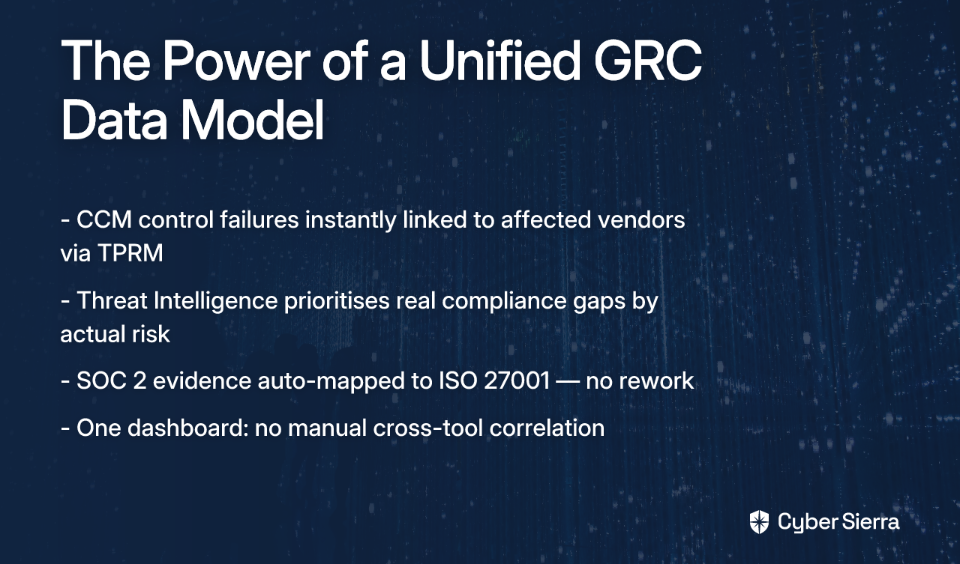
Cyber Sierra's core architectural advantage is that GRC, CCM, TPRM, and Threat Intelligence are not separate modules bolted together — they're built on a unified data model. That means:
- A control failure detected in CCM is immediately correlated with the vendors that touch that system via TPRM.
- Vulnerability data from Threat Intelligence informs which compliance gaps pose the highest actual risk.
- Evidence collected for SOC 2 is automatically mapped to ISO 27001, eliminating duplicated audit prep work.
This is the difference between a compliance platform and a security program. For a mid-market team with limited resources, that integration isn't a luxury — it's the only way to get real-time risk visibility without hiring an analyst to manually correlate data across tools.
Decision Matrix: Who Should Choose What?
✅ Choose Cyber Sierra if...
- You're a mid-market company that needs GRC, continuous control monitoring, vendor risk, and threat intelligence in a single, unified platform.
- You want to deploy quickly — in weeks, not months — without relying on external consultants or building a dedicated implementation team.
- You manage multiple compliance frameworks (SOC 2, ISO 27001, GDPR, HIPAA, PCI DSS) and want cross-mapping to eliminate redundant work.
- You believe that security posture and compliance aren't separate functions, and want a platform that treats them as one.
- You're concerned about supply chain risk and want TPRM fully integrated into your compliance program — not managed in a separate tool.
✅ Choose Hyperproof if...
- Your primary need is rapid audit readiness for a specific framework like SOC 2 or ISO 27001, and you want excellent evidence automation for that use case.
- You operate across many jurisdictions and genuinely need access to 140+ pre-built frameworks out of the box.
- Your vendor risk needs are minimal, and you're comfortable sourcing a separate TPRM solution.
- You prioritize UI polish and have a compliance team that will use the platform daily and benefits from a refined user experience.
✅ Choose LogicGate if...
- Your organization has uniquely complex or non-standard risk management processes that don't map well to pre-built GRC templates.
- Your biggest priority is building fully customized workflows for multi-stage risk and compliance processes — and you have the internal technical capacity to configure and maintain them.
- You're willing to invest more time upfront in configuration in exchange for maximum long-term flexibility.
- Your compliance program is already mature, and you're looking for a powerful automation layer rather than a guided GRC framework.
Stop Juggling Tools, Start Managing Risk
For too long, the GRC software market has forced mid-market teams into a difficult choice: stick with messy spreadsheets or overpay for an enterprise platform that requires a full-time staff to operate. The real challenge isn't just automating a single compliance framework—it's managing risk holistically without creating more work.
Here are the key takeaways:
- The biggest risk is tool sprawl. Stitching together separate platforms for compliance, vendor management, and control monitoring creates complexity and hides critical threats in the gaps.
- Integration is your strategic advantage. A unified platform provides a single source of truth, turning compliance from a reactive chore into a proactive, continuous security function.
Your next step today? Sketch out your current GRC process. If it involves more than two dashboards or manual data correlation between tools, you have an opportunity to simplify.
See how a unified GRC, CCM, and TPRM system provides real-time visibility and control. Book a personalized demo and get a clear path forward in just 30 minutes.
Frequently Asked Questions
What is a mid-market GRC platform?
A mid-market GRC platform is software designed for companies (200-2,000 employees) that need to manage compliance frameworks like SOC 2 but lack the budget for enterprise tools. It automates tasks, monitors controls, and manages risk without requiring a long, complex implementation.
Why is an integrated GRC platform better for mid-market teams?
An integrated GRC platform is better because it combines compliance, vendor risk (TPRM), and continuous monitoring into one system. This eliminates the need to manage multiple tools, reduces complexity, and provides a unified view of risk, which is crucial for lean teams with limited resources.
How do I choose between Cyber Sierra, Hyperproof, and LogicGate?
Choose based on your primary need. Cyber Sierra is best for an all-in-one, integrated platform (GRC, TPRM, CCM). Hyperproof excels at evidence automation across many frameworks. LogicGate offers maximum flexibility for building custom risk workflows if you have unique process requirements.
What is the main benefit of continuous control monitoring (CCM)?
The main benefit of CCM is moving from periodic check-ins to real-time validation. Instead of just collecting evidence for an audit, CCM automatically and continuously tests if your security controls are actually working, giving you a proactive, always-on compliance posture.
How long does it take to implement a mid-market GRC tool?
Implementation times vary. Platforms like Cyber Sierra are designed for rapid deployment, often taking just a few weeks to become operational. Others, especially highly customizable ones like LogicGate, may take longer depending on the complexity of the workflows you need to build and configure.
Can GRC platforms manage multiple compliance frameworks at once?
Yes, a key feature of modern GRC platforms is managing multiple frameworks like SOC 2, ISO 27001, and GDPR simultaneously. They use control cross-mapping, which means you collect evidence for a control once and it automatically applies to all relevant frameworks, saving significant time.
