



8 Best ISO 27001 Compliance Automation Tools for Enterprises

Join thousands of professionals and get the latest insight on Compliance & Cybersecurity.
Summary
- Manual compliance management for frameworks like ISO 27001 is inefficient and doesn't provide the continuous visibility enterprises need.
- Enterprises should evaluate automation tools based on their ability to provide continuous monitoring, map controls across multiple frameworks, and integrate vendor risk management (TPRM).
- The goal of automation is to eliminate repetitive evidence collection, enabling teams to focus on strategic risk management rather than just audit preparation.
- Platforms like Cyber Sierra unify GRC, continuous control monitoring, and TPRM to help enterprises move from periodic audit prep to continuous compliance.
The good news is that ISO 27001 compliance automation has matured significantly. The bad news is that most "best tools" listicles read like recycled G2 summaries and miss the criteria enterprises actually care about. This article evaluates tools on a rubric built for complex, multi-framework environments—not just whether they offer a pretty dashboard for a solo startup's first audit.
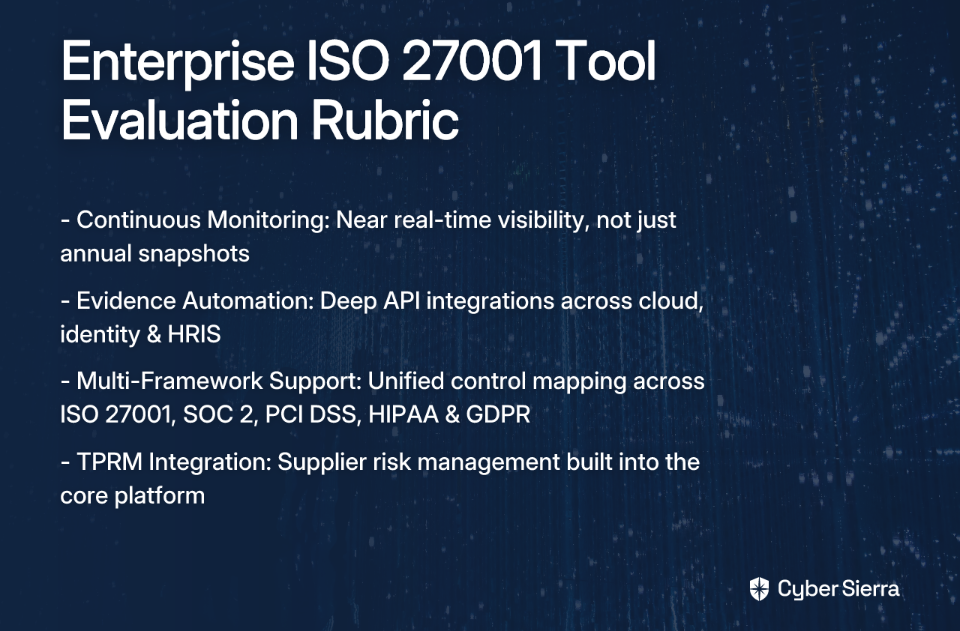
The Enterprise Evaluation Rubric: What Actually Matters
Before we dive into the list, let's establish what separates a genuinely enterprise-grade ISO 27001 compliance automation tool from the rest:
- Continuous Monitoring. Passing an annual audit is the floor, not the ceiling. Enterprise tools should provide near real-time visibility into your security posture—not just a snapshot every 12 months.
- Evidence Automation. Deep API integrations with your cloud providers, code repositories, identity systems, and HRIS matter. A long integration list isn't just a vanity metric—it's the difference between automated evidence pulls and your team spending weekends on screenshots.
- Multi-Framework Support. Enterprise environments rarely live under a single compliance regime. Your platform needs to map controls across ISO 27001, SOC 2, PCI DSS, HIPAA, and GDPR simultaneously, reducing duplicated effort through unified control mapping.
- TPRM Integration. ISO 27001's scope doesn't end at your firewall. Annex A controls explicitly require managing supplier relationships. Bolt-on vendor risk modules don't cut it; TPRM needs to be core to the platform.
With that rubric in place, here are the eight best tools worth evaluating.
8 Best ISO 27001 Automation Tools for Enterprises
1. Cyber Sierra
Best for: Enterprises needing a unified platform for continuous, multi-framework compliance and third-party risk management.
Standout Feature: Fully integrated Continuous Control Monitoring (CCM) and Third-Party Risk Management (TPRM) that share a single source of truth for security posture.
Cyber Sierra's AI-enabled platform is purpose-built for enterprises that need more than point-in-time audit prep. Its GRC module automates data collection, risk assessments, and control validation across ISO 27001, SOC 2, PCI DSS, and HIPAA — enabling compliance teams to stay audit-ready year-round without the quarterly evidence scramble. What sets it apart is the depth of integration between modules: vendor risks identified in TPRM are directly linked to internal ISO 27001 controls in the CCM dashboard, giving CISOs a genuinely unified view instead of siloed reports. For organizations grappling with two or more overlapping frameworks and extensive vendor ecosystems, Cyber Sierra is the strongest all-in-one contender on this list.
2. Vanta
Best for: Tech companies and scaling startups getting audit-ready for the first time.
Standout Feature: Over 1,200 automated tests and integrations with over 400 tools for seamless evidence collection.
Vanta has built a strong reputation for making ISO 27001 and SOC 2 compliance accessible, particularly for engineering-led teams. Its AI-powered policy templates and hourly control monitoring significantly reduce the time-to-audit-ready. While it's a powerful choice for companies earlier in their compliance journey, larger enterprises managing deeply customized control environments may find its rigidity limiting as they scale.
3. Drata
Best for: Mid-market companies managing multiple frameworks who value a clean, intuitive user experience.
Standout Feature: Real-time compliance monitoring with strong cross-framework control mapping across ISO 27001, SOC 2, GDPR, and more.
Drata delivers continuous compliance visibility through an exceptionally well-designed dashboard, pulling automated evidence from cloud platforms and identity providers. Its framework-agnostic approach makes it a solid pick for teams managing two or three overlapping standards. Where it can fall short for larger enterprises is in the depth of its native TPRM capabilities, which may require supplementation with a dedicated vendor risk tool.
4. Secureframe
Best for: Organizations pursuing their first ISO 27001 certification who need structured, workflow-driven guidance.
Standout Feature: An extensive library of policy templates and step-by-step implementation workflows tailored to ISO 27001 requirements.
Secureframe is designed to make compliance accessible, with automated evidence collection, user access reviews, and a guided approach that leads teams through each stage of the certification process. It's a strong fit for companies earlier in their compliance maturity curve. However, enterprises with complex, multi-domain environments may find that they outgrow its guided structure as their needs become more nuanced.
5. AuditBoard
Best for: Large enterprises with mature internal audit programs and established GRC functions.
Standout Feature: Enterprise-grade audit management with comprehensive planning, workflow, and reporting capabilities across multiple frameworks.
AuditBoard is built for the scale and complexity of large enterprise risk and compliance operations. It centralizes internal audit management, cross-framework control tracking, and issue remediation into a single platform — making it a powerful choice for organizations with dedicated internal audit teams. Its strength, however, is more in audit management workflow than in continuous automated control testing, so teams expecting deep real-time monitoring may need to complement it with additional tooling.
6. LogicGate (RiskCloud)
Best for: Organizations that require highly customizable GRC workflows and flexible risk assessment processes.
Standout Feature: A no-code, app-based platform that allows compliance teams to build and adapt their own risk and compliance workflows.
RiskCloud by LogicGate takes a fundamentally different approach from pre-configured compliance tools. Its flexibility makes it ideal for enterprises with unique or evolving compliance architectures — teams can model their own ISO 27001 control processes, risk scoring methodologies, and remediation workflows without writing a single line of code. The tradeoff is onboarding time: the flexibility that makes it powerful also means it requires more configuration to get running than out-of-the-box solutions.
7. ISMS.online
Best for: Smaller organizations and beginners needing an out-of-the-box, ISO 27001-specific guided solution.
Standout Feature: Pre-configured ISMS tools and structured implementation guidance specifically aligned to the ISO 27001 standard.
ISMS.online is purpose-built for ISO 27001, providing everything a team needs to build and maintain an Information Security Management System from scratch. Its structured, guided approach is ideal for organizations new to the standard who want a clear path to certification. For enterprise-scale deployments managing multiple frameworks with large vendor ecosystems, its specialized focus may become a limitation rather than an asset.
8. Qualys
Best for: Enterprises that want to connect vulnerability management and asset visibility directly to compliance controls.
Standout Feature: A unified security and compliance view that maps technical vulnerabilities to specific compliance requirements in real time.
Qualys is a security-first platform that extends its industry-leading vulnerability and asset management capabilities into the compliance space. For organizations that want their ISO 27001 evidence automation grounded in actual technical security data — network scans, cloud misconfigurations, software vulnerabilities — Qualys offers a uniquely credible integration between operational security and compliance posture. It's less suited for teams looking for a GRC-first experience with guided policy and risk workflows.
Automation Is a Tool, Not a Silver Bullet
If you've ever been the person responsible for ISO 27001 compliance at an enterprise, you know the feeling. It's not just the annual audit prep—it's the quarterly evidence collection, the vendor questionnaires piling up, and the silent dread of managing PCI DSS, SOC 2, and HIPAA on top of it, all with a security team that's stretched thin. As one compliance practitioner put it on Reddit, "collecting that evidence every quarter manually is soul crushing when you're trying to run a business."
Here's something the "automate everything or die" crowd won't say loudly: automation is only as good as the team behind it. As some practitioners have pointed out, if you've spent all your time connecting APIs without understanding why a control exists, you'll be caught flat-footed the moment an auditor asks a probing question.
The most honest framing is this: the best compliance automation tools handle the repetitive collection so your team can invest their attention in genuine understanding. Well-organized evidence is critical—but as another user noted, "you still need to be ready on the fly during the audit itself." And practically speaking, as one user pointed out, most auditors don't care whether your evidence came from a polished API integration or a well-organized PDF folder—what matters is that it's clear, verifiable, and aligned to the ISO 27001 control structure.
Use automation to eliminate the soul-crushing manual burden. But never let it become a substitute for your team actually knowing the program.
Decision Framework: Managing ISO 27001 Alongside 2+ Other Frameworks
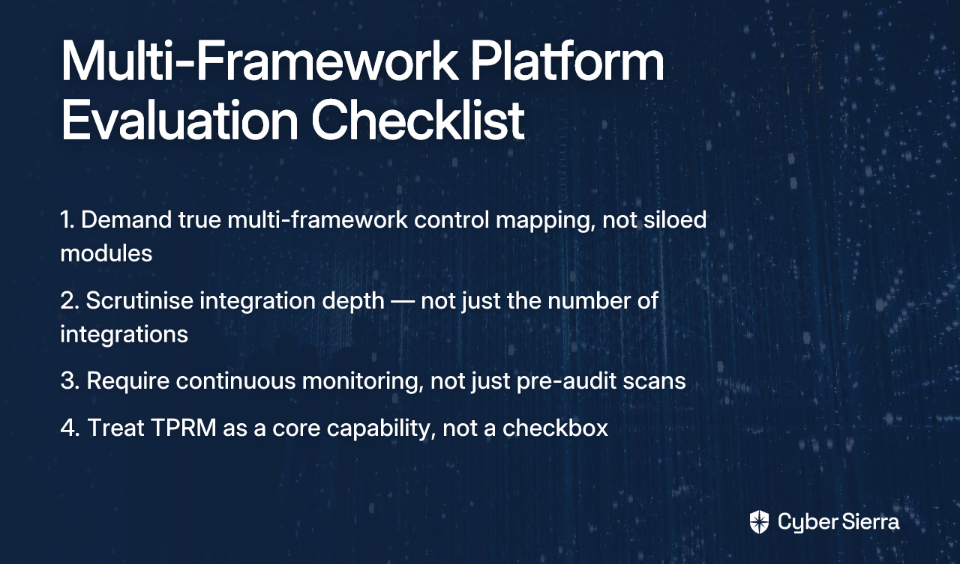
If your compliance environment spans multiple standards, here's how to prioritize your platform evaluation:
1. Demand True Multi-Framework Control Mapping, Not Just Multiple Modules
There's a meaningful difference between a platform that has separate, siloed modules for ISO 27001 and SOC 2 versus one that genuinely maps overlapping controls between frameworks. Ask vendors: Can I see a control in ISO 27001 Annex A mapped to its equivalent SOC 2 Common Criteria? Does satisfying one automatically update the other? Platforms that unify control evidence reduce your team's workload dramatically; platforms that merely bundle separate products do not.
2. Scrutinize How Automation Actually Works—Depth Over Breadth
A vendor claiming "400+ integrations" means little if those integrations are shallow polling connections. What matters is whether the platform has deep, bidirectional API integrations with the specific systems in your stack: your cloud provider (AWS, Azure, GCP), your identity platform (Okta, Azure AD), your code repository (GitHub, GitLab), and your HRIS. Ask for a live demo of evidence being pulled automatically for a specific ISO 27001 control.
3. Require Continuous Monitoring, Not Just Pre-Audit Scans
If a platform "monitors controls" on a weekly or monthly schedule, that's periodic compliance—not continuous compliance. For enterprises operating in regulated industries, real-time or near real-time control testing is what differentiates proactive security management from reactive audit-cram sessions. Ask vendors: How frequently are controls tested, and how quickly am I alerted when a control fails?
4. Treat TPRM as a Core Capability, Not a Checkbox
ISO 27001's Annex A has explicit requirements for supplier relationships (A.15). If a platform's vendor risk management is a lightly integrated third-party module, your team will end up reconciling two separate systems when an auditor asks about a specific vendor's compliance posture. Look for platforms where TPRM findings are natively linked to internal controls and surfaced in the same compliance dashboard.
From Audit Prep to Continuous Compliance
The right ISO 27001 automation platform doesn't just pass audits; it eliminates the "soul-crushing" manual work that prevents your team from focusing on strategic risk management. The goal is to move from periodic snapshots to a state of continuous compliance.
For any enterprise juggling multiple frameworks, remember two core principles from this evaluation. First, demand a platform that unifies controls across ISO 27001, SOC 2, and others—don't settle for siloed modules. Second, ensure that vendor risk management (TPRM) is deeply integrated, not a bolt-on afterthought. This creates a single source of truth for your entire security posture.
If managing these challenges sounds familiar, see how Cyber Sierra's unified GRC platform helps teams trade quarterly audit scrambles for year-round visibility and control.
Book a personalized demo to see how automated evidence collection and continuous control monitoring can streamline your ISO 27001 compliance.
Frequently Asked Questions
What is ISO 27001 compliance automation?
ISO 27001 compliance automation uses software to automatically collect evidence, monitor security controls, and manage tasks required for certification. This replaces manual work like taking screenshots, allowing teams to focus on improving security posture instead of just preparing for audits.
How does automation help manage multiple compliance frameworks?
Automation platforms map a single piece of evidence to multiple overlapping controls across frameworks like ISO 27001, SOC 2, and PCI DSS. This "unify and comply once" approach dramatically reduces duplicated effort, saving significant time for teams managing several compliance standards.
What is continuous control monitoring (CCM) and why is it important?
Continuous Control Monitoring (CCM) provides near real-time visibility into your security posture, rather than just a snapshot during an annual audit. It enables proactive risk management by alerting you to control failures as they happen, ensuring you remain compliant year-round.
Can compliance automation tools replace the need for a security team?
No, automation tools do not replace security teams; they augment them. These platforms handle repetitive evidence collection, freeing up your team to focus on strategic tasks like risk analysis, control design, and responding to auditor questions with genuine understanding of the security program.
What should I look for when choosing an ISO 27001 tool for a large enterprise?
For large enterprises, prioritize tools with continuous monitoring, deep evidence automation, unified multi-framework control mapping, and integrated Third-Party Risk Management (TPRM). These features ensure the platform can handle the complexity and scale of enterprise environments beyond a single audit.
How does Third-Party Risk Management (TPRM) relate to ISO 27001 compliance?
ISO 27001 Annex A explicitly requires managing the security of supplier relationships, making TPRM a core component of compliance. An integrated TPRM module connects vendor risks directly to your internal controls, providing a unified view of your entire security ecosystem for auditors.
