



Top Privacy Compliance Automation Platforms for Enterprises in 2025


Join thousands of professionals and get the latest insight on Compliance & Cybersecurity.
The constant barrage of privacy regulations has created an exhausting reality for compliance teams. As you prepare for yet another audit, you're likely facing the all-too-familiar dread of tedious evidence gathering, endless documentation, and the stress of meeting ever-changing requirements—all while trying to run your business with a lean team.
"The most painful part of an audit is typically evidence gathering," notes one frustrated compliance professional on Reddit. "You end up on long calls with engineers who may or may not speak GRC and hope they remember where to find a config and take a screenshot with a timestamp. It's painful and sucks up a lot of time."
If this resonates, you're not alone—and the landscape is only becoming more complex as we move through 2025.
The Evolving Privacy Landscape: Why Automation is No Longer Optional
The privacy landscape has fundamentally transformed this year, increasing both the stakes and complexity for enterprises:
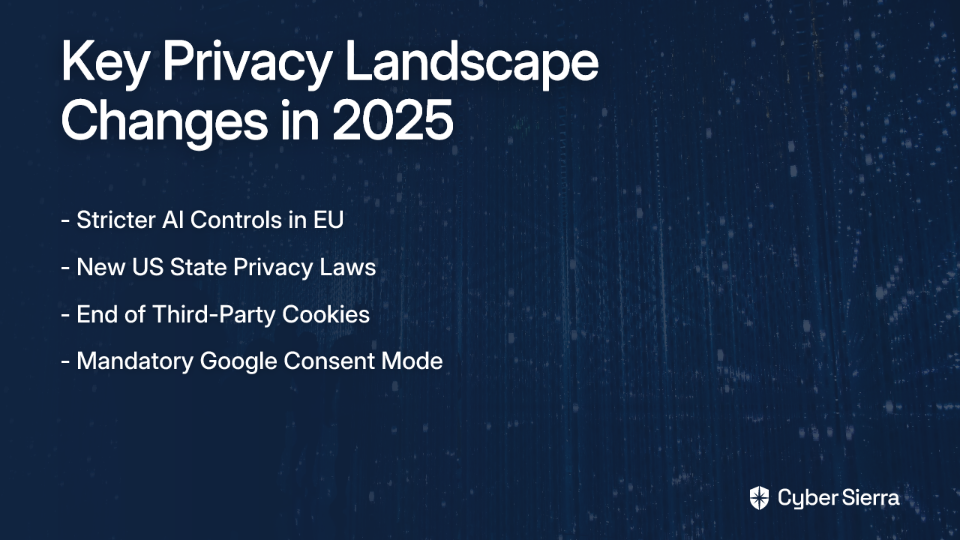
- Stricter AI Controls: The EU's comprehensive AI regulations have set a global precedent, requiring enterprises to implement robust privacy measures for AI systems.
- Expanding US State Laws: New comprehensive privacy laws in states like New Hampshire and New Jersey have taken effect, adding to the already complex patchwork of state-level regulations.
- The End of Third-Party Cookies: Google's phase-out of third-party cookies in Chrome has fundamentally altered how businesses track users and manage consent.
- Mandatory Google Consent Mode: Websites using Google Ads in Europe must now integrate with certified consent management platforms (CMPs).
These shifts have created a perfect storm where manual compliance is not just inefficient—it's practically impossible at enterprise scale.
Why Manual Compliance is No Longer Viable for Enterprises
The numbers tell a compelling story about the necessity of automation:
- According to OneTrust research, over 60% of organizations struggle with managing and demonstrating accountability for data processing activities due to regulatory complexity.
- Manual processes leave organizations vulnerable to human error, with studies showing that manual compliance tasks have error rates as high as 40%.
- The average enterprise must comply with 13+ privacy regulations simultaneously, each with its own nuanced requirements.
Beyond the risks, there's a clear business case for automation:
- Massive Productivity Gains: Enhance productivity by up to 75% through AI-driven automation of repetitive tasks.
- Significant Risk Reduction: Reduce regulatory risk by up to 75% by operationalizing privacy use cases in a single platform.
- Drastic Cost Savings: Cut down on redundant compliance actions by up to 30% by identifying shared requirements across multiple frameworks, as reported by TrustArc.
As one Reddit user aptly put it: "While tools may not shorten audit periods, they significantly reduce the workload." This reduction is critical as compliance teams are increasingly asked to do more with less.
Essential Features of a Top-Tier Privacy Automation Platform
Before diving into specific platforms, let's establish what enterprises should look for in a privacy compliance automation solution in 2025:
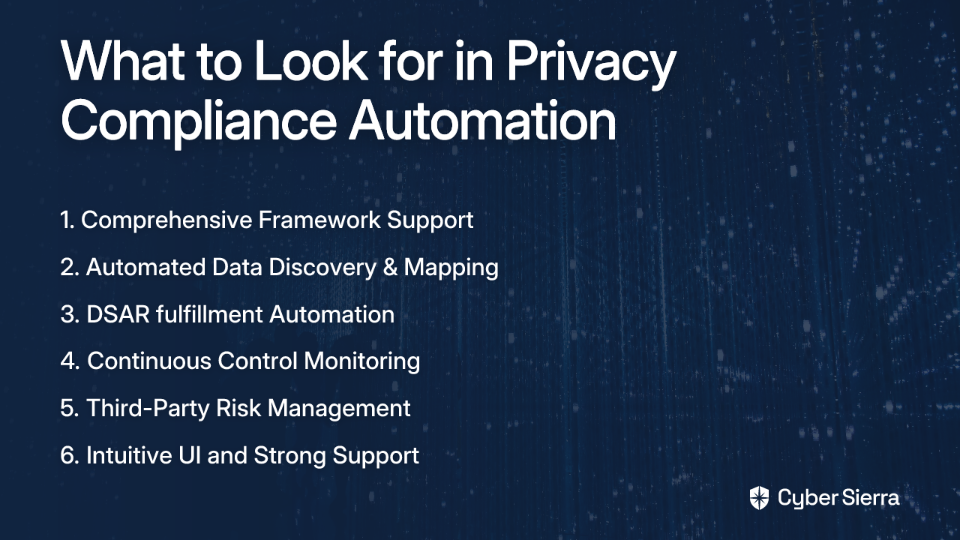
1. Comprehensive Framework Support
The ideal platform should support multiple global regulations from a single interface. TrustArc's PrivacyCentral, for example, maps over 20,000+ pre-defined controls across 125+ privacy and security laws, ensuring comprehensive coverage across jurisdictions.
2. Automated Data Discovery & Mapping
Look for platforms that can automatically discover, classify, and maintain records of processing activities (ROPAs). This capability addresses one of the most labor-intensive aspects of compliance: building and maintaining an accurate data map.
3. DSAR Fulfillment Automation
A core privacy function, the platform should automate the entire lifecycle of Data Subject Access Requests—from intake via web forms to data discovery and fulfillment. OneTrust's DSAR Automation solution exemplifies this capability.
4. Continuous Control Monitoring (CCM)
This represents the shift from point-in-time snapshots to near real-time visibility. A robust CCM provides automated evidence collection from your tech stack (e.g., AWS, Azure, Google Cloud) to prove controls are working continuously—directly addressing the pain of manual evidence gathering.
5. Third-Party Risk Management (TPRM)
With vendor-related privacy breaches on the rise, look for features like automated vendor assessments, centralized vendor inventories, and continuous monitoring of third-party security posture.
6. Intuitive UI and Strong Support
Many users report frustration with platforms that have a "steep learning curve," "poor UI," and "difficult onboarding" processes. The right solution should be intuitive and backed by responsive support teams.
Top Privacy Compliance Automation Platforms in 2025
OneTrust
Overview: A market leader known for its comprehensive suite of privacy, security, and ethics tools. OneTrust is an official Europrivacy technology partner with extensive integration capabilities.
Key Strengths:
- Regulatory Intelligence: Backed by insights from 2,000 trusted experts and the DataGuidance research portal with input from 1,700 legal experts across 300 jurisdictions.
- End-to-End Automation: Covers everything from readiness assessments and PIAs to data mapping, consent management, and DSAR automation.
- Vendor Risk Management: Streamlines vendor onboarding and risk assessment with AI-powered assessments and continuous monitoring.
Best For: Large enterprises with significant budgets that require a feature-rich, all-encompassing solution and extensive support.
Potential Drawbacks: Can be high-cost and have a difficult onboarding process, as noted in user reviews.
TrustArc (PrivacyCentral)
Overview: A platform focused on automating privacy compliance and data governance to accelerate time-to-compliance.
Key Strengths:
- Extensive Control Library: Provides over 20,000+ pre-defined controls mapped across 125+ laws and standards, continuously maintained by privacy experts.
- Efficiency-Driven: Identifies shared requirements across frameworks to cut down on up to 30% of redundant work.
- AI-Powered: Uses AI for monitoring regulatory changes, auto-filling responses, and analyzing evidence to close compliance gaps.
Best For: Organizations managing multiple compliance frameworks that need to quickly identify gaps and prioritize tasks efficiently.
DataGrail
Overview: A modern platform designed for advanced users, focusing on deep integrations to streamline compliance.
Key Strengths:
- Deep Integrations: Connects with over 1,900 enterprise applications (e.g., Salesforce, Marketo, Slack) to automate data mapping and DSARs.
- Strong Support: Known for comprehensive training and strong customer support.
Best For: Tech-forward companies with a complex and sprawling application ecosystem.
Potential Drawbacks: High cost and long onboarding times.
BigID
Overview: A platform specializing in data intelligence and discovery.
Key Strengths:
- Data-Centric Security: Excels at discovering, classifying, and managing sensitive and personal data across the entire data landscape (cloud, on-prem, SaaS).
- Enterprise-Grade Toolsets: Offers powerful features for privacy impact assessments and data governance.
Best For: Data-heavy enterprises whose primary challenge is understanding and controlling their vast and complex data stores.
Potential Drawbacks: User feedback points to issues with usability and high management effort.
Beyond Silos: The Power of an Integrated GRC & Security Platform
While the above platforms offer robust privacy compliance capabilities, there's a growing recognition that privacy doesn't exist in isolation. According to one Reddit user, "a poorly defined process can make any GRC tool ineffective." This insight highlights the need for platforms that support holistic processes, not just discrete tasks.
Cyber Sierra: A Unified Approach to Compliance and Security
Cyber Sierra represents the next evolution in privacy compliance automation by offering an AI-enabled platform that provides a unified view of an enterprise's entire GRC and security landscape. This integration is particularly valuable for enterprises managing multiple compliance frameworks simultaneously.
The platform's key modules work together to create a robust and automated compliance program:
- Governance, Risk & Compliance (GRC): Automates data collection, risk assessments, and reporting for frameworks like SOC2, ISO 27001, GDPR, and HIPAA. This directly addresses the need for audit readiness and reduces "compliance fatigue" that many organizations experience.
- Continuous Control Monitoring (CCM): This core engine automates evidence collection, offering "ongoing visibility into security controls" and "centralizing control repositories with near real-time updates," directly solving the most cited user pain point of tedious evidence gathering.
- Third-Party Risk Management (TPRM): Manages the entire vendor lifecycle with "automated assessments and risk management processes," providing "near real-time, 24/7 visibility into vendor security compliance."
What sets Cyber Sierra apart is its transformation of security from periodic, manual checks to proactive, near real-time risk management, providing a single source of truth for compliance and security posture.
Making the Right Choice for Your Enterprise
As you evaluate privacy compliance automation platforms for your enterprise in 2025, consider these key factors:
- Integration Capabilities: How well does the platform integrate with your existing tech stack and workflows?
- Scalability: Will the solution grow with your organization and adapt to new regulations?
- Support Quality: Is the vendor known for responsive support and comprehensive training?
- Total Cost of Ownership: Consider not just license fees but implementation costs and ongoing maintenance.
The landscape of privacy compliance is only becoming more complex, but with the right automation platform, enterprises can turn compliance from a burden into a strategic advantage. The future belongs to organizations that adopt integrated approaches—combining privacy, GRC, and security—to navigate the regulatory challenges of 2025 and beyond.
Remember: The best platform isn't necessarily the one with the most features, but the one that best addresses your specific compliance challenges while integrating seamlessly into your enterprise architecture.
Frequently Asked Questions
What is privacy compliance automation?
Privacy compliance automation refers to using software platforms to manage, streamline, and track the tasks required to adhere to data privacy regulations like GDPR, CCPA, and others. These platforms replace manual, error-prone processes with automated workflows for tasks such as data discovery, managing Data Subject Access Requests (DSARs), evidence collection for audits, and continuous monitoring of controls.
Why is manual compliance no longer sufficient for enterprises?
Manual compliance is no longer sufficient for enterprises due to the increasing complexity of global regulations, the high risk of human error, and the sheer volume of data involved. As mentioned in the article, enterprises often need to comply with over 13 regulations simultaneously. Manual processes are slow, difficult to scale, and can have error rates as high as 40%, making it nearly impossible to keep up with new laws and prove continuous compliance.
How does a privacy automation platform help with DSARs?
A privacy automation platform significantly helps with Data Subject Access Requests (DSARs) by automating the entire lifecycle. It provides a centralized system to receive requests (e.g., via a web form), automatically discovers and collects the requestor's personal data from integrated systems (like Salesforce or Marketo), and helps compile the information for secure delivery, reducing manual effort and ensuring timely fulfillment.
What is the difference between a privacy automation tool and an integrated GRC platform?
A specialized privacy automation tool focuses specifically on privacy-related tasks like consent management and DSARs. In contrast, an integrated Governance, Risk, and Compliance (GRC) platform, like Cyber Sierra, provides a holistic view by combining privacy with broader security and risk management. This unified approach prevents silos, reduces redundant work across frameworks (e.g., SOC2, ISO 27001, GDPR), and creates a single source of truth for an organization's entire compliance posture.
What are the most critical features to look for in a privacy automation platform?
The most critical features to look for in a privacy automation platform are comprehensive framework support to manage multiple regulations, automated data discovery and mapping to maintain an accurate record of processing activities, DSAR fulfillment automation, and Continuous Control Monitoring (CCM) for near real-time evidence collection. Strong third-party risk management is also essential to manage vendor-related privacy risks.
How can enterprises get started with privacy compliance automation?
Enterprises can get started with privacy compliance automation by first assessing their current compliance processes to identify the most significant pain points and risks, such as DSAR fulfillment or audit evidence gathering. From there, they should evaluate platforms based on their ability to integrate with the existing tech stack, scalability for future regulations, and the quality of vendor support. Starting with a pilot program focused on a high-priority area can demonstrate value and ensure a smoother enterprise-wide rollout.
