



8 Best Regulatory Compliance Systems for Enterprises in 2026

Join thousands of professionals and get the latest insight on Compliance & Cybersecurity.
Summary
- Manual compliance management using spreadsheets leads to inefficient "fire drills" before audits and produces stale, unreliable evidence.
- Key features of an enterprise-grade compliance system include automated evidence collection, multi-framework support (SOC 2, ISO 27001), and Continuous Control Monitoring (CCM) for a real-time view of your security posture.
- When selecting a platform, match its capabilities to your specific pain points, such as audit fatigue, vendor risk blind spots, or the complexity of managing multiple compliance standards.
- A unified platform like Cyber Sierra helps organizations shift from reactive audit preparation to a proactive state of continuous compliance by integrating Governance, Risk, and Compliance (GRC), Continuous Control Monitoring (CCM), and Third-Party Risk Management (TPRM).
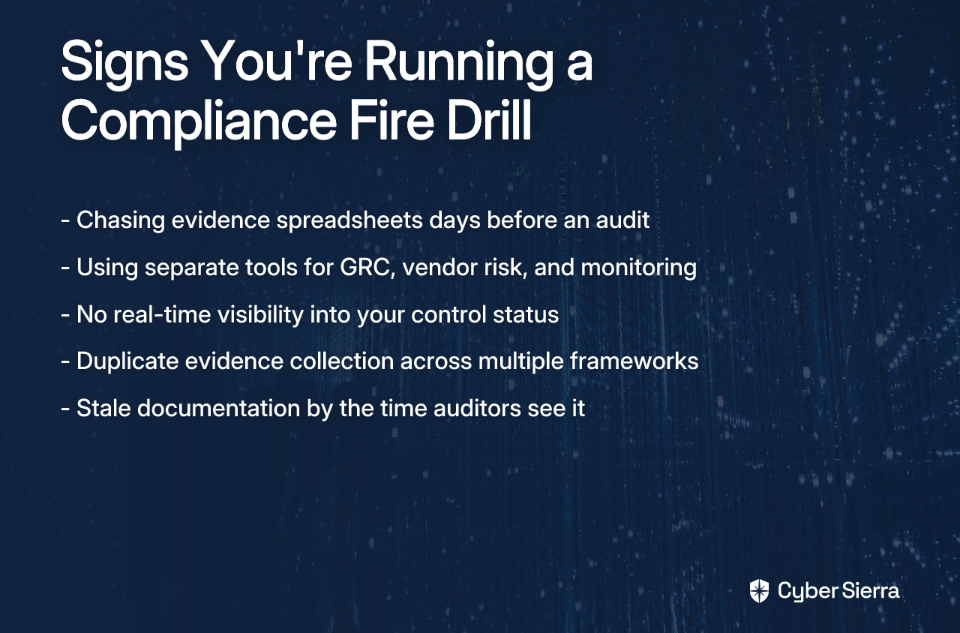
If your team is still chasing spreadsheets and screenshots two weeks before an audit, you're not running a compliance program — you're running a fire drill. The real problem isn't a lack of effort. It's that most organizations are trying to manage overlapping frameworks like SOC 2, ISO 27001, HIPAA, and PCI DSS with tools that were never designed for the job.
A true regulatory compliance system does more than track tasks on a checklist. It automates evidence collection, maps controls across multiple frameworks without duplicating work, and gives Chief Information Security Officers (CISOs), Compliance Managers, and IT Managers a continuous, real-time view of where they stand — not just a snapshot taken six weeks before an audit.
This article evaluates the eight best regulatory compliance systems for 2026 and maps each one to the buyer persona and pain points it's best suited for.
What Defines an Enterprise-Grade Compliance System?
Not all compliance tools are built for enterprise-scale complexity. Before evaluating any platform, it helps to agree on what "enterprise-grade" actually means in practice.
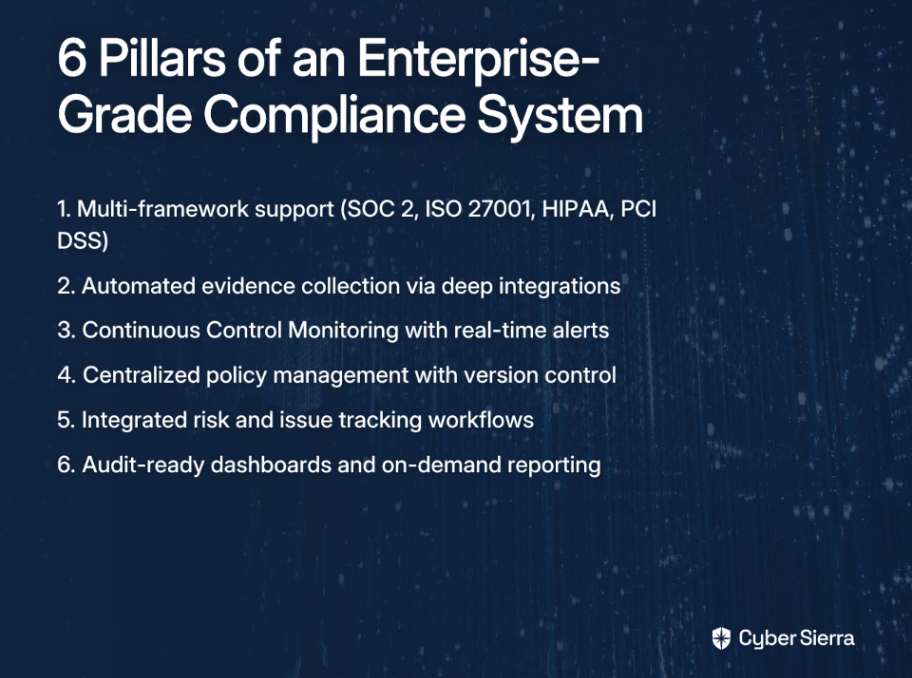
According to Usercentrics' compliance platform guide, the core capabilities that separate serious platforms from glorified task managers include:
- Multi-framework support. The platform must manage and map controls across SOC 2, ISO 27001, HIPAA, PCI DSS, GDPR, and custom frameworks — without requiring duplicate evidence collection for each.
- Automated evidence collection. Deep integrations with your cloud infrastructure, HRIS, and endpoint tooling should gather proof automatically. Manual "screenshot and spreadsheet" cycles waste hundreds of hours per audit cycle and produce stale evidence by the time it reaches an auditor.
- Continuous Control Monitoring (CCM). Real-time or near-real-time alerting on control failures transforms compliance from a periodic "fire drill" into an ongoing state of readiness.
- Centralized policy management. A single source of truth for all policies, procedures, and control documentation — with version control and clear ownership — so auditors aren't met with a scattered mess of shared drives and outdated wikis.
- Risk and issue tracking. Proactive risk identification, assessment, and remediation workflows integrated directly into the compliance workflow.
- Audit-ready reporting. Dashboards that generate board-level summaries and auditor-facing evidence portals on demand — not two weeks of manual assembly.
With those criteria established, here are the eight platforms that meet the bar in 2026.
The 8 Best Regulatory Compliance Systems for Enterprises in 2026
The tools below cover a range of enterprise use cases, from AI-driven continuous monitoring to specialized financial services compliance. Each entry is tagged with the buyer persona it serves best and the frameworks it handles most effectively.
1. Cyber Sierra
Best for: CISOs and Compliance Managers managing multi-framework compliance with AI-driven automation and continuous monitoring. Supported frameworks: SOC 2, ISO 27001, GDPR, HIPAA, PCI DSS, NIST CSF, and custom controls. Deployment: Cloud-based SaaS.
Cyber Sierra is an AI-enabled cybersecurity platform that addresses the two most common enterprise failure modes in compliance: fragmented tooling and reactive, periodic audits. Rather than requiring separate tools for Governance, Risk, and Compliance (GRC), vendor risk, control monitoring, and threat intelligence, Cyber Sierra consolidates all of these into a single platform — giving CISOs a unified view of security posture that most multi-tool environments simply can't provide.
The platform's Continuous Control Monitoring module is its clearest differentiator. Instead of gathering evidence in batches before an audit, CCM automates control testing and validation on an ongoing basis, detecting exceptions and anomalies in near real-time. Compliance Managers who previously spent weeks chasing control owners for attestations can instead manage from a centralized control repository that stays current.
Cyber Sierra was recognized as a Sample Vendor in the Gartner® Hype Cycle™ for Cyber-Risk Management, 2024, and holds accreditation from the Cyber Security Agency of Singapore (CSA) — both indicators of enterprise credibility.
Key features:
- Continuous Control Monitoring (CCM). Automates control testing and validation, provides near real-time alerts on failures, and maintains a centralized control repository across all active frameworks.
- Unified GRC platform. Manages SOC 2, ISO 27001, HIPAA, PCI DSS, GDPR, and custom controls within a single GRC module, generating audit-ready reports and maintaining detailed audit trails.
- Integrated Third-Party Risk Management (TPRM). Automates vendor assessments and provides continuous visibility into supply chain security — moving beyond the point-in-time questionnaire model that leaves vendor risk blind spots unaddressed.
- AI-driven risk intelligence. Maps controls across frameworks automatically and surfaces actionable remediation priorities, reducing the manual coordination overhead that typically falls on Compliance Managers.
2. Vanta
Best for: Compliance Managers in fast-growing SaaS companies with large integration ecosystems. Supported frameworks: SOC 2, ISO 27001, HIPAA, GDPR, and 35+ additional frameworks. Deployment: Cloud-based SaaS.
Vanta built its reputation on deep automation and a library of 400+ integrations that pull evidence directly from your existing tech stack. Customers report a 526% return on investment over three years, making it a well-established option for Compliance Managers who need to achieve SOC 2 Type II or ISO 27001 certification quickly and with minimal manual lift.
Vanta also offers a public-facing Trust Center, questionnaire automation, and a continuous GRC module with real-time risk alerts.
Key features:
- Automated evidence collection. Integrates with hundreds of tools to eliminate manual evidence gathering across audit cycles.
- Vendor risk management. Automates vendor security reviews and onboarding workflows.
- Questionnaire automation. Uses AI to accelerate responses to customer security questionnaires, reducing the burden on security teams.
- Continuous GRC. Integrated risk management with real-time alerts on control drift.
3. OneTrust GRC
Best for: CISOs at large, global enterprises managing privacy, security, and ethics frameworks simultaneously. Supported frameworks: 50+ including SOC 2, ISO 27001, GDPR, and CCPA/CPRA. Deployment: Cloud-based SaaS.
OneTrust operates at a scale suited for organizations where compliance spans privacy law, security certifications, ESG mandates, and ethics programs — often all at once. Its standout capability is a shared evidence framework: evidence collected once is mapped and reused across multiple compliance standards, directly targeting the multi-framework sprawl that makes compliance work feel Sisyphean.
For Compliance Managers dealing with overlapping requirements across GDPR, HIPAA, and SOC 2 simultaneously, this architectural choice alone saves significant rework.
Key features:
- Shared evidence framework. Collect compliance evidence once; apply it across numerous audits and standards automatically.
- Automated GRC workflows. Simplifies assessments, policy lifecycle management, and risk treatment tracking at enterprise scale.
- AI governance tools. Extends compliance capabilities to emerging regulatory areas including AI risk and data ethics.
4. Sprinto
Best for: IT Managers and Compliance Managers at cloud-native companies pursuing SOC 2 or ISO 27001 certification on a compressed timeline. Supported frameworks: SOC 2, ISO 27001, HIPAA, GDPR, PCI DSS, and 20+ more. Deployment: Cloud-based SaaS.
Sprinto is purpose-built for cloud-first environments. Its integrations continuously monitor controls directly within cloud services, flagging misconfigurations and automatically gathering evidence in an auditor-friendly format. For understaffed IT teams that need to reach SOC 2 Type II readiness without adding headcount, Sprinto's automation-first design reduces the compliance workload substantially.
Key features:
- Continuous cloud monitoring. Provides real-time control checks and flags misconfigurations in cloud services automatically.
- Automated evidence collection. Centralizes audit documentation in a structured format designed for auditor access.
- Integrated risk management. Includes built-in risk assessment workflows and remediation tracking.
5. AuditBoard
Best for: Internal Auditors and Compliance Managers who need a unified platform connecting audit, risk, and IT compliance activities. Supported frameworks: Customizable for SOX, NIST, ISO, and other frameworks. Deployment: Cloud-based SaaS.
AuditBoard is strongest at breaking down the organizational silos that develop between internal audit, risk management, and IT compliance teams. Its 200+ integrations power automated evidence collection, while AuditBoard AI handles administrative tasks like generating summaries and drafting reports. For enterprises where audit and compliance functions have historically operated independently, AuditBoard provides the connective tissue.
Key features:
- AuditBoard AI. Automates administrative compliance tasks, generates summaries, and streamlines control testing documentation.
- Connected Risk. Links risk findings across audit, compliance, and IT security for a holistic posture view.
- CrossComply. A dedicated compliance management module that maps controls across multiple frameworks simultaneously.
6. Resolver
Best for: Compliance Managers in highly regulated industries — financial services, energy, utilities — who need real-time regulatory change tracking. Supported frameworks: Customizable for global and industry-specific regulations. Deployment: Cloud-based SaaS.
Resolver's primary differentiator is regulatory change management. The platform delivers AI-summarized alerts on relevant regulatory updates, filtered by geography and business type, while smart control mapping automatically connects new requirements to existing controls.
For compliance teams whose frameworks evolve frequently — particularly those navigating NIS2 or DORA in the EU — Resolver cuts the rework involved in keeping controls current. According to a Forrester study cited by the company, its software can reduce compliance testing time by up to 75%.
Key features:
- Real-time regulatory change management. Delivers AI-summarized alerts on relevant regulatory updates as they happen.
- Smart control mapping. Automatically links new regulatory requirements to existing controls, eliminating redundant rework.
- Automated evidence collection. Streamlines Risk and Control Self-Assessments (RCSAs) and centralizes results.
7. IBM OpenPages
Best for: CISOs at large, complex enterprises managing GRC across multiple business units and geographies. Supported frameworks: Highly customizable to various regulatory and internal frameworks. Deployment: Cloud-based SaaS.
IBM OpenPages is a heavy-duty GRC platform designed for organizations where risk data is fragmented across dozens of business units and dozens of systems. A single data repository aggregates risk information across the entire enterprise hierarchy, while an AI-powered virtual assistant provides real-time support for compliance queries. It's best suited for mature, well-resourced GRC programs that need scalability above all else.
Key features:
- AI-powered virtual assistant. Provides real-time answers for compliance and risk management queries across the enterprise.
- Single data repository. Aggregates risk and compliance data across all business units into a consistent, unified view.
- Advanced reporting. Highly customizable dashboards and executive reporting tailored to complex enterprise stakeholder structures.
8. Fenergo
Best for: Compliance Managers and Risk Officers in financial institutions managing KYC, AML, and client lifecycle regulations. Supported frameworks: Customizable for financial services regulations including AML, KYC, and ESG mandates. Deployment: Cloud-based SaaS.
Fenergo is a specialized platform for Client Lifecycle Management (CLM) in financial services. It automates complex onboarding, due diligence, and offboarding processes using AI agents for document management and data sourcing. For banks and financial institutions navigating stringent KYC and AML requirements, Fenergo reduces the operational overhead while maintaining the audit trail regulators demand.
Key features:
- Client Lifecycle Management. Automates the complete client journey from onboarding through offboarding with compliance controls embedded throughout.
- Regulatory workflows. Pre-built and customizable workflows for KYC, AML, ESG, and investor protection requirements.
- AI-powered automation. Uses AI for document management, data extraction, and risk scoring at the client level.
Decision Matrix: Matching the Right System to Your Pain Points
The right regulatory compliance system depends less on feature lists and more on which pain points are costing your team the most time. Use this matrix to match your biggest frustrations to the platforms built to address them.
| Pain Point | Required Feature | Top Systems |
|---|---|---|
| Audit fatigue and manual evidence collection | Automated evidence collection, unified auditor portal | Cyber Sierra, Vanta, AuditBoard |
| Multi-framework sprawl (duplicated effort across SOC 2, ISO 27001, HIPAA, PCI DSS) | Control mapping, shared evidence framework | Cyber Sierra, OneTrust, Resolver |
| Reactive "fire drill" audits (last-minute scrambles, stale evidence) | Continuous Control Monitoring, real-time alerts | Cyber Sierra, Sprinto |
| Vendor risk blind spots (outdated questionnaires, unknown supply chain exposure) | Integrated Third-Party Risk Management | Cyber Sierra, Vanta |
| Regulatory change confusion (struggling to track new laws and requirements) | Real-time regulatory intelligence feeds | Resolver, OneTrust |
| Siloed risk and compliance data (no unified view of security posture) | Unified GRC platform, centralized reporting | Cyber Sierra, IBM OpenPages, AuditBoard |
| Financial services KYC/AML complexity | Client lifecycle management, regulatory workflows | Fenergo |
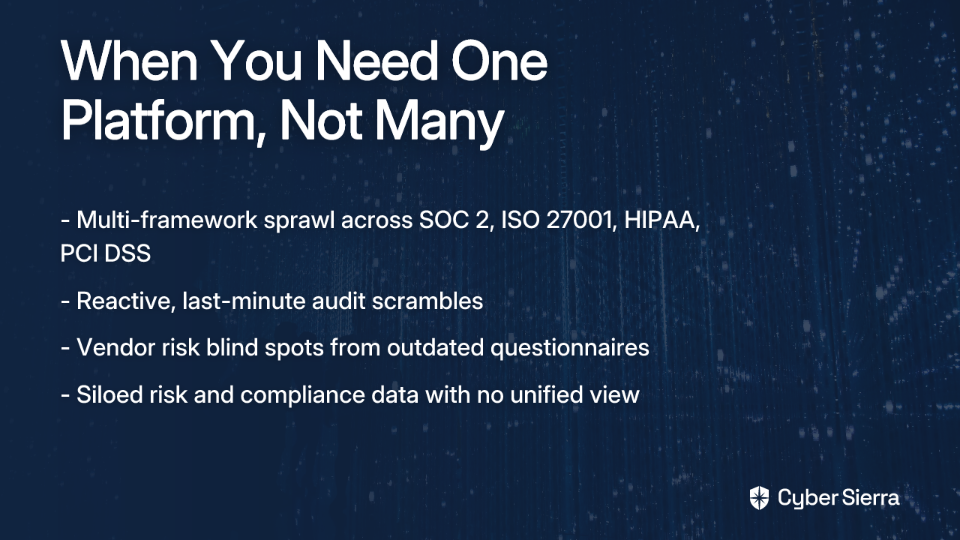
If several rows in this table resonate simultaneously — especially the combination of multi-framework sprawl, reactive audits, and vendor blind spots — that's a strong signal you need a platform with depth across GRC, CCM, and TPRM, not separate point solutions bolted together.
Make This Your Last Compliance Fire Drill
If your audit prep feels like a recurring fire drill, the problem isn't your team—it's the toolset. Relying on spreadsheets and manual evidence collection for complex frameworks like SOC 2 and ISO 27001 will always lead to last-minute scrambles and stale documentation.
The shift from periodic audit prep to a state of continuous compliance rests on two practical takeaways:
- Automate your evidence: Continuous Control Monitoring (CCM) provides a real-time, accurate view of your security posture, so you're always prepared.
- Unify your frameworks: Managing GRC and Third-Party Risk Management (TPRM) in one system stops the duplicate work that burns out your team.
Your next step today? Identify the single biggest time-sink from your last audit cycle. Was it chasing down proof for a specific control? Pinpointing that bottleneck is the first move toward eliminating it for good.
When you're ready to swap manual chaos for automated control, book a Cyber Sierra demo. We help you turn audit season into just another month on the calendar.
Frequently Asked Questions
What is a regulatory compliance system?
A regulatory compliance system is a platform that automates and centralizes the management of security frameworks like SOC 2 and ISO 27001. It automates evidence collection, maps controls across frameworks, and provides real-time visibility into your compliance posture, replacing manual spreadsheets.
Why is automated evidence collection important for compliance?
Automated evidence collection is crucial because it eliminates manual, error-prone tasks and ensures evidence is always current. It saves hundreds of hours per audit cycle by integrating with your tech stack to gather proof, preventing the "fire drills" caused by chasing stale screenshots.
What is Continuous Control Monitoring (CCM)?
Continuous Control Monitoring (CCM) is the process of automatically testing and validating security controls in near real-time. Instead of checking controls only before an audit, CCM provides ongoing alerts on failures, transforming compliance from a periodic event into a continuous state of readiness.
How does a compliance system handle multiple frameworks like SOC 2 and ISO 27001?
An effective compliance system handles multiple frameworks by mapping overlapping controls and using a shared evidence framework. This means you collect evidence for a control once, and the platform automatically applies it to all relevant frameworks, saving significant time and eliminating duplicate work.
How do I choose the right compliance system for my company?
Choose the right compliance system by matching its core features to your primary pain points. If you struggle with manual evidence collection, prioritize automation. For multi-framework sprawl, seek strong control mapping. For last-minute audit scrambles, focus on Continuous Control Monitoring capabilities.
What is the main difference between a GRC tool and a spreadsheet?
The main difference is automation and real-time visibility. A GRC tool automates compliance tasks, while a spreadsheet is a static, manual document. GRC platforms provide continuous monitoring and integrated risk management, creating a single source of truth that is always audit-ready.
