



Top 10 Tools for Continuous Vendor Risk Scoring in 2025

Join thousands of professionals and get the latest insight on Compliance & Cybersecurity.
You've set up a sophisticated third-party risk management program with all the right assessments and questionnaires. But when a critical supplier suffers a breach that impacts your operations, you discover they had claimed robust security controls in their assessment just three months ago. Even worse, your TPRM tool gave them a high security rating.
Sound familiar? You're not alone. With 74% of healthcare breaches involving third-party vendors and similar statistics across industries, the stakes for effective vendor risk management have never been higher.
Beyond Static Scores: The Evolution of Vendor Risk Management
The problem with traditional vendor risk scoring? As one security professional bluntly put it on Reddit: "Risk scores are crap and ineffective... they can't even tell you anything meaningful." Many tools excel at "observing the problem" but fail to "instigate change" or lead to actual risk reduction.
In 2025, the leading tools have evolved beyond point-in-time assessments and superficial scores. They offer continuous validation, actionable intelligence, and remediation tracking that drive genuine risk reduction.
What Makes a Great Vendor Risk Scoring Tool in 2025?
Before diving into our top 10 list, let's establish what capabilities separate the leaders from the laggards:
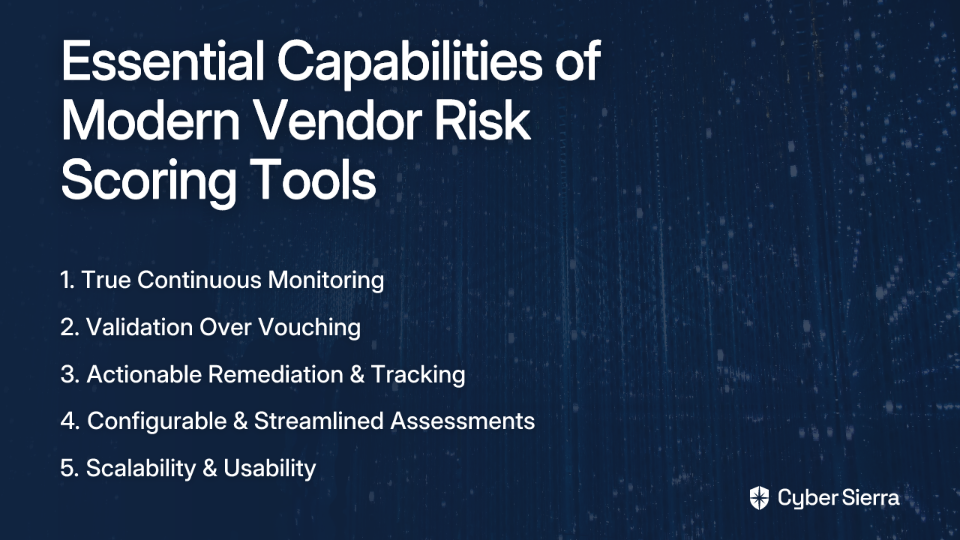
1. True Continuous Monitoring
It's not enough to conduct annual assessments anymore. Top tools provide near real-time tracking of vendor security postures, including automated alerts on document expiries and security incidents.
2. Validation Over Vouching
The most effective platforms don't blindly accept questionnaire responses. They help "validate technical claims against real-world data where possible," as one TPRM practitioner recommended, correlating assessments with outside-in scanning.
3. Actionable Remediation & Tracking
A major user pain is that tools "do not do a good job at repeat findings that have been remediated." Look for features like Corrective Actions and Preventive Actions (CAPA) workflows to efficiently manage compliance issues.
4. Configurable & Streamlined Assessments
Many users complain about "overly complex questionnaires" like the SIG by SharedAssessments. The best tools offer customizable assessments and AI assistance for faster completion.
5. Scalability & Usability
Your tool should handle your entire supplier base, whether it's 10 or 10,000 vendors, without requiring excessive resources to manage.
The Top 10 Tools for Continuous Vendor Risk Scoring in 2025
Note: This list is presented in no particular order and reflects the evolving landscape of vendor risk management solutions.
1. UpGuard
Core Features: Comprehensive vendor scanning, automated assessments, integrated remediation tracking, regulatory compliance mapping (HIPAA, SOC 2, GDPR).
Ideal Users: Security and GRC teams in mid-to-large organizations needing robust validation capabilities.
Why It Stands Out: UpGuard delivers instant vendor security risk insights and streamlines the remediation process with its intuitive dashboard. Users particularly value its ability to correlate questionnaire responses with technical scanning results to validate vendor claims.
2. SecurityScorecard
Core Features: A-F security grades, dark web threat monitoring, customizable questionnaires, breach notification alerts.
Ideal Users: Tech-forward enterprises needing clear, easy-to-understand vendor ratings that can be shared with non-technical stakeholders.
Why It Stands Out: Strong visualization capabilities and continuous monitoring make SecurityScorecard popular for its ability to provide an outside-in view of vendor security postures without requiring vendor participation.
3. BitSight
Core Features: Daily security ratings, malware intelligence, financial risk quantification, compromised systems detection.
Ideal Users: Enterprises using data-driven KPIs for risk management across large vendor ecosystems.
Why It Stands Out: BitSight excels at providing external cyber risk ratings and has developed sophisticated algorithms to enhance TPRM with outside-in telemetry that helps prioritize vendor risks based on potential business impact.
4. OneTrust
Core Features: Customizable questionnaires, robust mapping to privacy regulations, workflow automation, vendor exchange network.
Ideal Users: Organizations with complex regulatory requirements, particularly around privacy (GDPR, CCPA).
Why It Stands Out: Despite mixed reviews on its overall TPRM capabilities, OneTrust's questionnaire function is considered its strongest feature, with excellent privacy management integration.
5. Prevalent
Core Features: Risk assessments, dark web intelligence, content libraries, unified risk register, inherent risk calculators.
Ideal Users: Organizations preferring a hybrid approach to VRM that combines assessments with continuous monitoring.
Why It Stands Out: Prevalent offers a strong platform that balances traditional assessments with modern continuous monitoring capabilities, making it suitable for organizations transitioning to more mature TPRM processes.
6. Panorays
Core Features: Proprietary "Risk DNA" for custom assessments, AI for faster questionnaire completion, external posture checks, automated validation.
Ideal Users: Businesses focused on detailed, automated risk management with limited resources for manual verification.
Why It Stands Out: Panorays is gaining traction for its ability to automate both security questionnaires and external attack surface checks, addressing the common pain point of verifying vendor claims against observable security practices.
7. RiskRecon (a Mastercard Company)
Core Features: Real-time monitoring of vendor vulnerabilities, tracking across 11 security domains, risk prioritization algorithms.
Ideal Users: Enterprises seeking deep insights into the external security posture of their partners without requiring vendor participation.
Why It Stands Out: RiskRecon focuses heavily on external cyber scanning and risk analytics for third parties, making it particularly valuable for organizations dealing with vendors resistant to completing assessments.
8. ProcessUnity
Core Features: Streamlined due diligence, predictive risk insights, configurable workflows, vendor tiering.
Ideal Users: Businesses wanting to improve efficiency in vendor lifecycle processes from onboarding through ongoing monitoring.
Why It Stands Out: ProcessUnity has developed mature workflows for managing third-party risk assessments and orchestration, with particular strength in automation that reduces manual effort.
9. Kodiak Hub
Core Features: Combined vendor risk, supplier performance, and quality management platform with risk-tiered onboarding and CAPA workflows.
Ideal Users: Organizations seeking a single platform for holistic supplier relationship management that goes beyond security to include performance metrics.
Why It Stands Out: Kodiak Hub stands out by integrating risk with performance and quality management, offering a broader view of supplier relationships that resonates with procurement teams seeking a more complete picture.
10. Censinet (Healthcare Focus)
Core Features: Censinet RiskOps™ cloud-based platform with shared intelligence, Digital Risk Catalog™, breach alerts, and automated reassessments specifically designed for healthcare organizations.
Ideal Users: Healthcare organizations needing to ensure HIPAA compliance across their vendor ecosystem.
Why It Stands Out: Purpose-built for the healthcare ecosystem, Censinet streamlines assessments and compliance with regulations like HIPAA, addressing the unique challenges faced by healthcare providers managing sensitive patient data across complex vendor relationships.
Beyond Scoring: Integrating TPRM into a Unified GRC Strategy
While the tools above excel at vendor risk assessment and scoring, true risk management maturity comes from integrating vendor risk into your broader Governance, Risk, and Compliance (GRC) program. A standalone tool can still leave you with data silos and disconnected processes.
The Problem with Siloed Vendor Risk Management
Vendor risk doesn't exist in a vacuum. A vendor's poor security can directly impact your own compliance with frameworks like SOC 2 or ISO 27001. When these connections aren't visible, you're left with blind spots in your risk management program.
As organizations mature, many are moving toward integrated platforms that connect vendor risk with internal controls, compliance requirements, and threat intelligence.
Integrated Platforms: A More Holistic Approach
This is where platforms like Cyber Sierra are changing the landscape. Its Third-Party Risk Management (TPRM) module provides the core functionality discussed earlier, while addressing the integration challenge:
- Near real-time visibility into vendors' security compliance
- Risk-based prioritization of your vendor inventory
- Streamlined onboarding and offboarding processes that reduce manual effort
- Automated assessments that validate vendor claims
What sets integrated platforms apart is how they connect vendor risk to your broader security and compliance program. For example, Cyber Sierra's TPRM module works in concert with its Continuous Control Monitoring (CCM) capabilities to link vendor risks directly to your internal controls. This means you can see exactly how a vendor's vulnerability impacts your own compliance posture and audit readiness.
Similarly, when connected to a GRC Automation module, this integrated data streamlines audits for frameworks like SOC 2, ISO 27001, and HIPAA, reducing audit fatigue and manual evidence gathering—a common pain point for security teams.
Making the Right Choice for Actionable Risk Reduction
The paradigm for vendor risk management is shifting. In 2025, it's not enough to just collect scores or run annual assessments. The focus must be on continuous validation, actionable insights, and efficient remediation that actually reduces risk.
As you evaluate tools for your organization, consider:
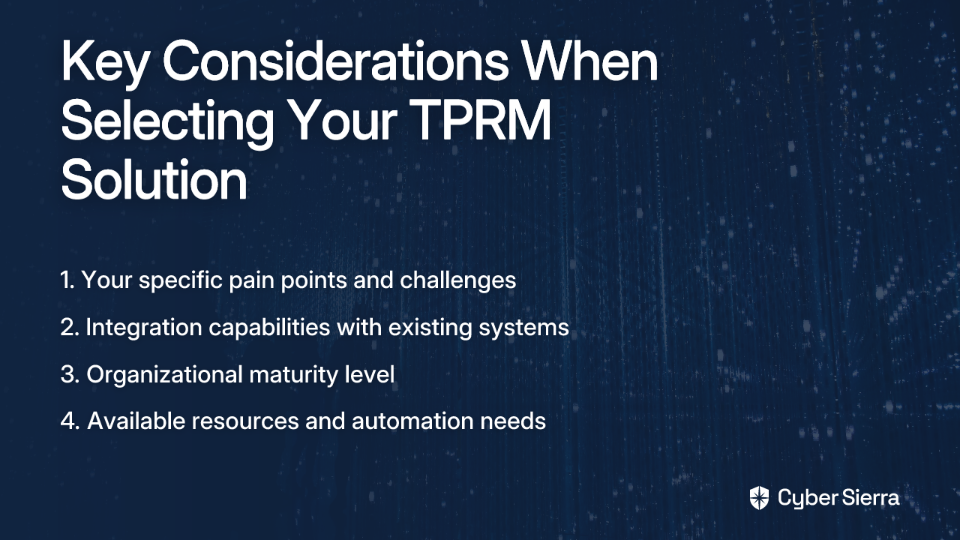
- Your specific pain points: Are you struggling with validating vendor claims? Managing remediation workflows? Scaling your program across thousands of vendors? Choose a tool that directly addresses your biggest challenges.
- Integration capabilities: Will the tool connect with your existing security and GRC systems, or create yet another silo?
- Maturity level: Does your organization need a point solution for TPRM, or are you ready for an integrated platform that connects vendor risk with internal compliance and controls?
- Resource constraints: Many TPRM programs fail due to lack of resources. Tools with automation, AI assistance, and managed services can help overcome this hurdle.
By choosing the right vendor risk scoring tool—one that moves beyond observation to enable actual risk reduction—you can build a more resilient and secure supply chain through intelligent, proactive vendor risk management.
Remember, the most sophisticated risk score is worthless if it doesn't drive meaningful action to reduce risk. In 2025, the best tools are those that help you not just measure risk, but actually manage it.
Frequently Asked Questions
What is continuous vendor risk scoring?
Continuous vendor risk scoring is an ongoing process of monitoring and assessing a vendor's security posture in near real-time, rather than relying on a single, point-in-time assessment. This approach uses automated tools to track various security indicators, such as vulnerability scans, dark web mentions, and compliance document expiry. It provides a dynamic and current view of vendor risk, allowing organizations to respond quickly to emerging threats instead of waiting for an annual review.
Why are traditional vendor risk scores often ineffective?
Traditional vendor risk scores are often considered ineffective because they are based on static, point-in-time assessments that can quickly become outdated. These scores rely heavily on self-reported questionnaires, which may not accurately reflect a vendor's actual security practices. Without continuous monitoring and external validation, these static scores fail to capture emerging vulnerabilities or changes in a vendor's security posture, creating a false sense of security.
How can I validate a vendor's security claims?
You can validate a vendor's security claims by using tools that correlate their questionnaire responses with real-world, externally observable data. This "trust but verify" approach involves using outside-in scanning technologies that check for vulnerabilities, misconfigurations, and other security issues on a vendor's external-facing systems. Modern TPRM platforms automate this process, comparing assessment answers against technical evidence to provide a more accurate risk profile.
What is the difference between a TPRM tool and an integrated GRC platform?
A standalone Third-Party Risk Management (TPRM) tool focuses specifically on managing vendor risk, while an integrated Governance, Risk, and Compliance (GRC) platform connects that risk to your organization's broader internal controls and compliance programs. While a TPRM tool is excellent for assessing and monitoring vendors, an integrated GRC platform provides a more holistic view. It allows you to see how a vendor's risk directly impacts your own compliance with frameworks like SOC 2 or ISO 27001, streamlining auditing and overall risk management.
How do I choose the right vendor risk management tool?
To choose the right vendor risk management tool, start by identifying your organization's specific pain points, maturity level, and integration needs. Evaluate tools based on their ability to provide continuous monitoring, validate vendor claims, and offer actionable remediation workflows. Consider whether you need a specialized point solution or an integrated platform that connects with your broader GRC strategy. Finally, assess the tool's scalability and usability to ensure it can handle your vendor ecosystem without overwhelming your team.
What are Corrective Actions and Preventive Actions (CAPA) in vendor risk management?
CAPA (Corrective Actions and Preventive Actions) is a structured workflow used to identify, address, and prevent the recurrence of issues, such as security findings or compliance gaps, identified during a vendor assessment. A corrective action addresses an existing problem (e.g., patching a vulnerability), while a preventive action aims to stop a potential problem from occurring. TPRM tools with CAPA features help you track remediation efforts to ensure vendors not only fix current issues but also improve their processes to prevent future ones.
This article provides an overview of vendor risk scoring tools but is not an exhaustive evaluation. Organizations should conduct their own assessments based on their specific requirements and risk profiles. The landscape of vendor risk management tools continues to evolve rapidly, and capabilities may change over time.
