



Beyond Excuses: Confronting Skill Shortages and Knowledge Gaps in GRC Cybersecurity



Join thousands of professionals and get the latest insight on Compliance & Cybersecurity.
You're a CISO staring at yet another alarming report on your desk. The global cybersecurity workforce gap has expanded to 4.8 million professionals—a staggering 19% increase from last year. Meanwhile, your team is stretched thin, struggling to keep pace with evolving compliance requirements and mounting security threats.
Sound familiar? You're not alone.
In boardrooms across industries, skill shortages and knowledge gaps in Governance, Risk, and Compliance (GRC) cybersecurity have become the standard explanation for security lapses and compliance failures. But in today's high-stakes environment, where the average data breach costs $4.88 million, these challenges can no longer serve as acceptable excuses for inaction.
The Reality of Cybersecurity Talent Scarcity
The statistics paint a sobering picture. According to the ISC2 Cybersecurity Workforce Study 2023, the global active cybersecurity workforce stands at 5.5 million professionals, while the actual need is closer to 10.2 million—leaving a gaping hole of 4.8 million unfilled positions.
This shortage is particularly acute in specialized areas like GRC, where professionals need a unique blend of technical knowledge, regulatory expertise, and business acumen. As one industry professional noted in a recent forum: "Finding people interested in learning regulatory requirements, having the soft skills for the job, and handling the definite boredom that can happen is not easy."
The impact of these shortages is far-reaching:
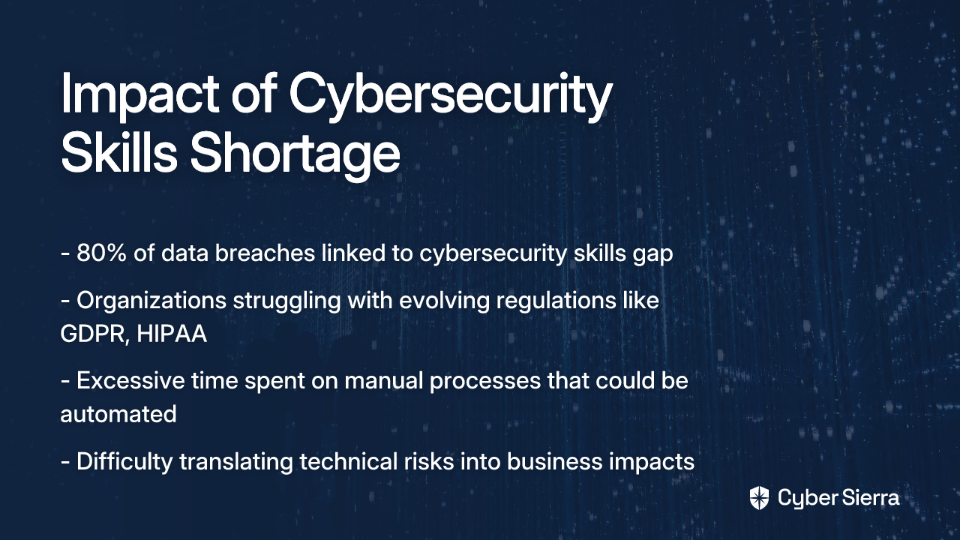
- Increased security vulnerabilities: 80% of data breaches can be directly attributed to the cybersecurity skills gap
- Compliance lapses: Organizations scramble to keep up with evolving regulations like GDPR, HIPAA, and SEC disclosure rules
- Operational inefficiencies: Security teams spend excessive time on manual processes that could be automated
- Strategic blindspots: Without proper expertise, organizations struggle to translate technical risks into business impacts
But here's the hard truth: While the talent shortage is real, it's no longer a valid excuse for security and compliance failures. Forward-thinking organizations are finding innovative ways to overcome these challenges.
Why Skills Shortages and Knowledge Gaps Are Not Valid Excuses
Despite the undeniable challenges, organizations can no longer hide behind talent shortages to justify inadequate security postures. Here's why:
1. Technology Has Evolved to Bridge the Gap
Today's GRC solutions leverage automation and artificial intelligence to perform tasks that once required specialized human expertise. These technologies can:
- Automate compliance workflows: Reducing the manual burden of documentation, evidence collection, and reporting
- Continuously monitor controls: Providing real-time visibility into security posture without constant human intervention
- Generate actionable insights: Helping teams prioritize remediation efforts based on risk impact and likelihood
- Streamline audits: Reducing preparation time and stress on limited resources
As noted in the State of GRC 2025 report, 96% of companies attribute their increased focus on GRC to high-profile breaches, with emerging technologies becoming critical to addressing talent gaps.
2. External Expertise Is More Accessible Than Ever
The rise of specialized security service providers has democratized access to GRC expertise:
- Managed security service providers (MSSPs): Offer economies of scale and specialized knowledge
- Virtual CISOs: Provide strategic guidance without the cost of a full-time executive
- GRC consultants: Help implement frameworks and prepare for audits
- Security awareness training platforms: Upskill existing staff to recognize and respond to threats
3. Regulators and Customers Are Unforgiving
Most importantly, neither regulators nor customers accept staffing challenges as justification for security lapses:
- Regulatory penalties continue to increase: GDPR violations can cost up to 4% of global annual revenue
- Board liability is growing: Directors face personal liability for cybersecurity oversight failures
- Customer trust, once lost, is difficult to regain: 60% of small businesses close within six months of a cyberattack
The Real Issue: Strategic Prioritization
Beneath the surface, what appears as a skills shortage often reveals a more fundamental problem: strategic misalignment.
As one industry forum participant bluntly stated: "There's definitely a shortage in the sense that most companies don't have enough qualified cybersecurity staff, but the problem is that they aren't willing to hire to make up for the gap." Another added, "They think they can get by with less, and as long as they don't get breached and/or cybersecurity insurance will pay, they're fine taking the risk of running skeleton crews."
This mindset reflects a deeper issue—treating cybersecurity as a cost center rather than a business enabler. Organizations that view security investments this way inevitably understaff and underfund their security programs, creating a self-fulfilling prophecy of inadequate protection.

How Cyber Sierra's Platform Addresses the Skills and Knowledge Gap
In this challenging landscape, Cyber Sierra's GRC platform emerges as a comprehensive solution specifically designed to address the skills and knowledge gaps that plague cybersecurity teams. By leveraging cutting-edge technology and intelligent automation, Cyber Sierra enables organizations to maintain robust security postures despite talent shortages.
AI-Enabled Automation: Multiplying Your Team's Capabilities
Cyber Sierra's platform features sophisticated AI that automates time-consuming GRC processes, effectively extending your team's capabilities without additional headcount:
- Automated Data Collection & Risk Assessments: The platform automatically gathers evidence across your technology stack, eliminating manual collection processes that typically consume 40-60% of compliance efforts
- Continuous Control Monitoring: Rather than point-in-time assessments, Cyber Sierra provides real-time visibility into control effectiveness, alerting teams only when intervention is needed
- Multi-Framework Management: The system maps controls across multiple regulatory frameworks (SOC2, GDPR, HIPAA, etc.), allowing teams to achieve compliance with various standards simultaneously without duplicative efforts
Bridging Knowledge Gaps Through Guided Workflows
Even with limited GRC expertise, teams can successfully navigate complex compliance requirements through Cyber Sierra's guided workflows:
- Contextual Guidance: Built-in explanations and best practices help teams understand the "why" behind compliance requirements
- Templated Policies and Procedures: Pre-configured templates based on industry best practices eliminate the need to create documentation from scratch
- Risk-Based Prioritization: AI-powered analytics help identify and prioritize the most critical risks, ensuring teams focus their limited resources where they matter most
Transforming Raw Data into Actionable Intelligence
Cyber Sierra doesn't just collect data—it transforms it into actionable intelligence that enables informed decision-making:
- Executive Dashboards: Translate technical compliance metrics into business-relevant insights for leadership
- Trend Analysis: Identify patterns and emerging risks before they become critical issues
- Benchmarking: Compare your organization's security posture against industry peers to identify improvement opportunities
Real-World Impact
Organizations using Cyber Sierra have reported significant operational improvements:
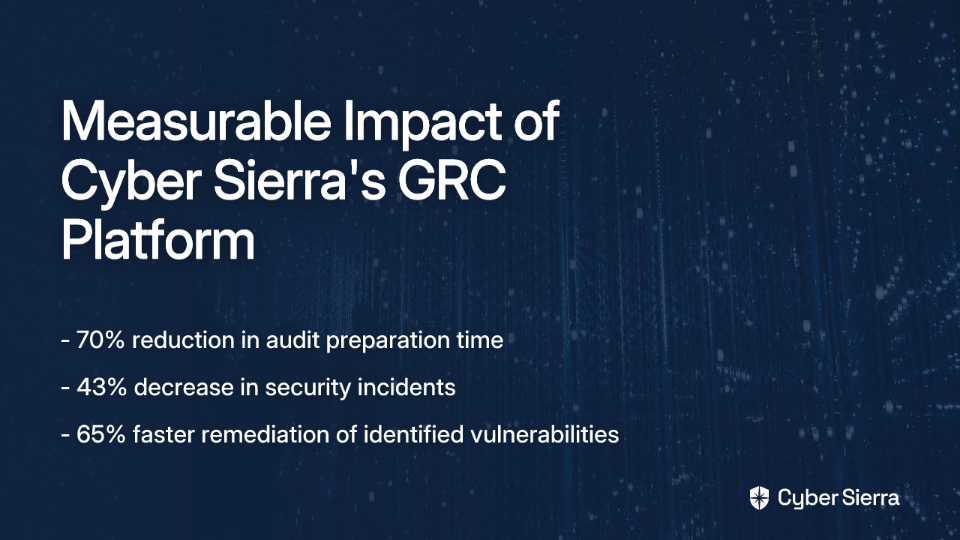
- 70% reduction in time spent preparing for audits
- 43% decrease in the number of security incidents due to improved visibility and proactive risk management
- 65% improvement in time-to-remediation for identified vulnerabilities
Taking Action: Beyond Excuses to Solutions
While skill shortages and knowledge gaps in GRC cybersecurity are legitimate challenges, they cannot become permanent excuses for inadequate security and compliance. Here's how forward-thinking CISOs can take action:
- Conduct an honest assessment of your current GRC capabilities, identifying specific knowledge gaps and process inefficiencies
- Explore technology solutions like Cyber Sierra that can automate routine tasks and provide guided workflows for less experienced staff
- Invest in targeted training for existing team members to upskill them in critical GRC competencies
- Foster a culture of shared responsibility for security and compliance across the organization
- Partner with specialized service providers to supplement internal capabilities where needed
Conclusion: From Challenge to Opportunity
The cybersecurity skills shortage isn't disappearing anytime soon. But with platforms like Cyber Sierra, organizations can transform this challenge into an opportunity to build more efficient, effective security programs.
By leveraging intelligent automation, guided workflows, and actionable analytics, CISOs can ensure their organizations maintain robust security postures and regulatory compliance—regardless of staffing constraints. In doing so, they not only protect their organizations from threats but also position security as a strategic business enabler rather than a cost center.
The question is no longer whether you have enough security experts on staff, but whether you're leveraging the right tools and approaches to maximize the effectiveness of your existing team.
Frequently Asked Questions
What is the GRC cybersecurity skills gap?
The GRC cybersecurity skills gap refers to the significant shortfall of qualified professionals needed to manage Governance, Risk, and Compliance in the cybersecurity sector. The ISC2 Cybersecurity Workforce Study 2023 highlights a global deficit of 4.8 million professionals. This shortage is especially pronounced in GRC, which requires a unique mix of technical, regulatory, and business knowledge, leading to increased security vulnerabilities and compliance issues.
Why is the cybersecurity skills shortage no longer a valid excuse for security failures?
The cybersecurity skills shortage is no longer a valid excuse because organizations now have multiple avenues to mitigate this challenge. Firstly, advanced GRC technologies leverage automation and AI to handle tasks previously requiring specialized human expertise. Secondly, external expertise through MSSPs, virtual CISOs, and GRC consultants is more accessible than ever. Lastly, regulators and customers have increasingly high expectations and are unforgiving of security lapses, regardless of staffing issues.
How can technology help bridge the GRC skills gap?
Technology, particularly AI-enabled GRC platforms, can significantly help bridge the GRC skills gap by automating and simplifying complex processes. These platforms can automate compliance workflows, continuously monitor security controls in real-time, generate actionable insights for risk prioritization, and streamline audit preparations. This allows smaller teams or those with less specialized GRC knowledge to manage compliance effectively, essentially multiplying their capabilities.
What is the real underlying issue often misidentified as a skills shortage in cybersecurity?
The real underlying issue often misidentified as a skills shortage is a lack of strategic prioritization and investment in cybersecurity by organizations. Many companies are unwilling to hire adequate cybersecurity staff or invest in necessary tools, viewing cybersecurity as a cost center rather than a critical business enabler. This mindset leads to understaffed and underfunded security programs, creating a self-inflicted vulnerability.
How does a GRC platform like Cyber Sierra address GRC challenges for teams with limited staff?
A GRC platform like Cyber Sierra addresses challenges for teams with limited staff by leveraging AI-enabled automation, guided workflows, and actionable intelligence. It automates time-consuming tasks like data collection and risk assessments, provides continuous control monitoring, and helps manage multiple compliance frameworks efficiently. Guided workflows and contextual guidance assist less experienced staff, while executive dashboards translate technical data into business-relevant insights, enabling even constrained teams to maintain robust security and compliance.
What practical steps can CISOs take to address GRC skill shortages?
CISOs can take several practical steps to address GRC skill shortages within their organizations. These include:
- Conducting an honest assessment of current GRC capabilities to identify specific gaps.
- Exploring and implementing technology solutions, like GRC platforms, to automate tasks and guide staff.
- Investing in targeted training to upskill existing team members in critical GRC areas.
- Fostering a culture where security and compliance are shared responsibilities across the organization.
- Partnering with specialized external service providers to supplement internal capabilities where necessary.

Ready to move beyond excuses and embrace solutions? Learn more about how Cyber Sierra's GRC platform can help your organization overcome skill shortages and knowledge gaps in GRC cybersecurity.
