



Energy Sector Cybersecurity: Building a Defense-in-Depth Strategy for 2026


Join thousands of professionals and get the latest insight on Compliance & Cybersecurity.
Summary
- The energy sector is a prime target, with ransomware attacks up 80% and 45% of intrusions originating from third-party vendors.
- Adopting a "Defense-in-Depth" strategy is crucial, involving multiple layers of security to protect converging IT and OT environments from sophisticated threats.
- The essential first step is establishing continuous, automated monitoring to replace outdated periodic checks and gain real-time visibility into your security posture.
- Unify these defensive layers with an automated platform like Cyber Sierra's GRC solution to streamline compliance, automate monitoring, and gain a holistic view of your security posture.
You've implemented the latest regulatory standards, employed advanced security tools, and trained your team on best practices. Yet, the question keeps you up at night: "Is it enough to protect our critical infrastructure from increasingly sophisticated attacks?"
With ransomware attacks targeting the energy sector surging by 80% in 2024 and 67% of energy organizations reporting attacks in the last year, the threat landscape is evolving faster than traditional security approaches can adapt. As we approach 2026, the stakes couldn't be higher.
This guide provides a clear roadmap for building a comprehensive, multi-layered security strategy that goes beyond compliance checkboxes to establish true cyber resilience for your energy infrastructure.
The 2026 Threat Landscape: Why Energy is a Prime Target
The energy sector sits at a precarious intersection: it's both essential to national security and increasingly vulnerable as systems become more interconnected. Understanding the threat landscape is the first step in building an effective defense.
Nation-State Actors: The Geopolitical Battlefield
Geopolitical tensions have transformed critical infrastructure into a prime target for nation-state actors. Groups like Russia's APT28, China's APT41, and North Korea's Lazarus Group specifically target energy facilities with sophisticated, persistent campaigns designed to establish long-term access or cause disruption.
These aren't opportunistic attacks—they're strategic operations with significant resources and expertise behind them.
Hacktivists and Ideological Actors
Pro-Russian hacktivist groups like Z-Pentest and S16 have demonstrated capabilities to target industrial control systems in countries supporting Ukraine. These ideologically motivated actors often launch disruptive attacks against energy infrastructure to make political statements.
Ransomware: The Persistent Threat
Criminal enterprises operating ransomware-as-a-service models have increasingly focused on energy targets, recognizing that operational disruption creates maximum pressure to pay. Groups like RansomHub and DragonForce specifically target organizations with critical uptime requirements.
The OT/IT Convergence Risk
The traditional air gap between Information Technology (IT) and Operational Technology (OT) networks has eroded as energy companies embrace digital transformation. While this convergence delivers operational benefits, it also creates new attack vectors:
- Legacy OT systems were never designed with cybersecurity in mind
- Many use obsolete protocols lacking authentication or encryption
- Updating or patching these systems often requires downtime, leading to security debt
The Supply Chain Vulnerability
Perhaps most concerning is the supply chain risk, with 45% of malicious intrusions in the energy sector originating from third-party breaches. Your security is only as strong as your weakest vendor, and the energy sector relies on extensive supplier networks.

Decoding Defense-in-Depth: More Than Just Layered Security
To address these evolving threats, energy organizations need a comprehensive security strategy that goes beyond point solutions. This is where the Defense-in-Depth approach becomes essential.
Defense-in-Depth is defined as "a strategy employing multiple security measures to protect an organization's assets. It acts as a backup when one line of defense is compromised." (Fortinet)
Think of it like the security for a physical power plant:
- Outer perimeter fencing and cameras (physical controls)
- Badge access and security guards (administrative controls)
- Reinforced doors with biometric access (technical controls)
- Motion sensors inside critical areas (monitoring)
- Response teams ready to act (incident response)
If any single layer fails, the others remain to protect your assets. This contrasts with traditional "layered security," which might involve deploying multiple technologies of the same type (like having several antivirus solutions).
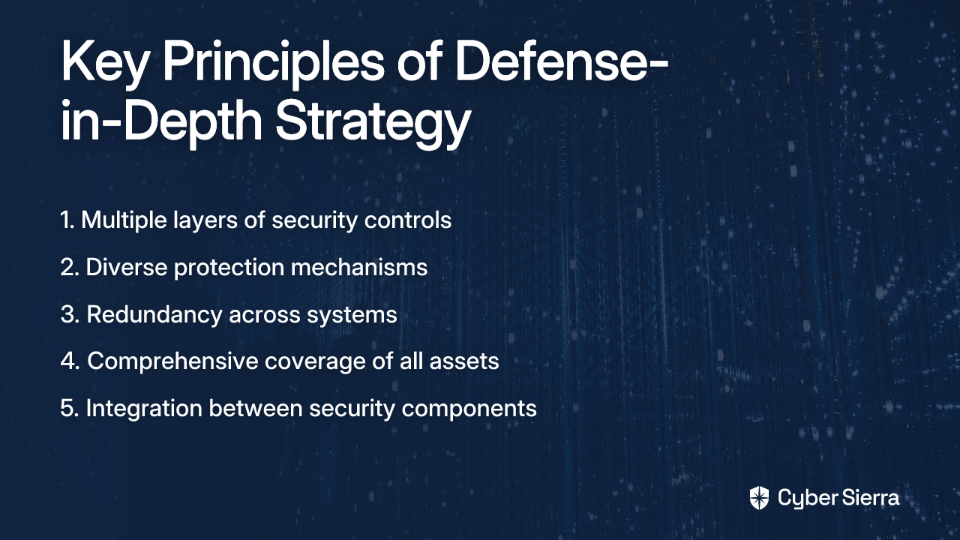
The true power of Defense-in-Depth lies in its comprehensive nature—creating redundancy through diverse protection mechanisms that address different types of threats across your entire technology ecosystem.
The 5 Essential Layers of a Resilient Energy Cybersecurity Strategy
1. Foundational Layer: Establish Continuous, Automated Monitoring
The Challenge: In today's fast-evolving threat landscape, periodic security assessments and manual checks create dangerous blind spots. You can't defend what you can't see.
The Solution: Continuous Security Monitoring (CSM) provides automated, real-time surveillance of your entire infrastructure—both IT and OT.
Cyber Sierra's Continuous Control Monitoring (CCM) platform establishes this critical foundation by:
- Building a central controls repository with near real-time updates
- Providing clear visibility into your security posture with automated exception detection
- Delivering actionable risk intelligence for data-driven remediation
- Managing controls across multiple frameworks (
NIST,ISO 27001,NERC CIP) from a unified dashboard
By moving from periodic assessments to continuous monitoring, you gain the real-time visibility necessary to identify emerging threats before they impact your operations.
2. Perimeter & Internal Defense Layer: Secure Your Network and Endpoints
The Challenge: Energy organizations manage complex networks spanning both IT and OT environments, often with thousands of endpoints and industrial control systems.
The Strategy: Implement robust network segmentation, vulnerability management, and threat intelligence.
Key implementation steps include:
- Adopting the PURDUE MODEL FRAMEWORK for industrial control systems to create logical security zones
- Establishing strict access controls between IT and OT networks
- Continuously scanning for vulnerabilities across your attack surface
- Deploying intrusion detection systems tuned for industrial protocols
Cyber Sierra's Threat Intelligence solution enhances this layer by:
- Conducting comprehensive network vulnerability scanning
- Performing cloud infrastructure scanning to identify misconfigurations
- Providing a security scorecard for holistic posture insights
- Supporting proactive threat detection specific to energy sector attack patterns
3. Supply Chain Layer: Manage Third-Party Risk
The Challenge: With nearly half of breaches originating through third parties, supply chain security has become a critical vulnerability for energy organizations.
The Strategy: Implement a comprehensive Third-Party Risk Management (TPRM) program that goes beyond periodic questionnaires to establish continuous visibility into vendor security postures.
Effective TPRM for energy organizations should include:
- Risk-based vendor classification based on access to critical systems
- Thorough security assessments aligned with standards like
IEC-62443andNIST 800-82 - Contractual security requirements with clear SLAs
- Continuous monitoring of vendor security postures
Cyber Sierra's TPRM platform streamlines this process by:
- Prioritizing vendors based on risk levels
- Automating assessment workflows and remediation tracking
- Providing near real-time visibility into vendor compliance
- Simplifying the onboarding and ongoing monitoring of critical suppliers
4. Human Layer: Fortify Your 'Human Firewall'
The Challenge: Despite technological advances, human error remains one of the leading causes of security breaches. Sophisticated phishing and social engineering attacks continue to target energy sector employees.
The Strategy: Build a security-conscious culture through ongoing education, practical training, and simulated attack scenarios.
Cyber Sierra's Employee Security Training strengthens this critical layer by:
- Providing interactive, role-specific security awareness training
- Conducting simulated phishing campaigns tailored to energy sector threats
- Offering specialized OT security awareness for engineering teams
- Tracking improvement through comprehensive metrics and dashboards
5. Governance & Response Layer: Streamline Compliance and Prepare for Incidents
The Challenge: Energy organizations face a complex web of regulatory requirements (NERC CIP, ISO 27001, IEC-62443) that can create "audit fatigue" and divert resources from actual security improvements.
The Strategy: Automate compliance processes and develop comprehensive incident response capabilities to minimize both the likelihood and impact of security events.
Cyber Sierra's Governance, Risk & Compliance (GRC) platform unifies these functions by:
- Automating evidence collection and maintaining detailed audit trails
- Managing multiple frameworks from a single dashboard
- Streamlining incident response documentation and workflows
- Providing policy management capabilities aligned with industry standards
As a final backstop, Cyber Sierra's Cyber Insurance module helps demonstrate the robust security posture you've established to insurers, ensuring appropriate coverage at optimal rates.
From Siloed Security to Unified Defense: The Path Forward
The future of energy sector cybersecurity isn't about acquiring more standalone tools—it's about integration and automation. A true Defense-in-Depth strategy requires breaking down the silos between previously disconnected security functions.
By 2026, successful energy organizations will have moved from:
- Periodic assessments to continuous monitoring
- Manual processes to automated workflows
- Reactive response to proactive defense
- Siloed tools to integrated platforms
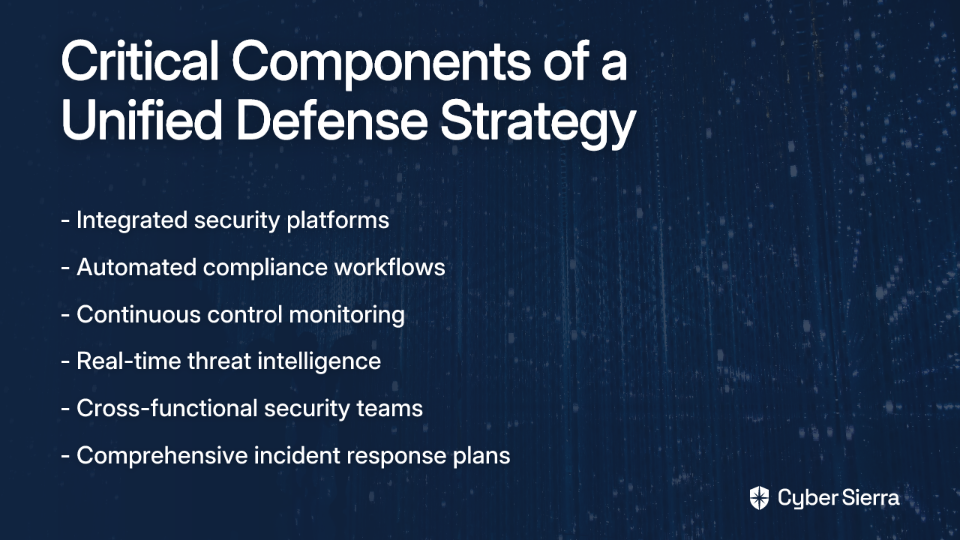
This unified approach, powered by continuous monitoring as its foundation, provides the comprehensive visibility and coordinated response capabilities needed to defend against increasingly sophisticated threats targeting critical energy infrastructure.
Don't wait for a breach to test your defenses. The time to build a resilient, multi-layered security strategy is now, before attackers find and exploit the gaps in your current approach.
Take the Next Step Toward Comprehensive Protection
Ready to strengthen your energy organization's cybersecurity posture with an integrated Defense-in-Depth strategy? Contact the Cyber Sierra team today for a comprehensive security assessment and discover how our unified platform can transform your approach to protecting critical infrastructure.
Frequently Asked Questions
What is a Defense-in-Depth strategy and why is it critical for the energy sector?
A Defense-in-Depth strategy is a cybersecurity approach that employs multiple, diverse security measures to protect critical assets, ensuring that if one layer fails, others remain to prevent a breach. It is critical for the energy sector because it provides resilience against sophisticated, multi-pronged attacks from nation-states, ransomware groups, and hacktivists. Instead of relying on a single technology, this strategy creates redundancy across physical, technical, and administrative controls, addressing vulnerabilities in IT, OT, the supply chain, and even the human element.
What are the primary cybersecurity threats the energy sector will face leading up to 2026?
The primary cybersecurity threats include targeted attacks from nation-state actors, disruptive campaigns by hacktivists, financially motivated ransomware attacks, and breaches originating from third-party supply chain vendors. Geopolitical tensions are driving nation-state groups to target critical infrastructure for espionage or disruption. At the same time, ransomware-as-a-service models make sophisticated tools available to a wider range of criminals who see energy companies as high-value targets due to their need for continuous operation.
How does the convergence of IT and OT networks increase cyber risk?
The convergence of Information Technology (IT) and Operational Technology (OT) networks increases risk by creating new digital pathways for attackers to access legacy industrial control systems that were not designed with modern security in mind. Historically, OT systems were "air-gapped" or physically isolated. As they become connected to IT networks for efficiency and data analysis, they are exposed to internet-based threats. Many of these legacy systems use unencrypted protocols and are difficult to patch without causing operational downtime, making them vulnerable targets.
Why is managing third-party and supply chain risk so important for energy companies?
Managing supply chain risk is crucial because a significant percentage of cyberattacks in the energy sector—nearly 45%—originate from breaches at third-party vendors who have access to the primary organization's network or data. An energy company's security is only as strong as its weakest partner. A comprehensive Third-Party Risk Management (TPRM) program is essential to vet, monitor, and manage the security posture of all vendors, contractors, and suppliers who connect to your systems, ensuring they don't become an entry point for attackers.
What is the first step to building a resilient, multi-layered cybersecurity strategy?
The foundational first step is to establish continuous, automated security monitoring across your entire IT and OT infrastructure. You cannot protect what you cannot see. Moving away from periodic, manual assessments to a continuous monitoring model provides the real-time visibility needed to detect vulnerabilities, misconfigurations, and emerging threats as they happen. This forms the data-driven foundation upon which all other security layers—from network defense to employee training—can be effectively built and managed.
