



Continuous Compliance Tool ROI Calculator: How to Justify the Investment


Join thousands of professionals and get the latest insight on Compliance & Cybersecurity.
Summary
- Manual compliance is a major hidden cost, with teams spending up to 60% of their time on repetitive tasks that could be automated.
- The ROI of continuous compliance tools is not only calculable but compelling, based on quantifiable cost savings, risk reduction, and strategic productivity gains.
- Automating compliance can reduce manual effort by up to 80% and deliver an ROI of over 100% in the first year by cutting labor costs and preventing expensive regulatory fines.
- Build a business case for automation by calculating your potential savings; a platform like Cybersierra's GRC solution can help turn compliance from a cost center into a strategic advantage.
You've heard it before: "You can't calculate a cybersecurity ROI." Or perhaps, "Compliance is just a cost of doing business." These statements reflect a frustrating reality for security professionals—the struggle to quantify the value of investments that are designed to prevent bad things from happening.
But what if we told you that calculating the ROI of continuous compliance tools isn't just possible—it's essential for modern security programs?
The True Cost of the Status Quo: What Manual Compliance is Really Costing You
Before we can calculate the return on investment, we need to understand what your current approach is costing your organization. Manual compliance processes create hidden expenses that many organizations fail to recognize:
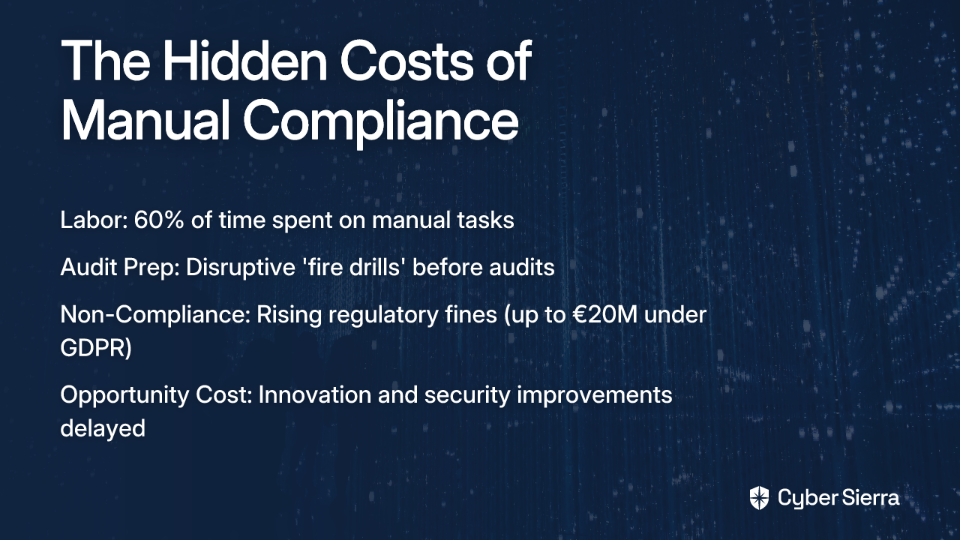
Labor Costs: The Time Sink
Compliance teams typically spend a staggering 60% of their time on manual tasks like evidence collection, documentation, and status tracking. For a team of two compliance officers earning $80,000 each, that translates to $96,000 annually spent just on repetitive, low-value work.
Audit Preparation: The Quarterly Fire Drill
Traditional point-in-time compliance approaches create intense "fire drill" periods before audits. These disruptions pull team members from strategic work for weeks or months. One manufacturing firm reported that their entire security team spent nearly four weeks preparing for each audit—time that could have been dedicated to improving security posture.
Non-Compliance Risks: The Financial Cliff
The cost of non-compliance has risen dramatically. Under GDPR alone, fines can reach up to €20 million or 4% of annual global turnover. In 2023, regulators issued over $2.5 billion in fines related to data protection and privacy violations.
Opportunity Cost: The Innovation Gap
Perhaps most significant is what your team isn't doing while they're manually gathering evidence and chasing stakeholders for attestations. They could be enhancing your security program, investigating emerging threats, or implementing controls that truly reduce risk.
A Practical Framework for Calculating Continuous Compliance ROI
Let's break down the calculation into three measurable components:
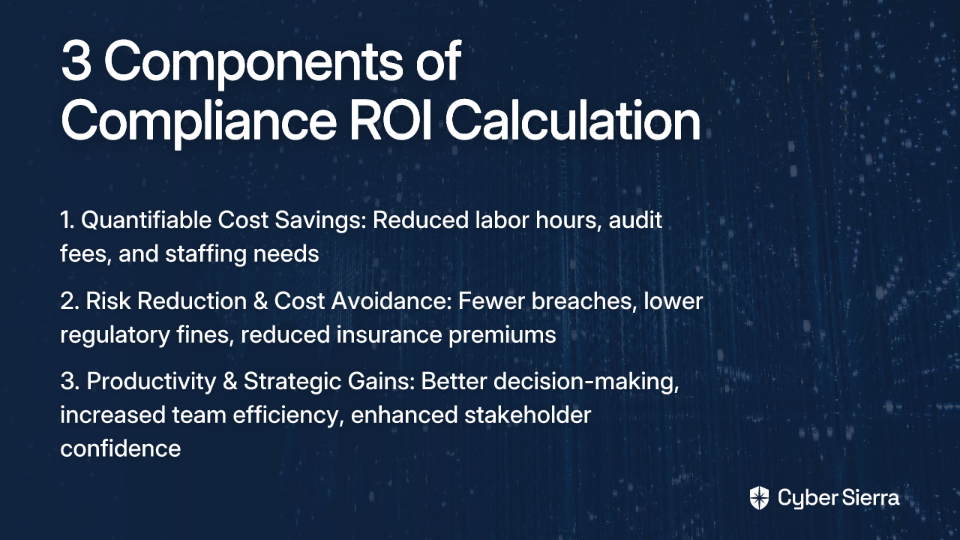
A. Quantifiable Cost Savings (The Hard Numbers)
- Reduced Labor Hours for Compliance Tasks Automated tools can reduce time spent on compliance tasks by 60-80% according to industry research. Calculation:
(Current Hours Spent on Manual Tasks) × (Hourly Rate) × (60% to 80% Reduction) = Annual Savings - Reduced Audit Preparation & Fees Continuous evidence collection dramatically reduces the time needed for audit preparation and the billable hours of external auditors. Real-world impact: A mid-sized financial services company reduced their audit preparation time by 70% after implementing a continuous compliance tool, saving approximately $45,000 annually in external auditor fees.
- Reduced Compliance Staffing Needs Organizations report up to 30-50% savings on compliance personnel expenses by avoiding new hires as the company scales. For a growing company that would otherwise need to add a compliance specialist ($90,000 annually) to handle expanding requirements, this represents a significant avoided cost.
B. Risk Reduction & Cost Avoidance (The Insurance Policy)
- Reduced Likelihood of Breaches Continuous Controls Monitoring (CCM) provides real-time visibility into security gaps, allowing you to fix issues before they're exploited. Research shows that organizations with mature continuous monitoring programs experience 80% fewer successful attacks. Calculation:
(Average Breach Cost) × (Reduction in Breach Probability) = Risk Reduction Value - Reduced Cost of Regulatory Fines AI-driven compliance solutions can decrease violation rates by 34% through proactive monitoring and automated remediation workflows. Calculation:
(Potential Fine Amount) × (Likelihood of Violation) × (34% Reduction) = Avoided Cost - Lower Cyber Insurance Premiums Insurers increasingly offer premium discounts to organizations that demonstrate robust security controls through continuous monitoring. Some companies report 5-15% reductions in cyber insurance costs after implementing automated compliance tools.
C. Productivity & Strategic Gains (The Business Enabler)
- Improved Decision-Making Continuous monitoring provides executives with a comprehensive risk overview, enabling data-driven strategic decisions. This translates to faster, more confident business initiatives.
- Increased Team Efficiency Automation allows your security team to focus on high-value activities rather than chasing documentation. One tech company reported their security analysts gained back 15 hours per week to focus on threat hunting after implementing a continuous compliance platform.
- Enhanced Stakeholder Confidence Real-time dashboards and comprehensive reporting increase trust among investors, partners, and customers, potentially accelerating sales cycles in regulated industries.
Putting It All Together: A Sample ROI Calculation in Action
Let's examine a hypothetical case study for "FinTech Corp," a mid-sized company with two compliance officers preparing for SOC 2 and managing GDPR compliance:
Step 1: Calculate Annual Manual Compliance Cost
- Labor: 2 officers × $90,000 salary × 60% manual work = $108,000
- Audit Fees: $50,000
- Total Annual Cost: $158,000
Step 2: Introduce the Solution
- Cost of Continuous Compliance Tool: $40,000/year
Step 3: Calculate Annual Savings & Gains
- Labor Savings: $108,000 × 70% reduction = $75,600
- Audit Fee Reduction: $50,000 × 40% reduction = $20,000
- Total Annual Savings: $95,600
Step 4: Calculate the ROI
- Net Gain: $95,600 (Savings) - $40,000 (Cost) = $55,600
- ROI = ($55,600 / $40,000) × 100 = 139% in the first year
Most organizations implementing continuous compliance tools see a payback period of just 1-2 years, with the ROI continuing to improve as the organization grows and compliance requirements expand.
Maximizing Your Return with an Automated Compliance Platform
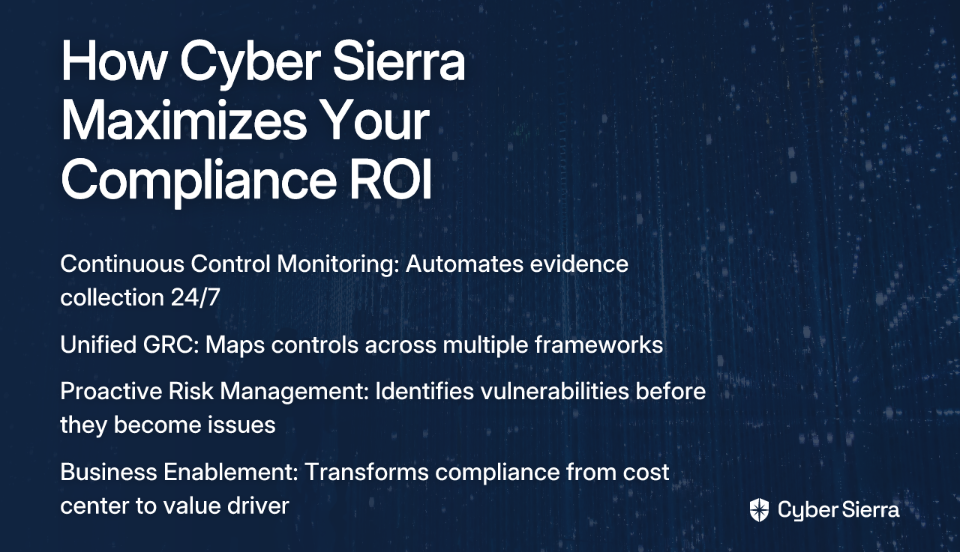
While the ROI framework above applies to any continuous compliance tool, the actual returns you'll see depend significantly on the capabilities of the platform you choose. Here's how a comprehensive solution like Cyber Sierra can maximize your investment:
Continuous Control Monitoring: The Foundation of Automation
Cyber Sierra's Continuous Control Monitoring (CCM) module automates control testing and evidence collection 24/7, eliminating the manual work that currently consumes your team's time. The platform builds a central controls repository that serves as a single source of truth, directly delivering the "Reduced Labor Hours" component of our ROI calculation.
A healthcare technology company using Cyber Sierra's CCM reported that their compliance officers reduced evidence gathering time by 75%, allowing them to focus on strategic risk management instead of documentation.
Unified GRC: Breaking Down Compliance Silos
One of the biggest inefficiencies in compliance comes from managing multiple frameworks (SOC2, ISO 27001, HIPAA, etc.) in isolation. Cyber Sierra's GRC platform unifies these requirements, eliminating tool sprawl and mapping controls across frameworks.
This approach directly addresses the challenge of scattered information that contributes to audit preparation overhead. When a retail company consolidated five separate compliance tools into Cyber Sierra's platform, they reduced their total compliance software costs by 35% while improving visibility.
Proactive Risk Management: Beyond Compliance
The integration of Cyber Sierra's Threat Intelligence and Third-Party Risk Management (TPRM) capabilities provides a holistic view of your risk landscape. This proactive approach directly impacts the "Risk Reduction" component of our ROI calculation by identifying and addressing vulnerabilities before they become compliance issues or breaches.
Transforming Compliance from Cost Center to Business Enabler
Perhaps most importantly, platforms like Cyber Sierra transform compliance from a periodic checkbox exercise into a continuous, value-adding business function. The real-time dashboards and comprehensive reporting provide transparency to executives and demonstrate due diligence to customers and partners—directly contributing to the "Strategic Gains" portion of our ROI framework.
Build Your Bulletproof Business Case for Continuous Compliance
Calculating compliance ROI isn't just possible—it's a strategic necessity. This approach changes the conversation from "How much does it cost?" to "How much value will it create?" and helps you justify investments to the C-level and Board in the language they understand: numbers.
By quantifying the labor savings, risk reduction, and productivity gains of continuous compliance tools, you can build a compelling business case that demonstrates clear financial returns alongside improved security and compliance posture.
Ready to build your own business case? Download our free, pre-populated Continuous Compliance ROI Calculator to plug in your own numbers and present a data-driven proposal to your leadership.
Then, see how Cyber Sierra's automated platform can help you achieve the ROI you've just calculated. Schedule a personalized demo and let us show you how to turn compliance from a burden into a strategic advantage.

Frequently Asked Questions (FAQ)
What is continuous compliance and how does it differ from traditional compliance?
Continuous compliance is an automated, proactive approach to meeting regulatory requirements, where controls are monitored and validated in real-time. It differs from traditional compliance, which is typically a manual, point-in-time activity conducted periodically (e.g., annually) and often results in "fire drills" before an audit.
How do you calculate the ROI of a continuous compliance tool?
The ROI of a continuous compliance tool is calculated by subtracting the tool's cost from the total value gained, then dividing by the cost. The value gained comes from three key areas: 1) Quantifiable cost savings from reduced manual labor and audit fees, 2) Risk reduction through avoiding fines and breach costs, and 3) Strategic gains from increased team productivity and faster decision-making.
What is a realistic ROI for continuous compliance automation?
A realistic ROI for continuous compliance automation is often over 100% within the first year, with a typical payback period of 1-2 years. The exact figure depends on your organization's size, the complexity of your compliance frameworks, and the current level of manual effort. Automation generates compounding value as your organization scales.
Why is manual compliance so expensive?
Manual compliance is expensive due to significant hidden costs that go beyond salaries. These include the high percentage of time skilled staff spend on repetitive, low-value tasks like evidence collection; the disruptive, all-hands-on-deck "fire drills" to prepare for audits; the massive financial risk of regulatory fines for non-compliance; and the opportunity cost of what your security team could be doing, such as threat hunting and improving security posture.
How does a continuous compliance platform improve overall security posture?
A continuous compliance platform improves security posture by shifting from a reactive, checkbox-ticking exercise to a proactive, risk-based approach. By providing 24/7 visibility into the status of security controls, it allows teams to identify and remediate gaps and misconfigurations as they occur, rather than discovering them during an annual audit. This directly reduces the organization's attack surface and strengthens its defenses against real-world threats.
What are the first steps to building a business case for a continuous compliance tool?
The first step is to benchmark your current state. Start by quantifying the hours your team spends on manual compliance tasks and the fees paid to external auditors. Next, identify your key compliance risks and the potential financial impact of a violation. Use these numbers in an ROI calculator to project your potential savings and present a data-driven case to leadership that focuses on financial return, risk reduction, and strategic value.
Remember: In today's regulatory landscape, compliance isn't optional—but how efficiently you achieve it is entirely within your control. Make the smart investment in continuous compliance automation and watch your ROI grow year after year.
