How to Choose a Thorough PCI DSS QSA (Red Flags to Avoid)


Join thousands of professionals and get the latest insight on Compliance & Cybersecurity.
You've invested heavily in your payment security infrastructure. Your team has worked tirelessly to implement PCI DSS requirements. Now it's time for the formal assessment—but how do you ensure your Qualified Security Assessor (QSA) will conduct a genuinely thorough audit rather than just checking boxes?
The stark reality is that despite being certified, many companies have substantial security gaps. As one industry professional laments, "On every single audit, since the first one, it boggles my mind how the auditors don't catch simple mistakes of critical nature." This troubling observation is not isolated—it represents a widespread frustration with superficial PCI compliance audits.
A QSA is an independent security organization qualified by the PCI Security Standards Council (PCI SSC) to validate an entity's adherence to PCI DSS. But not all QSAs approach this responsibility with the same rigor. Choosing the right one is not merely a procurement decision—it's a critical security choice that directly impacts your organization's risk posture.
The Root of the Problem: Why Superficial Audits Happen
The fundamental issue lies in a misaligned relationship structure. As one expert candidly states, "I firmly believe that QSAs half-ass the audit intentionally because the client is the one that hires the audit company." This inherent conflict of interest creates a dynamic where thoroughness may be sacrificed to maintain client satisfaction.

The pressure to minimize costs further exacerbates the problem. Comprehensive assessments of large environments take significant time and resources. As another industry professional points out, "Assessing large scope environments thoroughly takes months. You don't want to pay for that." This creates a race to the bottom, where the lowest-priced QSAs often win contracts but deliver superficial results.
The consequences of checkbox compliance are severe. A company might receive a clean Report on Compliance (RoC) or Attestation of Compliance (AoC), creating a false sense of security while significant vulnerabilities remain unaddressed. When a data breach occurs, the organization faces not only financial penalties but also reputational damage—despite being "certified compliant."
Hallmarks of a High-Quality QSA: What to Look For
Deep Technical Expertise & Credentials
A truly valuable QSA brings more than just the basic PCI SSC certification. Look for professionals who hold respected security certifications like CISSP (Certified Information Systems Security Professional) or CISA (Certified Information Systems Auditor). These credentials demonstrate a broader understanding of information security principles beyond mere compliance requirements.
This expertise is essential because, as industry insiders acknowledge, "It is rare for a QSA to have vast knowledge of all technologies in an environment." A QSA with a strong technical background can better evaluate security controls across your complex infrastructure.
Proven Industry-Specific Experience
Different industries face unique security challenges. A QSA with experience in your specific sector will understand the nuances of your business environment. They'll recognize common vulnerabilities and compliance pitfalls particular to your industry, providing more relevant guidance.
HALOCK emphasizes that industry-specific experience enables QSAs to offer practical recommendations tailored to your business context rather than generic compliance advice.
A Consultative Partnership Approach
The best QSAs don't simply identify compliance vs. non-compliance issues. They explain the security concepts behind each requirement, helping your team understand not just what to do, but why it matters. This educational approach fosters a culture of security awareness rather than just technical compliance.
As ERMProtect notes, top-tier QSAs work as partners, helping integrate PCI DSS into your daily operations. This transforms compliance from a yearly headache into an ongoing security practice that adds genuine value to your organization.
Comprehensive Service Offerings
A high-quality QSA firm typically offers a full spectrum of services beyond the final audit, including:
- Pre-assessment gap analysis to identify issues early
- Policy and procedure development assistance
- Security architecture and design reviews
- Ongoing compliance support
- Incident response consultation
These additional services indicate a QSA committed to your security success, not just ticking boxes to complete an assessment.

Your Vetting Playbook: A Step-by-Step Guide to Choosing the Right QSA
Step 1: Official Verification
Begin by verifying a potential QSA's certification status on the official PCI SSC website. Pay particular attention to any QSA listed as "In Remediation," which indicates they have violated QSA Validation Requirements—a major red flag.
Step 2: The Interview - Critical Questions to Ask
When interviewing potential QSAs, ask these probing questions:
- "Has your firm ever been in remediation with the PCI Council? If so, why?"
- "Can you describe your process for determining the assessment scope for our specific environment?"
- "Who precisely from your team will be performing the assessment? What are their specific technical backgrounds and certifications?"
- "How do you handle situations where you discover potential non-compliance issues during the assessment?"
- "Can you provide references from clients in our industry with similarly complex environments?"
- "What is your approach to explaining complex security concepts to non-technical stakeholders?"
- "How do you ensure your independence and avoid pushing proprietary products over our best interests?"
The depth and confidence of their responses will reveal much about their expertise and approach.
Step 3: Check References and Reputation
Don't just ask for references—actually call them. Ask specific questions about the QSA's communication style, thoroughness, and ability to work as a partner rather than just an auditor. Inquire about any surprises that emerged during the audit process and how the QSA handled challenging situations.
Additionally, research their reputation through industry forums, LinkedIn discussions, and peer networks. A pattern of complaints about superficial assessments should be an immediate disqualifier.
Major Red Flags: Warning Signs to Avoid at All Costs
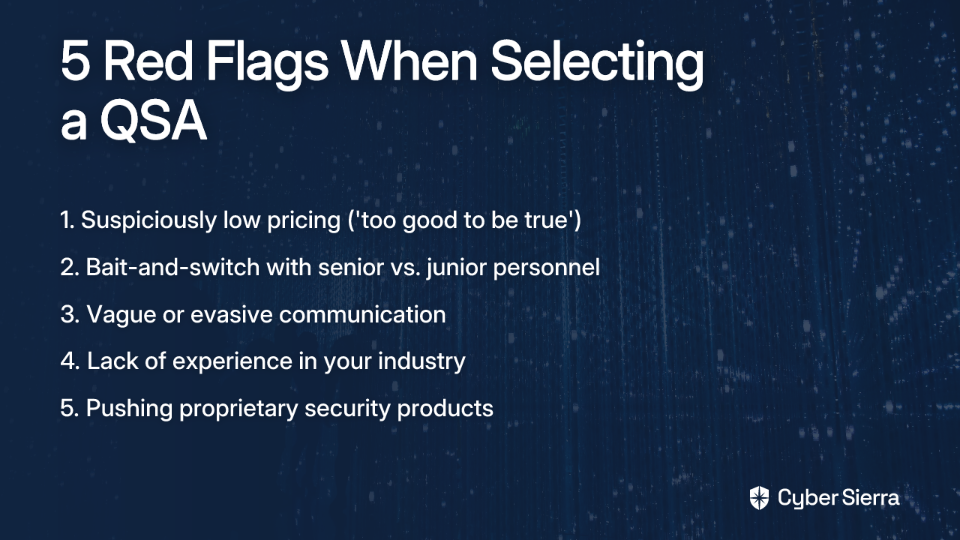
Red Flag 1: The "Too Good to Be True" Price
Beware of significantly lower-priced options. As ERMProtect warns, unusually low pricing often indicates a superficial approach that will miss critical security issues. Remember that you're investing in a thorough security assessment, not just purchasing a compliance certificate.
Quality assessments require appropriate time and expertise, which come at a reasonable cost. If a QSA's price is substantially below others, question what corners they're planning to cut.
Red Flag 2: The "Bait and Switch"
A common complaint in the industry is that senior, experienced QSAs sell the engagement, but as one professional notes, "Sometimes, the QSAs won't even audit himself, they'll send someone to gather evidence/do interviews." This bait-and-switch tactic often results in less experienced personnel conducting critical aspects of your assessment.
Always get contractual clarity on exactly which individuals will be performing your assessment and their specific qualifications. Request that any personnel changes be approved by your organization before proceeding.
Red Flag 3: Vague Communication & Hesitation
If a QSA struggles to clearly explain their assessment methodology or seems evasive when answering your vetting questions, this indicates potential knowledge gaps or a lack of transparency. A quality QSA should communicate their process with confidence and clarity, demonstrating deep understanding of both the technical and procedural aspects of PCI DSS.
HALOCK emphasizes that clear, consistent communication is essential throughout the assessment process.
Red Flag 4: Lack of Industry-Specific Experience
A QSA without proven experience in your specific industry may miss critical context, applying generic standards that don't address your unique risks. When reviewing a QSA's qualifications, specifically ask for case studies or references from organizations similar to yours in size, complexity, and industry sector.
Red Flag 5: The Hard Sell on Proprietary Products
If a QSA seems more focused on selling their company's security products than on providing an independent assessment, their objectivity is compromised. A true security partner may recommend solutions when appropriate, but never in a way that undermines their assessment independence.
Investing in a Partner, Not Just an Audit
Selecting a QSA is one of the most important security decisions your organization will make. The goal isn't simply to obtain a compliance certificate—it's to find a long-term partner who strengthens your security posture through meaningful assessment and guidance.
A thorough QSA helps you build a sustainable security culture with continuous compliance, rather than treating PCI DSS as an annual hurdle to overcome. As the PCI SSC Blog emphasizes, integrating compliance into daily business operations is essential for maintaining effective security.
By following this guide to select a QSA who prioritizes security over mere checkbox compliance, you're making an investment in your organization's true security posture. And remember—you can help improve the entire QSA program by providing feedback on your experiences through the official PCI SSC feedback channel.
The difference between a thorough assessment and superficial compliance isn't just academic—it could be the difference between preventing a breach and explaining to your customers why their data was compromised despite your "compliant" status.
Frequently Asked Questions
What is a Qualified Security Assessor (QSA) and why is their role critical?
A Qualified Security Assessor (QSA) is an independent security organization certified by the PCI Security Standards Council (PCI SSC) to validate a company's adherence to the Payment Card Industry Data Security Standard (PCI DSS). Their role is critical because a thorough QSA provides an objective, expert assessment of your security controls, helping to identify and remediate vulnerabilities that could lead to a data breach. Choosing a high-quality QSA is a crucial security decision that impacts your organization's risk posture.
How can I verify a QSA's official certification?
You can verify a QSA's official certification status by searching for their company name on the official PCI Security Standards Council (PCI SSC) website. The PCI SSC maintains a public list of all certified QSAs. When checking this list, it is important to pay attention to any QSA listed with an "In Remediation" status, as this is a major red flag indicating they have recently violated QSA validation requirements.
Why do some QSAs perform superficial "checkbox" audits?
Superficial PCI audits often happen due to a conflict of interest, where the QSA is hired and paid directly by the client they are auditing, creating pressure to ensure client satisfaction over conducting a rigorous assessment. This dynamic can be worsened by pressure to keep costs low. Thorough assessments are time-consuming and expensive, leading some companies to opt for lower-priced QSAs who may cut corners, resulting in "checkbox compliance" that provides a false sense of security.
What are the most important qualities of a high-quality QSA?
A high-quality QSA possesses deep technical expertise, proven industry-specific experience, a consultative partnership approach, and offers comprehensive services beyond the final audit. Look for QSAs with advanced security certifications (like CISSP or CISA), a track record in your industry, and a willingness to explain the 'why' behind security requirements. They should act as a partner, helping to integrate security into your daily operations.
What are the biggest red flags to watch for when selecting a QSA?
The biggest red flags include unusually low pricing, a "bait-and-switch" tactic where junior staff perform the audit after a senior member sells the engagement, vague communication, a lack of industry-specific experience, and a hard sell on their own proprietary products. A price that seems "too good to be true" often indicates a superficial assessment that will miss critical issues.
What should happen if a QSA discovers a non-compliance issue during an audit?
If a QSA discovers a non-compliance issue, you should view it as an opportunity to strengthen your security posture. A good QSA will work with you as a partner to address it. They will not simply fail you, but will explain the finding, discuss the associated risks, and provide guidance on remediation options. Their goal is to help you become genuinely secure and compliant, not just to check a box.