The Complete CISO Guide to Data Loss Prevention Strategy for Modern SaaS Teams


Join thousands of professionals and get the latest insight on Compliance & Cybersecurity.
You've set up a robust SaaS ecosystem that allows your team to collaborate at lightning speed. But as many CISOs have painfully discovered, data visibility can get away from you just as quickly. Most concerning of all? The majority of data exposure isn't malicious—it comes from good intentions, like an employee dropping a public Google Drive link into a Slack channel with external guests.
For modern SaaS-first companies, traditional data protection approaches are no longer sufficient. With an estimated 60% of corporate data now stored in cloud environments, the old network perimeter has dissolved, creating urgent new challenges for security leaders.
This guide provides CISOs with a framework to build and implement a Data Loss Prevention (DLP) strategy that works for today's SaaS-powered teams—helping you achieve regulatory compliance, ensure business continuity, and protect your organization's most valuable assets.
Why Traditional DLP Strategies Fall Short in the Cloud
The paradigm shift to cloud-based work has rendered traditional DLP models ineffective. Where security teams once focused on securing the network perimeter and on-premises endpoints, modern work is defined by data flowing freely between cloud apps, third-party services, and unmanaged devices.
Today's SaaS environments introduce unique security challenges:
Shadow IT & Unmanaged Apps
Teams adopt "shadow tools" without security oversight, creating dangerous blind spots in your security posture. These unauthorized applications often handle sensitive data without proper controls or visibility.
Over-Permissive Third-Party Access
"A lot of AI browser extensions and productivity tools can read Drive files or Slack messages if they've been granted broad access" via OAuth permissions, according to security professionals. These permissions often go unaudited, creating significant exposure risks.
Unmanaged Device Access
A key concern is whether "data access is coming from unmanaged devices or unknown sessions." Without proper controls, sensitive information can be accessed from personal devices lacking appropriate security measures.
Common DLP Myths That Hold Organizations Back
Before diving into the solution, let's address some persistent myths that prevent organizations from implementing effective DLP programs:
Myth 1: DLP requires a massive, enterprise-wide effort. Reality: A modern program can start small, focusing on the most critical data first, and expand over time.
Myth 2: DLP only works inside the corporate network. Reality: Modern context-aware DLP can apply protection at the data level, securing it regardless of location, network, or device.
Myth 3: DLP hinders productivity. Reality: Today's solutions are designed to guide users with notifications rather than just blocking actions, preventing disruption to legitimate data use.
With these myths dispelled, let's explore how to build an effective DLP strategy for today's SaaS-centric world.
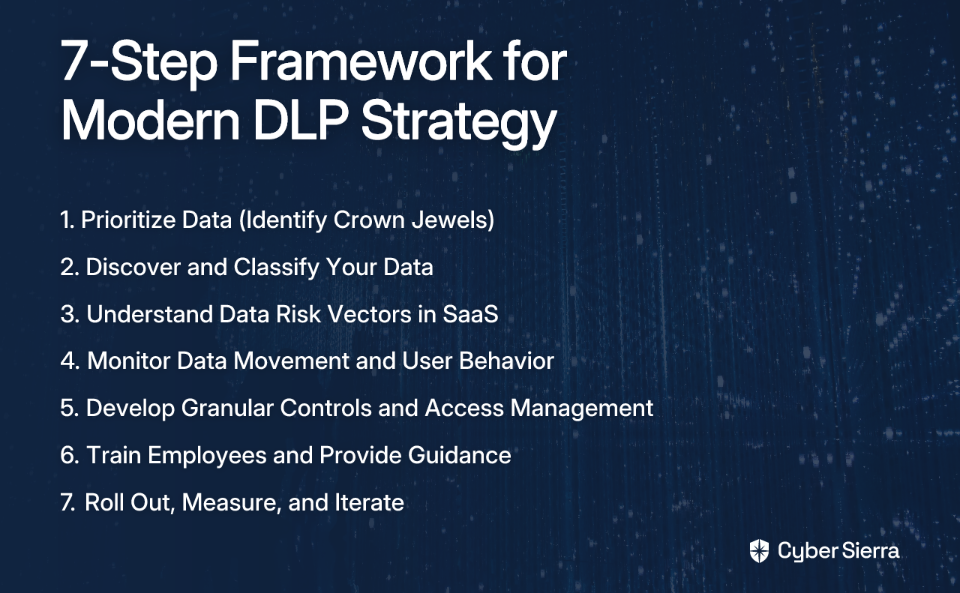
A 7-Step Framework for a Modern, SaaS-Centric DLP Strategy
Step 1: Prioritize Data ("Identify the Crown Jewels")
Begin by determining which data, if lost, would cause the most significant harm to your organization. As one security leader put it, "the first thing would be to understand what the crown jewels (the most sensitive info) are and where they are stored or captured." (Source)
This might include:
- Intellectual property
- Customer personally identifiable information (PII)
- Payment card information (PCI)
- Protected health information (PHI)
- Financial data and forecasts
Action: Create an inventory of your most valuable data assets and rank them by sensitivity and business impact.
Step 2: Discover and Classify Your Data
Once you've identified what matters most, you need to find where it actually lives. Systematically scan all data repositories (both on-premises and cloud) to identify where sensitive data resides.
Use a combination of methods for robust classification:
- Context-based: Classify data based on the source application (e.g., Salesforce), data store, or user who created it.
- Content inspection: Analyze the data itself for keywords, patterns (like credit card numbers), or persistent classification tags.
- Automation: Leverage tools to automate data classification to improve accuracy and consistently enforce policies.
Action: Implement automated data classification tools that can scan your SaaS environments and apply appropriate tags based on sensitivity.
Step 3: Understand Data Risk Vectors in SaaS
Analyze risk across the three states of data:
- Data-at-rest: In cloud storage buckets, databases, and SaaS platforms
- Data-in-transit: Moving between SaaS apps via APIs or shared externally
- Data-in-use: Being accessed on endpoints, often within a web browser
Action: Map out how sensitive data flows through your organization and identify the highest-risk transmission vectors.
Step 4: Monitor All Data Movement and User Behavior
Implement "continuous monitoring of data flows in tools like Slack and Google Drive to detect unusual sharing or downloads." (Source)
Leverage technology with AI and machine learning to detect suspicious activities and anomalies that deviate from baseline user behavior. This enables you to spot potential data exfiltration or accidental exposure before it becomes a breach.
Action: Deploy monitoring solutions that can detect anomalous data access, sharing, or download patterns across your SaaS applications.
Step 5: Develop Granular Controls and Access Management
Shift towards a least-privilege model. Implement Role-Based Access Control (RBAC) to ensure users only have access to the data necessary for their jobs.
Key control methods include:
- Data encryption for data at rest and in transit
- Regular, automated access reviews for platforms like Slack and Google Drive to find over-provisioned access or lingering guest accounts
- Auditing OAuth permissions granted to third-party applications to revoke excessive access
Action: Conduct quarterly access reviews across all SaaS platforms and implement just-in-time access for sensitive systems.
Step 6: Train Employees and Provide Continuous Guidance
Educate teams on data handling best practices, social engineering threats, and the specific risks of SaaS collaboration tools. This is critical as 68% of data breaches involve a non-malicious human element, according to research from Island.io.
Use advanced DLP tools that prompt users with guidance in real-time when they attempt a risky action, enabling self-correction rather than simply blocking activities.
Action: Develop role-specific training that addresses the unique data handling requirements for different departments and implement real-time guidance tools.
Step 7: Roll Out, Measure, and Iterate
Implement DLP in phases. Start with a pilot program focused on your most critical data and a small user group. Establish clear metrics to gauge effectiveness and report on the program's success.
Action: Define key metrics for your DLP program (e.g., reduction in public sharing, time to remediate exposure incidents) and continuously monitor and refine policies based on these measurements.
DLP as a Cornerstone of Regulatory Compliance
A staggering 95% of companies fail to meet all regulatory data protection requirements, exposing them to massive risk, according to Strac.io. This makes DLP not just a security best practice but a critical compliance tool.
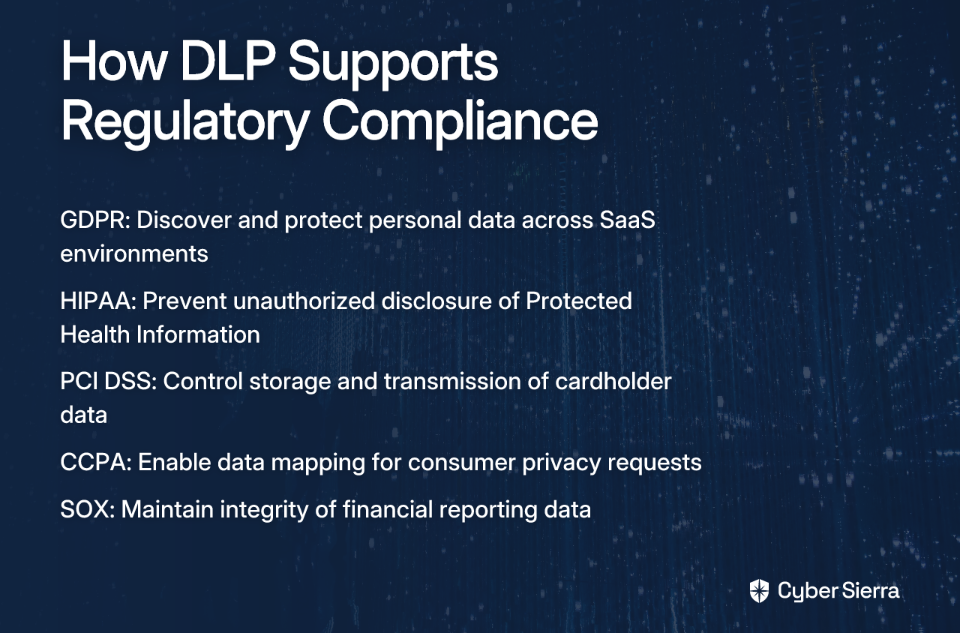
Here's how a robust DLP strategy directly supports major regulations:
GDPR (General Data Protection Regulation)
DLP helps discover, classify, and protect EU residents' personal data, a core mandate. Non-compliance can lead to fines of up to 4% of global annual revenue. Your DLP program should include capabilities to identify personal data across SaaS environments and enforce appropriate controls.
HIPAA (Health Insurance Portability and Accountability Act)
DLP solutions are critical for identifying and preventing unauthorized disclosure of Protected Health Information (PHI). Healthcare organizations and their business associates must implement technical safeguards to ensure PHI remains confidential—DLP provides these safeguards.
PCI DSS (Payment Card Industry Data Security Standard)
DLP helps enforce controls around the storage, transmission, and access of cardholder data, making it easier to maintain PCI DSS compliance and avoid costly penalties.
CCPA (California Consumer Privacy Act) and State Privacy Laws
DLP tools facilitate the data mapping and discovery necessary to fulfill consumer data rights requests and ensure proper handling of personal information.
Justifying Your DLP Program to the Board
When presenting your DLP strategy to the board, frame the discussion around mitigating financial and operational risk, not just technical controls.
Use Data to Build Your Case
- Cost of a Breach: The average data breach costs approximately $4.5 million. (Source)
- Frequency: Nearly 80% of IT/security leaders experienced one or more data breaches in the past year. (Source)
- Operational Impact: Data breaches cause an average disruption of 22 days in business operations. (Source)
Connect DLP to Business Enablement and Trust
Position your DLP program as a business enabler that builds customer trust. Just as Apple has turned privacy into a brand differentiator, your organization can leverage strong data protection practices as a competitive advantage.
Conclusion: The Future of DLP is Proactive and Integrated
A modern DLP strategy is not a single tool but an ongoing program that is data-centric, user-aware, and iterative. It moves security from a reactive, blocking function to a proactive, guiding one that supports both compliance and collaboration.
Future trends to watch in the DLP space include:
- Integration with DSPM: DLP is becoming a cornerstone of broader Data Security Posture Management (DSPM) frameworks.
- Advances in AI/ML: Expect more sophisticated and automated data classification and anomaly detection.
- Cloud-Native Focus: DLP solutions will continue to evolve with deeper integrations into cloud and SaaS environments.
The time to move beyond legacy approaches is now. By building a DLP program that secures data wherever it flows, you'll not only protect your organization from costly breaches but also enable the safe, productive collaboration that modern businesses demand.
Remember: In today's SaaS-first world, data loss prevention isn't just about stopping data from leaving—it's about ensuring the right data is available to the right people, in the right contexts, while maintaining compliance and security. Your DLP strategy should reflect this nuanced approach to truly protect your organization's most valuable assets.