



Top 5 Governance Challenges CISOs Face in 2025


Join thousands of professionals and get the latest insight on Compliance & Cybersecurity.
Summary
- The modern CISO's role has shifted from a technical expert to a strategic business leader, focusing on aligning security governance with core business objectives.
- Key governance challenges for 2025 include navigating complex regulations, securing the supply chain, and managing an attack surface that has expanded for 62% of organizations in the last two years.
- To succeed, CISOs must transition from periodic audits and scans to a strategy of continuous monitoring and proactive risk management.
- An integrated platform can unify these efforts by automating Governance, Risk & Compliance (GRC) and providing a holistic view of an organization's security posture.
The modern CISO stands at a critical inflection point. As one cybersecurity leader aptly observed, "executives hire CISOs to tell them what time it is, not how to make a watch." This fundamental shift captures the evolution of the cybersecurity leader from technical gatekeeper to strategic business partner.
The primary struggle for today's CISO is no longer purely technical but centers on governance: aligning security with business objectives, managing ever-expanding risk landscapes, and communicating value effectively. Many CISOs report "misunderstanding the relationship between risk and business objectives" as their most significant hurdle.
As we look toward 2025, CISOs will grapple with five key governance challenges that will define their success or failure. This article explores these challenges—from regulatory complexity and supply chain chaos to embedding resilience and bridging the human gap—providing a strategic roadmap for navigating them.
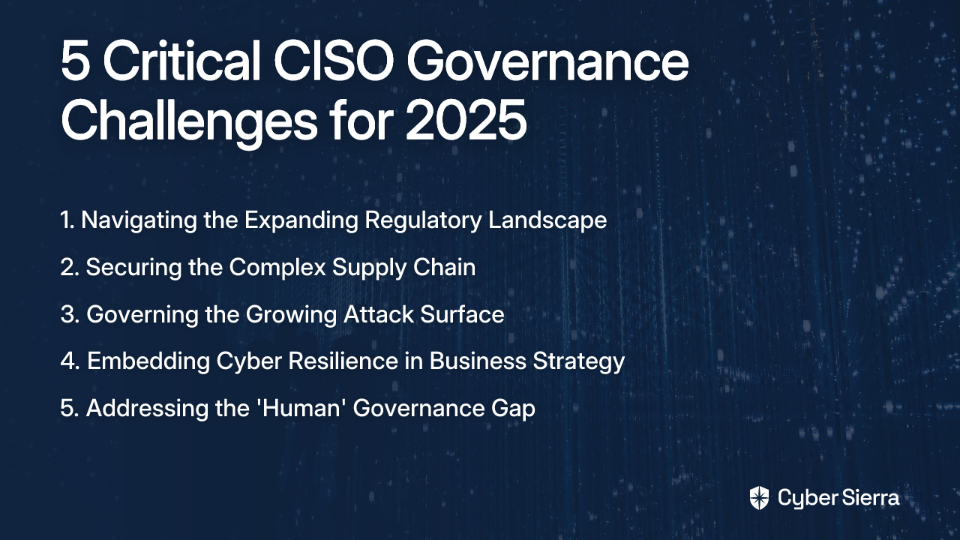
1. Navigating the Expanding and Fragmented Regulatory Landscape
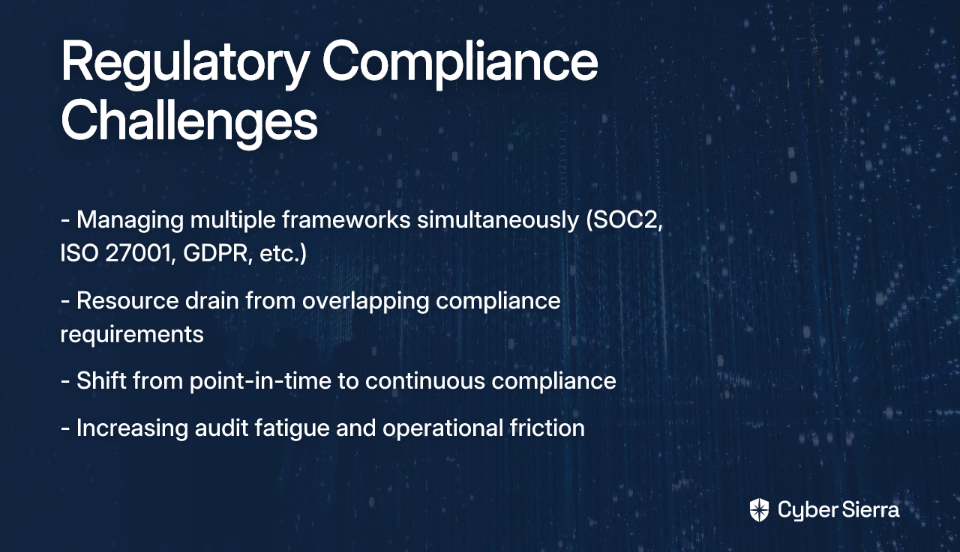
CISOs are facing unprecedented "audit fatigue" due to a complex web of overlapping global and industry-specific regulations. The challenge is not just achieving compliance but demonstrating it continuously.
The regulatory environment is becoming increasingly complex with new mandates like the Digital Operational Resilience Act (DORA) and updated SEC requirements. Organizations must simultaneously manage multiple frameworks (SOC2, ISO 27001, GDPR, HIPAA, PCI DSS), leading to resource drain and operational friction.
Traditional point-in-time audit models are no longer sufficient for today's dynamic threat landscape. Regulators and stakeholders now demand proof of ongoing compliance, not just annual attestations.
Strategy & Solution:
- Map Regulations to Business Processes: A key recommendation is to map regulations directly to existing business processes to better manage compliance expectations and integrate them into daily operations.
- Embrace GRC Automation: Shift from manual, periodic checks to automated, continuous monitoring.
- Platforms like Cyber Sierra's Governance, Risk & Compliance (GRC) module address this challenge by automating data collection, streamlining risk assessments, and maintaining detailed audit trails. By leveraging Continuous Control Monitoring (CCM), CISOs gain a "central controls repository with near real-time updates," transforming compliance from a periodic burden into a continuous, automated process.
2. Securing the Complex and Unruly Supply Chain
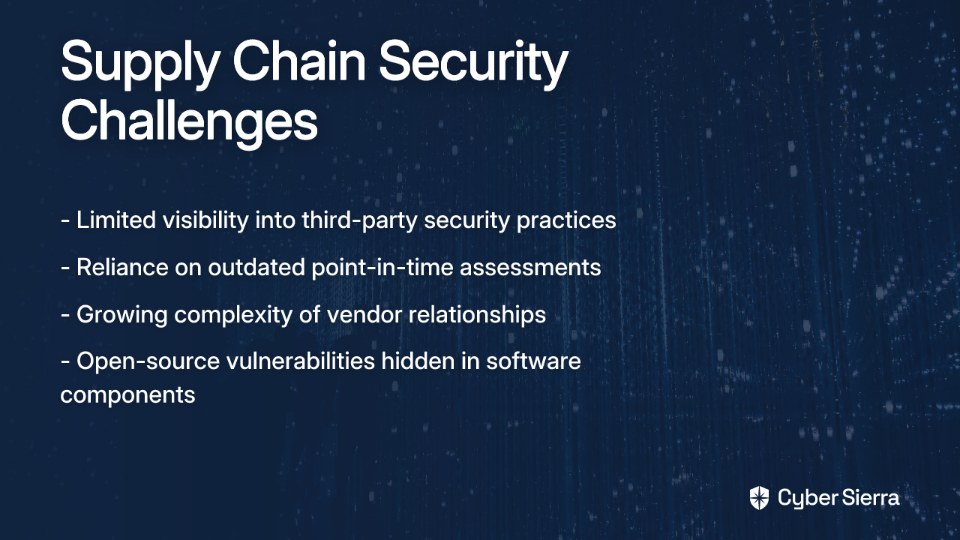
Governance now extends far beyond an organization's perimeter. The intricate web of third-party vendors, partners, and open-source software creates a massive, often invisible, attack surface.
The modern supply chain is a primary vector for attacks, with vulnerabilities emerging from both trusted vendor applications and open-source libraries. A major governance failure is the "inadequate visibility into third-party security practices," often relying on static, point-in-time questionnaires that quickly become outdated.
The need for Software Bills of Materials (SBOMs) is becoming critical to identify and manage risks embedded within software components, especially as organizations depend on increasingly complex technology stacks.
Strategy & Solution:
- Adopt Continuous Vendor Monitoring: Move beyond static assessments to a dynamic model. This allows for the "quick diagnosis and triaging of third-party cyber risks."
- Prioritize Risks: Not all vendors are created equal. A strategic approach requires categorizing vendors by risk level to focus resources where they matter most.
- Cyber Sierra's Third-Party Risk Management (TPRM) module directly addresses this challenge by providing "near real-time, 24/7 visibility into vendor security compliance" and automating the entire vendor risk lifecycle, from onboarding and assessment to continuous monitoring and offboarding. This allows CISOs to effectively govern their entire supply chain without drowning in manual processes.
3. Governing the Ever-Growing and Dynamic Attack Surface
The digital footprint of the average organization is expanding at an explosive rate, making comprehensive visibility and governance nearly impossible with traditional tools.
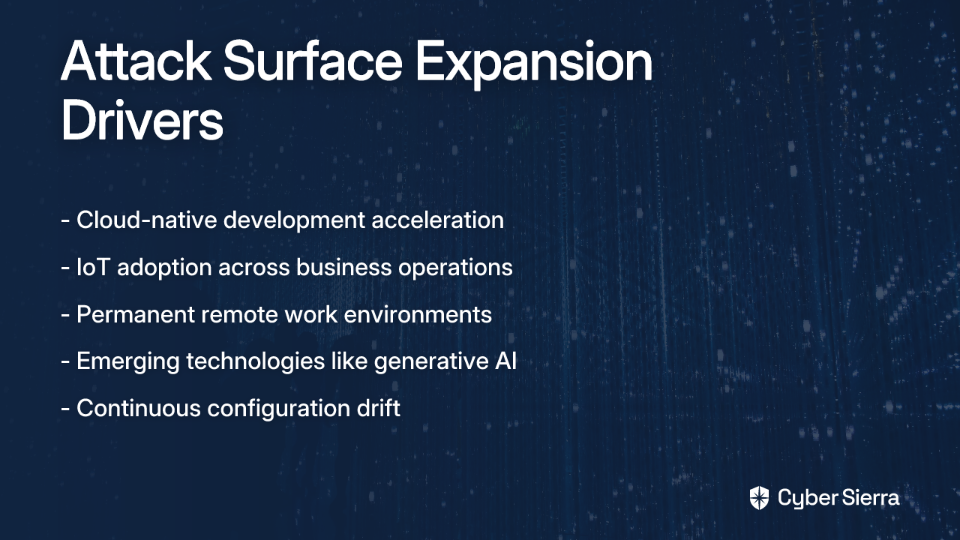
A staggering 62% of organizations report that their attack surface has expanded in the last two years, driven by cloud-native development, IoT adoption, and permanent remote work models. Emerging technologies like generative AI are introducing novel and unpredictable risks, further complicating risk monitoring.
Constant IT changes and configuration drift mean that "periodic scanning" is no longer effective. Governance requires continuous visibility and validation of security controls to ensure that security posture remains intact despite the rapid pace of technological change.
Strategy & Solution:
- Implement Risk-Based Vulnerability Management: Focus on intelligence-led prioritization to mitigate the threats that pose the most significant business risk, rather than trying to fix everything at once.
- Adopt an "Outside-In" View: Understand how attackers see your organization to identify and close the most obvious and exploitable gaps.
- Proactive defense tools become critical in this environment. Cyber Sierra's Threat Intelligence platform provides this "outside-in" perspective by performing continuous "network vulnerability scanning" and "cloud infrastructure scanning for misconfigurations," offering a comprehensive security scorecard. This enables CISOs to govern their attack surface proactively, identifying risks before they can be exploited.
4. Embedding Cyber Resilience into Business Strategy
The most mature security programs are shifting their governance focus from prevention-only to holistic cyber resilience. This means treating security not as a technical control but as a core catalyst for enterprise strategy and innovation.
Resilience is an "adaptive strategy" that accepts that cyber incidents are "inevitable yet manageable." The goal is to withstand and recover from attacks while maintaining business operations. This requires "elevating cybersecurity within enterprise strategy to build trust and innovation." Security must be seen as a business enabler, not a blocker.
A key component is demonstrating robust cyber hygiene, which is increasingly a prerequisite for obtaining adequate cyber insurance coverage in a hardening market.
Strategy & Solution:
- Quantify and Communicate Risk: Use data to build a business case for resilience investments, linking security posture to potential financial and operational impacts.
- Integrate Security into the Business Lifecycle: Ensure security is involved early in all new initiatives, from product development to M&A.
- Achieving strategic resilience requires a unified view of risk. An integrated platform provides the data CISOs need to have strategic conversations with the board. Cyber Sierra's Cyber Insurance module helps bridge this gap by enabling organizations to "meet insurer requirements through demonstrable cyber hygiene" and "streamline the application process." This directly links governance efforts to tangible business outcomes like insurability and financial protection.
5. The "Human" Governance Gap: From the Boardroom to the Frontline
Perhaps the most significant governance challenge is the human element. This manifests in two critical areas: the CISO's ability to communicate effectively with the board and the organization's ability to foster a security-conscious culture among all employees.
The Boardroom Gap: As one cybersecurity professional aptly put it, "the part that makes you a good CISO or not is the leadership and management skill, not the tech." CISOs must translate complex technical risks into clear business implications, acting as a "problem solver, and politically savvy" leader.
The Frontline Gap: The human factor remains a top vulnerability. Many organizations fail to implement foundational best practices, and employees are often the unwitting entry point for attackers through phishing and social engineering.
Strategy & Solution:
- Educate Upwards: CISOs must "educate executives and the board" by providing cybersecurity context within business impacts, avoiding jargon, and focusing on what matters to them. As one CISO recommends, "be a master of the analogy, keep them fresh, and relate them directly to what your audience understands."
- Train Downwards and Sideways: Implement continuous and engaging security awareness programs that go beyond an annual checkbox exercise.
- To address the frontline gap, Cyber Sierra's Employee Security Training platform helps build a strong "human firewall." It uses "interactive quizzes," "continuous learning modules," and "simulated counter-phishing campaigns" to foster a company-wide, security-first culture and provide CISOs with measurable data on their organization's security quotient.
Conclusion: The Path Forward
The governance challenges for CISOs in 2025 are multifaceted, spanning regulatory complexity, supply chain vulnerabilities, an expanding attack surface, the need for strategic resilience, and the critical human element.
Thriving in this new era requires a shift in mindset—from technical manager to strategic business leader. As one cybersecurity leader noted, "if you're not aligned with the business, that is akin to someone throwing you a baseball and you scoring a touchdown." The modern CISO must leverage automation and integrated platforms to govern risk holistically.
By embracing continuous monitoring, proactive intelligence, and a unified view of risk, CISOs can transform their security programs from a cost center into a strategic advantage. Platforms like Cyber Sierra are designed to provide this unified visibility and automation, empowering CISOs to confidently navigate the governance challenges of tomorrow.
The successful CISO of 2025 will be the one who can tell executives "what time it is" in a language they understand, while ensuring their organization's security architecture can withstand the challenges of an increasingly complex digital world.
Frequently Asked Questions
What is the main role of a modern CISO?
The main role of a modern Chief Information Security Officer (CISO) is to act as a strategic business partner who aligns security initiatives with business objectives, rather than just being a technical manager. This involves translating complex technical risks into clear business impacts for executives and the board. Instead of focusing solely on implementing security controls ("how to build the watch"), the modern CISO is responsible for communicating the overall security posture and its implications for the business ("telling them what time it is").
Why is cybersecurity governance becoming more challenging for CISOs?
Cybersecurity governance is becoming more challenging due to a combination of an expanding regulatory landscape, complex supply chains, a growing digital attack surface, and a persistent "human gap" in security awareness. These factors create a dynamic and fragmented risk environment. CISOs must manage overlapping compliance requirements, secure third-party vendors, gain visibility over ever-changing cloud and remote work infrastructure, and address vulnerabilities from the boardroom to the frontline employee, making a holistic governance strategy essential.
How can CISOs effectively manage multiple compliance regulations?
CISOs can effectively manage multiple compliance regulations by shifting from periodic, manual audits to a continuous, automated approach using Governance, Risk, and Compliance (GRC) platforms. The key is to map regulations to business processes and leverage technology for continuous control monitoring. This transforms compliance from a resource-draining, point-in-time exercise into an integrated and efficient part of daily operations, reducing audit fatigue and providing real-time visibility into the organization's compliance posture.
What is the difference between cybersecurity and cyber resilience?
While traditional cybersecurity focuses primarily on preventing attacks, cyber resilience is a broader strategic approach that includes the ability to withstand, respond to, and recover from incidents while maintaining business operations. Cyber resilience accepts that breaches are inevitable and builds security into the enterprise strategy. It's an adaptive model that aims to minimize the impact of an attack and ensure the organization can continue to function and innovate.
How can a CISO improve communication with the board of directors?
A CISO can improve communication with the board by translating technical jargon into clear business language, focusing on financial and operational impacts, and using relatable analogies. Effective communication involves educating executives on the business context of cyber risk rather than overwhelming them with technical details. By framing security investments in terms of risk reduction and business enablement, a CISO can become a trusted advisor who helps the board make informed governance decisions.
What is the best way to manage third-party and supply chain risk?
The best way to manage third-party and supply chain risk is to move beyond static, point-in-time questionnaires to a model of continuous vendor monitoring and risk-based prioritization. This involves using automated tools to gain real-time visibility into the security posture of vendors and partners. By categorizing vendors based on their risk level and continuously monitoring their security status, CISOs can proactively identify and mitigate vulnerabilities within the supply chain.
