



A CISO's Guide to Country-Level Access Policies


Join thousands of professionals and get the latest insight on Compliance & Cybersecurity.
You've carefully set up geolocation blocking to protect your organization's data, using conditional access policies to restrict access from high-risk countries. Then suddenly, your CEO calls from an overseas business trip, unable to access critical systems, and you're scrambling to create an exception while balancing security and business continuity.
This scenario plays out in organizations worldwide, creating friction between security teams and users, while potentially introducing dangerous security gaps. Managing country-level access effectively requires more than just blocking a list of "problematic countries" – it demands a comprehensive strategy that balances compliance, security, and business needs.
The Strategic Foundation: Default-Deny or Default-Allow?
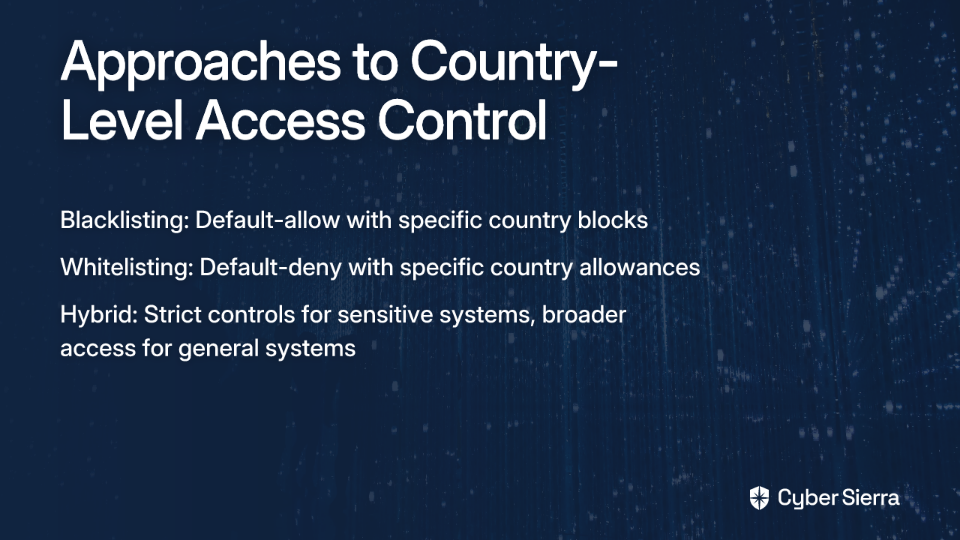
Before implementing any country-level access policy, CISOs must make a fundamental philosophical choice that will shape their entire approach: default-deny (whitelisting) or default-allow (blacklisting).
Blacklisting (Default-Allow)
With blacklisting, you deny access to a specific list of countries deemed high-risk, while allowing access from all others by default. This approach:
- Is relatively easy to implement and causes minimal business disruption
- Requires less upfront planning and coordination
- Places the burden on security teams to identify and block all potential threats
However, this approach inherently leaves your organization vulnerable to threats originating from countries not yet on your blocklist, creating a perpetual game of catch-up against evolving threats.
Whitelisting (Default-Deny)
The alternative is whitelisting, or a default-deny strategy, where access is blocked from all countries except those explicitly approved. This approach:
- Drastically reduces your attack surface by limiting access to only necessary regions
- Aligns with Zero Trust principles where access is denied by default
- Provides stronger protection against emerging threats from unexpected locations
The tradeoff is increased operational complexity and potential business disruption if not carefully planned and communicated.
Recommendation: A Layered Approach
For most organizations, a hybrid approach works best:
- Apply a strict whitelisting strategy to your most sensitive systems and privileged accounts
- Use a robust blacklisting approach for less sensitive, generally accessible systems
- Ensure both layers are informed by compliance requirements and threat intelligence
The Compliance Layer: OFAC and Beyond
A solid country-level access policy must start with regulatory compliance as its foundation. For US organizations (and many international companies with US connections), this means integrating the Office of Foreign Assets Control (OFAC) sanctions list.
Understanding OFAC's Role in Your Access Policies
Many security professionals express frustration over maintaining updated OFAC country lists for their access policies. The reality is that OFAC doesn't maintain a simple static "list of embargoed countries" – it's more complex than that.
OFAC administers various sanctions programs, some comprehensive (blocking an entire country) and others selective (targeting specific individuals, entities, or activities). For your country-level access policy to be compliant, you need to:
- Use the OFAC Sanctions List Service (SLS) as your authoritative source
- Focus on comprehensively sanctioned jurisdictions including Cuba, Iran, North Korea, Syria, and specific regions of Ukraine
- Automate the integration of these lists rather than maintaining them manually
Beyond OFAC: Additional Compliance Considerations
While OFAC provides a baseline, a comprehensive policy should also incorporate:
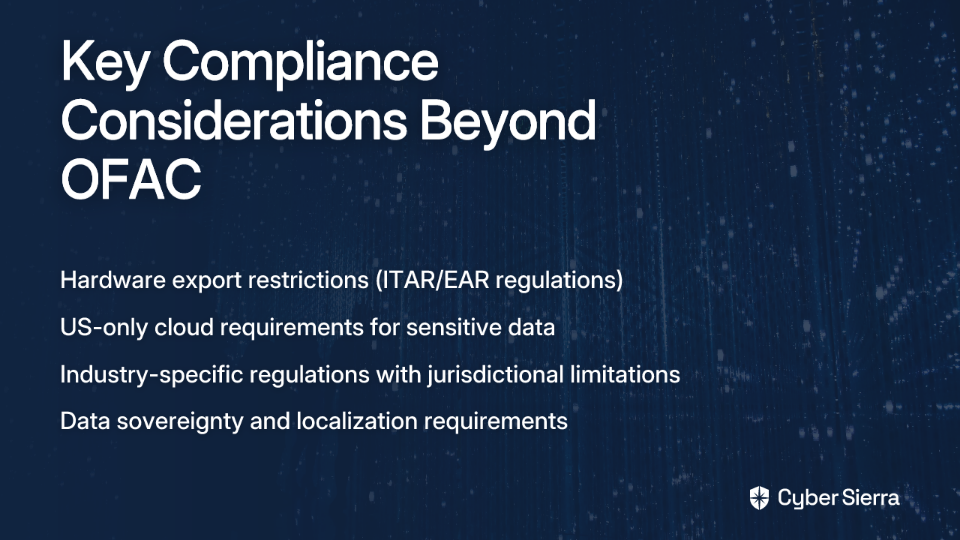
- Hardware export restrictions: Certain devices with sensitive technologies may be subject to additional controls under ITAR or EAR regulations
- US only cloud requirements for certain data types or government contracts
- Industry-specific regulations that may restrict data processing in certain jurisdictions
The Intelligence Layer: Beyond Static Lists
Compliance alone is insufficient. Sophisticated attacks often originate from trusted countries using compromised infrastructure. To build a robust country-level access policy, integrate threat intelligence to identify:
- Countries with disproportionate sources of automatic attacks
- IP ranges associated with state-sponsored threat actors
- Regions showing unusual login patterns for your specific organization
Modern security platforms like Microsoft Entra ID and similar solutions use machine learning to identify suspicious logins based on location anomalies, even when they come from allowed countries. This adds a dynamic layer to your static country-level policies.
From Geo-Blocking to Geo-Fencing
Rather than simply blocking "bad" countries, create a comprehensive geo-fencing strategy that combines:
- Location-based access controls (denying or allowing access based on country)
- Behavioral analytics (identifying suspicious patterns regardless of location)
- Risk-based conditional access (requiring additional authentication for unusual locations)
This multi-layered approach provides defense in depth against both known and emerging threats.
Practical Implementation: Building Your Policy
Let's translate these principles into actionable steps using Microsoft Entra ID (formerly Azure AD) as an example platform, though similar concepts apply across other security solutions.
Step 1: Create Named Locations for Access Control
- Sign in to the Microsoft Entra admin center with appropriate privileges
- Navigate to Conditional Access > Named locations
- Create locations for both allowed and blocked countries based on your strategy
- Consider creating separate location groups for different risk levels (e.g., "High Risk Countries," "Business Operations Countries")
Step 2: Implement Your Conditional Access Policy
- Navigate to Conditional Access > Policies
- Create a new policy with a clear name (e.g., "Block Access from Unauthorized Countries")
- Target appropriate users and cloud apps
- Configure location conditions based on your named locations
- Set the access control to block non-compliant attempts
- Always test in "Report-only" mode before enforcing
Step 3: Establish Exception Processes

One of the most common pain points in country-level access policies is managing legitimate business exceptions, particularly for international travel. Address this with a formal process:
- Require formal travel requests: Users must submit international travel request forms with destination and exact dates before departure
- Implement time-bound exceptions: Configure exceptions to automatically expire based on the return date
- Enforce enhanced security for exceptions: Require phishing-resistant MFA and compliant devices for users accessing from exception countries
- Automate revocation: Use your ticketing system to automatically create tasks to revoke exceptions on the stated return date
Step 4: Hardware and Device Considerations
Country-level access isn't just about cloud services. Consider:
- Export compliant devices: Provide Chromebooks or other export-compliant devices for travel to certain regions
- Device attestation: Ensure only trusted, compliant devices can access systems from foreign countries
- Data minimization: Limit the data accessible from high-risk locations, even for authorized users
Managing the Human Element
Technology alone can't solve all country-level access challenges. The most robust policies still need human processes:
- Clear communication: Ensure all employees understand the policy and exception process
- Business justification: Require legitimate business reasons for any exceptions
- Case-by-case review: Evaluate each international travel request individually
- Security operations integration: Ensure your SOC monitors for unusual access patterns even from allowed countries
- User account exceptions: Create a formal process for handling VIP or special-case users
Conclusion: Beyond the Blocklist
An effective country-level access policy goes far beyond simply blocking a list of high-risk countries. It requires:
- A strategic foundation (default-deny or default-allow)
- A compliance baseline (OFAC and other regulatory requirements)
- Dynamic threat intelligence integration
- Practical implementation with clear exception processes
- Consideration of both human and technical factors
By building a comprehensive, multi-layered approach to country-level access, CISOs can better protect their organizations while enabling legitimate business activities – even in our increasingly global and mobile business environment.

Frequently Asked Questions
What is the difference between blacklisting and whitelisting for country-level access?
Blacklisting (a default-allow strategy) denies access from a specific list of known high-risk countries, while whitelisting (a default-deny strategy) blocks access from all countries except for those you explicitly approve. While blacklisting is easier to implement, whitelisting provides superior security by drastically reducing your attack surface and aligning with Zero Trust principles, making it the recommended approach for sensitive systems.
How can I ensure my country blocking policy is OFAC compliant?
To ensure OFAC compliance, you must use the official, dynamic OFAC Sanctions List Service (SLS) as your authoritative source, not a static, manually maintained list. Your policy should focus on blocking access from comprehensively sanctioned jurisdictions like Cuba, Iran, North Korea, and Syria. The key is to automate the integration of these lists to keep your policy current with regulatory changes.
Why is simply blocking high-risk countries not enough for security?
Blocking a static list of countries is insufficient because sophisticated attackers often operate from compromised infrastructure located in "trusted" or allowed countries. A truly robust policy must be dynamic, incorporating threat intelligence to identify suspicious IP ranges and behavioral analytics to detect unusual login patterns, regardless of their country of origin. This creates a multi-layered defense that is much harder to bypass.
What is the best way to handle exceptions for employees traveling internationally?
The best way to handle travel exceptions is through a formal, time-bound process that balances security with business needs. This involves requiring users to submit formal travel requests with specific dates, implementing temporary access that automatically expires, and enforcing stronger security controls—like phishing-resistant MFA and device compliance checks—for any access granted from an exception location.
How does a country-level access policy fit into a Zero Trust strategy?
A country-level access policy is a foundational component of a Zero Trust architecture, directly supporting the core principle of "Verify Explicitly." By implementing a default-deny (whitelisting) approach, you treat every access request as potentially hostile until it is proven legitimate. This enforces the idea that trust is never assumed based on network location, including the country of origin, and every request must be authenticated and authorized.
Remember that country-level access is just one component of a comprehensive data security strategy. It works best when integrated with other security controls as part of a defense-in-depth approach grounded in Zero Trust principles.
