



Why Your CISO Shouldn't Report to Your CIO



Join thousands of professionals and get the latest insight on Compliance & Cybersecurity.
Imagine having your chief watchdog report directly to the person they're supposed to be watching. Sound like a recipe for disaster? That's exactly the scenario playing out in organizations where the Chief Information Security Officer (CISO) reports to the Chief Information Officer (CIO).
"You are the chief watchdog of the tech department. Reporting to the person you are watching almost never works out," notes one cybersecurity professional in a recent online discussion. This sentiment isn't just anecdotal—it's backed by research and real-world experience that consistently shows this reporting structure creates fundamental problems for effective security governance.
Yet despite expert warnings, this flawed model persists. A 2020 Deloitte study found that 62% of CISOs reported to CIOs or CTOs—a significant increase from 38% in 2019 and 20% in 2018. This trend is moving in precisely the wrong direction, creating organizational blind spots that leave companies vulnerable.
The Inherent Conflict of Interest
At its core, this reporting structure creates an unavoidable conflict of interest. The CIO's primary mission centers on system availability, performance, speed of delivery, and cost-effectiveness. Meanwhile, the CISO's mission focuses on risk management, protection, and resilience.
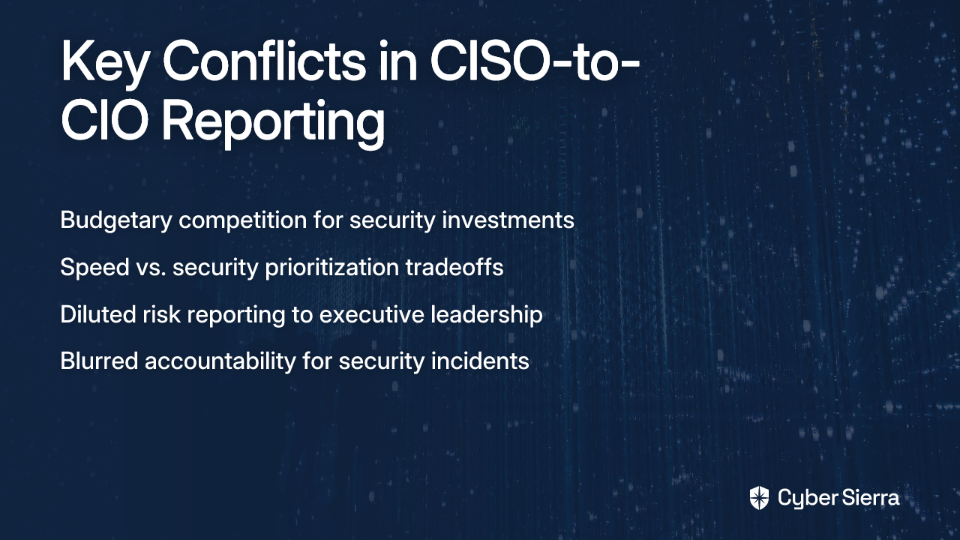
These priorities naturally clash in several critical ways:
Budgetary Battles
When the CISO's budget exists as a line item in the CIO's financial plan, crucial security investments (like a new endpoint detection and response solution) must compete directly with IT operational needs (such as server upgrades or new software licenses). In this competition, security initiatives often lose out.
Operations vs. Security Prioritization
CIOs face constant pressure to deliver new capabilities quickly and maintain high system uptime. This can lead to scenarios where a CIO might push to delay critical patching to avoid system downtime or fast-track a new application launch without adequate security testing to meet a business deadline.
"The CISO shouldn't be reporting to the CIO in the first place - they have a natural inherent tension already," explains another security professional. This tension isn't necessarily bad—it's actually necessary for proper checks and balances. However, when one reports to the other, that healthy tension becomes imbalanced.
Diluted Risk Reporting
Perhaps most concerning is how this structure can dilute critical security information. A CISO reporting to a CIO may feel pressured to soften or downplay security audit findings to avoid making their boss's department look bad. This prevents unfiltered, objective risk assessments from reaching the CEO and board—exactly the people who need this information most.
The Scapegoat Dilemma
The CISO-to-CIO reporting structure creates another insidious problem: blurred accountability. When a security incident occurs, who's really responsible? Was it the CISO's failure to implement proper controls, or the CIO's failure to approve the budget for those controls?
This ambiguity creates what many security professionals describe as a scapegoat scenario. As one CISO bluntly put it, "Regardless of how good you are at your job as CISO, YOU WILL get blamed for most security-related incidents even if they are the fault of a shitty superior."
Instead of fostering a "no-blame culture" that encourages transparency and proactive risk reporting, this structure can create a culture of fear. Security teams may become hesitant to raise concerns, knowing they could become the fall person if something goes wrong. This directly contradicts best practices in security governance, where open communication about vulnerabilities is essential.
What the Data Shows
The impact of reporting structures isn't just theoretical—it's measurable. Research consistently shows that organizations with independent CISO reporting lines demonstrate better security outcomes.
A study by ISACA found a stark difference in security confidence based on reporting lines. Approximately 40% of respondents whose cybersecurity functions report to a CISO felt confident in their ability to detect and respond to threats, compared to only 31% for those reporting to a CIO.
Additionally, research from Nemertes Research concludes that greater cybersecurity success correlates directly with the CISO reporting to top-level business executives (like the CEO) rather than a technology executive.
Board engagement also plays a crucial role. Companies with a CISO are nearly twice as likely to improve security initiatives through board engagement, according to CSO Online. This engagement becomes diluted when security concerns must filter through the CIO before reaching the board.
The Blueprint for Effective Governance
So what's the alternative? Security experts and researchers point to several more effective reporting structures:
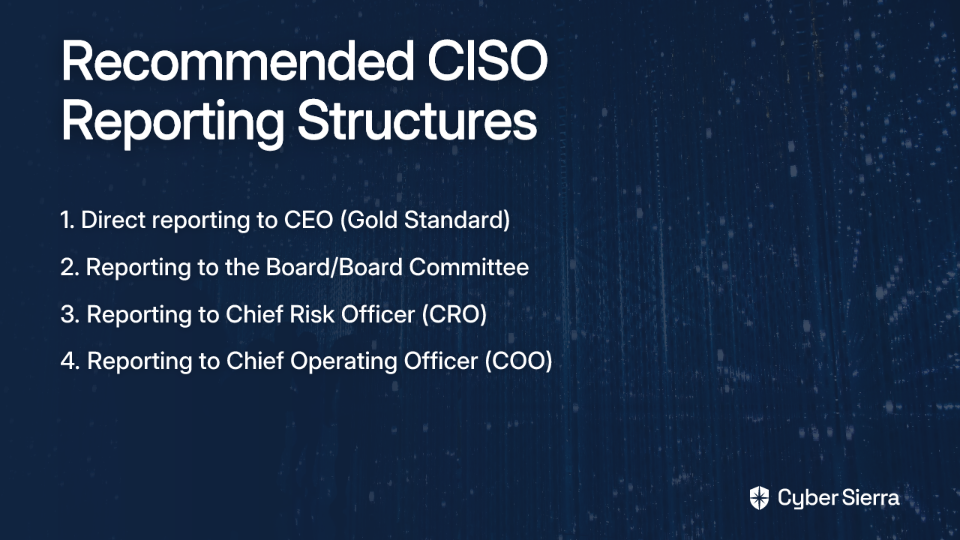
The Gold Standard: CISO Reporting to the CEO
This is widely considered the most effective option. It positions cybersecurity as a core business function and an enterprise-wide risk management issue, not just an IT problem. It gives the CISO the necessary authority and resources, and ensures the CEO receives unfiltered information about the organization's security posture.
"In an ideal world: Always to the CEO and not the CIO/CTO," states one security professional. This structure acknowledges that modern cybersecurity is a business risk that transcends technology.
Alternative Effective Structures
If reporting to the CEO isn't feasible, several other options still maintain the CISO's independence:
CISO to the Board/Board Committee: This provides the highest level of oversight and independence. As one cybersecurity professional warned, "When you see CISO reporting to CIO and not to the board, run. Run as fast as you can."
CISO to the Chief Risk Officer (CRO): This is a strong option for organizations with a mature enterprise risk management program. It correctly frames cyber risk as a component of overall business risk.
CISO to the Chief Operating Officer (COO): This structure recognizes that cybersecurity is a vital operational necessity, essential for business continuity. It gives the CISO independence from IT priorities while maintaining executive visibility.
Foundations of Good Governance
An effective reporting structure is part of a larger governance strategy. According to the Cybersecurity and Infrastructure Security Agency (CISA), strong cybersecurity governance includes defined accountability frameworks, decision-making hierarchies, and a clear understanding of risks related to business objectives.
Case studies from states like Georgia and Michigan demonstrate how to build enterprise-wide governance that properly positions security leadership.
Restructuring for Resilience
The CISO-to-CIO reporting line is an organizational anti-pattern that creates conflicts of interest, stifles accountability, and demonstrably leads to weaker security outcomes. As cyberattacks become more sophisticated and damaging, organizations cannot afford to maintain structures that undermine their security posture.
Elevating the CISO to a peer of the CIO, reporting directly to the CEO, CRO, or the board, is not just a change to the org chart—it's a strategic declaration that the organization takes cybersecurity seriously. It acknowledges that in today's threat landscape, security is a business imperative that deserves its own seat at the executive table.
This restructuring provides several immediate benefits:
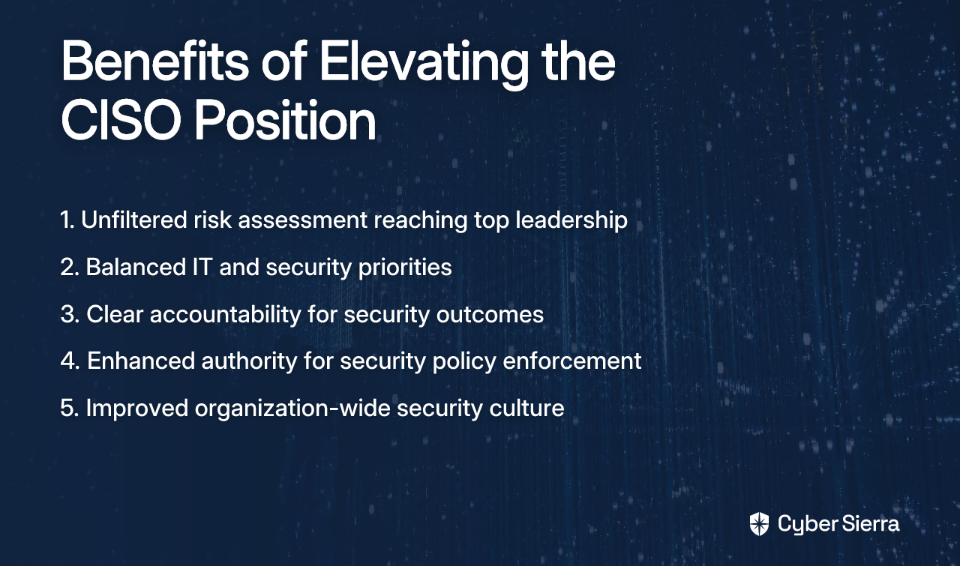
- Unfiltered risk assessment: The board and CEO receive direct, unvarnished information about security posture and risks.
- Balanced priorities: Security requirements are evaluated alongside, not subordinate to, IT operational needs.
- Clear accountability: Responsibilities for security outcomes are clearly defined.
- Enhanced authority: The CISO has the necessary authority to implement and enforce security policies across the organization.
- Improved security culture: The elevation signals to the entire organization that security is a top-level concern.
Conclusion
Boards and executive leadership must ask themselves: Is our CISO empowered to protect the organization, or are they constrained by the very department they are meant to oversee?
A healthy tension between the CISO and CIO is necessary; subordination is a liability. In an era where a single security breach can damage reputation, destroy customer trust, and trigger regulatory penalties, proper security governance isn't optional—it's essential.
Restructuring the CISO's reporting line is one of the most impactful decisions a company can make to build true, long-term cyber resilience. It may require overcoming organizational inertia and political challenges, but the alternative—leaving your security watchdog reporting to the person they're watching—is a risk no modern organization should accept.

As one security professional succinctly put it: "The CISO should NOT report to the CIO. There should be some natural tension between them." That tension, properly structured, isn't a problem to solve—it's a feature that keeps your organization secure.
Frequently Asked Questions
Why shouldn't a CISO report to a CIO?
A CISO should not report to a CIO because it creates a fundamental conflict of interest between security priorities and IT operational goals. The CIO's mission is to ensure system availability, performance, and speed of delivery, which can directly clash with the CISO's mission to manage risk and protect the organization. This structure often leads to security budgets being cut, critical risks being downplayed, and a lack of objective security information reaching executive leadership.
Who is the ideal person for a CISO to report to?
The ideal reporting line for a CISO is directly to the Chief Executive Officer (CEO). This structure positions cybersecurity as a core business function and an enterprise-wide risk, not just an IT problem. It grants the CISO the necessary authority and independence and ensures the CEO and board receive unfiltered, direct information about the organization's security posture.
What are the best alternative reporting structures if the CISO can't report to the CEO?
If reporting to the CEO is not feasible, effective alternatives include having the CISO report to the Chief Risk Officer (CRO), the Chief Operating Officer (COO), or directly to the board of directors or a board committee. Each of these options preserves the CISO's independence from the IT department, which is crucial for effective security governance. They frame cyber risk as a component of either overall business risk (CRO) or operational integrity (COO).
How does changing the CISO's reporting structure improve security?
Changing the CISO's reporting structure to be independent of the CIO directly improves security by enabling unfiltered risk assessment, creating balanced priorities, and clarifying accountability. An independent CISO can present unvarnished facts about security vulnerabilities to top leadership without fear of reprisal. This ensures security needs are evaluated on their own merit alongside—not subordinate to—IT goals, which leads to better-informed decisions, appropriate resource allocation, and a stronger security culture.
What is meant by "healthy tension" between a CISO and CIO?
"Healthy tension" refers to the productive, natural opposition that exists when the CISO and CIO operate as peers. The CIO is driven to innovate and deliver services quickly, while the CISO is responsible for ensuring those innovations are secure. This tension forces collaboration and compromise, leading to solutions that balance speed and safety. For example, they might negotiate a project timeline that accommodates both a fast-to-market launch and adequate security testing, a balance that is lost when one role is subordinate to the other.
