Top 6 Methods to Reduce Compliance Fatigue in Your Security Team


Join thousands of professionals and get the latest insight on Compliance & Cybersecurity.
Summary
- Compliance fatigue, driven by manual processes, increases security risks and contributes to long breach detection times, which averaged 204 days in 2023.
- Reduce redundant work by unifying compliance frameworks like ISO 27001 and NIST, mapping overlapping controls to create a "test once, comply many" system.
- Overcome internal resistance by securing executive buy-in to formalize security policies and fostering a culture of shared responsibility.
- Transition from periodic audits to proactive risk management using automation and continuous monitoring. Cybersierra's GRC platform automates evidence collection and control monitoring to streamline this process.
Are you tired of being the "compliance police," struggling to enforce rules without alienating colleagues? Do you face constant pushback when implementing security measures, or feel the emotional toll of lacking support from leadership? If so, you're experiencing what security professionals know all too well: compliance fatigue.
Compliance fatigue is more than just being busy. It's the exhaustion and cynicism that builds from the repetitive, often manual, and seemingly endless cycle of audits, evidence collection, and chasing down stakeholders. This fatigue doesn't just affect team morale—it creates serious security vulnerabilities.
Consider this: The average time to identify and contain a data breach was 204 days in 2023, a gap that fatigue-driven errors can significantly widen. Meanwhile, non-compliance can lead to substantial financial penalties and reputation damage.
This article outlines six proven methods to break this cycle, reduce fatigue, and build a more effective and resilient security program.

1. Embrace Automation and Continuous Monitoring
Manual processes are the bedrock of compliance fatigue. Repetitive tasks like evidence gathering, control testing, and reporting consume valuable time and are prone to human error.
The Solution: Automation
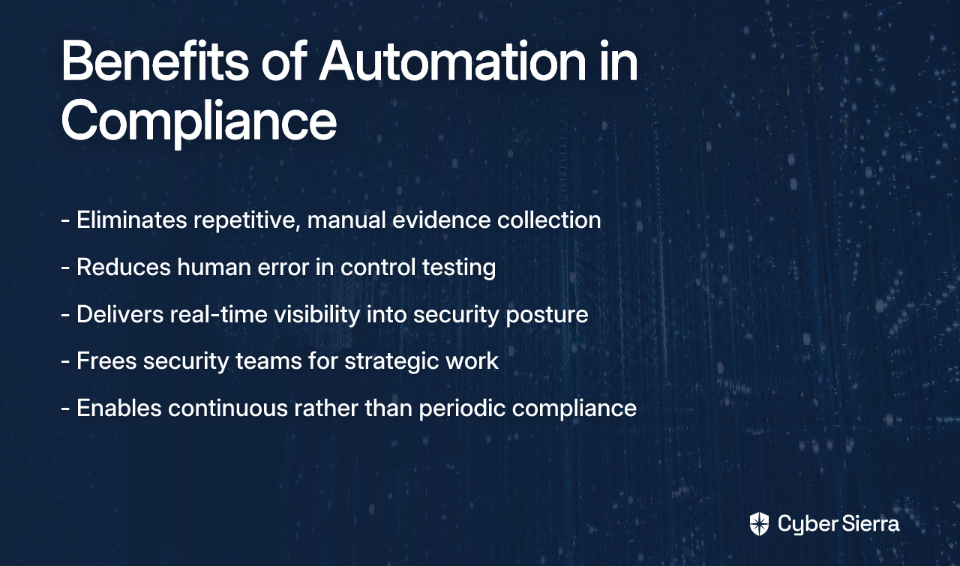
Leveraging technology to automate repetitive compliance tasks frees your team for more strategic work like risk analysis and mitigation. The benefits of automation include:
- Reduction of human errors
- Time savings and resource optimization
- Enhanced real-time monitoring of compliance activities
- Improved accuracy in documentation and reporting
Implement Continuous Control Monitoring (CCM)
Shift from periodic, snapshot-in-time audits to ongoing, real-time visibility into your security controls. CCM helps you proactively fix security gaps instead of discovering them during an audit.
Platforms like Cyber Sierra's Continuous Control Monitoring (CCM) module are designed specifically for this purpose. They provide a central controls repository with near real-time updates, automate control testing, and offer actionable risk intelligence, transforming security from a periodic chore into a continuous, automated process.
Use an Integrated GRC Platform
A Governance, Risk, and Compliance (GRC) platform centralizes compliance efforts by automating data collection, risk assessments, control monitoring, and reporting across multiple frameworks, significantly reducing the manual burden on your team.
2. Unify and Rationalize Compliance Frameworks
Many organizations must comply with multiple frameworks (NIST, ISO 27001, PCI DSS, GDPR, etc.), each with its own set of controls, leading to duplicated effort and increased fatigue.
The Solution: Map and Identify Framework Overlap
Gain an in-depth understanding of the core elements of each framework you adhere to:
- COBIT: Bridges the gap between control requirements, technical issues, and business risks
- NIST Cybersecurity Framework: Enhances security and resilience for organizations of all sizes
- ISO 27000 series: Implements processes and controls to support information security
Step-by-step process:
- Identify Uniform Requirements: Review all relevant frameworks to find common or overlapping controls.
- Produce a Control Mapping Matrix: Create a unified control set in a structured document that aligns controls from different frameworks. This ensures you can "test once, comply many."
Control Mapping Example
| ISO 27001 Control | NIST Control | Control Objective |
|---|---|---|
| A.9.1.1 Access Control Policy | AC-1 Access Control Policy | Document access controls formally. |
| A.9.2 User Access Management | AC-2 Account Management | Ensure access is aligned to job requirements and follows least privilege. |
| A.9.4 System/Application Access Control | AC-3 Access Enforcement | Set authentication and role-based security requirements. |
By mapping controls across frameworks, you eliminate redundant work and create a more efficient compliance process, as recommended by ISACA.
3. Foster a Culture of Shared Responsibility, Not Blame
Security teams often feel isolated, fighting an uphill battle against resistant colleagues. A key pain is "the difficulty of fostering a culture of compliance without cooperation from others," as noted by security professionals.
The Solution: Build a Positive Compliance Culture
Promote Compliance as a Shared Responsibility
Frame compliance as a shared goal that protects the entire organization, not a set of rules imposed by the security team. It's about "winning hearts and minds" rather than enforcing regulations.
Ensure Leadership Support and Involvement
Visible commitment from leadership is non-negotiable. When leaders champion compliance, it becomes integral to the company's success. According to the Risk and Resilience Hub, leadership engagement is critical to embedding compliance within organizational culture.
Encourage Open Communication
Create channels for feedback on compliance challenges. When people feel heard, they become part of the solution rather than contributing to the problem.
Celebrate Compliance Achievements
Recognize teams and individuals who demonstrate strong compliance practices. Positive reinforcement is more effective than constant criticism in building a culture of compliance.
Provide Continuous Training and Education
An undertrained workforce is a major source of compliance failures and frustration. Move beyond boring annual training to implement engaging, continuous learning opportunities.
Tools like Cyber Sierra's Employee Security Training module can help build this human firewall. By using interactive quizzes and simulated counter-phishing campaigns, it makes security education an ongoing, engaging process rather than a one-time chore, fostering a company-wide security-conscious culture.
4. Secure Executive Buy-In and Formalize Governance
Security teams feel powerless without formal authority. A common pain is "struggling with the lack of genuine commitment from management regarding compliance enforcement," as highlighted in discussions among security professionals.
The Solution: Formalize Your Mandate
Create Enforceable Policies
- Draft clear, detailed policies outlining what is and isn't permissible.
- These policies must be signed by top management—the executive team or even the Board of Directors—to give them legitimacy and make them enforceable.
Without formal policies that have executive backing, security teams are left trying to enforce best practices without any real authority, leading to frustration and ineffectiveness.
Communicate Risk in Business Terms
Stop talking about vulnerabilities and start talking about business impact. Frame non-compliance in terms of:
- Financial loss (fines, lost contracts)
- Reputational damage
- Operational disruption
Present a clear picture: "Here are the consequences of noncompliance. Here is the cost of compliance/partial compliance." This helps leaders make informed, risk-based decisions and understand why compliance measures are necessary business investments, not just technical requirements.
5. Streamline Documentation and Simplify Processes
Cumbersome, bureaucratic documentation and complex processes add unnecessary friction and contribute significantly to compliance fatigue.
The Solution: Simplify and Integrate
Streamline Documentation
Avoid overly long and complex documents. Procedures should be concise, clear, and easily accessible to those who need them. According to ISACA, simplifying documentation is a key strategy for reducing compliance fatigue.
Integrate Compliance into Daily Operations
Don't treat compliance as a separate activity. Embed checks and controls into standard workflows. When compliance is part of the normal process, it becomes second nature instead of an interruption. The Risk and Resilience Hub emphasizes that this integration is essential for sustainable compliance practices.
Develop a Consistent Process
Define a clear, consistent process for managing compliance, from risk assessment to issue remediation. This creates predictability and reduces chaos, as noted by Crowe.
6. Shift to Proactive Risk Management
A reactive compliance model means you're always putting out fires. This is stressful, inefficient, and contributes significantly to team burnout.
The Solution: Get Ahead of the Issues
Proactive Threat Intelligence
Don't wait for an audit to find your weaknesses. Use tools to continuously scan your network and cloud infrastructure for vulnerabilities and misconfigurations.
A proactive stance requires a clear view of your attack surface. Cyber Sierra's Threat Intelligence module provides this through comprehensive security scorecards and vulnerability scanning, enabling teams to identify and remediate risks before they are exploited.
Third-Party Risk Management (TPRM)
Your vendors are part of your attack surface. Manually managing vendor questionnaires and tracking their compliance is a major source of fatigue.
Automated TPRM solutions can dramatically reduce this burden. By simplifying vendor assessments and providing continuous monitoring of third-party security posture, they allow your team to manage supply chain risk efficiently and proactively.
Validate Controls with Independent Consultants
Engage qualified external experts to review the design and effectiveness of your controls. They can provide a fresh perspective and help identify redundancies or gaps you may have missed, further reducing the burden on your internal team.
Conclusion: Moving Toward Continuous Compliance
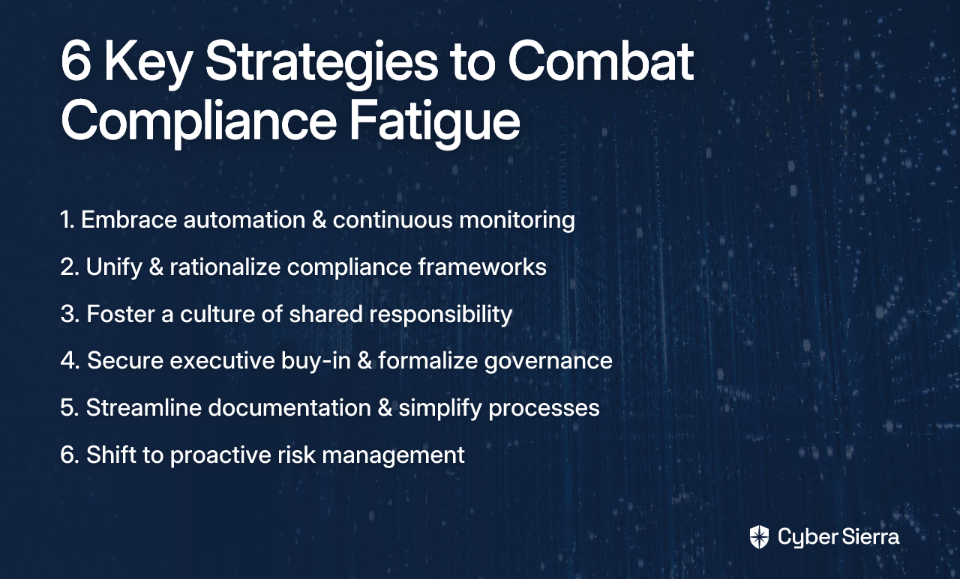
Combating compliance fatigue isn't just about making your security team's life easier—it's a strategic imperative for building a stronger, more resilient organization. By implementing these six methods:
- Automating with CCM and GRC platforms
- Unifying frameworks through control mapping
- Building a positive, shared-responsibility culture
- Formalizing governance with executive buy-in
- Simplifying documentation and processes
- Shifting to proactive risk management
You can transform compliance from a dreaded, exhausting cycle into a continuous, integrated part of your business operations.
The result? A more engaged security team, fewer compliance gaps, faster response to threats, and an organization that's always audit-ready. The goal is to achieve a state of continuous compliance, where security is an integrated and sustainable part of your business—not a burden that leads to fatigue and vulnerability.
Remember, compliance isn't just about checking boxes; it's about building a security-conscious organization that can confidently face tomorrow's challenges.
Frequently Asked Questions
What is compliance fatigue?
Compliance fatigue is the exhaustion and cynicism experienced by security professionals due to the repetitive, manual, and endless cycle of compliance tasks. It stems from activities like manual evidence collection, chasing stakeholders, and preparing for audits, leading to decreased morale, human error, and increased security vulnerabilities.
How can automation reduce compliance fatigue?
Automation reduces compliance fatigue by eliminating repetitive manual tasks such as evidence gathering, control testing, and reporting. This frees up security teams to focus on more strategic initiatives like risk analysis and mitigation, while also reducing human error, improving accuracy, and providing real-time visibility into the organization's compliance posture.
What is the best way to manage multiple compliance frameworks?
The best way to manage multiple compliance frameworks is to unify them by identifying and mapping overlapping controls. This "test once, comply many" approach involves creating a unified control set that aligns requirements from different frameworks (like ISO 27001, NIST, and PCI DSS), which eliminates redundant work, saves time, and creates a more efficient and streamlined compliance process.
Why is executive buy-in crucial for overcoming compliance fatigue?
Executive buy-in is crucial because it gives the security team the formal authority and resources needed to enforce compliance policies effectively. When leaders champion compliance, it transforms from a siloed security task into a shared organizational priority, making it easier to secure cooperation from other departments, formalize governance, and build a sustainable culture of security.
How do you shift from a reactive to a proactive compliance strategy?
Shifting from a reactive to a proactive compliance strategy involves moving from periodic audits to continuous risk management. This can be achieved by implementing continuous control monitoring (CCM) to get real-time visibility into security controls, using threat intelligence to identify vulnerabilities before they are exploited, and automating third-party risk management (TPRM) to manage supply chain risks proactively.
What is the difference between continuous control monitoring (CCM) and traditional audits?
The key difference is that traditional audits provide a periodic, point-in-time snapshot of compliance, whereas Continuous Control Monitoring (CCM) offers ongoing, real-time visibility into your security controls. CCM automates the testing and validation of controls, allowing you to identify and remediate security gaps as they occur, rather than discovering them months later during an audit.