



Translating Cyber Risk to Business Language: Executive Communication Guide


Join thousands of professionals and get the latest insight on Compliance & Cybersecurity.
You've spent weeks on a thorough risk assessment, but when you present it to the board, you're met with blank stares. You're explaining something that's incredibly obvious to you to people that know little to nothing about your field. Sound familiar?
For GRC professionals in regulated industries, this communication gap isn't just frustrating—it's a critical obstacle to building an effective security program. With regulations like the SEC's new disclosure rules, Europe's NIS2 Directive, and the Digital Operational Resilience Act (DORA) now mandating board-level oversight of cyber risk, the ability to translate technical findings into business language isn't optional—it's essential for compliance and organizational resilience.
This guide provides a practical playbook for transforming complex cybersecurity concepts into the language executives understand, enabling you to secure the resources and support your security program needs.
The Great Disconnect: Why Technical Metrics Fail in the Boardroom
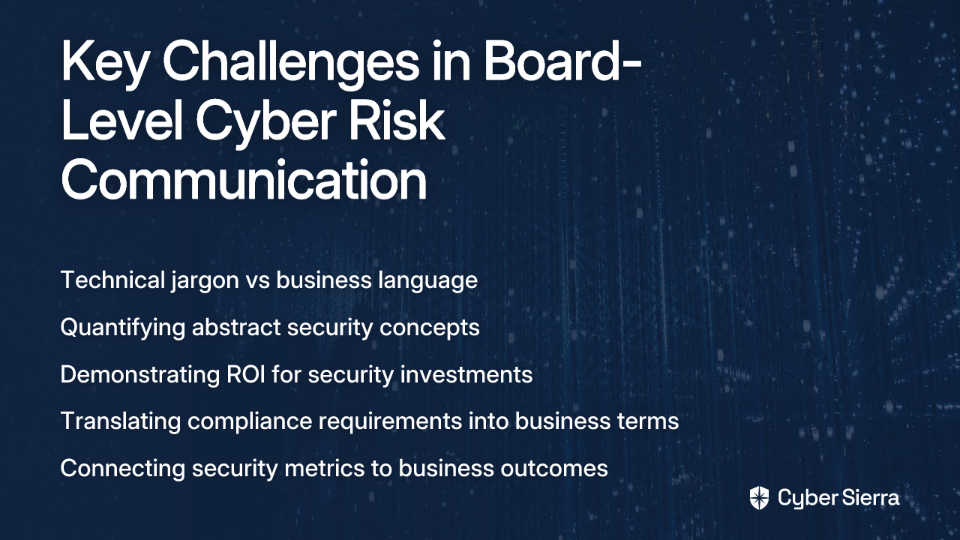
When security professionals present technical data to executives, they often encounter what appears to be disinterest or disengagement. This isn't because executives don't care about security—it's because they don't speak the same language. There are several fundamental reasons for this disconnect:
- Lack of technical understanding: Most C-suite executives don't have backgrounds in cybersecurity. Terms like "CVE scores," "zero-day vulnerabilities," or "threat vectors" are as foreign to them as complex financial derivatives might be to you.
- Focus on overarching business issues: Executives are primarily concerned with revenue, market share, competitive positioning, and profitability. They need to understand how cybersecurity relates to these priorities.
- Information overload: Presenting too many technical metrics or complex data points can lead to cognitive overload, causing executives to disengage from the conversation entirely.
- Misaligned priorities: While you might be focused on patching critical vulnerabilities, executives are thinking about quarterly targets, investor expectations, and strategic initiatives.
The goal isn't to transform executives into cybersecurity experts. Rather, it's to provide them with the business context necessary to make informed decisions about risk acceptance, mitigation strategies, and security investments.
The Rosetta Stone: Shifting from Cyber Risk to Business Impact
To bridge this gap, you need to reframe cybersecurity risk in business terms that resonate with executive concerns. Start by redefining cyber risk:
Technical Definition: "A critical vulnerability in our web application with a CVSS score of 9.8."
Business Definition: "Cybersecurity risk is the possibility of financial loss, operational disruption, or reputational damage due to failures or breaches in digital systems."
The key to effective executive communication is translating technical metrics into these three pillars of business language:
- Financial Impact: How much could this cost us? (e.g., regulatory fines, legal settlements, lost revenue, incident response costs)
- Operational Impact: How will this affect our ability to do business? (e.g., system downtime, supply chain disruption, productivity loss)
- Reputational Impact: How will this affect our brand and customer trust? (e.g., customer churn, negative media coverage, decreased market valuation)
When discussing risk components with executives, translate each element into business terms:
- Assets: "Our crown jewels include customer data, intellectual property, and critical applications that generate $10M in daily revenue."
- Threats: "Ransomware gangs are increasingly targeting companies in our industry, with average ransom demands of $2.5M."
- Vulnerabilities: "Our current authentication system lacks multi-factor authentication, which was exploited in 80% of breaches in our industry last year."
- Impact: "A successful ransomware attack could cause a 5-day operational shutdown, resulting in $50M in lost revenue and recovery costs."
- Likelihood: "Based on current controls, we estimate a 30% chance of experiencing this scenario in the next 12 months."
This approach transforms abstract technical concepts into concrete business risks that executives can evaluate alongside other organizational priorities.

A Practical Toolkit for Quantifying Cyber Risk
To move beyond subjective risk descriptions like "high," "medium," and "low," you need tools that quantify cyber risk in financial terms. This is where Cyber Risk Quantification (CRQ) becomes invaluable.
CRQ shifts the conversation from "this is a high-risk vulnerability" to "this vulnerability represents a potential $2M loss." This financial framing helps executives make informed decisions about security investments and risk acceptance.
One practical, free tool you can start using immediately is the CIS CSAT Ransomware Business Impact Analysis Tool. This resource was specifically designed to "help organizations assess cyber risk in financial terms to communicate effectively with business leaders," according to CIS.
The tool uses the CIS Controls and Community Defense Model to estimate the likelihood of a ransomware incident and calculate the potential financial impact across key business categories:
- Productivity Costs: Lost revenue and staff wages during downtime
- Response Costs: Forensics, PR, and incident response expenses
- Replacement Costs: Hardware or software that needs replacement
- Legal Costs: Regulatory fines, legal fees, and penalties
- Competitive Advantage Costs: Loss of intellectual property or strategic plans
- Reputation Costs: Customer churn and brand value degradation
You can access this valuable resource directly at https://bia.cisecurity.org/ and download the Quick Start Guide at https://workbench.cisecurity.org/files/3927.
By quantifying risk in financial terms, you create a common language that bridges the gap between cybersecurity and business priorities.
Your Executive Communication Playbook: 7 Actionable Lessons
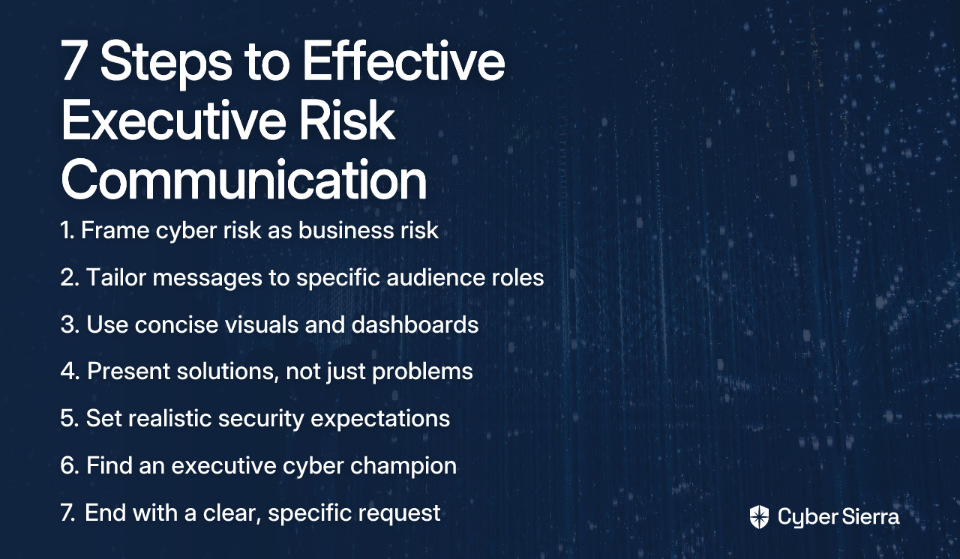
Now that you understand the importance of translating technical risk into business language, here's a step-by-step guide to effectively communicate with executives:
1. Frame Cyber Risk as Business Risk
Always lead with the business impact. Instead of saying "We have 500 critical vulnerabilities," say "Our current vulnerability level exposes us to a potential week-long manufacturing shutdown, costing an estimated $5M in lost revenue."
2. Tailor the Message to Your Audience
Know your board members and customize your communication accordingly:
- For the CFO: Focus on ROI, potential financial losses, and cost-efficiency of security investments
- For the COO: Emphasize operational resilience, system availability, and business continuity
- For the Legal Counsel: Highlight compliance requirements, liability concerns, and legal obligations
3. Use Concise Visuals
Leverage executive dashboards and simple visualizations to show trends and key metrics at a glance. A red/yellow/green status indicator for key risk areas is often more effective than a detailed spreadsheet. Remember, executives typically have limited time and need to grasp information quickly.
4. Make Cybersecurity Actionable
Never present a problem without a proposed solution. For each risk, outline:
- Necessary actions to address the risk
- Required resources (budget, personnel)
- Clear timeline for implementation
- Expected outcomes and risk reduction
5. Set Realistic Expectations
Educate the board that 100% security is neither achievable nor cost-effective. Frame security as a risk management exercise focused on resilience—the organization's capacity to detect, respond, and recover from incidents while minimizing business impact.
6. Find a "Cybersecurity Champion"
Identify a senior executive or board member who understands the importance of cybersecurity and can act as an advocate for your initiatives. This champion can help translate your technical concerns into business language and lend credibility to your proposals.
7. Clarify the 'Ask'
End every presentation with a clear, concise request: "We are asking for a budget of $250,000 to implement an Endpoint Detection and Response solution. This investment will reduce the likelihood of a successful ransomware attack by an estimated 60%, mitigating a quantified risk of $3M."
Aligning Communication with Governance and Frameworks
Many GRC professionals feel overwhelmed by the complexity of security frameworks. As one Reddit user noted, "The complexity of the existing frameworks leaves us feeling overwhelmed and unsure where to start." However, these frameworks can actually serve as valuable communication tools when properly positioned.
Rather than presenting frameworks as technical checklists, position them as business tools that demonstrate due diligence to regulators, insurers, and customers. Here's how to map common frameworks to business conversations:
- NIST Cybersecurity Framework (CSF): Use its five functions (Identify, Protect, Detect, Respond, Recover) to structure your reports and show a holistic view of your program's maturity. This framework is particularly effective for explaining program completeness to executives.
- CIS Controls v8: Refer to these as the foundational "cyber hygiene" actions that provide the biggest risk reduction for the investment. Link this back to the CIS BIA tool mentioned earlier to show how implementing these controls reduces financial risk.
- ISO/IEC 27001: Position this as the international gold standard for an Information Security Management System (ISMS), often a requirement for winning enterprise contracts or operating globally.
Frameworks also help establish clear governance by defining roles and responsibilities for cyber risk management across the organization. This reinforces that cybersecurity is a shared responsibility, not just an IT problem.
Conclusion
The bridge between technical risk and business strategy is built with the language of money, operations, and reputation. To secure executive support, GRC professionals must become skilled translators who can convert technical findings into business impacts.
By quantifying risk in financial terms, tailoring your message to your audience, and making cybersecurity actionable, you transform security from a perceived cost center into a strategic business enabler. This approach not only improves communication but also elevates your role from a technical specialist to a trusted business advisor.
As threats continue to evolve, including AI-augmented attacks and sophisticated supply chain compromises, the ability to clearly communicate cyber risk to leadership will become even more critical for business survival and success. Master this skill, and you'll not only improve your organization's security posture but also advance your career as an indispensable security leader who speaks the language of business.
Frequently Asked Questions
How do you explain cyber risk to the board?
The most effective way to explain cyber risk to the board is to translate technical issues into business impacts, focusing on potential financial, operational, and reputational damage. Instead of discussing vulnerabilities and CVSS scores, frame the conversation around how a security incident could affect revenue, disrupt operations, or harm the company's brand. This approach helps executives understand cybersecurity as a core business risk, not just a technical problem.
Why do executives often disengage during cybersecurity presentations?
Executives often disengage because technical metrics and jargon are disconnected from their primary concerns, which are business-oriented priorities like revenue, profitability, and market share. Presenting a long list of technical data can lead to information overload. To keep them engaged, you must connect security data directly to business objectives and strategic goals.
What is Cyber Risk Quantification (CRQ)?
Cyber Risk Quantification (CRQ) is the process of evaluating and expressing cyber risk in financial terms, such as potential dollar losses. CRQ moves the conversation from subjective labels like "high-risk" to concrete financial figures, for example, "This risk represents a potential $2M loss." This helps executives compare cyber risks against other business risks and make informed, data-driven decisions about security investments.
What is the biggest mistake to avoid when asking for a security budget?
The biggest mistake is presenting a problem without a clear, actionable solution and a well-defined "ask." Simply highlighting risks is not enough. You must follow up with a concrete plan that outlines the necessary actions, required resources, a timeline, and the expected reduction in risk. Always end your presentation with a specific request tied to a measurable outcome.
How do I use frameworks like NIST or CIS in board meetings?
Position security frameworks not as technical checklists, but as business tools that demonstrate due diligence and measure the maturity of your security program. For example, use the five functions of the NIST Cybersecurity Framework (Identify, Protect, Detect, Respond, Recover) to structure your report and provide a holistic overview. Refer to the CIS Controls as foundational actions that offer the greatest risk reduction for the investment, linking them to quantifiable financial outcomes.
