



How to Present Cyber Risk to Executive Leadership Effectively


Join thousands of professionals and get the latest insight on Compliance & Cybersecurity.
Summary
- Many cybersecurity reports are ineffective because they focus on technical details instead of the financial and business impact that leadership understands.
- To gain executive support, security initiatives must be directly linked to strategic business goals, such as protecting revenue or ensuring operational uptime.
- Quantify risks in financial terms using frameworks like FAIR and present findings with clear, visual dashboards and compelling stories to drive action.
- Automating risk quantification and reporting with a unified GRC platform simplifies the creation of compelling, executive-level communications.
You've spent weeks analyzing vulnerabilities, gathering data, and preparing a comprehensive cybersecurity risk report. But when you present it to your executive leadership, you're met with blank stares, dismissive nods, or worse—defensiveness and pushback. If this scenario feels painfully familiar, you're not alone.
"Reporting risks to leadership can be fraught with defensiveness and difficult dynamics," notes a security professional in a recent online discussion. Another points out that "technical risks are often overlooked by C-level executives" because they lack context and business relevance.
The problem isn't your expertise or the validity of your concerns—it's a fundamental communication gap. While security teams speak in terms of vulnerabilities, patches, and technical controls, executives think in terms of financial impact, strategic objectives, and business risk.
This article offers a practical framework for bridging this gap—translating complex cybersecurity risks into compelling business narratives that drive action and secure investment.
Why Your Current Risk Reports Are Falling Flat
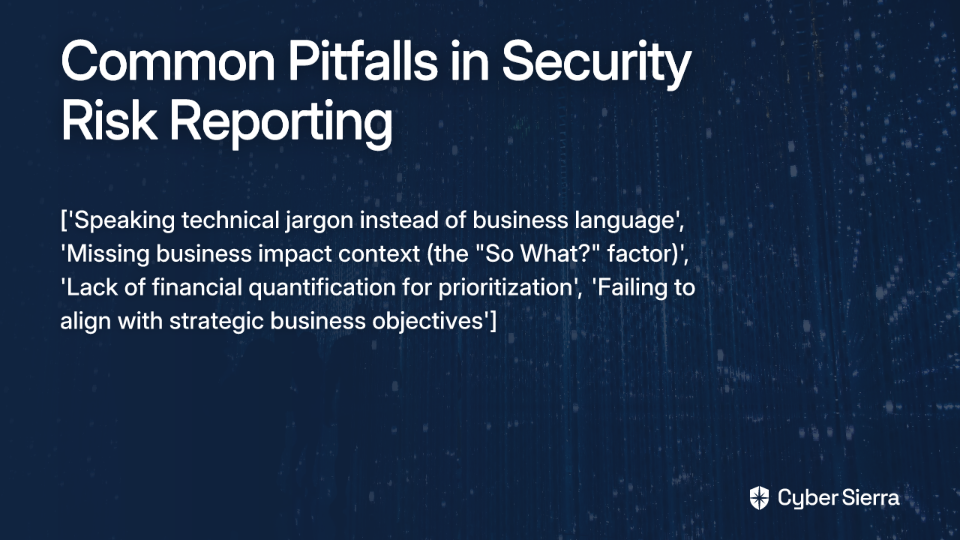
Before we discuss solutions, let's diagnose the common pitfalls that lead to disengagement:
You're Speaking the Wrong Language
When you dive into the technical details of a stored XSS vulnerability or an unpatched server, executives aren't dismissing the importance—they're struggling to translate it into business terms they understand. As one CISO bluntly put it, "At the C-level, they speak business risk only."
According to Forbes, overloading presentations with technical jargon is one of the quickest ways to lose executive attention. Remember, most board members don't have cybersecurity backgrounds; they're experts in finance, operations, or business strategy.
You're Missing the "So What?" Factor
Your reports may meticulously document risks but fail to answer the crucial question: "How does this affect the business?"
Without clear connections to revenue, reputation, customer trust, or operational stability, risks remain abstract. This mirrors the frustration many security professionals express that "without quantification tied to business processes, risks may not be taken seriously."
Your Data Lacks Financial Context
Presenting risks without quantifying their potential financial impact makes it impossible for leaders to prioritize investments. Which deserves more attention: the unpatched server or the weak access controls? Without financial context, it's just a list of technical issues competing for limited resources.
The FAIR Institute emphasizes that translating technical risks into financial terms allows stakeholders to understand potential impacts and prioritize investments effectively.
The Foundation: Shifting Your Mindset Before You Speak
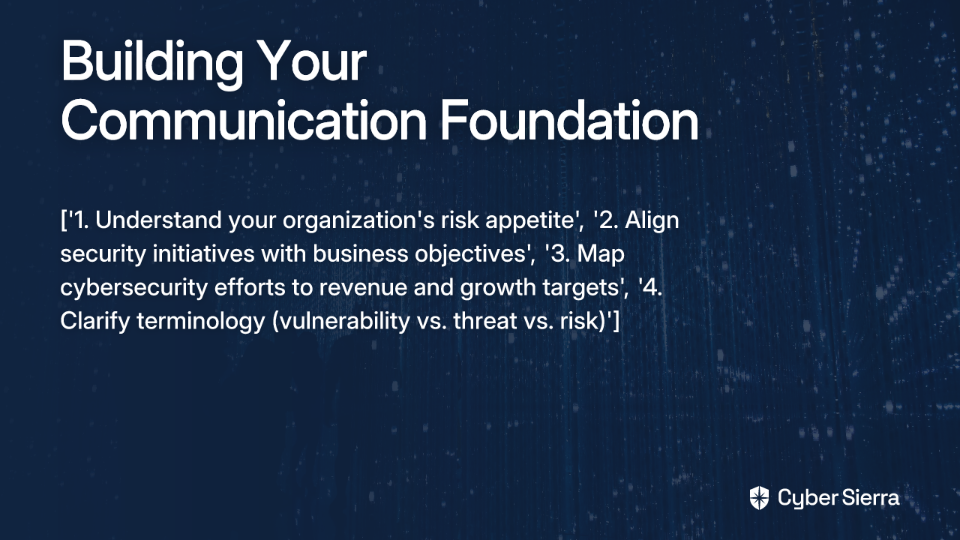
Before creating your next presentation, you need to establish a foundation that bridges the gap between technical details and business strategy:
Know Your Audience & Their Risk Appetite
Organizations have different tolerances for risk based on their industry, regulatory environment, and business model. As highlighted by Forbes, risk appetite can be high, low, or neutral, directly influencing decision-making and resource allocation.
Before proposing security initiatives, understand:
- What level of risk is acceptable to your organization?
- Which business assets are most critical to protect?
- What regulatory requirements must be met?
This knowledge allows you to calibrate your message appropriately. Instead of arguing that all risks must be addressed immediately, you can prioritize based on your organization's unique risk tolerance.
Align with Business Objectives and KPIs
Every security discussion should connect directly to strategic goals. A key insight from cybersecurity professionals is the "need to align cybersecurity strategies with the business goals and key performance indicators (KPIs) of the board."
Instead of saying, "We need to patch these vulnerabilities," reframe it as: "To protect our Q4 revenue target of $10M, we must address this vulnerability that threatens our e-commerce platform's availability."
This approach transforms cybersecurity from a cost center into a business enabler that supports growth, customer trust, and competitive advantage.
Clarify Your Terms: Vulnerability vs. Threat vs. Risk
The distinction between these terms often causes confusion, as noted by multiple security professionals. Providing simple, clear definitions ensures everyone is speaking the same language:
- Vulnerability: A weakness that can be exploited (e.g., an unpatched server)
- Threat: A malicious actor or event that could exploit a vulnerability (e.g., a ransomware gang)
- Risk: The potential for loss or damage when a threat exploits a vulnerability (e.g., the financial and reputational damage from a ransomware attack)
This clarity is essential for productive conversations about cybersecurity priorities.
A Practical Playbook for Communicating Cyber Risk

Now that we've established the foundation, let's build a step-by-step approach to creating compelling risk presentations:
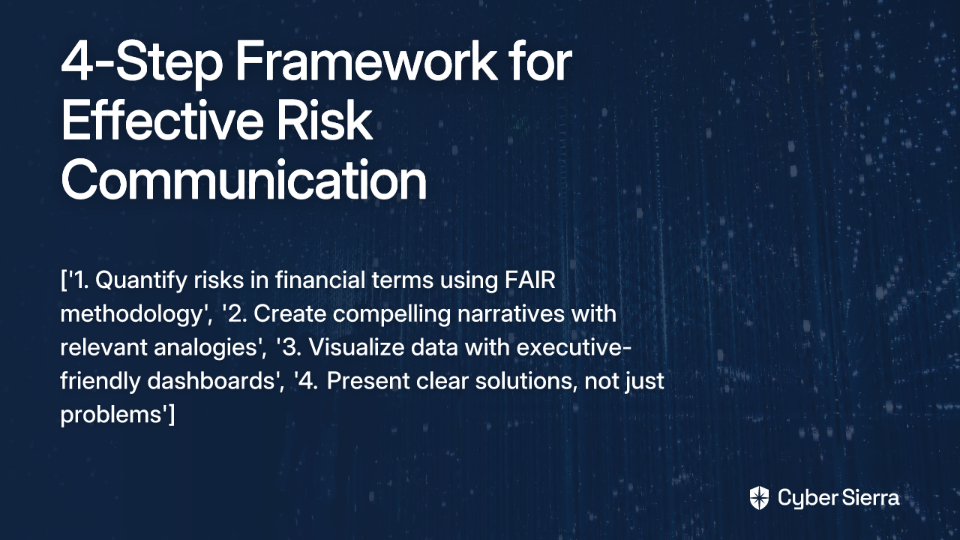
Step 1: Quantify Risk in Financial Terms (The FAIR Approach)
Factor Analysis of Information Risk (FAIR) provides a framework for translating technical risks into business-friendly financial terms. Rather than abstract risk levels (high/medium/low), FAIR helps you calculate probable loss magnitudes.
This shifts the conversation from "We have a stored XSS vulnerability" to "This vulnerability creates a 15% probability of a data breach this year, with a likely financial impact of $2.5 million in fines and remediation costs."
Using scenario analysis makes the consequences tangible. For example, walking through the potential impact of a supply chain attack—from initial detection to remediation costs, regulatory penalties, and customer churn—provides a comprehensive view of the risk landscape.
Step 2: Craft a Compelling Narrative with Storytelling
Effective communication aims to "inform, influence, and alter behavior," and storytelling is a powerful tool to achieve this, according to Forbes.
Use relatable analogies to make complex concepts accessible. For instance, compare a third-party breach to a contagious virus spreading through a school—it highlights how one infected vendor can compromise your entire ecosystem.
Beyond the numbers, discuss qualitative impacts on customer trust, brand reputation, and competitive positioning. These factors often resonate deeply with leadership teams focused on market perception.
Keep your presentations concise with one-page executive summaries that highlight key risks, financial implications, and recommended actions. This respects executives' time constraints while ensuring your message is received.
Step 3: Visualize Data with Executive Dashboards
Dense spreadsheets and text-heavy slides rarely engage executive audiences. Instead, use charts, graphs, and heat maps to help stakeholders quickly grasp complex data.
As suggested by Quodorbis, a powerful executive dashboard should focus on three primary areas:
- Business Impact: Major threats and their potential financial, legal, and operational repercussions
- Cybersecurity Effectiveness: Evidence of how well current security investments are performing (your ROI)
- Actionable Steps: Clear recommendations with required resources, budgets, and timelines
Step 4: Provide Clear, Actionable Recommendations
Don't just present problems—come with solutions. Develop a top-down risk register by interviewing senior leaders to translate their concerns into tangible risk items. This ensures alignment from the start and demonstrates that you understand their business priorities.
Before your main presentation, consider piloting your messaging with industry experts or friendly stakeholders for feedback. This allows you to refine your approach and anticipate potential questions or objections.
Streamlining Risk Communication with Automation
Implementing the playbook above requires significant data collection, analysis, and continuous monitoring. For many organizations, this manual approach quickly becomes overwhelming, especially when "constantly managing a multitude of risks."
Modern GRC (Governance, Risk, and Compliance) platforms can streamline this process, providing the data foundation needed for effective executive communication.
For example, Cyber Sierra's GRC module automates data collection, risk assessments, and reporting across multiple frameworks like SOC 2, ISO 27001, and NIST. This makes it simple to generate the executive dashboards discussed earlier without the manual overhead.
Continuous Control Monitoring (CCM) solutions like Cyber Sierra's CCM platform provide ongoing, near real-time visibility into your security posture. This replaces periodic checks with a live view, helping you identify control gaps before they become major risks and providing concrete data to demonstrate cybersecurity effectiveness to the board.
For organizations concerned about supply chain risks, Third-Party Risk Management (TPRM) tools can automate vendor risk assessments, helping quantify and communicate risks from your extended ecosystem—a major concern for boards in today's interconnected business landscape.

Conclusion: From Technical Guardian to Strategic Advisor
By mastering the art of risk communication, security leaders can elevate their role from technical guardians to strategic business partners. This transformation is essential not just for securing resources, but for building truly resilient organizations where security enables rather than hinders business objectives.
The key strategies to remember:
- Speak the language of business: Focus on financial impact, KPIs, and ROI
- Quantify and contextualize: Use frameworks like FAIR to translate technical issues into business terms
- Tell a story: Use narratives, analogies, and visualizations to make data memorable and impactful
- Be proactive and solution-oriented: Present clear, actionable plans, not just problems
For teams looking to move from periodic, manual reporting to a continuous, automated approach, exploring how a unified platform can provide the risk intelligence needed for effective leadership conversations is a worthwhile next step.
By bridging the communication gap, you transform cybersecurity from a cost center into what it truly is—a strategic business enabler that protects your organization's most valuable assets and supports its long-term success.
Frequently Asked Questions
Why do executive leaders often ignore cybersecurity reports?
Executive leaders often ignore cybersecurity reports because they are filled with technical jargon and lack clear business context. To be effective, reports must bridge the communication gap by translating technical issues into financial impact, aligning with strategic business objectives, and answering the crucial "So what?" question for the business.
How can I translate technical cyber risks into business terms?
The most effective way to translate technical risks is to quantify their potential financial impact. Frameworks like Factor Analysis of Information Risk (FAIR) help calculate probable loss. Instead of describing a vulnerability, explain how it could disrupt a key business process, threaten a quarterly revenue target, or result in specific regulatory fines.
What is the difference between a vulnerability, a threat, and a risk?
These terms are often confused but have distinct meanings. A vulnerability is a weakness (e.g., an unpatched server). A threat is a malicious actor or event that could exploit that weakness (e.g., a ransomware gang). Risk is the potential for loss or damage when a threat exploits a vulnerability (e.g., the financial and reputational damage from a successful attack).
What is the FAIR framework and how does it help in risk communication?
FAIR, which stands for Factor Analysis of Information Risk, is a model for quantifying information risk in financial terms. It helps security professionals move away from subjective, qualitative ratings (like "high," "medium," or "low") and instead calculate the probable frequency and magnitude of future loss. This allows executives to compare cybersecurity risks alongside other business risks and make informed investment decisions.
How can I make my cybersecurity presentations more engaging for executives?
To make presentations more engaging, use storytelling and visual data. Craft a compelling narrative with relatable analogies, use executive dashboards with charts and heat maps instead of dense spreadsheets, and provide a one-page executive summary. The goal is to inform, influence, and alter behavior by making complex data accessible and memorable.
What role do GRC platforms play in communicating risk?
Governance, Risk, and Compliance (GRC) platforms automate the data collection, risk assessment, and reporting required for effective communication. They provide a centralized, data-driven foundation to quantify risks, monitor security controls continuously (CCM), and generate executive-friendly dashboards, streamlining the entire process and reducing the manual effort needed to prepare compelling reports.
