



10 Enterprise Risk Management Software Tools For Cybersecurity Compliance


Join thousands of professionals and get the latest insight on Compliance & Cybersecurity.
Summary
- Effective ERM programs can reduce risk events by 63% and operational losses by 35% by shifting from periodic checks to a continuous, proactive security posture.
- The best ERM software prioritizes continuous monitoring, automation, and seamless integration to provide a real-time view of your risk landscape, not just aesthetically pleasing dashboards.
- Before selecting a tool, it's crucial to define your risk management processes to ensure the chosen platform supports your workflows and encourages user adoption.
- Platforms like Cyber Sierra's GRC solution help overcome audit fatigue by automating evidence collection and harmonizing controls across multiple compliance frameworks.
In today's complex regulatory landscape, you've likely noticed that many enterprise risk management software tools seem more focused on creating aesthetically pleasing dashboards than actually solving your fundamental risk management challenges. As one frustrated security professional put it, "Most GRC tools are obsessed with compliance and audit automation and/or painting pretty dashboards for management presentations."
If you're struggling to build a risk culture from scratch, working with asset owners who view risk as either "it happens or it doesn't," or drowning in spreadsheets during manual evidence collection, you're not alone. The right enterprise risk management solution should do more than just help you tick compliance boxes—it should transform your approach to cybersecurity risk.
Organizations with effective ERM programs see a 63% reduction in risk events and a 35% reduction in operational losses. But achieving these results requires moving beyond periodic, manual checks to a proactive, continuous compliance posture.
In this article, we'll evaluate top enterprise risk management software tools based on three critical factors:

- Continuous monitoring capabilities
- Automation features
- Integration with existing security stacks
What to Look for in ERM Software for Cybersecurity Compliance
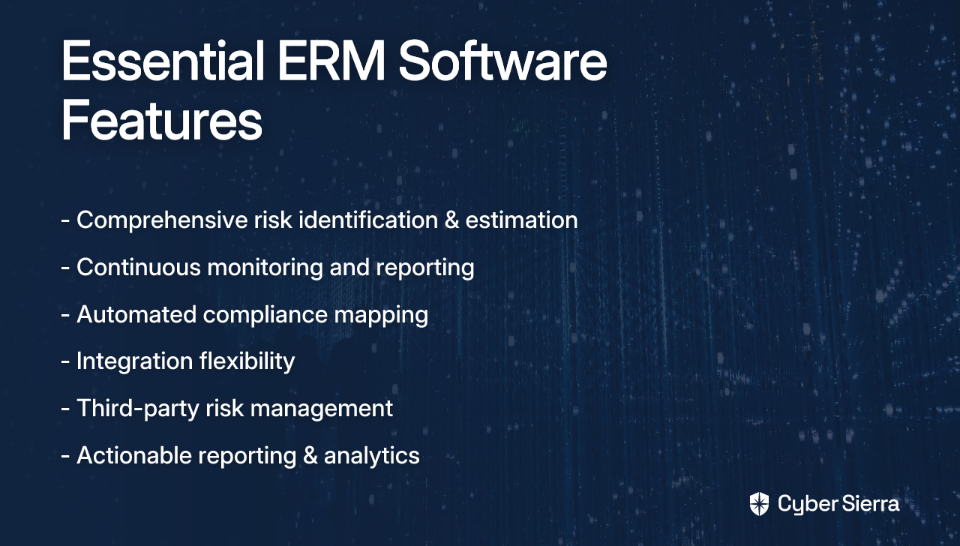
Before diving into specific tools, let's establish what makes an enterprise risk management solution truly effective for cybersecurity compliance:
Comprehensive Risk Identification & Estimation
Your ERM software should go beyond simple "Impact and Likelihood" forms. Many security professionals are "pipe-dreaming about having something to help asset owners estimate risks beyond 'please fill in Impact and Likelihood at your discretion.'" Look for solutions that provide structured risk estimation frameworks, customizable scoring methodologies, and visualization capabilities that help stakeholders understand complex risk scenarios.
Continuous Monitoring and Reporting
Point-in-time assessments are no longer sufficient in today's rapidly evolving threat landscape. Modern ERM solutions should provide ongoing, real-time visibility into your risk posture, automatically detecting changes in your environment and alerting you to emerging threats before they materialize into incidents.
Automated Compliance Mapping
Managing multiple compliance frameworks (NIST, ISO 27001, PCI DSS, GDPR) manually is time-consuming and error-prone. Your ERM tool should automatically map controls across frameworks, showing you where one control satisfies multiple requirements and highlighting gaps in your compliance posture.
Integration Flexibility
To avoid creating data silos that obscure your true risk picture, your ERM solution must integrate seamlessly with your existing technology stack—cloud providers, security tools, business applications, and more. This integration enables automated evidence collection and provides a unified view of your risk landscape.
Third-Party Risk Management (TPRM)
With supply chain attacks on the rise, effective ERM must include capabilities to assess and continuously monitor vendor risk. Look for solutions that streamline vendor assessments and provide ongoing visibility into third-party security postures.
Actionable Reporting & Analytics
Vanity metrics aren't helpful. Your ERM platform should deliver data-driven insights that guide remediation efforts and support strategic decision-making. Dashboards should be customizable for different stakeholders while maintaining a consistent view of organizational risk.
Top 10 ERM Software Tools for 2025
1. Cyber Sierra
Overview: Cyber Sierra is an AI-enabled cybersecurity platform built specifically to transform security from periodic checks to continuous, automated monitoring. It addresses the fundamental challenge many organizations face: moving beyond manual compliance processes to a proactive, always-audit-ready security posture.
Key Features:
- Continuous Control Monitoring (CCM): Creates a central controls repository with near real-time updates across multiple frameworks (NIST, ISO 27001, PCI DSS, GDPR), automating evidence collection and validation.
- Governance, Risk & Compliance (GRC): Streamlines compliance with automated data collection, risk assessments, and comprehensive reporting that reduces audit fatigue.
- Third-Party Risk Management (TPRM): Simplifies vendor risk assessment with continuous 24/7 monitoring that goes beyond point-in-time questionnaires.
- Threat Intelligence: Provides vulnerability scanning and a comprehensive security scorecard to help prioritize remediation efforts.
Best For: Organizations struggling with manual compliance processes, audit fatigue, and the lack of a unified, real-time view of their risk posture across multiple frameworks.
2. Archer (RSA)
Overview: A comprehensive integrated risk management platform with deep capabilities for managing operational, IT, and third-party risks.
Key Features:
- Strong reporting and highly customizable workflows
- Recently launched Archer Evolv, an AI-integrated SaaS version with enhanced user experience
- Extensive support for frameworks like NIST, SOX, PCI, and GDPR
- Risk quantification and scenario modeling
Best For: Large enterprises that require highly customizable compliance and risk management workflows, particularly in heavily regulated industries.
3. AuditBoard
Overview: A platform focused on streamlining audit, risk, and compliance processes with strong integration between IT risk management and broader compliance functions.
Key Features:
- Automated evidence collection and tracking
- Comprehensive risk reporting and visualization
- Workflow management for compliance processes
- Cross-framework control mapping
Best For: Enterprises focused on centralizing compliance management and improving audit visibility and efficiency, especially those with strong internal audit functions.
4. Vanta
Overview: A compliance automation platform that has gained popularity with startups and tech companies due to its ease of implementation and user-friendly interface.
Key Features:
- Real-time monitoring of compliance status
- Over 300 integrations to automate evidence collection
- Pre-built policy templates and controls library
- Support for SOC 2, ISO 27001, HIPAA, GDPR, PCI DSS
Best For: Startups and growing SaaS companies aiming for rapid compliance certification, particularly those pursuing SOC 2 or ISO 27001 for the first time.
5. Drata
Overview: A security and compliance automation platform designed specifically for cloud-first organizations looking to streamline their compliance efforts.
Key Features:
- Real-time control monitoring with robust automation
- Comprehensive dashboard for audit readiness
- Extensive integrations with cloud services and security tools
- Automated evidence collection and continuous compliance monitoring
Best For: Cloud-native tech companies that require continuous compliance assurance and have a modern tech stack requiring minimal manual intervention.
6. OneTrust
Overview: A comprehensive platform for trust intelligence, covering privacy, GRC, and ethics that has expanded its capabilities through acquisitions like Tugboat Logic.
Key Features:
- Automates risk assessments, vendor management, and compliance audits
- AI-driven document classification and governance
- Extensive regulatory intelligence covering global frameworks
- Strong privacy compliance capabilities (GDPR, CCPA)
Best For: Large enterprises with complex, global compliance needs that span beyond cybersecurity into privacy and data governance requirements.
7. Hyperproof
Overview: An advanced compliance operations platform built for orchestration and efficiency with strong workflow capabilities.
Key Features:
- Workflow automation and evidence management
- Risk-based prioritization of compliance activities
- Cross-framework control mapping to reduce redundant testing
- Continuous monitoring integrations
Best For: Enterprises managing complex, multi-framework compliance requirements that need strong workflow and orchestration capabilities to coordinate compliance efforts.
8. LogicGate
Overview: A highly customizable, no-code GRC platform known as Risk Cloud that allows organizations to build tailored solutions.
Key Features:
- No-code configuration for custom applications
- Strong mapping capabilities for controls against cybersecurity frameworks
- Extensive financial risk quantification features
- Workflow-driven compliance management
Best For: Organizations that need to build tailor-made GRC and compliance workflows to fit unique business processes or industry-specific requirements.
9. MetricStream
Overview: An AI-powered GRC platform offering integrated risk management solutions with strong analytics capabilities.
Key Features:
- Uses a federated data model for comprehensive risk visibility
- AI/ML features for proactive regulatory updates and risk insights
- Customizable dashboards and reporting
- Integrated workflows for compliance, audits, and ESG
Best For: Large enterprises managing compliance and risk across multiple, diverse business units that require sophisticated analytics and reporting.
10. IBM OpenPages
Overview: An AI-driven, highly scalable GRC platform designed for centralized risk management across large enterprises.
Key Features:
- Integrates AI/ML for automation in control testing
- Comprehensive risk scoring and analytics
- Manages various risk categories including ESG, data governance, and cybersecurity
- Supports frameworks like SOX, PCI, GDPR, NIST
Best For: Heavily regulated enterprises (particularly in finance and healthcare) needing a powerful, AI-enhanced platform with advanced analytics capabilities.
Beyond the Tool: Overcoming Common ERM Implementation Hurdles
Even the best enterprise risk management software can fail without addressing these common implementation challenges:

Cultural Resistance
As one Reddit user candidly admitted, "I have no such luxury as 'pre-built risk culture' right now." Building a risk-aware culture is often the most challenging aspect of implementing an ERM program. Senior management support is crucial to instill risk awareness across the organization.
Solution: Start with executive education sessions that translate cybersecurity risks into business impact terms. Use data from your ERM tool to demonstrate potential financial losses and regulatory consequences, helping leadership understand why risk management deserves investment.
Process Before Platform
A critical insight from an experienced risk manager: "If you don't know what your process looks like, what types of data need to be exchanged, what the desired workflow looks like...how can you tell which tool best fits your process?"
Solution: Before selecting an ERM tool, document your existing risk management processes—however informal they may be. Identify key stakeholders, information flows, and decision points. This documentation will help you select a tool that enhances rather than disrupts your operations.
Integration Challenges
Many organizations struggle to integrate their ERM platforms with existing systems, creating data silos that hinder a unified view of risk.
Solution: Prioritize tools with robust API capabilities and pre-built integrations with your critical systems. Develop an integration roadmap that phases in connections with your security tools, cloud providers, and business applications to ensure a comprehensive risk picture.
User Adoption
Sophisticated ERM tools are worthless if your team reverts to spreadsheets because the platform is too complex.
Solution: Select tools with intuitive interfaces that match your team's technical capabilities. Invest in proper training, create process documentation, and consider appointing "power users" who can support their colleagues during the transition.
Evolve Your ERM: From Manual Checks to Continuous Compliance
The future of enterprise risk management isn't in periodic assessments and point-in-time compliance checks—it's in continuous monitoring, automation, and intelligence. Leading organizations are evolving their approach in several key ways:
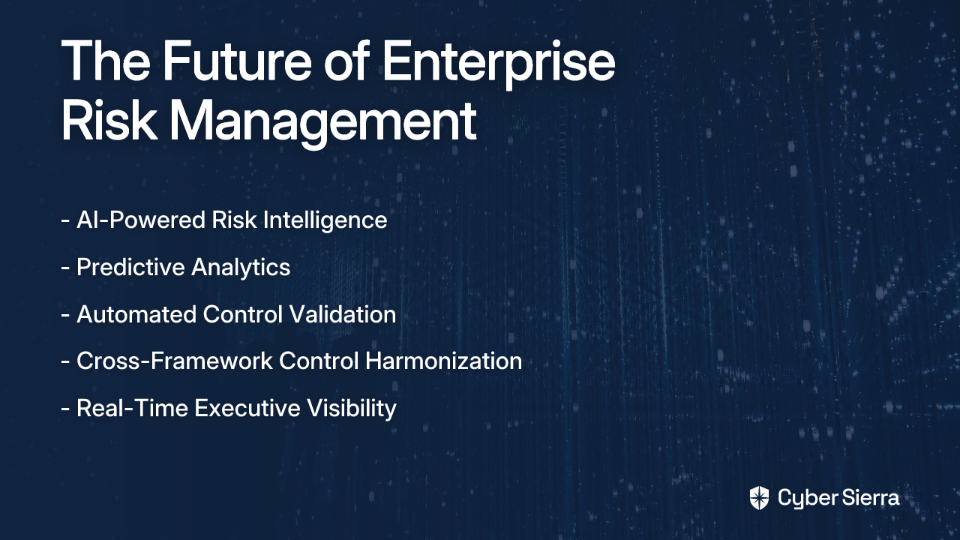
AI-Powered Risk Intelligence
Advanced ERM tools now employ artificial intelligence to detect patterns, anomalies, and emerging threats that might escape human analysts. This early detection capability allows security teams to address issues before they escalate into major incidents or compliance violations.
Predictive Analytics
Rather than simply documenting known risks, modern ERM solutions use predictive analytics to forecast potential disruptions and their business impacts. This forward-looking approach enables proactive risk management rather than reactive firefighting.
Automated Control Validation
The days of manually collecting screenshots and logs for evidence are ending. Next-generation ERM platforms continuously validate controls through automated testing and monitoring, ensuring they're not just documented but actually functioning as intended.
Cross-Framework Control Harmonization
As regulatory requirements multiply, organizations need tools that can map controls across frameworks, showing where one security measure satisfies multiple compliance requirements. This harmonization reduces redundant efforts and provides a clearer picture of your overall compliance posture.
Real-Time Executive Visibility
Today's ERM solutions transform complex risk data into actionable intelligence for executives, helping them understand the organization's security posture, compliance status, and risk exposure in business terms.
If you're still drowning in spreadsheets and manual evidence collection, it's time to evolve your approach. Stop treating compliance as a periodic checkbox exercise and start building a continuous, automated security program that makes compliance a natural byproduct.
Cyber Sierra's Continuous Control Monitoring platform provides a single source of truth for your controls and automates compliance across all your frameworks. With real-time visibility into your security posture, you can move beyond mere compliance to true risk management—and finally build that risk culture your organization needs.
Frequently Asked Questions
What is ERM software for cybersecurity?
Enterprise Risk Management (ERM) software for cybersecurity is a centralized platform that helps organizations identify, assess, monitor, and mitigate security risks while ensuring compliance with various regulatory frameworks. Unlike traditional tools focused on static reports, modern ERM solutions provide a real-time, dynamic view of your security posture by integrating with your existing tech stack to automate evidence collection and continuously monitor controls.
Why is continuous monitoring better than periodic risk assessments?
Continuous monitoring is superior because it provides real-time visibility into your risk posture, whereas periodic assessments only offer a static, point-in-time snapshot. The threat landscape changes constantly, and continuous monitoring allows you to proactively detect and respond to emerging threats, configuration drifts, and control failures as they happen, maintaining an "always audit-ready" state instead of scrambling before an audit.
How does ERM software simplify managing multiple compliance frameworks?
ERM software simplifies multi-framework compliance by using a "control harmonization" approach. It automatically maps a single security control to multiple requirements across different frameworks (like NIST, ISO 27001, PCI DSS, and GDPR). This eliminates redundant work, reduces the evidence collection burden, and provides a unified dashboard to track your compliance status against all relevant regulations simultaneously.
What is the first step to implementing an ERM program?
The first and most critical step is to define your risk management process before selecting a tool. This involves documenting your existing workflows, identifying key stakeholders, and understanding your data and reporting needs. A clear process ensures you choose a platform that fits your organization's requirements and culture, which is essential for successful implementation and user adoption.
Can a small business benefit from ERM software?
Yes, small businesses can significantly benefit from ERM software, especially cloud-native solutions designed for scalability. Many modern ERM platforms are built to help smaller, fast-growing companies automate compliance for certifications like SOC 2 or ISO 27001. This automation saves valuable time and resources, builds trust with enterprise customers, and establishes a strong security foundation early on.
How does automation in ERM tools reduce audit fatigue?
Automation directly reduces audit fatigue by eliminating the manual, time-consuming process of collecting evidence. ERM tools integrate with your cloud services and security systems to automatically gather the screenshots, logs, and configuration data needed for audits. This evidence is collected continuously and stored in a central repository, making it readily available for auditors and freeing your team from last-minute evidence-hunting.
Request a demo today to see how Cyber Sierra can transform your approach to enterprise risk management and cybersecurity compliance.
