



7 Best NIST CSF Maturity Assessment Software for CISOs


Join thousands of professionals and get the latest insight on Compliance & Cybersecurity.
Summary
- Manual NIST CSF assessments using spreadsheets are inefficient and provide only a point-in-time snapshot; automation software is designed to reduce audit preparation time by up to 75%.
- Modern security programs are moving away from periodic audits toward continuous, automated monitoring for a real-time view of their security posture.
- Select a tool based on your organization's maturity: compliance automation for SMBs, flexible GRC for enterprises, and continuous monitoring for regulated industries.
- For a proactive approach that moves beyond simple audit prep, Cyber Sierra's Continuous Control Monitoring (CCM) offers real-time visibility into your security controls.
Your last NIST CSF maturity assessment probably lived in a spreadsheet. Maybe it was a consultant-led audit that took weeks, produced a polished slide deck, and then sat in a shared drive untouched for the next six months.
Sound familiar?
For most security teams, this is the reality. The NIST Cybersecurity Framework (CSF) is the gold standard for measuring cybersecurity posture — but the way most organizations actually run assessments is still painfully manual. Think hidden pivot tabs, VLOOKUPs, color-coded maturity tiers, and a compliance calendar that turns every quarter into a fire drill.
The consequences are real: a point-in-time audit from six months ago tells you nothing about the control gaps that opened up last Tuesday. As one security practitioner put it, "Finding things and searching for things will give you a headache especially during audits." And when "the certs, risk docs, and endless follow-ups become a full-time job" — your team is spending more time chasing evidence than actually managing risk.
The good news: a new generation of NIST CSF maturity assessment software is replacing the spreadsheet grind with continuous, automated visibility. According to research, automation tools can reduce audit preparation time by up to 75% — freeing your team to focus on what matters.
Here are the 7 best platforms to consider, evaluated on framework coverage, automation depth, reporting, CSF 2.0 support, and pricing model.
1. Cyber Sierra — AI-Enabled Continuous Control Monitoring (CCM)
Best for: Regulated enterprises and security-mature organizations that need proactive, real-time control visibility across multiple frameworks.
If your goal is to move beyond point-in-time scoring and into a continuously monitored security program, Cyber Sierra's CCM module is purpose-built for exactly that. Rather than treating NIST CSF maturity as an annual checkbox, Cyber Sierra transforms it into an ongoing, automated process — giving CISOs a live view of control effectiveness, not a months-old snapshot.
Framework Coverage: NIST CSF (including CSF 2.0), ISO 27001, PCI DSS, GDPR, SOC 2, HIPAA, and custom frameworks. The platform manages controls across all these frameworks from a single, centralized repository — eliminating the siloed spreadsheets that create blind spots across overlapping requirements.
Automation Depth: This is where Cyber Sierra separates itself from the pack. The platform automates evidence collection and control testing continuously, detecting exceptions and anomalies in near real-time before they become audit findings. A central controls repository is kept up-to-date automatically — no more manual evidence chases before an audit. This approach is designed to deliver significant time savings, with organizations often seeing up to a 75% reduction in manual evidence collection effort and 40% faster audit preparation.
Reporting: Maturity-based scoring, actionable risk intelligence dashboards, and comprehensive audit-ready reports with full audit trails. Auditors get a clean, defensible record — not a scrambled folder of screenshots.
CSF 2.0 Support: Full support for NIST CSF 2.0, including mapping to the new Govern function introduced in the updated framework.
Pricing Model: Custom pricing based on enterprise needs.
Why it's #1: Most tools on this list will help you prepare for a NIST CSF assessment. Cyber Sierra makes the assessment continuous. For CISOs managing regulated environments or multiple compliance frameworks simultaneously, that shift from periodic scoring to always-on monitoring is the difference between reactive compliance and real risk management.
2. Vanta
Best for: SMBs and growth-stage companies looking for fast, clean compliance automation across core frameworks.
Vanta has earned its reputation as one of the most approachable compliance automation platforms on the market. Its polished UI, 100+ pre-built integrations, and quick time-to-value make it a go-to for teams pursuing their first SOC 2 or ISO 27001 — with NIST CSF coverage layered on top.
Framework Coverage: NIST CSF, SOC 2, ISO 27001, HIPAA, PCI DSS, and more.
Automation Depth: Continuous monitoring via integrations with cloud providers, identity platforms, HR tools, and developer environments. Evidence is collected automatically; tests run on a schedule.
Reporting: A real-time compliance dashboard surfaces passing and failing controls. Audit-ready reports can be shared directly with external auditors.
CSF 2.0 Support: Yes, with updated mappings for CSF 2.0.
Pricing Model: Subscription-based, tiered by number of frameworks and employee count. Vanta is designed to significantly reduce audit prep time for its users.
Limitation to note: Vanta excels at audit readiness but is less focused on continuous risk intelligence and maturity trending over time — making it better suited for compliance-first buyers than risk-first ones.
3. Drata
Best for: Mid-market teams wanting deep SaaS integrations and clean cross-framework control mapping.
Drata is a strong contender for teams that live in cloud-native environments. Its strength lies in automated evidence collection from a wide library of SaaS tools, combined with smart cross-framework control mapping that reduces redundant work when managing NIST CSF alongside SOC 2 or ISO 27001.
Framework Coverage: NIST CSF, SOC 2, ISO 27001, PCI DSS, GDPR, HIPAA.
Automation Depth: Automated evidence pull from cloud infrastructure and SaaS apps, with controls mapped across frameworks to avoid duplicated effort. Drata aims to significantly reduce the manual compliance workload.
Reporting: Centralized dashboard with control ownership, remediation tracking, and maturity scoring.
CSF 2.0 Support: Yes.
Pricing Model: Custom subscription pricing based on company size and frameworks selected.
4. Scrut Automation
Best for: Organizations needing broad multi-framework coverage with a risk-centric lens.
Scrut Automation takes a risk-first approach to compliance, which resonates well with security teams who want their GRC program to inform actual risk decisions — not just satisfy auditors. It supports over 100 policies and frameworks out of the box.
Framework Coverage: NIST CSF 2.0, NIST 800-53, ISO 27001, SOC 2, PCI DSS, HIPAA, and 100+ others.
Automation Depth: Automates evidence collection and risk management workflows, with a unified risk register that ties control gaps back to business impact.
Reporting: Continuous monitoring dashboards and audit readiness reports with real-time control status.
CSF 2.0 Support: Yes, with direct integration and native support for CSF 2.0 controls and functions.
Pricing Model: Subscription-based with custom pricing available for enterprise tiers.
5. Hyperproof
Best for: Compliance operations teams managing overlapping frameworks who need structured workflows and accountability.
Hyperproof is built for the compliance operator — the person who owns the evidence calendar, chases down control owners, and has to have everything organized before the auditor walks in. Its compliance calendar, structured workflows, and centralized document management make it a strong pick for teams that need process discipline alongside automation.
Framework Coverage: NIST CSF, ISO 27001, SOC 2, PCI DSS, and more.
Automation Depth: Automated evidence collection from cloud services and business applications, coupled with a compliance calendar that keeps assessment cycles on track. Hyperproof aims to significantly reduce the time teams spend on compliance activities.
Reporting: Centralized compliance documentation with real-time updates, progress dashboards, and built-in risk assessment tools.
CSF 2.0 Support: Yes, with built-in risk assessment tools aligned to the new framework.
Pricing Model: Custom pricing.
6. LogicGate Risk Cloud
Best for: Larger enterprises with complex, custom GRC workflows and cross-functional stakeholders.
If your NIST CSF program needs to span multiple business units, integrate into an existing risk register, and accommodate custom approval workflows — LogicGate Risk Cloud gives you the flexibility to build it your way. It's less plug-and-play than Vanta or Drata, but significantly more configurable for enterprise-scale programs.
Framework Coverage: NIST CSF and virtually any custom framework through its flexible workflow builder.
Automation Depth: Workflow automation for control assessments, risk registers, policy management, and exception handling. Shifts teams from annual reviews to a more continuous assessment cadence without forcing a rigid template.
Reporting: Visual dashboards designed for executive reporting — maturity scores, heat maps, and risk posture trends that communicate clearly to boards and leadership.
CSF 2.0 Support: Yes. The platform's flexibility makes adopting new framework versions straightforward.
Pricing Model: Custom pricing based on application usage and number of users.
7. OneTrust
Best for: Large enterprises managing privacy, risk, and compliance across global jurisdictions.
OneTrust is a heavyweight in the GRC and privacy management space. For organizations that need to manage NIST CSF alongside GDPR, CCPA, and a stack of international regulations, OneTrust's broad coverage and modular design offer a unified platform that scales across complex regulatory landscapes.
Framework Coverage: NIST CSF, ISO 27001, GDPR, CCPA, SOC 2, HIPAA, and dozens of regional regulations.
Automation Depth: Assessment automation, maturity scoring, and workflow management for control testing and policy reviews.
Reporting: Executive dashboards, compliance status tracking, and risk visualization tools for cross-functional reporting.
CSF 2.0 Support: Yes, updated to reflect current framework versions.
Pricing Model: Modular — pricing is based on the specific solutions and add-ons selected. OneTrust reports significant time savings, including up to a 38% reduction in scoping efforts and 61% time savings in compliance activities.
Limitation to note: OneTrust's breadth can make it feel heavy for teams that only need NIST CSF maturity assessment capabilities. It's worth the investment if privacy and multi-jurisdictional compliance are already on your roadmap.
Decision Guide: Which Tool Is Right for You?
Not every organization needs the same level of sophistication. Use this table to quickly identify the right category based on where you are today:
| Tool Category | Buyer Profile | Best For | Example Tools |
|---|---|---|---|
| Compliance Automation Platforms | SMBs & Mid-Market | Fast audit readiness for 1–2 core frameworks; automated evidence collection; clean auditor experience | Vanta, Drata, Scrut, Hyperproof |
| Flexible GRC Platforms | Mid-Market & Large Enterprise | Custom workflows, multi-department rollouts, complex risk registers, multi-jurisdictional compliance | LogicGate, OneTrust |
| AI-Enabled Continuous Control Monitoring (CCM) | Regulated Enterprises & Security-Mature Orgs | Proactive, near real-time control visibility across multiple frameworks; moving from point-in-time scoring to continuous risk management | Cyber Sierra |
A quick rule of thumb:
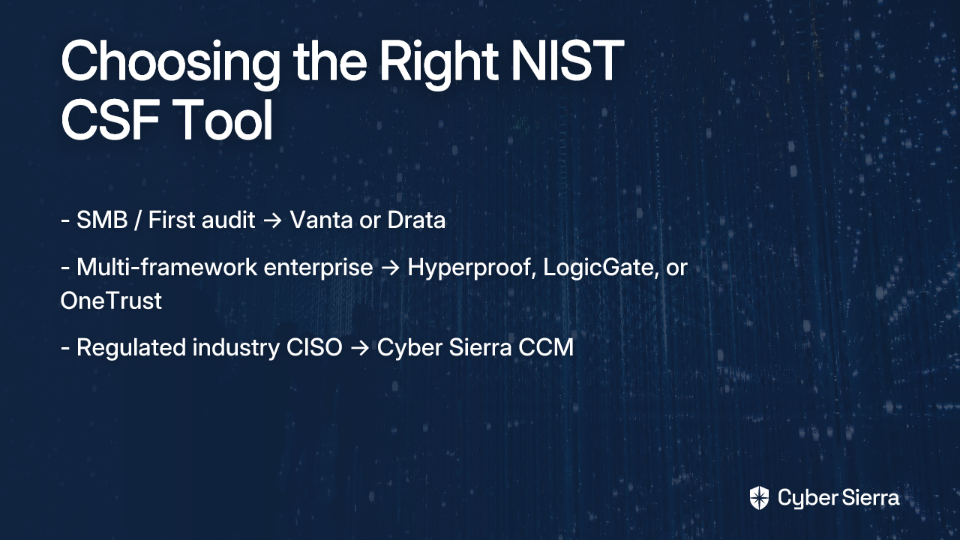
- If you're an SMB chasing your first SOC 2 or preparing for a NIST audit — start with Vanta or Drata.
- If you're a mid-market or enterprise team managing multiple frameworks with complex stakeholder workflows — look at Hyperproof, LogicGate, or OneTrust.
- If you're a CISO in a regulated industry who needs to know right now whether your controls are working — not in six months after the next audit — Cyber Sierra's CCM module is built for you.
From Static Reports to Real-Time Resilience
The biggest risk in your NIST CSF program isn’t a failed control—it’s an outdated spreadsheet telling you everything is fine weeks after a gap has opened up. Moving beyond manual assessments isn't just about efficiency; it's about accuracy.
Here are the key takeaways:
- Snapshots are not security. A point-in-time audit is obsolete the moment it's finished. Real security requires a live, continuous view of your controls.
- Automation frees up your experts. The right tool automates evidence collection, turning quarterly fire drills into an always-on security signal so your team can focus on managing risk, not paperwork.
Your next step today? Pinpoint one manual evidence collection task that consumes the most time during audit prep. That’s your prime candidate for automation.
When you’re ready to trade outdated reports for a live, defensible view of your security posture, see how Cyber Sierra’s continuous control monitoring platform can transform your NIST CSF program. Explore a platform demo to see how it turns your assessment into a continuous advantage.
Frequently Asked Questions
What is NIST CSF maturity assessment software?
NIST CSF maturity assessment software is a tool that automates evaluating an organization's cybersecurity posture against the NIST Cybersecurity Framework. It replaces manual spreadsheets with automated evidence collection, continuous testing, and real-time dashboards to track maturity and identify gaps.
Why use software instead of spreadsheets for NIST CSF assessments?
Software provides real-time, continuous visibility into your security posture, unlike static spreadsheets which quickly become outdated. Automation tools are designed to reduce manual effort by up to 75%, minimize error, and provide a single source of truth, freeing your team to manage risk instead of paperwork.
How does automation help with NIST CSF compliance?
Automation helps by continuously collecting evidence, testing controls, and identifying gaps without manual intervention. It connects to your tech stack to pull data, run scheduled tests, and alert you to non-compliance in near real-time, significantly speeding up audit preparation.
What is the difference between compliance automation and continuous control monitoring (CCM)?
Compliance automation focuses on preparing for audits, while Continuous Control Monitoring (CCM) provides a live, ongoing view of control effectiveness. While related, CCM is more proactive, aiming to manage risk by detecting control failures as they happen, not just for periodic audit readiness.
Which NIST CSF tool is best for a small business?
For small to medium-sized businesses (SMBs), platforms like Vanta or Drata are excellent starting points. They offer user-friendly automation for core frameworks like NIST CSF and SOC 2, focusing on quick time-to-value and audit readiness without the complexity of enterprise GRC platforms.
Do these tools support the new NIST CSF 2.0?
Yes, all the leading NIST CSF assessment platforms listed provide full support for the updated NIST CSF 2.0 framework. This includes mappings to the new Govern function and updated controls, ensuring your assessments align with the latest industry standards for cybersecurity risk management.
