



Top Tools for ISO 27001 and SOC 2 Compliance Automation in 2025

Join thousands of professionals and get the latest insight on Compliance & Cybersecurity.
You've set up your security program and now you're facing the dreaded compliance audit. The spreadsheets are multiplying, your engineers are dodging your calls for screenshots, and the audit deadline looms ever closer. Sound familiar?
"The most painful part of an audit is typically evidence gathering," admits one security professional on Reddit. "You end up on long calls with engineers who may or may not speak GRC and hope they remember where to find a config and take a screenshot with a timestamp. It's painful and sucks up a lot of time."
In 2025, manual compliance is no longer just inefficient—it's a competitive disadvantage. Organizations that still rely on spreadsheets, email chains, and manual screenshots are falling behind those leveraging automated tools to achieve and maintain ISO 27001 and SOC 2 compliance.
This guide cuts through the noise to highlight the top compliance automation tools of 2025, what features truly matter, and how to choose the right solution for your specific needs.
Why Manual Compliance Is a Losing Battle
Before diving into the tools, let's understand what compliance automation actually means. Compliance automation is the process of streamlining ISO 27001 and SOC 2 certification by automating tasks like evidence collection, control monitoring, and policy management within an Information Security Management System (ISMS), according to compliance experts.
The Real Cost of "Doing It By Hand"
The traditional approach to compliance comes with significant challenges:
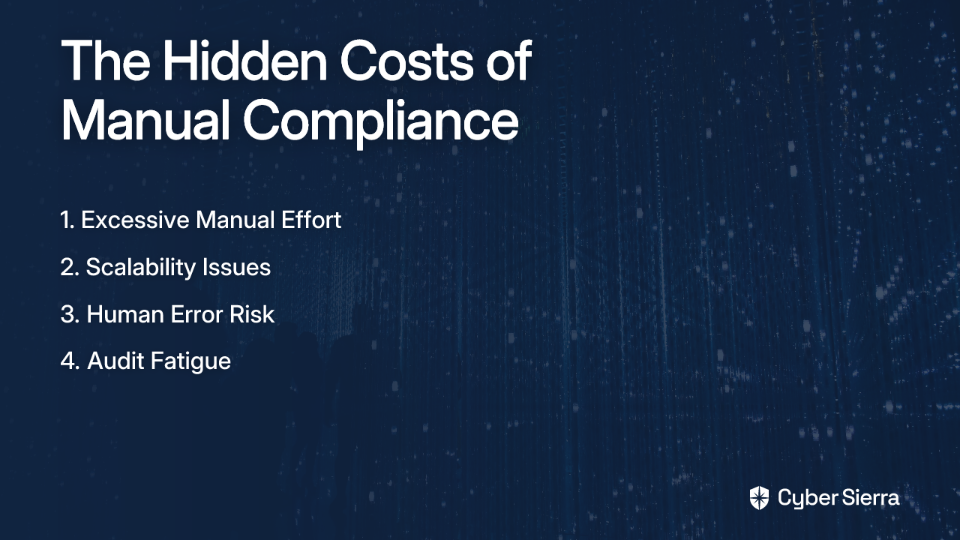
- Excessive Manual Effort: The cycle of manually amending policies, gathering evidence, and preparing for audits consumes valuable engineering and security resources.
- Scalability Issues: What works for a small team becomes unmanageable as your organization grows. More systems, more controls, more evidence to collect.
- Human Error Risk: Manual tracking increases the likelihood of missed controls and gaps in evidence, potentially leading to audit failures or security vulnerabilities.
- Audit Fatigue: The stress and disruption of preparing for audits creates a negative perception of compliance across the organization.
The Automation Advantage
Modern compliance automation delivers several key benefits:
- Reduced Manual Effort: Automates evidence collection and workflows, freeing your team from tedious tasks.
- Controlled Costs: Provides a more predictable cost structure for compliance, though as noted by users: "Compliance platforms can help, but they come with a steep learning curve and can cost up to $10k annually."
- Improved Scalability: Easily implement and monitor policies across a growing organization and technology stack.
- Proactive Risk Mitigation: Continuous monitoring helps you identify and address compliance gaps before they become audit findings.
The Anatomy of a Great Compliance Platform: 5 Must-Have Features
Based on research from Zluri, here are the five essential capabilities that define the best compliance platforms in 2025:
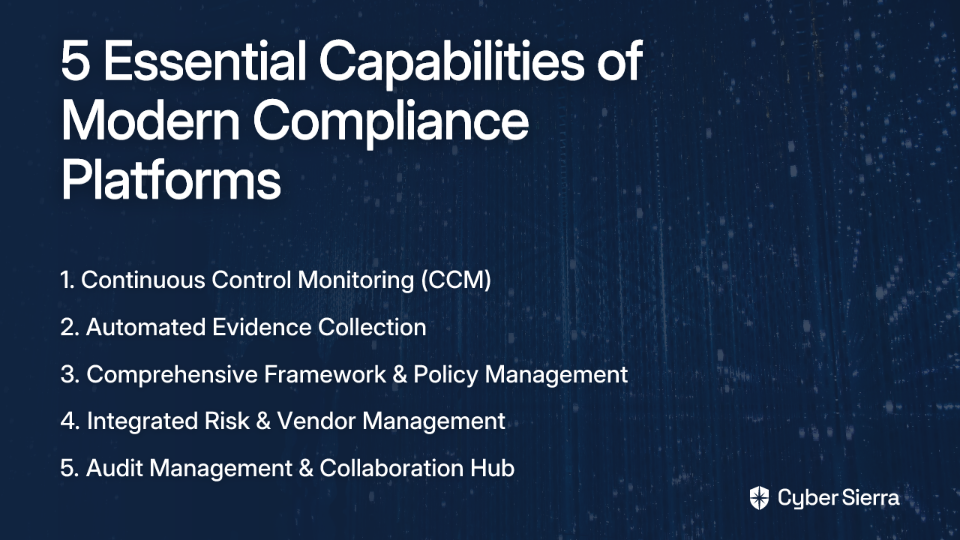
1. Continuous Control Monitoring (CCM)
This is the core of modern compliance—moving from point-in-time snapshots to ongoing, real-time visibility into your security controls. A robust CCM module should:
- Build a central controls repository with near real-time updates
- Detect exceptions and anomalies automatically
- Provide actionable risk intelligence to prioritize remediation
"When evaluating compliance tools, prioritize those with strong continuous monitoring capabilities," recommends Zluri's research on compliance automation tools.
2. Automated Evidence Collection
This directly addresses the number one pain point from user research. The best tools integrate with your tech stack (AWS, Azure, Google Cloud, GitHub, Jira, etc.) to automatically pull evidence for controls.
As one Reddit user succinctly put it: "Plug into Azure and any Azure evidence instantly pulls." This eliminates the need to chase engineers for screenshots and configuration details.
3. Comprehensive Framework & Policy Management
The platform should support multiple frameworks (ISO 27001, SOC 2, GDPR, HIPAA, PCI DSS) and allow you to map controls across them to avoid duplicating work. Look for:
- Pre-built, auditor-approved policy templates
- The ability to customize policies to your organization
- Version control and approval workflows for policy updates
4. Integrated Risk & Vendor Management
Compliance and risk are two sides of the same coin. Leading platforms in 2025 include:
- A built-in risk register to conduct assessments, assign owners, and track mitigation
- Third-Party Risk Management (TPRM) capabilities for vendor assessments
- Continuous monitoring of your vendor ecosystem for security changes
This integration is crucial because, as security professionals have noted, many organizations struggle with "inadequate depth of assessments for cybersecurity practices" when it comes to vendors.
5. Audit Management & Collaboration Hub
The platform should act as a single source of truth for you and your auditor. Look for features that:
- Allow you to grant auditors read-only access
- Track evidence requests and their status
- Facilitate direct communication within the platform
This addresses the pain point that "communication with auditors can be a bottleneck" in the audit process, according to user research.
The 2025 Contenders: Top Compliance Automation Tools
For Startups & Scale-ups (Speed to Certification)
- Drata
- Highlights: Market leader known for its user-friendly interface and extensive integration library
- Key Strengths: Automated evidence collection, real-time monitoring, policy templates
- Target Audience: Fast-growing startups seeking rapid certification
- Rating: 4.9/5 on G2
- Vanta
- Highlights: Strong competitor to Drata with comprehensive coverage for SOC 2, ISO 27001, and more
- Key Strengths: Real-time monitoring, pre-built policies, guided remediation
- Target Audience: Tech companies with cloud-based infrastructure
- Rating: 4.7/5 on G2
- Secureframe
- Highlights: Integrates with over 100 services for automated compliance
- Key Strengths: Quick implementation, strong customer support, continuous monitoring
- Target Audience: Organizations seeking rapid compliance with multiple frameworks
- Rating: 4.2/5 on G2
- Sprinto
- Highlights: Focus on making enterprises audit-ready quickly
- Key Strengths: Automated monitoring of controls, evidence collection
- Target Audience: SMBs looking for a straightforward path to compliance
- Rating: 4.8/5 on G2
For Enterprise & Mature Programs (Holistic GRC)
- AuditBoard
- Highlights: Comprehensive platform for audit, risk, and compliance management
- Key Strengths: Robust workflow capabilities, designed for complex organizations
- Target Audience: Large enterprises with established compliance programs
- Rating: 4.8/5 on G2
- OneTrust Compliance Automation
- Highlights: Part of a larger trust intelligence platform
- Key Strengths: InfoSec policy generation, continuous monitoring of controls
- Target Audience: Organizations with broader privacy and security requirements
- Rating: 4.6/5 on G2
For an Integrated Security Program (Beyond Compliance)
Cyber Sierra
- Highlights: AI-enabled platform designed for organizations wanting to unify their security program
- Key Strengths: Integrates Governance, Risk & Compliance (GRC) with Continuous Control Monitoring (CCM), Third-Party Risk Management (TPRM), and more
- Target Audience: Organizations seeking to address compliance as part of a broader security strategy
- Unique Value: Transforms security from periodic checks to continuous, automated monitoring
The Cloud-Native Alternative: DIY Compliance with AWS Tools
For organizations deeply embedded in AWS, native tools can offer a powerful and cost-effective path to continuous compliance. According to Cyber Sierra's research on automated AWS compliance, this approach can be significantly more economical, with estimates around $500-$1000/month for medium environments, compared to potentially higher SaaS fees.
Core AWS Toolset for Compliance Automation
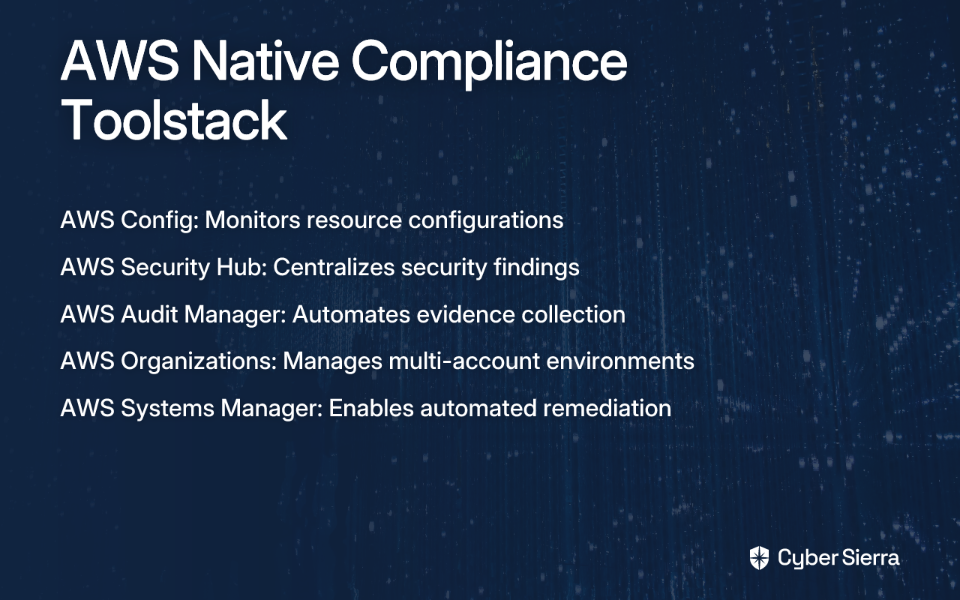
- AWS Config: The foundation for compliance in AWS. It monitors and evaluates resource configurations against compliance rules. Use Conformance Packs for ISO 27001 and SOC 2.
- AWS Security Hub: A centralized dashboard that aggregates findings from Config and other security services, providing a security score and mapping findings to compliance standards.
- AWS Audit Manager: Automates evidence collection with pre-built frameworks for ISO 27001 and SOC 2, collecting evidence and generating audit-ready reports.
Implementation Steps
- Foundational Setup: Use AWS Organizations and enable AWS Config across all accounts
- Deploy Compliance Rules: Deploy AWS Config Conformance Packs tailored for your required framework
- Centralize Visibility: Enable AWS Security Hub and integrate it with AWS Config
- Automate Evidence Collection: Configure AWS Audit Manager to run assessments against your frameworks
- Implement Automated Remediation: Use AWS Systems Manager Automation documents or Lambda functions to automatically fix non-compliant resources
This DIY approach requires more technical expertise but can deliver significant cost savings while providing powerful automation capabilities.
How to Choose Your Compliance Partner
There is no single "best" tool for everyone. The right choice depends on your organization's maturity, tech stack, and goals. Ask these questions:
- What is our primary goal?
- Quick certification for a funding round or customer requirement?
- Building a mature, long-term GRC program?
- What does our tech stack look like?
- Ensure the tool has deep integrations with the services you use most
- Cloud-native organizations might benefit from AWS-native tools
- What is our budget?
- Consider both the tool cost and the internal resources needed
- Factor in implementation, training, and maintenance
- Do we need a point solution or an integrated platform?
- Just compliance automation, or also vendor risk, threat intelligence, and training?
- Platforms like Cyber Sierra provide an integrated approach, while Drata and Vanta excel as focused compliance solutions
Conclusion: From Audit-Ready to Always-Ready
The goal of compliance automation isn't just to make your annual audit less painful—though that's certainly a benefit. It's to shift your organization's mindset from a reactive, checklist-based approach to a proactive, continuous security posture.
As compliance requirements continue to evolve and multiply, the organizations that thrive will be those that view compliance not as a burden but as an opportunity to strengthen their security program and build trust with customers and partners.
Whether you choose a market-leading SaaS platform like Drata, an integrated security platform like Cyber Sierra, or a cloud-native approach with AWS tools, the objective is the same: to build a resilient, trustworthy, and always-ready security program.
Frequently Asked Questions
What is compliance automation?
Compliance automation is the use of technology to streamline and simplify the process of meeting regulatory and security standards like ISO 27001 and SOC 2. It works by automating traditionally manual tasks such as evidence collection, control monitoring, policy management, and audit preparation, helping organizations maintain continuous compliance with less effort and fewer errors.
Why is compliance automation important for ISO 27001 and SOC 2?
Compliance automation is crucial for ISO 27001 and SOC 2 because it transforms compliance from a periodic, high-effort event into a continuous, integrated process. By automating evidence gathering and monitoring security controls in real-time, it significantly reduces the risk of human error, saves countless hours for engineering teams, and helps organizations maintain a strong security posture year-round, not just during audit season.
What are the most important features of a compliance automation tool?
The most effective compliance automation tools include five key features: Continuous Control Monitoring (CCM) for real-time visibility, Automated Evidence Collection to eliminate manual work, comprehensive Framework and Policy Management with pre-built templates, integrated Risk and Vendor Management to see the bigger picture, and a collaborative Audit Management Hub to streamline communication with auditors.
How much do compliance automation platforms cost?
The cost of compliance automation platforms varies widely based on your company's size, the complexity of your tech stack, and the number of frameworks you need. SaaS solutions like Drata or Vanta can cost upwards of $10,000 annually. In contrast, a Do-It-Yourself (DIY) approach using native cloud tools like AWS Config can be more economical, estimated at around $500-$1000 per month for a medium-sized environment, but requires more in-house technical expertise.
What is the difference between a compliance point solution and an integrated GRC platform?
A compliance point solution, such as Drata or Vanta, is primarily focused on achieving specific certifications (like SOC 2 or ISO 27001) as quickly as possible by automating evidence collection for that framework. An integrated GRC platform, like Cyber Sierra, treats compliance as one component of a broader security program, unifying Governance, Risk, and Compliance (GRC), vendor risk (TPRM), and continuous monitoring into a single system for a more holistic and mature security posture.
When should a company use a DIY compliance approach with AWS tools?
A DIY compliance approach using AWS tools is best suited for highly technical, cloud-native organizations that are deeply embedded in the AWS ecosystem. This path is ideal if you have significant in-house cloud security and engineering expertise to configure, manage, and maintain services like AWS Config, Security Hub, and Audit Manager. While it can offer significant cost savings, it requires a greater investment of internal resources compared to a commercial SaaS platform.
Ready to transform your compliance from a periodic scramble to a continuous, automated process? See how Cyber Sierra's GRC platform can unify your security controls and get you audit-ready faster.
