



How to Evaluate Enterprise Compliance Management Software (A CISO Checklist)


Join thousands of professionals and get the latest insight on Compliance & Cybersecurity.
Summary
- Evaluating compliance software requires a framework that looks beyond surface features to assess deep automation, multi-framework support, and continuous monitoring capabilities.
- With many organizations managing multiple frameworks, unified control mapping across standards like SOC 2, ISO 27001, and GDPR is essential to eliminate redundant work.
- Use the five-point framework to evaluate platforms on their ability to automate evidence collection, provide real-time monitoring, integrate third-party risk, and generate audit-ready reports.
- A unified platform like Cyber Sierra's GRC suite is built to meet these criteria by integrating continuous monitoring and third-party risk management to streamline compliance.
You've spent weeks shortlisting vendors. You've sat through demos. You've read the feature pages. And yet, somehow, every platform looks the same — each one promising to "simplify compliance" and "reduce audit burden."
The problem? Most of the content out there is written by vendors, for vendors. What's missing is a buyer's guide — a practical framework that helps a CISO or Compliance Manager cut through the noise, ask the right questions, and build a genuine business case for the right tool.
The stakes of choosing the wrong enterprise compliance management software are high: wasted budget, frustrated teams, and a compliance posture that's worse off than before. This guide gives you a five-dimension evaluation framework to assess any platform with confidence. It's structured around criteria that actually matter when you're building a shortlist and preparing a business case for stakeholder approval.
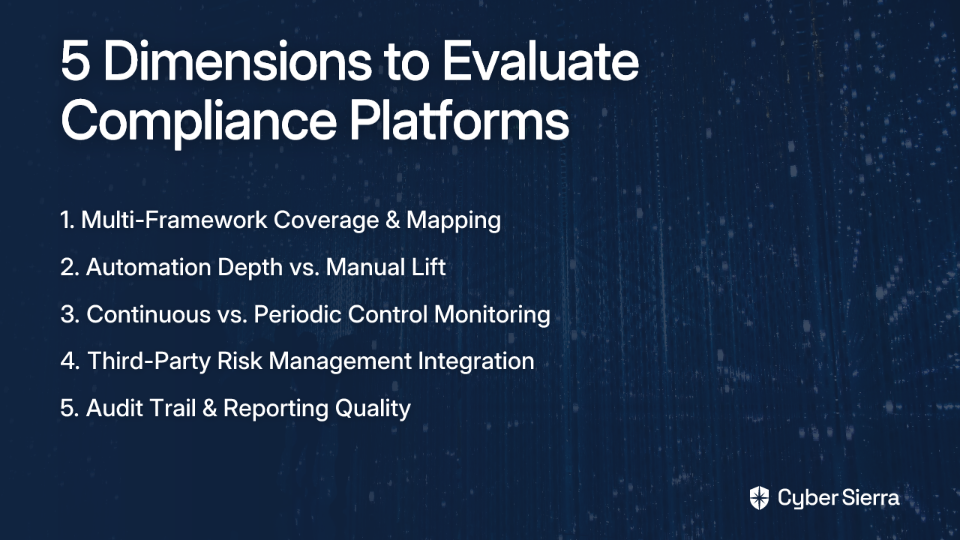
The 5-Point CISO Evaluation Framework
Use these five dimensions as your scoring criteria when evaluating any enterprise compliance management software. For each, we outline what good looks like, what questions to ask vendors, and what red flags to watch for.
Dimension 1: Multi-Framework Coverage and Mapping
Modern enterprises don't operate under a single compliance framework. If you're in financial services, you might be juggling SOC 2, PCI DSS, and ISO 27001 simultaneously. Add GDPR if you serve EU customers, or HIPAA if you're in HealthTech. Many service organizations find themselves demonstrating compliance with multiple frameworks at once.
That reality makes the case for unified control mapping. Without it, your team is duplicating evidence collection and control testing across every framework — a recipe for burnout and inconsistency.
What to look for:
- Unified control sets: Can the platform map a single internal control to requirements across SOC 2, ISO 27001, GDPR, HIPAA, and PCI DSS? The goal is to centralize framework requirements to manage multiple compliance programs without duplicating efforts.
- Pre-built framework libraries: Look for a broad library of supported frameworks out of the box. Fewer pre-built mappings means more manual setup time.
- Custom framework support: Regulatory landscapes change. The platform should allow you to add proprietary or emerging frameworks as your business evolves.
Red flag: A vendor that only supports a handful of frameworks or requires professional services to add new ones.
Cyber Sierra in practice: Cyber Sierra's GRC platform is built for this challenge. It supports SOC 2, ISO 27001, GDPR, HIPAA, PCI DSS, and custom controls from a single dashboard — automating data collection and risk assessments across all of them simultaneously, so your team isn't re-doing work every time a new audit cycle begins.
Dimension 2: Automation Depth vs. Manual Lift
This is where most enterprise compliance platforms separate themselves — or expose their limitations.
Surface-level automation looks impressive in a demo: automated reminders, a nice dashboard, some integrations. But when audit season hits and your team is still manually exporting spreadsheets and chasing control owners for screenshots, you'll wish you'd probed deeper. As one practitioner bluntly put it on Reddit, "You still need someone to configure and maintain these tools, draft and update the documents, and this will cost your time."
The question isn't "does it automate?" — it's "how deep does the automation actually go?"
What to look for:
- Automated evidence collection: Does the platform directly integrate with your cloud stack (AWS, Azure, GCP), HRIS, code repositories, and security tooling to pull evidence — not just store it? This kind of automation can save hundreds of hours per audit cycle.
- Automated control testing: The platform should test controls against mapped requirements, not just collect documents and wait for a human to check them.
- Workflow automation: Automated task assignments, review cycle triggers, and escalation reminders reduce the coordination overhead that bogs down lean compliance teams.
Red flag: A platform that advertises automation but requires manual uploads for most evidence types, or doesn't integrate natively with your existing tech stack.
Cyber Sierra in practice: Cyber Sierra's platform is designed to automate a wide range of compliance assessment tasks. Its GRC module automates data collection and risk assessments, while the CCM module performs automated control testing and validation — significantly cutting the manual lift your team carries into every audit cycle.
Dimension 3: Continuous vs. Periodic Control Monitoring
The traditional compliance model — scramble before audits, pass, go quiet for another year — is no longer sufficient. Threats don't wait for your annual review cycle, and neither do regulators.
Even a structured quarterly review is better than nothing, but if you're building a mature security program, continuous monitoring is the standard to hold vendors to.
What to look for:
- Real-time compliance dashboards: You should be able to see your current compliance posture at any moment — not just a snapshot from last week's report run.
- Dynamic risk and control linking: The ability to dynamically link risks, controls, and obligations so that when a control fails, you can immediately see its downstream impact on your overall compliance posture and risk register. This is critical for prioritizing remediation.
- Proactive anomaly detection: The platform shouldn't just log failures — it should alert you when an exception occurs, before it becomes an audit finding or a breach.
Red flag: A vendor that talks about "monitoring" but only updates compliance status when you manually trigger a scan or re-run an assessment.
Cyber Sierra in practice: Continuous monitoring is a core design principle behind Cyber Sierra's CCM module. It builds a central controls repository with near real-time updates, detects exceptions and anomalies as they happen, and delivers actionable risk intelligence to help teams remediate before issues escalate. This transforms security compliance from a periodic checkbox exercise into a living, breathing program.
Dimension 4: Third-Party Risk Management (TPRM) Integration
Your compliance posture is only as strong as your weakest vendor. Yet, as noted in real-world TPRM discussions, many organizations still struggle with "issues with managing vendor inventory and governance" — and that's before even factoring in continuous monitoring.
Siloed TPRM tools that live outside your compliance platform create blind spots. When a vendor's security posture degrades or a new supplier is onboarded without proper due diligence, you need to catch it within your existing compliance workflow — not in a separate system that no one is checking.
What to look for:
- Integrated vendor assessments: Can you send, track, and score security questionnaires without leaving the platform?
- Continuous vendor monitoring: Point-in-time questionnaires have a short shelf life. Look for platforms that provide continuous visibility into your vendors' actual security posture.
- Risk-based prioritization: Not all vendors carry the same risk. The platform should help you tier your vendor inventory and focus attention on high-criticality suppliers first.
- Onboarding and offboarding workflows: Due diligence shouldn't only happen at contract time. Proper offboarding — ensuring access is revoked and data is handled correctly — should be built into the workflow.
Red flag: A compliance platform that treats TPRM as an add-on module with no native integration into your control framework or risk register.
Cyber Sierra in practice: Cyber Sierra's TPRM module is fully integrated into the broader compliance ecosystem. It automates vendor assessments, prioritizes vendors based on risk level, and provides continuous visibility into vendor security compliance — covering the entire vendor lifecycle from onboarding through offboarding. This eliminates the need for a separate tool and keeps third-party risk visible within the same dashboard your team uses for everything else.
Dimension 5: Audit Trail and Reporting Quality
When your auditor walks in — or logs into your shared evidence portal — what they see in the first five minutes will shape the entire audit experience. A well-organized, immutable audit trail signals a mature compliance program. A disorganized evidence dump signals a long, painful engagement.
The goal is a single source of truth for all policies, controls, and evidence — one that your team can navigate easily and that auditors can consume without extensive hand-holding.
What to look for:
- Comprehensive, time-stamped audit logs: Every action taken within the platform — evidence uploads, control status changes, policy approvals — should be logged with timestamps and user attribution.
- Customizable dashboards: C-suite stakeholders need a different view than auditors. The platform should support audience-specific reporting so you're not generating ten different exports manually.
- Auditor-friendly evidence exports: Can you generate a clean, organized evidence package for a specific framework with a few clicks? This one feature alone can save days of prep time.
- Centralized policy and document management: Policies that live in SharePoint, controls that live in a spreadsheet, and evidence scattered across email threads is a recipe for compliance drift. Everything should live in one place.
Red flag: A vendor that can't demonstrate a live audit trail or whose reporting is limited to pre-built, non-customizable templates.
Cyber Sierra in practice: Cyber Sierra's GRC module generates comprehensive reports and maintains detailed audit trails — keeping the organization audit-ready at all times. When an auditor requests evidence, it's organized, accessible, and defensible, with no last-minute scrambling required.
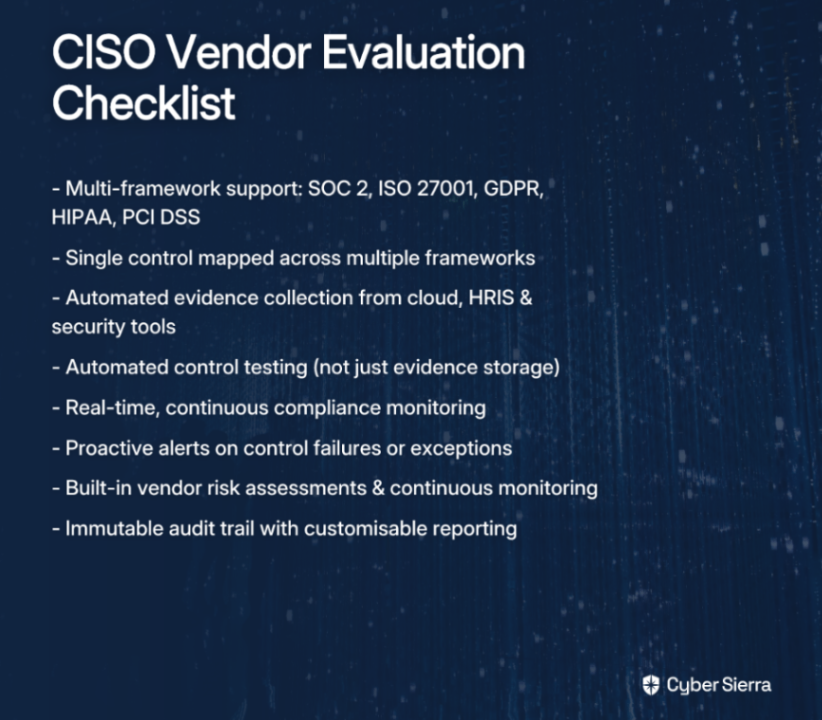
Your CISO Evaluation Checklist
Use this checklist when scoring vendors during your shortlisting process. Print it, paste it into your RFP template, or share it with your evaluation committee.
From Reactive Audits To Proactive Security
Choosing the right compliance platform isn’t about comparing feature lists—it’s about fundamentally shifting from periodic, audit-driven scrambles to a state of continuous, proactive security. The framework in this guide is designed to help you cut through the noise by focusing on what actually reduces manual work and strengthens your security posture.
Key takeaways to remember:
- Probe for deep automation: Does the tool pull evidence directly from your tech stack, or just store manual uploads?
- Demand unified controls: Can you map a single control to multiple frameworks (like SOC 2 and ISO 27001) to eliminate redundant work?
- Insist on continuous monitoring: Does it provide a real-time view of your compliance posture, or just a point-in-time snapshot?
Your next step today: Take one dimension from the framework—like Automation Depth—and use it to re-evaluate your top vendor. Their answer will tell you everything you need to know.
When you’re ready to see a platform that was built to answer those tough questions, book a Cyber Sierra demo.
Frequently Asked Questions
What is enterprise compliance management software?
Enterprise compliance management software is a centralized platform that helps organizations automate and monitor their adherence to regulatory frameworks like SOC 2, ISO 27001, and GDPR. It streamlines evidence collection, control testing, and reporting to simplify and accelerate audits.
Why is multi-framework mapping a critical feature?
Multi-framework mapping is critical because it allows you to test a single control and apply the evidence to multiple frameworks simultaneously. This prevents teams from duplicating efforts for each audit, saving hundreds of hours and ensuring consistency across all compliance programs.
How does compliance automation reduce manual work?
Compliance automation saves time by directly integrating with your cloud providers, HR systems, and security tools to automatically collect evidence. It replaces manual tasks like taking screenshots, chasing control owners for documents, and filling out spreadsheets during audit preparation.
What is the difference between continuous and periodic monitoring?
Periodic monitoring checks your compliance posture at scheduled intervals (e.g., quarterly), creating blind spots. Continuous monitoring provides a near real-time view, proactively alerting you to control failures as they happen so you can remediate issues long before an audit.
How should a compliance platform handle third-party risk?
A strong compliance platform should fully integrate third-party risk management (TPRM). This means it can automate vendor security assessments, continuously monitor vendor postures, and link vendor risks directly to your internal control framework, all from a single dashboard.
What makes an audit trail "auditor-friendly"?
An auditor-friendly audit trail is immutable, time-stamped, and easy to navigate. It allows an auditor to quickly find all policies, controls, and evidence for a specific framework without needing extensive guidance, making the entire audit process faster and more collaborative.
