



10 Compliance Monitoring Tools for Continuous Control Validation


Join thousands of professionals and get the latest insight on Compliance & Cybersecurity.
Summary
- Manual evidence gathering for compliance audits is a significant time drain, with automation reducing the workload by an estimated 30-40%.
- Continuous Control Validation (CCV) transforms compliance from a periodic scramble into an automated, ongoing process, providing real-time visibility into your security posture.
- When choosing a compliance tool, prioritize automated evidence collection, real-time monitoring, and multi-framework support to streamline audits.
- Platforms like Cyber Sierra’s Continuous Control Monitoring help unify compliance by automating evidence collection across multiple frameworks from a single repository.
You've set up a compliance program and diligently prepared for your audit. But now comes the dreaded part: evidence gathering. You find yourself on lengthy calls with engineers who don't speak "GRC," hoping they remember where to find configs and take properly timestamped screenshots. As one compliance professional lamented, "It's painful and sucks up a lot of time, especially when you're running lean teams who still need to patch and otherwise keep lights on."
This manual approach to compliance isn't just tedious—it's unsustainable as organizations grow. As another professional noted, "Manual tracking has already become a huge time suck, and we know it's not going to scale as we grow."
The solution? Continuous Control Validation (CCV), also known as Continuous Control Monitoring (CCM)—an approach that transforms compliance from periodic, stressful scrambles into an automated, ongoing process.
Let's explore the top compliance monitoring tools designed to solve these challenges by automating evidence collection and providing real-time visibility into your security posture.
What is Continuous Control Validation (and Why It Matters)?
Continuous Control Validation is the method of repeatedly testing security controls to validate they function as intended and to proactively address vulnerabilities. Rather than treating compliance as an annual event, CCV transforms it into an ongoing, automated process.
This approach matters because:
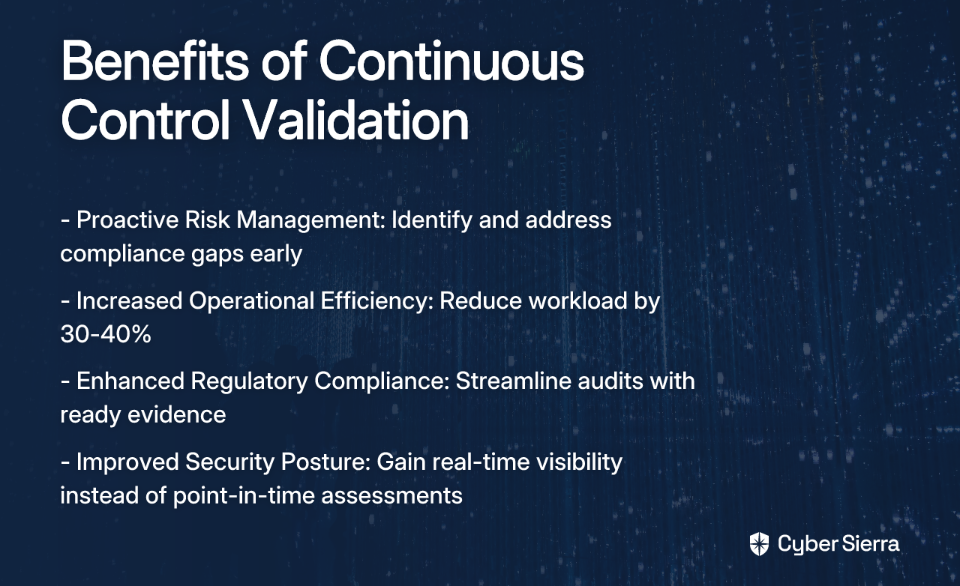
- Proactive Risk Management: Identify and address compliance gaps before they become security incidents, saving both time and potential breach costs.
- Increased Operational Efficiency: According to compliance professionals, automation can "reduce the load by a factor of 30-40%" for small to midsize businesses.
- Enhanced Regulatory Compliance: Streamline audits for frameworks like SOC 2, ISO 27001, PCI DSS, and GDPR with always-available evidence.
- Improved Security Posture: Gain real-time visibility instead of relying on outdated point-in-time assessments.
How to Choose the Right Compliance Monitoring Tool
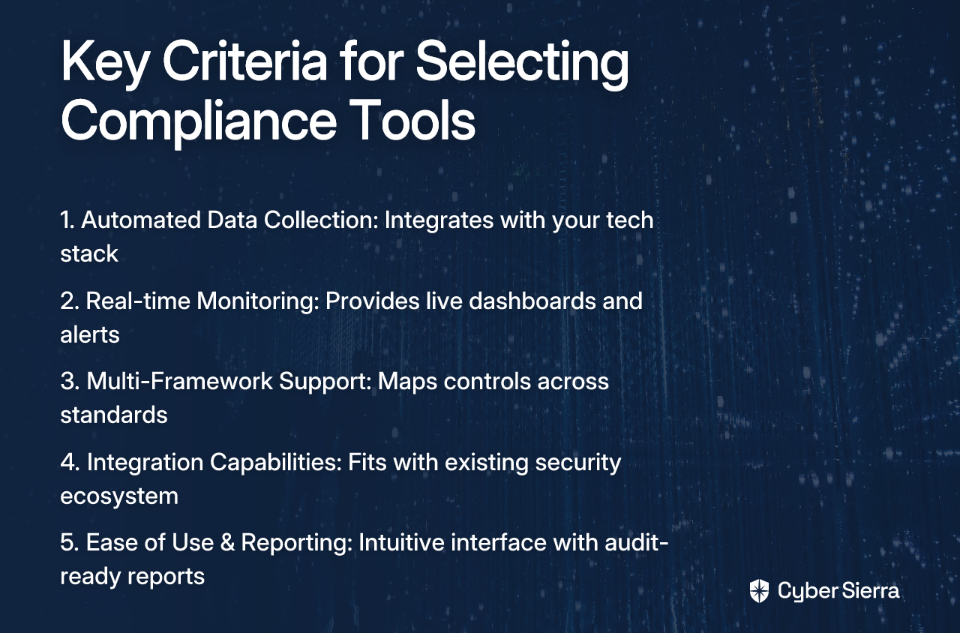
Finding the right compliance monitoring tool can be challenging. As one user mentioned after trying multiple options, "Wiz compliance is very generic." Consider these criteria when evaluating solutions:
- Automated Data Collection: Does the tool integrate with your tech stack to automatically pull evidence, eliminating manual screenshots?
- Real-time Monitoring: The tool should provide a live dashboard and alerts for control failures, enabling a "hands-off once it was set up" experience.
- Multi-Framework Support: Can it map controls across multiple frameworks to prevent duplicating effort?
- Integration Capabilities: Ensures the platform fits with your existing security ecosystem to avoid creating new data silos.
- Ease of Use & Reporting: The interface should be intuitive with audit-ready reporting capabilities while avoiding notification fatigue.
The Top 10 Compliance Monitoring Tools for 2024
1. Cyber Sierra
Best for: Enterprise organizations and fast-growing businesses needing a unified, framework-agnostic platform to automate compliance and risk management.
Key Features:
- Central Controls Repository: Creates a single source of truth for security controls mapped across multiple frameworks (NIST, ISO 27001, PCI DSS, GDPR, etc.)
- Near Real-Time Monitoring: Continuously scans your environment to automate control testing and detect exceptions
- Automated Evidence Collection: Integrates with your cloud and SaaS tools to gather evidence without manual intervention
- Actionable Risk Intelligence: Provides data-driven insights to help prioritize remediation efforts
- Comprehensive GRC Platform: Includes Third-Party Risk Management, Threat Intelligence, and Employee Security Training
Why it stands out: Cyber Sierra addresses the core pain point of manual evidence gathering with its framework-agnostic controls repository. This "comply once, attest to many" approach dramatically reduces repetitive work across multiple standards. Unlike competitors focused on point-in-time assessments, Cyber Sierra provides continuous visibility and automates the testing process, transforming compliance from periodic checks into a continuous, automated discipline.
2. Hyperproof
Best for: GRC teams looking to automate control testing across diverse internal, security, and access controls.
Key Features:
- Automated Testing and Monitoring: Moves beyond pre-audit checks to test controls in day-to-day operations
- Flexible Test Builder: Creates custom tests for specific controls
- Automated Responses: Sets up notifications and responses for test failures
- Common Use Cases: Monitors terminated employee access and validates vulnerability patching policies
Why it stands out: Hyperproof excels at providing strategic visibility for GRC teams with a clear process for setting up automated tests that follow a logical workflow: identify controls, select controls for testing, setup tests, define responses, and generate reports.
3. SentinelOne
Best for: Organizations needing an AI-driven platform with strong cloud security posture and threat detection capabilities.
Key Features:
- AI-Driven Cloud Security: Uses artificial intelligence for autonomous threat detection
- Compliance Dashboard: Provides holistic view of cloud infrastructure compliance against standards like PCI-DSS and ISO 27001
- CSPM & KSPM: Offers Cloud Security Posture Management and Kubernetes Security Posture Management
- Real-time Detection: Identifies cloud credential leakage in real-time
Why it stands out: SentinelOne combines compliance monitoring with advanced threat detection, making it a strong choice for security-first organizations operating heavily in the cloud.
4. Panaseer
Best for: Enterprises requiring active security posture management and comprehensive asset visibility.
Key Features:
- Real-time Posture Visibility: Provides accurate, real-time view of security posture
- Automated Vulnerability Analysis: Automates prioritization of vulnerabilities
- Comprehensive Asset Management: Delivers complete asset inventory visibility
Why it stands out: Panaseer's strength lies in its data-driven approach, correlating data from various security tools to provide quantifiable measures of control effectiveness and overall cyber risk.
5. MetricStream
Best for: Businesses looking for a robust GRC platform with deep integration into cloud environments like AWS.
Key Features:
- Automated Control Testing: Automates testing and monitoring of controls within cloud and on-premises environments
- AWS Integration: Strong focus on cloud compliance, particularly for AWS environments
- Continuous Auditing: Supports a continuous audit model
Why it stands out: MetricStream is a veteran in the GRC space and offers a mature platform designed for enhancing cloud usage while maintaining stringent compliance requirements.
6. Prisma Cloud by Palo Alto Networks
Best for: Organizations protecting cloud-native applications across multi-cloud environments.
Key Features:
- Cloud-Native Protection: Uses AI and ML to secure applications from code to cloud
- Extensive Compliance Checks: Offers over 1,000 compliance checks integrated with multiple frameworks
- Multi-Cloud Support: Provides a unified solution for AWS, Azure, Google Cloud, and more
Why it stands out: As part of the Palo Alto Networks ecosystem, Prisma Cloud provides deep, developer-friendly security that integrates compliance directly into the DevOps lifecycle.
7. Pathlock
Best for: Companies needing to monitor critical financial and business application controls (e.g., ERP systems).
Key Features:
- Financial Process Monitoring: Specializes in risk quantification for financial transactions
- Configuration Change Monitoring: Tracks changes to critical system configurations
- Access Control Focus: Automates controls related to user access and segregation of duties
Why it stands out: Pathlock carves a niche by focusing on the application layer, ensuring that critical business processes within systems like SAP or Oracle remain compliant and secure.
8. XM Cyber
Best for: Organizations focused on comprehensive cyber risk management and automated remediation.
Key Features:
- Real-time Threat Detection: Continuously monitors for threats and attack paths
- Automated Remediation: Provides prioritized, step-by-step remediation guidance
- Centralized Cyber Defense View: Offers a unified dashboard for managing all cyber defenses
Why it stands out: XM Cyber's attack-centric approach helps organizations see their environment through the eyes of an attacker, allowing them to proactively fix the security gaps that matter most.
9. Quod Orbis
Best for: Internal audit teams looking to streamline their evidence collection and control testing processes.
Key Features:
- Continuous Monitoring of Critical Controls: Focuses on the controls most important to the audit function
- Automates Audit Evidence Collection: Designed specifically to reduce the manual work of internal auditors
- Risk & Compliance Posture Management: Helps improve the overall compliance posture
Why it stands out: Quod Orbis is highly tailored to the needs of internal audit, making it an excellent choice for teams looking to modernize and automate their traditional audit processes.
10. AWS Security Hub
Best for: Organizations heavily invested in the AWS ecosystem.
Key Features:
- Centralized Security Alerts: Aggregates findings from various AWS services (GuardDuty, Inspector, Macie) and partner solutions
- Automated Compliance Checks: Runs continuous, automated checks against standards like CIS AWS Foundations Benchmark and PCI DSS
- Security Posture Score: Provides a score from 0-100% based on compliance checks
Why it stands out: For teams all-in on AWS, Security Hub is a native, cost-effective way to centralize security findings and automate foundational compliance checks without adding another third-party vendor.
Automate Your Way to Continuous Compliance
The days of spreadsheet-driven compliance and stressful, last-minute audit prep are numbered. As one professional shared after implementing automation: "We went from spending 2-3 days every month just gathering evidence and updating spreadsheets to maybe 30 minutes."
While these tools can't eliminate the need for human oversight—you still need someone who understands your compliance requirements—they can dramatically reduce the burden of evidence collection and provide the real-time visibility needed for true security assurance.
The right compliance monitoring tool depends on your specific environment, frameworks, and team size. However, a platform that unifies risk, compliance, and security provides the most strategic advantage.
Cyber Sierra's AI-enabled platform was built specifically to solve these challenges. With a central controls repository, near real-time monitoring, and a comprehensive GRC suite, it helps you move beyond compliance as a checkbox to security as a continuous discipline.
Frequently Asked Questions
What is Continuous Control Validation (CCV)?
Continuous Control Validation (CCV), also known as Continuous Control Monitoring (CCM), is the practice of automatically and continuously testing your security controls to ensure they are working correctly. Instead of scrambling to gather evidence once a year for an audit, CCV transforms compliance into an ongoing, automated process. This proactive approach helps you identify and fix compliance gaps in real-time, long before they can be exploited or flagged by an auditor.
Why is manual compliance evidence collection a problem?
Manual compliance evidence collection is a significant problem because it is time-consuming, prone to human error, and does not scale as an organization grows. It often requires lengthy meetings with technical teams to hunt for specific configurations and take properly timestamped screenshots. This manual-first approach is not just inefficient—it provides only a point-in-time snapshot of compliance, leaving you unaware of potential issues that may arise between audits.
How do compliance monitoring tools automate evidence collection?
Compliance monitoring tools automate evidence collection by directly integrating with your organization's tech stack, including cloud providers, SaaS applications, and security tools. Through these integrations (APIs), the tools can continuously pull required data, configurations, and logs without manual intervention. This collected data serves as automated evidence, validating that security controls are implemented and operating as intended, and it's always available for audits.
What are the key features to look for in a compliance monitoring tool?
The key features to look for in a compliance monitoring tool are automated data collection, real-time monitoring and alerting, support for multiple frameworks, broad integration capabilities, and intuitive, audit-ready reporting. An effective tool should eliminate manual work by connecting to your systems, provide a live dashboard to track your compliance posture, map controls across different standards to avoid duplicate effort, and make it easy to generate the reports needed for auditors.
Can one tool manage compliance for multiple frameworks like SOC 2 and ISO 27001?
Yes, many modern compliance monitoring platforms are designed to manage multiple frameworks simultaneously from a single, centralized repository of controls. This is a crucial feature for efficiency. Instead of treating each framework as a separate project, these tools allow you to map overlapping controls. This "comply once, attest to many" approach means you can collect evidence for a single control and use it to satisfy requirements across SOC 2, ISO 27001, PCI DSS, and others, saving significant time and effort.
What is the difference between CCV and traditional point-in-time audits?
The primary difference is that Continuous Control Validation (CCV) provides ongoing, real-time visibility into your security posture, whereas traditional audits offer only a static, point-in-time snapshot. A traditional audit validates compliance at a specific moment, but controls can fail or configurations can change the very next day. CCV constantly monitors your environment, alerting you immediately when a control fails. This transforms compliance from a periodic, stressful event into a continuous, proactive discipline that improves your actual security.
Ready to stop chasing screenshots and start building a proactive security program? Schedule a demo of Cyber Sierra today to see how we can automate your compliance journey and keep you continuously audit-ready.
