10 Continuous Monitoring Tools for Compliance Automation in 2026

Join thousands of professionals and get the latest insight on Compliance & Cybersecurity.
Summary
- Manual, point-in-time compliance checks are unsustainable, leading to security debt and audit stress. Continuous compliance monitoring automates this process, providing a real-time view of your security posture and reducing days of manual work to minutes.
- By 2026, continuous monitoring will be non-negotiable as regulations grow more complex and the cost of non-compliance rises.
- When selecting a tool, prioritize seamless integrations with your tech stack, real-time visibility through actionable dashboards, and robust, audit-ready reporting features.
- For enterprises managing multiple frameworks like NIST and ISO 27001, an integrated platform like Cyber Sierra's Continuous Control Monitoring (CCM) automates evidence collection to keep you perpetually audit-ready.
You've set up your compliance program, mapped controls to frameworks, and even passed your last audit. But now you're watching the technical debt climb as new security issues are found, with the same compliance gaps resurfacing month after month. The scramble before your next audit looms on the horizon, and you can already feel the stress building.
Sound familiar?
In today's complex, cloud-centric environments, the traditional approach of point-in-time compliance checks has become unsustainable. As one frustrated security manager put it, "I quit my last sec mgr job out of frustration with this very issue." The reality is that manual compliance processes are not just inefficient—they're actively harmful to your security posture.
The solution? Continuous compliance monitoring tools that transform what once "took days" into processes that "now take minutes."
What is Continuous Compliance Monitoring & Why It's Critical for 2026
Continuous compliance monitoring is the ongoing evaluation of an organization's adherence to regulatory and internal standards, ensuring real-time compliance to avoid data breaches and penalties. Unlike traditional periodic assessments, it provides a constant, automated view of your compliance posture.
The process typically works through five key stages:
- Define compliance standards and policies (e.g., NIST, ISO 27001, SOC 2)
- Implement monitoring controls across systems and networks
- Collect and analyze telemetry data from configurations and access logs
- Identify, prioritize, and alert on non-compliance risks in near real-time
- Generate reports and dashboards for continuous audit readiness

By 2026, continuous monitoring will be non-negotiable. With regulatory requirements growing more complex and cyber threats more sophisticated, the cost of non-compliance—financial penalties, operational disruptions, and reputational damage—will be higher than ever.
The Top 10 Continuous Monitoring Tools for Compliance Automation
1. Cyber Sierra
Overview: Cyber Sierra offers an AI-enabled platform specifically designed for enterprises managing multiple compliance frameworks simultaneously. It transforms security from periodic manual checks to proactive, continuous, and automated monitoring.
Key Features:
- Real-Time Control Monitoring: The Continuous Control Monitoring (CCM) module provides ongoing visibility into security controls with near real-time updates from your tech stack, directly addressing the pain of "surfacing all the messed up security debt that's been accumulating."
- Framework Coverage: Manages controls across numerous frameworks including NIST, ISO 27001, PCI DSS, GDPR, HIPAA, and SOC 2, making it ideal for organizations juggling multiple compliance standards.
- Evidence Collection Automation: Fully automates control testing, validation, and evidence gathering—transforming tasks that once "took days" into processes that "now take minutes."
- Actionable Intelligence: Delivers data-driven risk intelligence to help teams prioritize remediation efforts and address growing technical debt.
2. Vanta
Overview: A popular compliance automation platform that helps companies streamline the process of achieving certifications like SOC 2 and ISO 27001.
Key Features:
- Real-Time Monitoring: Continuously monitors your infrastructure for compliance risks and generates alerts when issues arise.
- Framework Coverage: Strong focus on SOC 2, HIPAA, ISO 27001, and PCI DSS.
- Evidence Collection Automation: Integrates with over 100 services to automatically collect required documentation for audits, significantly reducing manual effort.
Vanta is particularly strong for startups and SMBs seeking their first compliance certifications.
3. Drata
Overview: An AI-native security and compliance automation platform that emphasizes continuous monitoring to ensure companies are always audit-ready.
Key Features:
- Real-Time Monitoring: Continuously monitors security controls across your entire tech stack, flagging violations in real-time.
- Framework Coverage: Supports over 14 frameworks, including SOC 2, ISO 27001, HIPAA, GDPR, and PCI DSS.
- Evidence Collection Automation: Automates evidence collection and maintains up-to-date, audit-ready documentation, allowing you to simply "kick out the report for your audit" when needed.
Drata is frequently mentioned in user discussions as a tool that significantly simplifies the audit process.
4. Scrut
Overview: A unified GRC platform that integrates various compliance standards into a single dashboard for streamlined management.
Key Features:
- Real-Time Monitoring: Ensures security controls are continuously operational and updates compliance status in real-time.
- Framework Coverage: Provides comprehensive support for multiple compliance standards, allowing for efficient management of complex regulatory environments.
- Evidence Collection Automation: Features automated evidence mapping to reduce manual work and offers custom reporting for insights into compliance metrics.
Scrut is particularly effective for organizations looking to consolidate their compliance efforts into a single platform.
5. Secureframe
Overview: Helps organizations achieve and maintain compliance by automating tasks and providing expert guidance through the compliance journey.
Key Features:
- Real-Time Monitoring: Provides continuous scanning and monitoring of cloud infrastructure and tech stack.
- Framework Coverage: Focuses on frameworks like SOC 2, ISO 27001, HIPAA, and more.
- Evidence Collection Automation: Automates the collection of compliance evidence, which "saves time by eliminating manual evidence collection tasks" and "minimizes human error."
6. OneTrust Compliance Automation
Overview: A platform known for its privacy and trust solutions, which also offers a robust compliance automation module.
Key Features:
- Real-Time Monitoring: Built-in automation continuously monitors control compliance and detects violations before they become issues.
- Framework Coverage: Supports a wide range of industry standards and regulatory frameworks.
- Evidence Collection Automation: Automates policy generation and links them to controls, simplifying evidence management for audit preparation.
OneTrust excels in organizations with complex privacy requirements alongside their security compliance needs.
7. Hyperproof
Overview: A comprehensive compliance operations platform designed to organize and automate compliance tasks across multiple frameworks.
Key Features:
- Real-Time Monitoring: Offers centralized monitoring to ensure teams are always prepared for an audit, helping address the need for "regular internal check-ins" mentioned by users.
- Framework Coverage: Manages various regulatory frameworks from a single platform, reducing redundancy.
- Evidence Collection Automation: Provides a centralized evidence management repository and automation for control mapping.
Hyperproof is particularly valuable for teams seeking to avoid "scrambling before audits" through continuous readiness.
8. AuditBoard
Overview: A connected risk platform that unifies audit, risk, and compliance management in one place.
Key Features:
- Real-Time Monitoring: While more focused on workflow, it helps identify compliance gaps by analyzing practices against industry standards.
- Framework Coverage: Supports a wide array of compliance controls and frameworks.
- Evidence Collection Automation: Reduces manual tasks with automated workflows and centralized documentation, helping to address the "burden of time-consuming compliance tasks."
AuditBoard is particularly strong for organizations with established internal audit functions.
9. Fortinet
Overview: A cybersecurity giant that offers compliance automation features as part of its broader security fabric.
Key Features:
- Real-Time Monitoring: Provides actionable, real-time insights into compliance violations and security gaps.
- Framework Coverage: Supports various industry and security standards through its policy engine and integrated controls.
- Evidence Collection Automation: Ensures consistent implementation of security policies and maintains audit-ready documentation.
Fortinet offers the advantage of integrating compliance monitoring with broader security operations.
10. Sprinto
Overview: An advanced platform designed specifically for automating information security compliance for tech companies.
Key Features:
- Real-Time Monitoring: Provides real-time monitoring to enhance audit preparedness and ongoing compliance.
- Framework Coverage: Focuses on key frameworks like SOC 2, ISO 27001, and other standards relevant to technology businesses.
- Evidence Collection Automation: Automates mapping of controls to audit requirements and streamlines evidence collection.
Sprinto offers a simplified approach for technology companies seeking to achieve compliance with minimal overhead.
How to Choose the Right Compliance Automation Tool
With the "myriad of tools" available, selecting the right continuous monitoring solution can be overwhelming. Here's a framework to guide your decision:
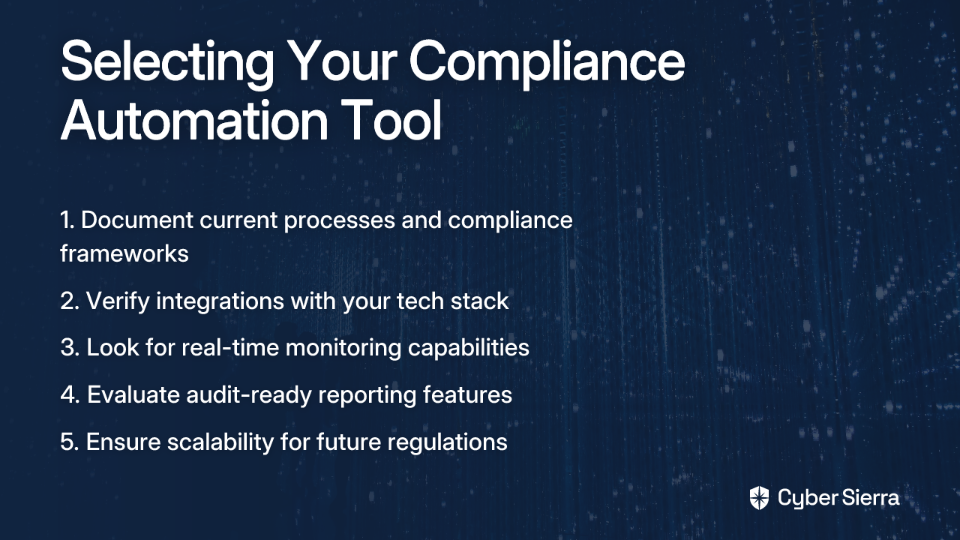
- Assess Your Needs: Start by documenting your current processes and identifying which frameworks you must adhere to (e.g., PCI DSS for payments, HIPAA for health data).
- Prioritize Integrations: Ensure the tool integrates seamlessly with your existing tech stack (e.g., AWS, Azure, Jira, GitHub) to avoid creating data silos and more manual work.
- Demand Real-Time Visibility: Choose solutions that provide clear, actionable dashboards and alerts. You need to see non-compliance risks as they happen, not a month later.
- Evaluate Reporting Capabilities: The right tool should make it easy to "kick out the report for your audit," simplifying preparation and satisfying auditors.
- Check for Scalability: Your compliance needs will grow. The tool should be adaptable to future regulatory changes and business expansion.
Transform Compliance from Burden to Strategic Asset
The future of compliance isn't about passing an annual audit; it's about maintaining a state of perpetual compliance and robust security, 365 days a year. By implementing continuous monitoring tools, you can:
- Transform what once "took days" into processes that "take minutes"
- Avoid "scrambling before audits" through constant readiness
- Address "all the messed up security debt that's been accumulating"
- Free your team from manual tasks to focus on strategic security initiatives
For enterprises juggling multiple frameworks like NIST, ISO 27001, and SOC 2 simultaneously, a comprehensive platform like Cyber Sierra provides the integrated approach needed to achieve true continuous compliance. By combining Continuous Control Monitoring with GRC, Third-Party Risk Management, and Threat Intelligence, organizations can build a truly resilient security posture that goes beyond checkbox compliance.
Ready to transform your compliance program from a periodic headache into a continuous, automated asset? Explore Cyber Sierra's AI-enabled cybersecurity platform to see how you can stay audit-ready, 24/7, and finally break free from the cycle of compliance scrambling.
Frequently Asked Questions
What is continuous compliance monitoring?
Continuous compliance monitoring is the process of constantly and automatically evaluating an organization's systems against regulatory and internal standards. Unlike traditional point-in-time audits, which provide a snapshot of compliance, continuous monitoring offers real-time visibility into your compliance posture, allowing you to detect and remediate gaps as they occur.
Why is continuous compliance better than traditional audits?
Continuous compliance is superior to traditional audits because it is proactive rather than reactive. It helps organizations maintain a constant state of audit-readiness, avoid the last-minute scramble before an audit, and reduce the risk of non-compliance penalties. By automating checks, it also frees up security teams from manual tasks to focus on strategic initiatives.
How do continuous compliance tools automate evidence collection?
These tools automate evidence collection primarily through API integrations with your existing tech stack (e.g., cloud providers like AWS, developer tools like GitHub, and HR systems). They continuously pull data—such as system configurations, user access logs, and security settings—and automatically map this data as evidence to specific compliance controls, eliminating the need for manual screenshotting and document gathering.
What should I look for when choosing a continuous compliance tool?
When choosing a tool, prioritize one that offers seamless integrations with your core systems, provides real-time visibility through actionable dashboards, and supports all the compliance frameworks you need to adhere to (e.g., SOC 2, ISO 27001, HIPAA). Additionally, evaluate its reporting capabilities to ensure it can easily generate audit-ready reports that simplify interactions with auditors.
Can these tools manage multiple compliance frameworks like SOC 2 and ISO 27001 at the same time?
Yes, a key benefit of modern compliance automation platforms is their ability to manage multiple frameworks simultaneously. They achieve this by mapping a single technical control to requirements across various standards. For example, a control for data encryption can satisfy requirements for SOC 2, ISO 27001, and GDPR, allowing you to "test once, comply many" and significantly reduce redundant effort.
Who benefits most from implementing a continuous compliance platform?
Security, compliance, and IT teams are the primary beneficiaries of a continuous compliance platform. Security teams can focus on mitigating real threats instead of manual evidence gathering. Compliance teams gain constant visibility and are always prepared for audits. For the business, it reduces the risk of fines, builds customer trust, and transforms compliance from a cost center into a strategic asset.