



7 Best Compliance Monitoring Tools for Managing Multiple Frameworks

Join thousands of professionals and get the latest insight on Compliance & Cybersecurity.
Summary
- Manually managing multiple compliance frameworks like SOC 2 and ISO 27001 with spreadsheets is inefficient and creates redundant work.
- Ineffective compliance has real business consequences, with 71% of consumers willing to leave companies that mishandle their data.
- The solution is to adopt a tool that uses control mapping to test a control once and apply the evidence across multiple frameworks, combined with continuous monitoring to automate data collection.
- An integrated GRC platform like Cyber Sierra can unify compliance management and reduce audit preparation time by up to 70%.
Are you drowning in spreadsheets trying to track controls across SOC 2, ISO 27001, GDPR, and HIPAA simultaneously? You're not alone.
"Been struggling with this one myself...very manual process and hope someone else comes along with a better idea," confesses one compliance professional on Reddit. Another laments: "Due to working in the healthcare sector at a public company that does business in the USA AND Europe, I am finding it difficult to put all of these together and manage them more efficiently."
The challenge isn't just ticking boxes for multiple standards – it's the redundant evidence collection, overlapping controls, and the dreaded "scramble... about a year to 8 months before major audits."
This compliance fatigue has real business consequences. According to research, 71% of consumers are prepared to leave companies that mishandle their data. Your compliance posture isn't just about avoiding fines; it's about maintaining customer trust and competitive advantage.

The solution? Moving from a reactive, manual compliance approach to a proactive, automated strategy using specialized compliance monitoring tools. Let's explore what features to look for and the top seven solutions that can transform how you manage multi-framework compliance.
Key Features to Look for in a Multi-Framework Compliance Tool
Before diving into specific tools, understand what capabilities are essential for effectively managing multiple compliance frameworks:
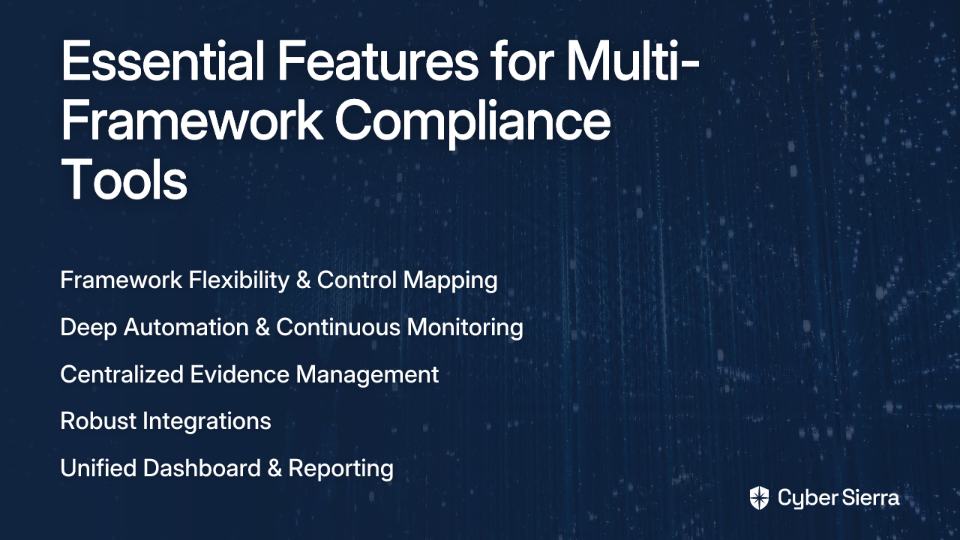
Framework Flexibility & Control Mapping
The tool must support multiple out-of-the-box frameworks (SOC 2, ISO 27001, GDPR, NIST, etc.) and allow for custom control creation. Crucially, it needs control mapping capabilities to "map multiple frameworks to a single control." This eliminates redundant work by allowing you to test one control and use the evidence across multiple frameworks.
Deep Automation & Continuous Monitoring
Your platform should automate evidence collection from your tech stack (cloud providers, identity providers, etc.). This addresses the pain of manual evidence gathering. It must shift compliance from periodic checks to real-time monitoring, providing an up-to-date view of your security posture and ensuring you're always audit-ready.
Centralized Evidence Management
A core function must be a secure, centralized repository for all compliance evidence. This directly solves the expressed pain of "keeping evidence centralized and controls mapped consistently as requirements evolve." Look for features like version control and access controls for sharing evidence with auditors.
Robust Integrations
The tool must seamlessly connect with your existing ecosystem (e.g., AWS, Azure, GCP, Jira, Slack, Okta). Integrations are vital for automated data collection and centralized visibility.
Unified Dashboard & Reporting
A single dashboard providing a clear, real-time overview of your compliance posture across all frameworks is non-negotiable. It should generate audit-ready reports with a single click to make audits "much easier."
The 7 Best Compliance Monitoring Tools for Managing Multiple Frameworks
1. Cyber Sierra
Overview: Cyber Sierra offers an AI-enabled cybersecurity platform that unifies GRC, Continuous Control Monitoring (CCM), and Third-Party Risk Management to simplify and automate security compliance. It's specifically designed to combat compliance fatigue for organizations juggling multiple standards.
Strengths for Multi-Framework Management:
- Unified GRC Platform: Manages multiple frameworks including SOC2, ISO 27001, GDPR, HIPAA, and PCI DSS from a single interface.
- Continuous Control Monitoring: Automates evidence collection and provides near real-time visibility into control effectiveness. This transforms security from periodic manual checks into a continuous, proactive process.
- Control Mapping & Evidence Reuse: Builds a central controls repository where evidence can be mapped and reused across multiple frameworks, directly addressing the inefficiency of redundant data gathering.
- AI-Driven Automation: Streamlines risk assessments and evidence collection, reducing audit preparation time by up to 70%.
Best for: CISOs and Compliance Managers in fast-growing companies who need an integrated platform to automate compliance across multiple frameworks and reduce manual audit preparation.
2. Drata
Overview: An AI-native security and compliance automation platform, particularly popular with cloud-native companies.
Strengths for Multi-Framework Management:
- Supports over 20 frameworks, providing broad coverage for organizations with diverse compliance requirements
- Features extensive integrations with cloud services and SaaS tools for automated evidence collection
- Offers a user-friendly "Trust Center" to share compliance posture with customers and stakeholders
Best for: Tech and SaaS companies operating primarily in the cloud that need to achieve and maintain compliance with multiple standards like SOC 2 and ISO 27001.
3. Archer (RSA)
Overview: A long-standing, enterprise-grade GRC solution known for its depth and customizability.
Strengths for Multi-Framework Management:
- Highly modular and configurable, allowing large organizations to build tailored GRC programs
- Provides deep capabilities for risk data management and comprehensive audit lifecycle management
- Extensive cross-mapping between different regulatory frameworks and standards
Best for: Large, mature enterprises in highly regulated industries (like finance) that require a powerful, deeply customizable GRC platform.
4. MetricStream
Overview: A unified GRC platform that leverages AI for predictive insights and risk management.
Strengths for Multi-Framework Management:
- Offers regulatory intelligence to keep organizations updated on changing requirements
- Provides extensive audit automation and continuous control monitoring capabilities, especially for cloud environments
- Strong capabilities for measuring and reporting on compliance metrics across frameworks
Best for: Organizations looking for an AI-powered GRC solution to provide predictive risk insights alongside compliance management.
5. AuditBoard
Overview: A user-friendly platform that began with a focus on audit management and has expanded into a broader risk and compliance solution.
Strengths for Multi-Framework Management:
- Excels at streamlining audit workflows, evidence collection, and collaboration between compliance teams and auditors
- Intuitive interface makes it easy to adopt and use even for teams with limited GRC experience
- Strong compliance calendar and deadline management features to prevent audit scrambles
Best for: Internal audit and compliance teams who prioritize ease of use and collaboration for managing audits across different frameworks.
6. LogicGate Risk Cloud
Overview: A flexible, no-code GRC platform that allows users to build custom applications and workflows.
Strengths for Multi-Framework Management:
- Its "no-code" nature allows for high customization of control sets, risk assessments, and reporting without developer resources
- Strong capabilities in specialized areas like third-party risk and cyber risk management
- Adaptable to evolving compliance requirements with customizable workflows
Best for: Companies with unique compliance processes that need a highly flexible and customizable platform to manage their GRC programs.
7. Hyperproof
Overview: A cloud-based GRC solution designed for continuous compliance and ease of use.
Strengths for Multi-Framework Management:
- Offers real-time compliance tracking and automated evidence collection
- Strong focus on making compliance a continuous, collaborative process rather than a point-in-time event
- User-friendly interface with clear visualization of control status across frameworks
Best for: Teams looking for a straightforward, cloud-based tool to maintain a continuous state of compliance and streamline audit readiness.
How to Choose the Right Compliance Monitoring Tool for Your Organization
Selecting the right GRC tool for your multi-framework compliance needs requires a methodical approach:
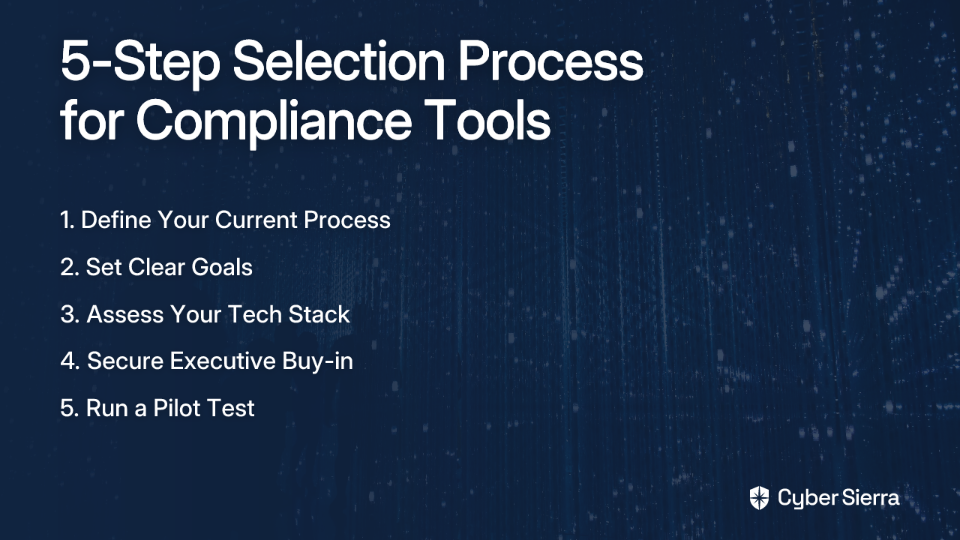
1. Define Your Current Process: Before looking at tools, map your existing compliance workflows. Identify the biggest bottlenecks—is it manual evidence collection, a lack of visibility, or audit prep stress?
2. Set Clear Goals: What do you want to achieve? Define measurable objectives like "reduce audit prep time by 50%" or "gain real-time visibility into critical ISO 27001 controls."
3. Assess Your Tech Stack: List your critical systems (AWS, Azure, Okta, Jira, etc.). Ensure any tool you consider has robust, pre-built integrations for your stack to enable automation.
4. Secure Executive Buy-in: Frame the investment not as a cost, but as a strategic advantage that builds customer trust and mitigates risk. This helps address the pain of management not caring about recurring issues.
5. Run a Pilot Test: Shortlist 2-3 vendors. Request demos and, if possible, run a pilot test on a specific use case (e.g., automating controls for a single framework) to see how the tool performs in your environment.
Turn Compliance from a Burden into a Business Advantage
Managing multiple compliance frameworks doesn't have to be a manual, high-stress endeavor filled with spreadsheets and last-minute scrambles. The shift to an automated, integrated GRC platform is essential for modern businesses to stay secure, compliant, and competitive.
By leveraging features like control mapping, continuous monitoring, and centralized evidence management, you can eliminate redundant work, maintain an always-audit-ready posture, and free up your team to focus on strategic security initiatives instead of manual compliance tasks.
"The biggest challenge I've seen is keeping evidence centralized and controls mapped consistently as requirements evolve," notes one compliance professional. This is exactly what modern compliance monitoring tools are designed to solve.
The right tool doesn't just help you pass audits—it transforms compliance from a time-consuming burden into a competitive advantage. When your team isn't buried in spreadsheets or scrambling before audits, they can focus on improving your security posture and building customer trust.
Platforms like Cyber Sierra are built to solve this exact challenge, unifying multiple security functions into a single, AI-powered platform. By automating evidence collection and enabling control mapping across frameworks, these tools can reduce audit preparation time by up to 70% while providing continuous visibility into your compliance posture.
If you're ready to end compliance fatigue and transform your security program, schedule a demo to see how Cyber Sierra can streamline your multi-framework compliance today.
As compliance requirements continue to multiply, the organizations that thrive will be those that employ smart tools to automate the process, enabling them to maintain robust security without sacrificing agility. Don't let compliance be your bottleneck—make it your strategic advantage.
Frequently Asked Questions (FAQ)
What is multi-framework compliance?
Multi-framework compliance is the process of adhering to the requirements of multiple security and data privacy standards simultaneously, such as SOC 2, ISO 27001, GDPR, and HIPAA. Companies often need to comply with several frameworks due to operating in different regions, serving various industries, or meeting specific customer demands, which requires a unified approach to avoid redundant work.
Why is managing multiple compliance frameworks manually so difficult?
Managing multiple frameworks manually is difficult due to significant overlap and redundancy between standards. Using spreadsheets leads to repetitive evidence collection for similar controls, a lack of real-time visibility into your compliance posture, and a high risk of human error. This manual process is time-consuming, inefficient, and makes audit preparation a stressful, last-minute scramble.
How does a compliance monitoring tool simplify multi-framework management?
A compliance monitoring tool simplifies management by automating evidence collection and mapping controls across different frameworks. This allows you to "test once, apply many," where evidence for a single control is automatically used to satisfy requirements for multiple standards. Key features like continuous monitoring and centralized dashboards eliminate manual work and provide a constant, audit-ready view of your compliance status.
What is control mapping and why is it important for compliance?
Control mapping is the process of linking a single security control to multiple requirements across different compliance frameworks. It is critically important because it eliminates redundant effort. For example, instead of testing your access control policy separately for SOC 2, ISO 27001, and PCI DSS, you can test it once and map the evidence to all three frameworks, saving significant time and ensuring consistency.
Can a single tool manage both security and privacy frameworks like ISO 27001 and GDPR?
Yes, most modern compliance management platforms are designed to handle both security frameworks (like ISO 27001, SOC 2) and privacy regulations (like GDPR, CCPA) in a single, unified system. This allows your team to manage all compliance obligations from one central dashboard, breaking down silos between security and privacy functions.
How much time can I realistically save with a compliance automation tool?
Organizations can realistically save up to 70% of the time and effort typically spent on manual audit preparation and evidence gathering. This significant time saving comes from automating repetitive data collection, reusing evidence across multiple audits through control mapping, and shifting from periodic, high-stress audit cycles to a state of continuous, year-round compliance readiness.
