



Vanta vs Drata vs Cyber Sierra: Which Compliance Platform Wins for Enterprises


Join thousands of professionals and get the latest insight on Compliance & Cybersecurity.
Summary
- Vanta and Drata are effective for startups seeking their first SOC 2 or ISO 27001 certification but often fall short when scaling to enterprise-level complexity.
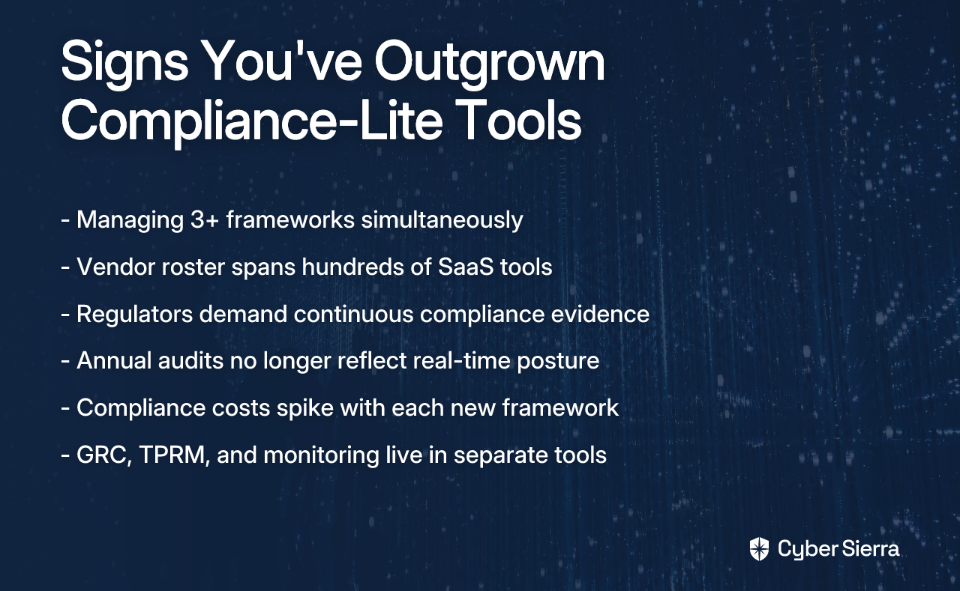
- Enterprises often outgrow these tools when managing 3+ compliance frameworks, hundreds of vendors, and facing rising costs for each additional framework.
- The critical shift for enterprises is from periodic evidence collection to true Continuous Control Monitoring (CCM) and 24/7 Third-Party Risk Management (TPRM).
- For organizations needing a unified platform to manage GRC, CCM, and TPRM at scale, Cyber Sierra provides an integrated solution designed for complex, multi-framework environments.
If you've been shopping for security compliance software, Vanta and Drata are probably the first names that come up. And for good reason — both platforms have earned their reputation as go-to tools for startups and growing companies chasing their first SOC 2 report or ISO 27001 certification. They're polished, well-marketed, and genuinely effective at getting you to that initial audit finish line.
But here's the question that doesn't get asked often enough: do these tools actually scale to enterprise complexity?
This article isn't a vendor pitch. It's an honest, side-by-side comparison of Vanta, Drata, and Cyber Sierra across the dimensions that matter most to enterprise security and compliance teams — so you can make an informed decision about which platform actually fits where you're headed.
When "Compliance-Lite" Isn't Enough Anymore
Most compliance journeys start simple: pick a framework, collect evidence, pass the audit. Tools like Vanta and Drata are purpose-built for this phase, and they do it well.
The challenge kicks in once your organization starts to mature. A single framework becomes three. Your vendor roster grows. Regulators start asking about GDPR, HIPAA, PCI DSS, and NIST — often simultaneously. And the annual audit mindset starts to crack under the weight of a dynamic, always-on threat environment.
As practitioners note in discussions on Reddit, the challenge shifts from getting compliant once to staying compliant over time. Cost also becomes a friction point at scale: "Platforms can range anywhere from 6K–20K+ depending on how many frameworks you want to support and maintain." When every added framework means a jump in licensing fees, multi-framework compliance becomes a budget conversation as much as a technical one.
There's also the third-party problem. Basic vendor questionnaires are no longer sufficient when your supply chain runs hundreds of SaaS tools, subprocessors, and infrastructure partners — each one a potential risk vector. Point-in-time assessments give you a snapshot; enterprises need a continuous feed.
And perhaps most critically, compliance can't live in a silo. The most mature security programs treat GRC not as a checkbox exercise but as a living system — one that helps you "identify gaps, [determine] how those gaps/risks will be addressed," and tie those decisions back to real business risk.
That's the gap between compliance tools and an enterprise-grade compliance platform.
Head-to-Head Comparison: Vanta vs. Drata vs. Cyber Sierra
Here's how the three platforms stack up across the features that matter most for enterprise buyers:
| Feature | Vanta | Drata | Cyber Sierra |
|---|---|---|---|
| Multi-Framework Support | Strong coverage of SOC 2, ISO 27001, GDPR, HIPAA; supports custom frameworks | Strong SOC 2 automation; expanding framework library | Native support for NIST, ISO 27001, PCI DSS, GDPR, HIPAA, and more with cross-framework control mapping |
| Continuous Control Monitoring (CCM) Depth | Automated evidence collection with real-time monitoring enrichment | Advanced automation for evidence collection and control status | Dedicated CCM module with central controls repository, near real-time updates, anomaly detection, and actionable risk intelligence |
| Third-Party Risk Management (TPRM) | Centralized vendor onboarding and security review workflows | Standardized vendor assessments with automated follow-ups | Dedicated TPRM module with automated assessments, 24/7 vendor monitoring, and risk-based vendor prioritization |
| AI & Automation | Automation focused on evidence collection and questionnaire responses | Robust AI for operational efficiency, especially in questionnaire handling | AI-powered automation for risk intelligence, proactive detection, and control validation |
| Integrated Platform Scope | GRC, risk management, questionnaire automation | GRC, Trust Center, TPRM | Unified suite: GRC + CCM + TPRM + Threat Intelligence + Employee Training + Cyber Insurance |
| Pricing Transparency | Available on request; can be opaque at scale | More transparent than some competitors; typically requires a demo | Offers flexible plans tailored to enterprise needs |
The takeaway: Vanta and Drata are genuinely strong platforms for automating the initial compliance journey. Their integrations are deep, their UX is polished, and for companies targeting a single certification, they deliver real ROI. But the architecture of both tools reflects their SMB roots — they're optimized for getting you to compliance, not necessarily for managing compliance as an ongoing, multi-dimensional enterprise program.
Cyber Sierra is built differently. Rather than layering GRC features onto a compliance automation base, it's architected from the ground up as an integrated security and risk management platform — one where CCM, TPRM, and GRC aren't separate products, but interconnected modules feeding a shared intelligence layer.
Where Cyber Sierra Pulls Ahead for Enterprise Teams
Continuous Control Monitoring That Actually Monitors Continuously
Most compliance platforms automate evidence collection — they pull logs, screenshots, and configuration data and attach them to controls. That's useful, but it's not the same as monitoring.
Cyber Sierra's Continuous Control Monitoring (CCM) module maintains a central controls repository with near real-time updates, continuously validating that controls are operating as intended — not just collecting proof that they existed at a point in time. When something drifts or an anomaly is detected, it surfaces as actionable intelligence, not just a flag in a dashboard.
For compliance managers who've experienced the pain of "Expect a few hours a week" manually tracking evidence and chasing down control owners, the difference is significant. CCM shifts the burden from human vigilance to automated, continuous validation — freeing your team to focus on remediation and risk decisions rather than evidence wrangling.
It also handles cross-framework control mapping natively, so a single control can satisfy requirements across NIST, ISO 27001, PCI DSS, and GDPR simultaneously — reducing duplication and the cost creep that comes from managing frameworks in isolation.
Third-Party Risk Management Built for the Long Game
Vendor risk is one of the fastest-growing attack surfaces in enterprise security. Yet most compliance platforms treat TPRM as an onboarding workflow — send a questionnaire, collect a response, mark the vendor as reviewed. Check.
That model breaks down when you're managing dozens (or hundreds) of vendors across different risk tiers, with contracts renewing on different cycles and threat landscapes shifting constantly.
Cyber Sierra's TPRM module approaches this differently. Instead of point-in-time assessments, it provides near real-time, 24/7 visibility into vendor security compliance — continuously monitoring your vendor ecosystem and surfacing changes in risk posture as they happen. Vendors are prioritized by risk level, so your team isn't spending equal time on a low-risk SaaS tool and a critical infrastructure partner.
This matters especially for industries like BFSI, HealthTech, and Manufacturing — where regulatory expectations around third-party oversight are explicit and auditors expect documented evidence of ongoing due diligence, not just an annual questionnaire.

A Platform That Goes Beyond the Audit
What separates Cyber Sierra from compliance-focused alternatives is the breadth of what it connects to. The platform extends beyond GRC and CCM into:
- Threat Intelligence: Network and cloud vulnerability scanning that gives you an outside-in view of your attack surface — so you're identifying risks before auditors (or attackers) do.
- Employee Security Training: Interactive modules and simulated phishing campaigns that turn compliance awareness into actual behavioral change, building the human firewall your controls depend on.
- Cyber Insurance: Helps teams demonstrate cyber hygiene to insurers, streamlining coverage applications and connecting your security posture directly to your risk financing strategy.
This interconnected architecture means that when your CISO asks "Are we actually secure right now?" — not just "Are we compliant?" — the platform can answer both questions from the same data source. For enterprise teams that have grown tired of maintaining five or six separate tools to get that unified view, that's a meaningful consolidation.
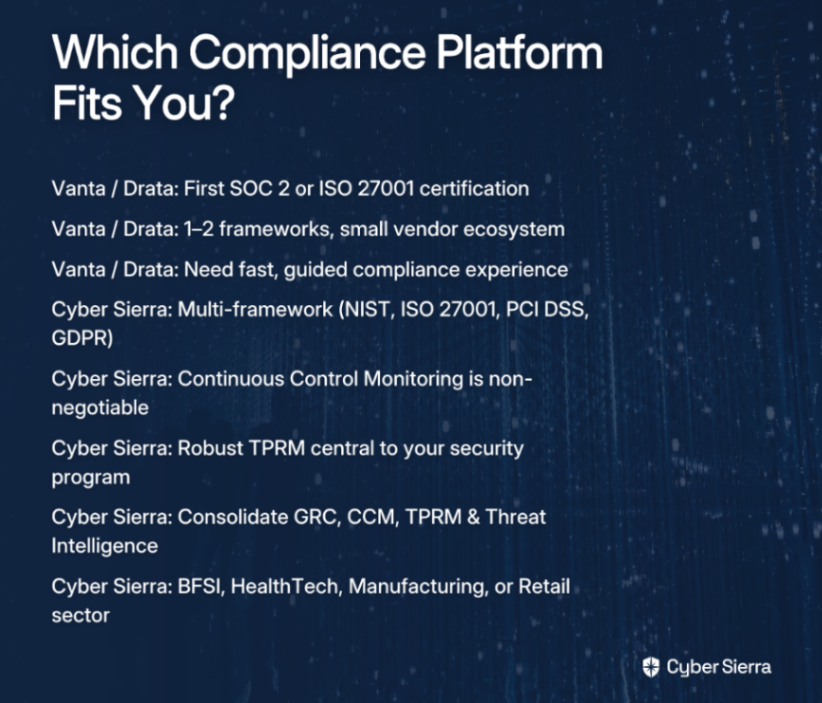
Decision Guide: Which Platform Is Right for You?
Not every organization needs the same tool. Here's how to self-qualify:
Making the Leap to Enterprise Compliance
Choosing the right compliance platform isn't about which tool is "best"—it's about which one fits your organization's maturity. While Vanta and Drata are effective for getting your first certification, enterprise scale introduces challenges they weren't built to solve.
The path forward comes down to two key shifts:
- From periodic evidence collection to real-time monitoring. Instead of scrambling for annual audits, Continuous Control Monitoring (CCM) and 24/7 Third-Party Risk Management (TPRM) give you a live, accurate view of your security posture.
- From siloed tools to a unified platform. Managing GRC, CCM, and TPRM in one place reduces complexity, eliminates duplicate work across frameworks, and provides a single source of truth for risk decisions.
Your next step is simple: map your complexity. How many frameworks, vendors, and manual hours are you juggling?
When you're ready to trade compliance chaos for confidence, we can show you how an integrated platform works. Book a platform walkthrough and see how you can unify your security program.
Frequently Asked Questions
What is the main difference between Vanta, Drata, and Cyber Sierra?
The main difference is their target scale. Vanta and Drata excel at helping startups achieve initial compliance for single frameworks like SOC 2. Cyber Sierra is an integrated platform built for enterprises managing multiple frameworks, continuous monitoring, and complex vendor risk.
When should our company consider switching from a tool like Vanta or Drata?
You should consider switching when managing 3+ frameworks, your vendor list is extensive, or you need continuous compliance evidence, not just annual audit prep. If your compliance costs are spiking with each new framework, it's a clear sign you've outgrown compliance-lite tools.
How does continuous control monitoring (CCM) in Cyber Sierra differ from other tools?
Cyber Sierra's CCM provides near real-time validation that controls are working, not just automated evidence collection. It maintains a central controls repository, detects anomalies, and offers actionable intelligence, shifting focus from manual evidence checks to proactive risk management.
Why is an integrated approach to GRC, CCM, and TPRM important?
An integrated approach provides a unified view of your security posture. It connects compliance activities (GRC), control effectiveness (CCM), and supply chain risks (TPRM) into a single data source, enabling better risk decisions and eliminating the need for multiple, siloed tools.
What types of businesses benefit most from using Cyber Sierra?
Cyber Sierra is ideal for mid-to-large enterprises, especially in regulated industries like BFSI, HealthTech, and Manufacturing. It's built for organizations that must manage multiple complex frameworks (NIST, ISO, PCI DSS, etc.) and require robust, continuous security monitoring.
