



Why Your Compliance Tool Needs SIEM Integration in 2025


Join thousands of professionals and get the latest insight on Compliance & Cybersecurity.
"I'd rather have these reports generated every day rather than only when the auditors come."
This sentiment, expressed by a frustrated compliance professional on Reddit, captures the growing pain of modern organizations: the gap between periodic compliance activities and the need for continuous security vigilance. As cyber threats evolve at breakneck speed, the traditional approach of treating compliance as a quarterly or annual checkbox exercise has become dangerously outdated.
In 2025, integrating your Governance, Risk Management and Compliance (GRC) tool with a Security Information and Event Management (SIEM) platform isn't just a competitive advantage—it's a foundational requirement for achieving proactive risk management, continuous compliance, and organizational resilience.
The Growing Divide: Traditional Compliance vs. Modern Security Threats
Historically, compliance and security operations have existed in separate realms within organizations:
- Compliance Teams focus on frameworks like SOC2 and ISO27001, managing policy documents, and preparing for annual audits. They often struggle with tools that are more document repositories than active monitoring solutions. As one Reddit user noted, "Complianceforge only sells policy documents, not actual tools for continuous compliance monitoring."
- Security Operations Teams use tools like SIEM platforms to monitor threats in real-time, investigating incidents and responding to attacks as they happen.
This siloed approach has serious consequences:
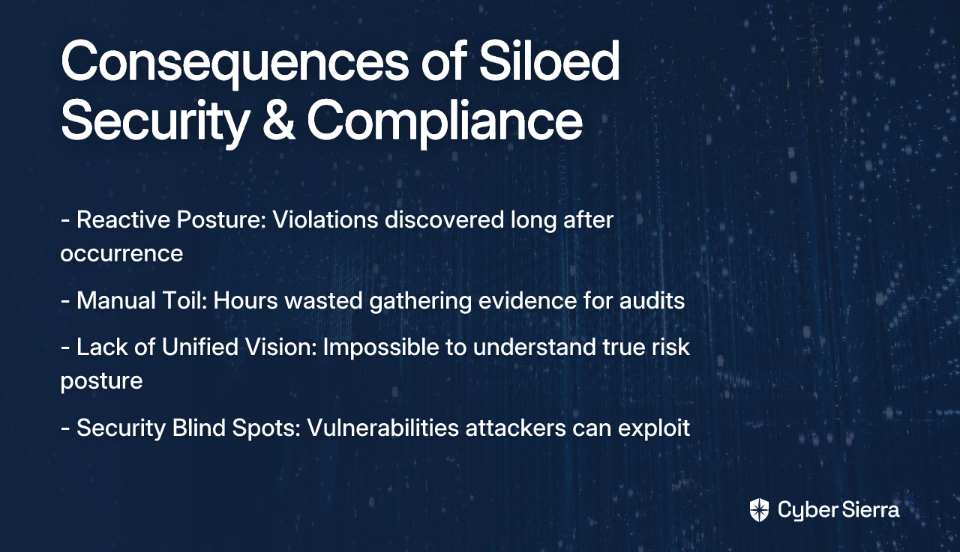
- Reactive Posture: Compliance violations are often discovered long after they occur, during manual reviews or audits
- Manual Toil: Security and IT teams spend countless hours manually gathering evidence for auditors
- Lack of Unified Vision: Without a consolidated view, it's impossible to understand the true risk posture of the organization
As MetricStream observes, organizations face significant challenges in "gaining a consolidated view of risk, compliance, and internal controls across the enterprise." This fragmentation creates blind spots that sophisticated attackers can exploit.
Primer: What is SIEM and Why is it a Game-Changer for GRC?
Before diving deeper, let's clarify what SIEM actually is and why it matters for compliance.
A SIEM (Security Information and Event Management) solution "collects, aggregates, and analyzes data from various applications, devices, servers, and users in real-time to support threat protection and visibility into security posture," according to Microsoft.
Core SIEM functions include:
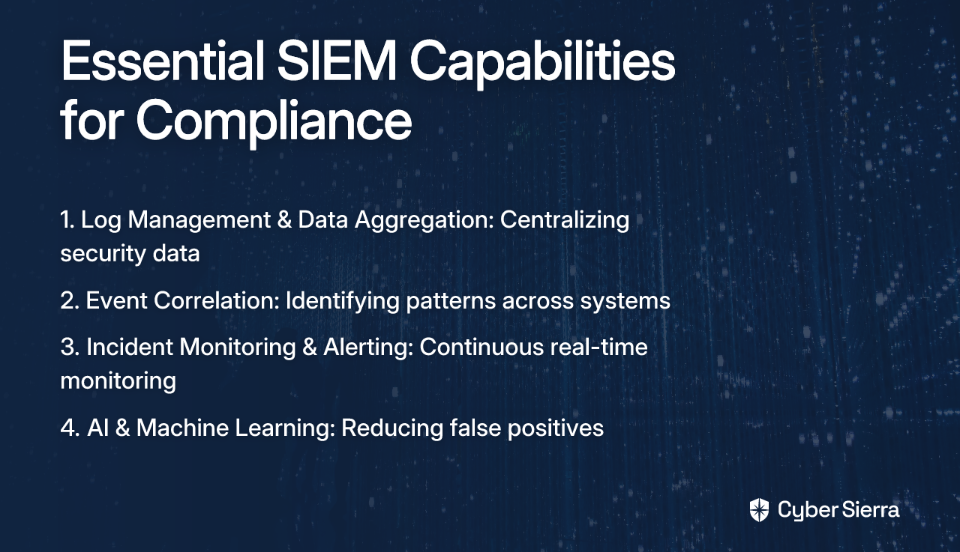
- Log Management & Data Aggregation: Centralizing security data from across your entire infrastructure
- Event Correlation: Using rules and analytics to analyze data from multiple systems and identify patterns
- Incident Monitoring & Alerting: Continuously monitoring systems and sending real-time alerts based on predefined rules
Modern SIEMs have evolved beyond simple log collection, incorporating AI and machine learning for User and Entity Behavior Analytics (UEBA). This helps reduce false positives by learning normal behavior patterns and flagging true anomalies, as noted by Exabeam.
For compliance teams, SIEM becomes the bridge between point-in-time assessments and continuous monitoring—providing the real-time visibility needed to transform GRC from a reactive exercise to a proactive strategy.
The Core Benefits: Unlocking Proactive Compliance with SIEM Integration
When you integrate your compliance tool with a SIEM platform, you unlock several transformative capabilities that fundamentally change how your organization approaches risk and compliance:
1. Automated Incident Response for Compliance Violations
The traditional compliance violation response typically looks like this: discover an issue during a quarterly review, scramble to understand what happened, manually remediate, and document everything for auditors—often weeks or months after the violation occurred.
With SIEM integration, this process transforms:
- Detection: The SIEM identifies a suspicious activity that violates a compliance rule (e.g., unauthorized access to PII)
- Analysis: The system automatically evaluates the incident's severity and compliance impact
- Response: Predefined playbooks deploy automated actions like isolating affected systems, creating tickets, and notifying compliance officers
Cynet reports that this automation can reduce the time from detection to containment by up to 80%, minimizing the compliance impact of security incidents.
2. Real-Time Risk Assessment & Continuous Control Monitoring (CCM)
This integration enables the shift from periodic sampling to 100% visibility, 100% of the time—directly addressing the need for continuous compliance monitoring expressed by many professionals.
Here's how it works:
- The SIEM acts as the data source, feeding live event data to the GRC platform
- The GRC tool maps this data to specific controls within frameworks like NIST, ISO27001, PCI DSS, and HIPAA
- Instead of guessing if controls are effective, you have a live dashboard showing their operational status
Platforms like Cybersierra are built specifically for this purpose. Their Continuous Control Monitoring (CCM) module is designed to "build a central controls repository with near real-time updates" and "automate control testing and validation," turning compliance from a periodic event into a continuous process. This approach provides actionable risk intelligence for data-driven remediation.
3. Unified Security and Compliance Dashboards
Integrating GRC and SIEM creates a unified dashboard that provides what MetricStream calls a "holistic view of enterprise risks." This single source of truth delivers multiple benefits:
- Breaks down communication barriers between SecOps and GRC teams
- Empowers CISOs and Compliance Managers with a single, reliable view of risk
- Simplifies executive and board-level reporting on security and compliance posture
This integration is particularly valuable for organizations subject to multiple regulatory frameworks, as it provides a consolidated view across all compliance requirements.
4. Streamlined Audits and Effortless Reporting
Perhaps the most immediate benefit is the dramatic reduction in audit preparation time and stress. The integrated system can automatically gather and correlate evidence required for audits.
When an auditor asks for proof that access controls have been working for the past 6 months, instead of a multi-day scramble to gather evidence, the system can generate automated audit reports in minutes.
Many GRC tools offer built-in support and reporting templates for major regulatory frameworks, making compliance reporting a matter of a few clicks rather than weeks of work. This transforms the high-stress audit season into a predictable, manageable process.

Putting it into Practice: Technical Implementation Considerations
If you're convinced of the value of SIEM-GRC integration, here are key considerations for successful implementation:
Step 1: Define Objectives & Prioritize Data Sources
Start with specific use cases aligned with your compliance needs. For example, if PCI DSS is your priority, focus first on monitoring cardholder data environments. According to Microsoft, identifying the most critical data sources (e.g., cloud logs, firewall logs, database access logs) to ingest first is crucial for a successful deployment.
Step 2: Develop Correlation Rules & Response Playbooks
Work with compliance and security teams to translate control requirements into specific SIEM correlation rules. For instance, a SOC2 requirement for access control can be implemented as a SIEM rule that detects unusual access patterns.
Develop detailed playbooks for various incident types, outlining the exact steps for automated response. These playbooks should be aligned with your Security Compliance Assessment (SCA) objectives and regularly tested.
Step 3: Ensure Seamless Integration
Verify that your GRC tool has robust APIs and pre-built connectors for your SIEM platform. Data normalization is key to ensuring that data from disparate sources can be analyzed effectively.
This is where no-code platforms can provide significant advantages, allowing compliance and security teams to configure integrations without extensive programming knowledge.
Step 4: Tune, Test, and Iterate
Regularly review and tune SIEM rules to avoid "alert fatigue." Continuously test automated response procedures to ensure they work as expected. Remember that human oversight remains crucial for complex incidents.
Choosing the Right Tools: Vendor Evaluation Criteria
When evaluating integrated GRC and SIEM solutions, consider these key criteria:
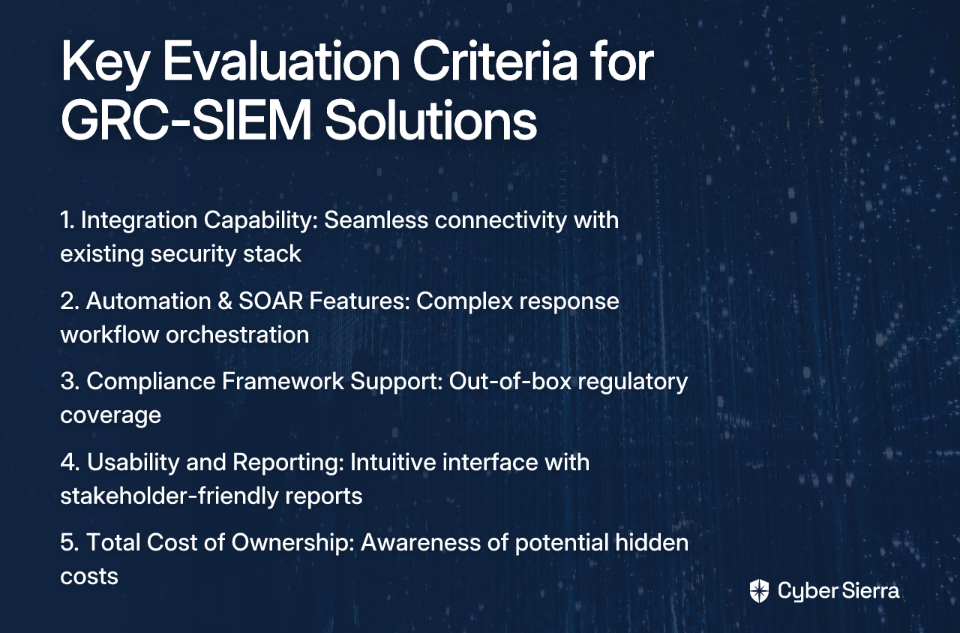
- Integration Capability: Does the solution integrate seamlessly with your existing security stack?
- Automation & SOAR Features: Look beyond basic alerting. Can the platform orchestrate complex response workflows?
- Compliance Framework Support: Does it support the regulations you need out-of-the-box? Can you add custom frameworks to fit specific organizational needs?
- Usability and Reporting: Is the interface intuitive? Can it generate reports that are easily understood by non-technical stakeholders?
- Total Cost of Ownership: Be aware of hidden costs related to data storage, ingestion, and professional services.
Cybersierra's integrated platform offers a compelling example of this unified approach. Their GRC module automates data collection and risk assessments, while their CCM capabilities provide continuous control monitoring. When combined with threat intelligence features, this creates a comprehensive solution that bridges compliance and security operations.
As Compliance as a Service models continue to evolve, platforms that offer this integrated approach can significantly reduce the burden on internal teams while improving overall security posture.
Conclusion: The Future of Compliance is Integrated and Continuous
The days of treating compliance and security as separate functions are over. The most successful organizations in 2025 will be those that have embraced an integrated GRC-SIEM strategy, moving from a reactive, checklist-driven approach to a proactive, resilient, and continuously compliant posture.
This integration doesn't just satisfy auditors—it fundamentally improves security and reduces risk by:
- Detecting and responding to compliance violations in real-time
- Providing continuous visibility into control effectiveness
- Breaking down silos between security and compliance teams
- Automating the most tedious aspects of compliance work
For organizations looking to thrive in an increasingly complex regulatory and threat landscape, the question is no longer if you should integrate your compliance and security tools, but how quickly you can make it a reality.
As one compliance professional put it, why wait for the auditors to come when you could have comprehensive compliance visibility every single day?
Frequently Asked Questions
What is the primary benefit of integrating GRC with SIEM?
The primary benefit is transforming compliance from a periodic, reactive exercise into a proactive, continuous process. By integrating the real-time monitoring capabilities of a SIEM with the policy and control management of a GRC tool, organizations gain continuous visibility into their security posture and can automate the detection and response to compliance violations as they happen.
How does SIEM integration automate compliance tasks?
SIEM integration automates compliance by using real-time data from the SIEM to continuously monitor and test security controls mapped within the GRC platform. Instead of manually gathering evidence for audits, the integrated system automatically collects relevant log data, correlates it to specific compliance requirements (like those in ISO 27001 or SOC2), and can generate audit-ready reports on demand, significantly reducing manual effort.
What is Continuous Control Monitoring (CCM)?
Continuous Control Monitoring (CCM) is an automated approach that uses technology to continuously test and validate the effectiveness of an organization's internal controls. In a GRC-SIEM integration, the SIEM feeds live operational data to the GRC platform, which then provides a near real-time dashboard showing whether security controls are functioning as intended, replacing periodic manual checks with constant automated verification.
Can this integration help with multiple compliance frameworks at once?
Yes, a key advantage of an integrated GRC-SIEM system is its ability to manage multiple compliance frameworks simultaneously. The GRC platform can map a single security control to several requirements across different frameworks (e.g., NIST, PCI DSS, HIPAA). The SIEM provides the evidence for that control's effectiveness, and the system can then report on compliance status across all relevant regulations from a unified dashboard.
What is the first step to integrating GRC and SIEM?
The first step is to define clear objectives and prioritize your most critical data sources. Instead of trying to monitor everything at once, start with a specific use case tied to a high-priority compliance requirement, such as monitoring access to sensitive data for PCI DSS. This focused approach allows you to demonstrate value quickly and build a scalable foundation for a broader integration.
Need help implementing an integrated SIEM-GRC approach? Cybersierra's platform offers a unified solution for continuous control monitoring, automated compliance reporting, and real-time risk visibility—helping you move from periodic compliance checks to continuous assurance.
