How to Connect Your GRC Platform to Cloud Security Posture Management (CSPM)


Join thousands of professionals and get the latest insight on Compliance & Cybersecurity.
Summary
- Operating GRC and CSPM tools in silos leads to manual, point-in-time audits that are inefficient and leave security gaps between assessments.
- Integrating GRC and CSPM platforms transforms compliance from a periodic, manual task into an automated, continuous process, providing a real-time view of your security posture.
- To connect these systems, use APIs or pre-built connectors to automate evidence collection and map cloud security findings directly to compliance controls.
- Platforms like Cybersierra's GRC suite simplify this by natively combining continuous control monitoring with automated compliance workflows, eliminating complex custom integrations.
You've set up a robust Governance, Risk, and Compliance (GRC) platform for your organization. You're also using Cloud Security Posture Management (CSPM) tools to monitor your cloud environments. But they're operating in silos, creating a frustrating disconnect between your compliance requirements and your actual cloud security posture.
Every time an audit approaches, your team scrambles to manually collect evidence from your CSPM tools, map it to compliance controls, and prepare documentation—a process that's not only time-consuming but also gives you only a point-in-time snapshot that's outdated almost immediately.
This manual approach leaves you vulnerable between audits, unable to demonstrate continuous compliance, and constantly playing catch-up with evolving cloud risks. You're drowning in alerts from your CSPM tool with no clear way to prioritize them based on compliance impact or business risk.
What if instead, your GRC platform and CSPM tools worked together seamlessly, automatically sharing data and insights to provide a real-time view of your compliance posture across all cloud environments?
By connecting these powerful systems, you can transform your compliance program from a reactive, manual process into a proactive, automated, and continuous one—saving countless hours, reducing risk, and providing executives with the confidence that cloud security is being managed effectively.
The Twin Pillars of Modern Security: Understanding GRC and CSPM
Before diving into integration strategies, let's clarify what these platforms do and why they're both essential components of modern security programs.
What is Governance, Risk, and Compliance (GRC)?
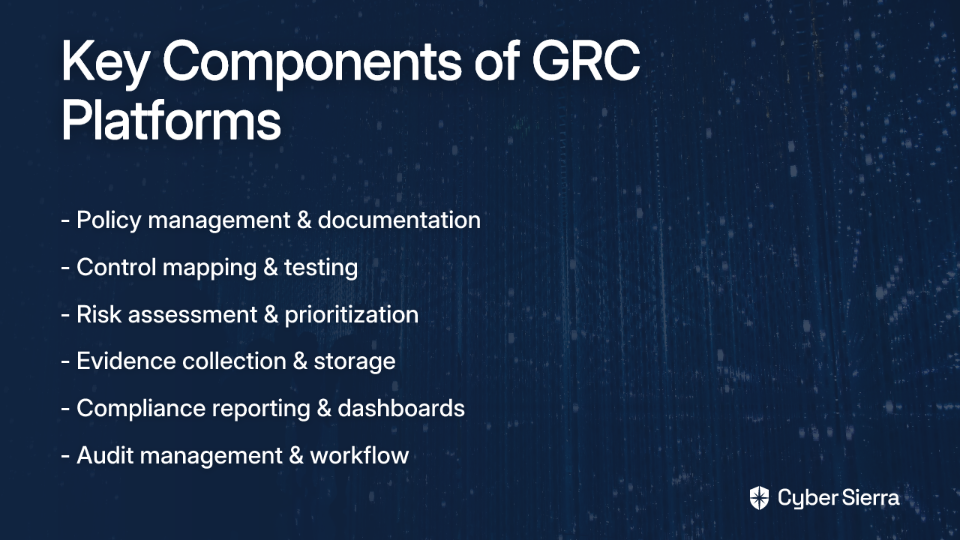
GRC is an organizational strategy to manage governance, enterprise risk, and compliance with industry and government regulations. A GRC platform centralizes and automates these functions, serving as the system of record for:
- Governance: The rules, policies, and processes ensuring activities align with business goals
- Risk Management: The identification, assessment, and control of various risks (financial, legal, strategic, security)
- Compliance: Adherence to rules and regulations governing organizational operations, such as SOC 2, ISO 27001, GDPR, NIS2, and HIPAA
In practice, GRC platforms help organizations document policies, map them to controls, test those controls, collect evidence, and generate reports for audits and board meetings. They're primarily used by CISOs, compliance managers, risk owners, IT/DevOps teams, and internal auditors.
What is Cloud Security Posture Management (CSPM)?
CSPM tools continuously scan cloud environments (AWS, Azure, GCP, etc.) to identify misconfigurations, compliance violations, and security risks. They're designed to help organizations:
- Detect and remediate cloud misconfigurations before they can be exploited
- Ensure cloud resources comply with industry frameworks and internal policies
- Maintain visibility across multi-cloud environments
- Integrate security earlier in the development lifecycle ("shift left")
According to industry research, CSPM tools can mitigate cloud security risks by up to 80%, primarily addressing issues caused by misconfigurations, lack of visibility, and poor understanding of cloud resources.
Why Integrate? The Synergy of GRC and CSPM
While GRC platforms and CSPM tools are powerful on their own, connecting them creates a multiplier effect that transforms how organizations approach security and compliance.
Moving Beyond Point-in-Time Audits to Continuous Monitoring
Traditional compliance approaches rely on periodic, point-in-time assessments that quickly become outdated in dynamic cloud environments. Many security professionals express frustration with this approach, noting that "unaddressed security issues lead to growing technical debt" between assessments.
By integrating GRC with CSPM, you enable continuous control monitoring (ConMon), where:
- Security controls are verified automatically and continuously
- Evidence is collected in real-time rather than manually during audit season
- Compliance posture is always current, not just during annual reviews
- Issues are identified and remediated promptly, reducing the risk window
The Power of a Single Source of Truth for Compliance and Risk
Integration creates a unified view that allows for "seamless management and monitoring of security and compliance across multiple frameworks" like SOC 2, ISO 27001, NIST, and more. This addresses a common pain point where security and compliance teams operate with different datasets and priorities.
With a connected approach, all stakeholders work from the same information, enabling:
- Consistent reporting across security, risk, and compliance functions
- Clear visualization of how cloud security issues impact compliance status
- Better decision-making with comprehensive visibility across frameworks
- Reduced confusion and conflicting priorities between teams
Key Benefits of Integration
Efficiency & Automation
Integrating GRC and CSPM dramatically reduces manual effort by automating evidence collection and control testing. This directly addresses the desire for "automated compliance evaluation" expressed by many security professionals.
Rather than manually gathering screenshots and configuration data for audits, the system continuously collects and organizes this information, making it readily available when needed.
Enhanced Visibility
A connected system provides live dashboards displaying risk status and control health across cloud environments. This helps address the "need for visibility in security debt" that many organizations struggle with.
Stakeholders can instantly see how cloud misconfigurations affect compliance posture and overall risk, enabling more informed decisions about resource allocation and remediation priorities.
Proactive Risk Management
Integration enables a shift from reactive to proactive security management. Instead of discovering issues during audits or after incidents, organizations can identify and address problems as they emerge.
This approach allows for "immediate action on identified risks," enabling faster remediation and minimizing exposure windows.
The Practical Guide: How to Connect Your GRC Platform with CSPM Tools
Now that we understand the benefits, let's explore a step-by-step approach to successfully connecting your GRC platform with your CSPM tools.
Step 1: Define Your Goals and Identify Compliance Frameworks
Before beginning any integration, clearly define what you want to achieve and which compliance frameworks you need to support.
- Identify relevant frameworks: Ensure your CSPM can support multiple compliance frameworks relevant to your organization, such as SOC 2, ISO 27001, GDPR, NIS2, HIPAA, or PCI DSS.
- Structure your GRC framework: Organize your GRC approach around key business and security risks, not just compliance checkboxes.
- Set clear objectives: Define specific goals like reducing manual evidence collection time by 80% or achieving a real-time compliance dashboard for executives.
Step 2: Evaluate Your Platforms' Integration Capabilities
Not all GRC and CSPM platforms offer the same integration capabilities. Evaluate your current tools to determine:
- API availability: Check if your GRC platform has APIs that can consume data from CSPM tools, and vice versa.
- Pre-built connectors: Look for native integrations between your specific platforms. Many modern GRC tools offer pre-built connectors for popular CSPM solutions.
- Integration with other systems: Verify integration capabilities with identity management systems (e.g., Okta, Azure AD) and ticketing systems (e.g., Jira, ServiceNow) to create a comprehensive workflow.
Step 3: Execute the Technical Integration
With goals defined and capabilities assessed, it's time to implement the technical connection between your GRC platform and CSPM tools.
- Use pre-built connectors: If available, leverage existing integrations between your platforms. These typically offer the easiest setup and most reliable data flow.
- Implement API integration: For platforms without native connectors, develop custom integrations using their respective APIs. This creates a data pipeline where CSPM findings are automatically sent to the GRC platform.
- Map findings to controls: Configure the system to map cloud security findings (e.g., a misconfigured S3 bucket) to specific controls within your compliance frameworks (e.g., mapping the S3 issue to a data protection control in your ISO 27001 or SOC 2 framework).
Step 4: Configure Automated Control Tests and Evidence Collection
Once connected, set up automated processes for testing controls and collecting evidence:
- Define control tests: Create scheduled control tests that run regularly to verify compliance with specific requirements.
- Automate evidence collection: Configure the system to automatically gather evidence (screenshots, configuration files, logs) from the CSPM and attach it to the relevant control in the GRC platform, creating a centralized evidence repository.
- Set up exception workflows: Establish processes for handling control failures, including automated ticket creation, notification workflows, and remediation tracking.
Step 5: Establish Continuous Monitoring and Real-time Reporting
The final step is implementing continuous monitoring and meaningful reporting:
- Create dashboards: Develop executive dashboards showing compliance status across frameworks, with drill-down capabilities for deeper analysis.
- Set up alerts: Configure notifications for critical control failures or significant changes in compliance status.
- Implement trend analysis: Track compliance posture over time to identify patterns and demonstrate continuous improvement to auditors and executives.
Selecting the Right Integrated GRC and CSPM Solution
The success of your integration depends heavily on choosing the right tools. Here are some options to consider:
1. Cybersierra
Cybersierra provides an AI-enabled cybersecurity platform that natively integrates GRC and continuous monitoring capabilities, simplifying the entire integration process.
Their Continuous Control Monitoring (CCM) module offers ongoing visibility into security controls, builds a central controls repository with near real-time updates, and automates control testing and validation. This functions as the engine that feeds live data into the GRC system.
Meanwhile, their Governance, Risk & Compliance (GRC) module automates data collection, risk assessments, and reporting for multiple frameworks like SOC2, ISO 27001, and HIPAA. It directly consumes data from the CCM module to make enterprises audit-ready faster while reducing manual effort.
What sets Cybersierra apart is its integrated approach that transforms security from periodic checks to continuous, automated monitoring, providing a single source of truth for controls and enabling proactive risk management.
2. Standalone GRC Platforms with Strong API Support
Some organizations prefer to use dedicated GRC tools and connect them to third-party CSPMs. When taking this approach, look for robust API documentation and pre-built connectors for popular CSPM tools. Ensure the platform can handle the volume and variety of data from your CSPM solution.
3. Cloud-Native Security Platforms (CNAPP)
Modern cloud-native application protection platforms (CNAPPs) often combine CSPM with other capabilities like cloud workload protection (CWPP) and cloud infrastructure entitlement management (CIEM). Many include modules or integrations for GRC functions, offering a different integration path.
Overcoming Common Integration Challenges
While connecting GRC and CSPM offers tremendous benefits, organizations often face several challenges during implementation:
Alert Fatigue
CSPMs can generate thousands of alerts, overwhelming security teams. Address this by using your GRC platform to prioritize alerts based on risk scores and asset criticality. Focus on the misconfigurations that directly impact your compliance posture and present the highest risk.
Tool Complexity & Training
Integration requires expertise in both GRC and CSPM domains. Train your teams on both functionalities to ensure they understand how to use the integrated platform effectively. Consider bringing in external expertise if needed to establish the initial integration.
Mapping Controls
The initial setup of mapping CSPM findings to specific GRC controls can be labor-intensive but is critical for automation. Invest time upfront to create comprehensive mappings between cloud configurations and compliance requirements to enable true automation.
Conclusion
Connecting your GRC platform to your Cloud Security Posture Management tools is no longer a luxury but a necessity for modern cloud security. This integration transforms risk management from a static, spreadsheet-driven exercise into a dynamic, data-driven process.
The result is a clear, defensible audit trail, simplified compliance, reduced risk, and security teams that can focus on strategic initiatives rather than manual evidence gathering.
If you're still managing compliance with spreadsheets and periodic scans, it's time to explore an integrated GRC and CSPM solution like Cybersierra to automate your security posture management and create a continuous, real-time view of your compliance status across all cloud environments.
By making this transition, you'll not only satisfy auditors but also provide meaningful security insights to your organization—turning compliance from a burden into a business enabler.
Frequently Asked Questions
What is the main difference between GRC and CSPM?
GRC platforms manage overall organizational strategy for governance, risk, and compliance policies, while CSPM tools specifically focus on continuously monitoring cloud environments for security misconfigurations and technical compliance violations. Think of GRC as the system of record for your compliance policies and controls (the "what" and "why"), whereas CSPM is the technical engine that continuously checks your cloud infrastructure against those rules (the "how").
Why should you integrate GRC and CSPM tools?
Integrating GRC and CSPM tools automates compliance monitoring by connecting your high-level compliance policies (in GRC) with real-time cloud security data (from CSPM), creating a single source of truth and eliminating manual evidence collection. This integration transforms compliance from a periodic activity into a continuous, automated process, enabling proactive risk management and significant time savings during audits.
How does integrating GRC and CSPM simplify the audit process?
An integrated GRC and CSPM system simplifies audits by automatically and continuously collecting evidence, mapping it to specific compliance controls, and maintaining an always-up-to-date audit trail. Instead of scrambling to gather screenshots and logs before an audit, the system provides a central repository of evidence and live dashboards, offering auditors a more accurate and defensible picture of your security posture.
What is the first step to connect a GRC platform with a CSPM tool?
The first step is to clearly define your goals by identifying the specific compliance frameworks you need to adhere to (e.g., SOC 2, ISO 27001, HIPAA) and setting clear objectives for the integration. This strategic foundation ensures the technical integration aligns with business needs, such as reducing manual audit preparation time or achieving a real-time compliance dashboard for executives.
Can I just use my CSPM tool for cloud compliance?
While a CSPM tool is excellent for identifying technical compliance violations in the cloud, it lacks the broader context of a GRC platform, which manages overall risk, policy documentation, and audit workflows across the entire organization. A GRC platform links technical findings to specific business risks and compliance controls, serving as the central hub for managing the entire compliance lifecycle.
What are the biggest challenges when integrating GRC and CSPM?
The most common challenges include dealing with a high volume of alerts from the CSPM (alert fatigue), the technical complexity of mapping findings to GRC controls, and ensuring teams are adequately trained on both platforms. To overcome these, prioritize alerts based on business risk, invest time upfront in mapping controls, and provide comprehensive training to ensure your team can effectively manage the integrated system.