10 Best Third-Party Monitoring Tools for Compliance-Driven Companies

Join thousands of professionals and get the latest insight on Compliance & Cybersecurity.
Summary
- Manual vendor compliance management creates operational bottlenecks, making it nearly impossible to stay audit-ready.
- Failing to meet regulatory requirements like GDPR can result in severe fines of up to 4% of annual global revenue.
- The key to effective vendor management is shifting from outdated, point-in-time assessments to automated, continuous monitoring.
- Streamline your compliance workflows and automate vendor monitoring with Cyber Sierra's Third-Party Risk Management (TPRM) solution.
You've set up a robust vendor management process, but now your team is drowning in security questionnaires, compliance certifications, and risk assessments. What once seemed manageable has become a massive operational bottleneck, with every task feeling like a full-time job that's grossly underappreciated.
As one IT manager put it: "Trying to stay audit-ready in that mess was nearly impossible."
For companies in regulated industries, this pain is all too familiar. Managing third-party compliance isn't just about checking boxes—it's about protecting your organization from the devastating consequences of a vendor-related security breach or compliance violation.
Why Continuous Compliance Monitoring Matters
Traditional point-in-time assessments are no longer sufficient in today's dynamic threat landscape. Continuous compliance monitoring—the ongoing evaluation of systems to ensure adherence to regulatory standards—has become essential for several reasons:
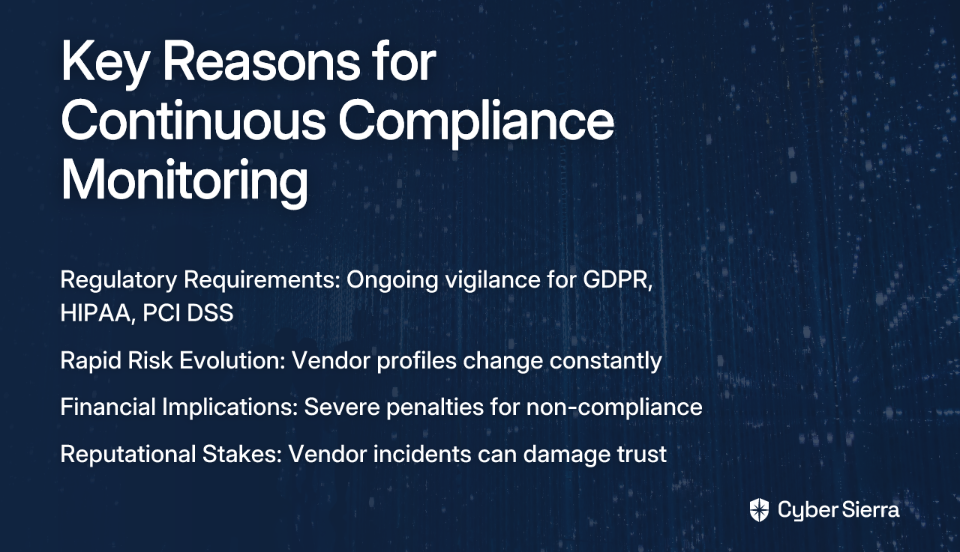
- Regulatory Requirements: Frameworks like GDPR, HIPAA, PCI DSS, and others require ongoing vigilance, not just periodic checks
- Rapid Risk Evolution: Vendor risk profiles change constantly as they update systems, add new features, or experience security incidents
- Financial Implications: Non-compliance can result in severe penalties (GDPR fines reach up to €20 million or 4% of annual global revenue)
- Reputational Stakes: A single vendor security incident can irreparably damage your brand and customer trust
The solution? Moving away from spreadsheets and manual follow-ups toward automated, continuous monitoring tools that keep you audit-ready at all times. Let's explore the top solutions that can transform this burden into a streamlined, manageable process.
The 10 Best Third-Party Monitoring Tools
1. Cyber Sierra
Overview: Cyber Sierra stands out as a comprehensive AI-enabled cybersecurity platform designed specifically to simplify and automate security compliance. It addresses the core challenges mentioned by IT managers—transforming vendor risk management from a "thankless full-time job" into an efficient, automated process.
Key Compliance Features:
- Third-Party Risk Management (TPRM): Automates vendor assessments and questionnaires, provides continuous 24/7 monitoring of vendor security posture, and prioritizes vendors based on risk levels
- Governance, Risk & Compliance (GRC): Automates data collection and reporting across multiple frameworks (SOC 2, ISO 27001, GDPR, HIPAA, PCI DSS), maintaining detailed audit trails
- Continuous Control Monitoring (CCM): Offers real-time visibility into security controls with automated testing and exception detection
- Framework Coverage: Supports comprehensive mapping across all major frameworks simultaneously, ideal for companies managing multiple compliance requirements
Best For: Organizations managing multiple compliance frameworks who need a unified platform to automate the entire compliance lifecycle while maintaining continuous visibility into third-party risk.
2. UpGuard
Overview: A comprehensive TPRM platform known for its security ratings and extensive monitoring capabilities.
Key Compliance Features:
- Provides security ratings with a 24-hour scanning refresh rate for real-time risk visibility
- Features Trust Exchange for streamlining vendor onboarding and risk data collection
- Maps controls to regulatory standards for simplified compliance tracking
- Monitors for data leaks and security breaches across vendors
Best For: Organizations requiring deep visibility into their vendors' external security posture with strong emphasis on continuous monitoring.
3. Drata
Overview: A security and compliance automation platform focused on helping companies achieve and maintain continuous audit readiness.
Key Compliance Features:
- Specializes in mapping controls directly to compliance frameworks like GDPR, HIPAA, and SOC 2
- Offers continuous monitoring of compliance controls to ensure ongoing adherence
- Streamlines evidence collection for audits with automated workflows
- Provides real-time compliance status dashboards for at-a-glance monitoring
Best For: Startups and SMBs prioritizing audit readiness who need to demonstrate compliance across multiple frameworks without the overhead of a large security team.
4. Vanta
Overview: A compliance platform with strong vendor monitoring capabilities focused on streamlining security questionnaires and documentation.
Key Compliance Features:
- Features an integrated risk management and compliance monitoring dashboard
- Automates security questionnaire distribution and response tracking
- Helps track vendor alignment with various compliance frameworks
- Maintains a continuous record of vendor compliance status for audit purposes
Best For: Organizations whose primary need is tracking vendor compliance status rather than deep-diving into their overall security risk posture.
5. SecurityScorecard
Overview: Offers powerful visualization tools and real-time security ratings to assess and monitor third-party risk continuously.
Key Compliance Features:
- Performs comprehensive attack surface scanning across key areas like Open Ports, DNS, and SSL
- Provides detailed security ratings broken down by risk factor categories
- Offers compliance mapping to standards like NIST, ISO, and others
- Features portfolio-level reporting for compliance oversight
Best For: Tech-heavy teams that need strong visual insights into their vendors' security posture and attack surface with quantifiable metrics for executive reporting.
6. Bitsight
Overview: A tool that uniquely integrates cyber risk quantification with vendor risk monitoring, helping translate technical risks into business impact.
Key Compliance Features:
- Provides external risk monitoring from an attacker's perspective
- Offers financial impact assessments to help prioritize remediation efforts
- Features continuous monitoring with automated alerts for security changes
- Includes peer benchmarking to understand relative compliance posture
Best For: Organizations that need to translate third-party risks into financial terms to justify security investments and communicate effectively with executive stakeholders.
7. OneTrust
Overview: A platform tailored for privacy and risk management, with comprehensive third-party risk assessment capabilities.
Key Compliance Features:
- Provides security ratings and compliance mapping with regulatory standards
- Automates data collection for stakeholder reporting on TPRM initiatives
- Offers pre-built assessment templates aligned with industry standards
- Includes workflow automation for remediation tracking
Best For: Privacy-focused organizations needing a tool that combines vendor risk management with broader privacy and compliance objectives, especially for GDPR and CCPA requirements.
8. AuditBoard
Overview: A cloud-based platform designed specifically for audit, risk, and compliance management with strong third-party monitoring capabilities.
Key Compliance Features:
- Supports multiple compliance frameworks with automated evidence collection
- Provides real-time regulatory intelligence to help companies proactively manage changes
- Centralizes controls, risks, and audit evidence in one place
- Features robust reporting for board and executive-level presentations
Best For: Internal audit and compliance teams looking for a purpose-built platform to streamline audit workflows while maintaining visibility into vendor compliance.
9. LogicGate
Overview: A GRC platform that provides a holistic view of third-party risks through automated workflows and assessment processes.
Key Compliance Features:
- Offers pre-built questionnaires aligned with industry standards like SIG and NIST
- Features a secure assessment portal for vendor collaboration
- Aggregates third-party intelligence to centralize onboarding and assessment workflows
- Includes continuous monitoring capabilities for ongoing risk oversight
Best For: Organizations that want to automate and standardize their vendor onboarding and assessment processes using industry-recognized questionnaires with workflow automation.
10. Prevalent
Overview: A TPRM solution that combines point-in-time assessments with continuous monitoring, leveraging a shared intelligence network.
Key Compliance Features:
- Provides access to a network of preemptively submitted questionnaires from vendors to speed up onboarding
- Monitors the dark web for data leaks related to third parties
- Offers automated monitoring for emerging risks
- Includes built-in remediation tracking and management
Best For: Companies looking for efficiency in vendor onboarding by leveraging a shared network of vendor risk data while maintaining ongoing monitoring capabilities.
Transform Your Compliance from Burden to Business Advantage
The days of managing vendor security as a "massive operational bottleneck" with "endless follow-ups" that feel like "a full-time job" should be behind us. As we've seen from discussions among IT managers, trying to stay audit-ready with manual processes and spreadsheets is "nearly impossible" in today's complex regulatory environment.
Modern third-party monitoring tools offer a path forward—transforming compliance from a reactive, periodic burden into a proactive, continuous security function that provides real business value:
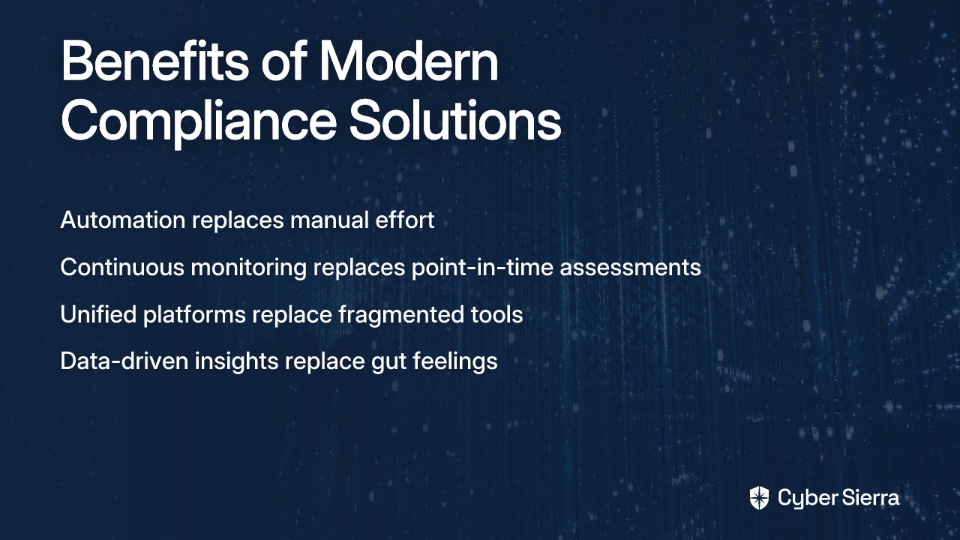
- Automation replaces manual effort: No more chasing vendors for questionnaires and certifications
- Continuous monitoring replaces point-in-time assessments: Stay audit-ready at all times
- Unified platforms replace fragmented tools: Manage multiple compliance frameworks in one place
- Data-driven insights replace gut feelings: Make risk-based decisions with confidence
While specialized tools can address specific compliance needs, organizations managing multiple frameworks simultaneously will benefit most from comprehensive platforms like Cyber Sierra that integrate continuous control monitoring, third-party risk management, and GRC automation in one unified solution.
By implementing the right third-party monitoring tools, you can turn compliance from a thankless burden into a competitive advantage—protecting your organization while freeing your team to focus on strategic initiatives that drive the business forward.
Ready to transform your approach to compliance? Book a demo with Cyber Sierra today to see how our AI-enabled platform can automate your vendor risk management and keep you continuously audit-ready across all your compliance frameworks.
Frequently Asked Questions
What is a third-party monitoring tool?
A third-party monitoring tool is a software solution that automates the process of assessing, monitoring, and managing the security and compliance risks associated with external vendors. It moves beyond manual spreadsheets and questionnaires by providing continuous visibility into a vendor's security posture, tracking their compliance with regulations like GDPR or SOC 2, and alerting you to potential risks in real-time.
Why is continuous monitoring important for vendor compliance?
Continuous monitoring is important because it provides real-time visibility into a vendor's risk profile, which can change at any moment, ensuring you remain compliant and secure between periodic audits. Traditional point-in-time assessments can quickly become outdated. Continuous monitoring tools actively scan for issues, track compliance status 24/7, and provide immediate alerts, keeping you perpetually audit-ready.
How do I choose the right third-party monitoring tool?
To choose the right tool, evaluate your specific needs, such as the compliance frameworks you manage (e.g., SOC 2, ISO 27001), the scale of your vendor ecosystem, and your primary goal. For instance, if you manage multiple complex frameworks, a unified GRC platform is ideal. If your main concern is vendor security ratings, look for tools specializing in that area.
What are the key features of a good vendor compliance tool?
Key features include automated vendor assessments, continuous control monitoring, support for multiple compliance frameworks, risk-based prioritization, and robust reporting and audit trail capabilities. Look for a solution that automates security questionnaires (TPRM), continuously tests security controls against standards (CCM), and maps evidence to multiple frameworks simultaneously (GRC).
How do these tools help with specific regulations like GDPR or HIPAA?
These tools help with regulations like GDPR and HIPAA by automating the collection of evidence and mapping security controls directly to the specific requirements of each framework. Instead of manually tracking vendor adherence, the platform can continuously monitor controls, manage Data Processing Agreements (DPAs), and maintain an audit-ready trail to prove due diligence.
What is the difference between TPRM, GRC, and CCM?
TPRM focuses specifically on managing vendor risk, GRC is a broader strategy for managing an organization's overall governance, risk, and compliance, and CCM is the technology that continuously tests security controls. Modern platforms often integrate all three to provide a comprehensive compliance solution.