



9 Best Audit Readiness Software Tools for Continuous Compliance

Join thousands of professionals and get the latest insight on Compliance & Cybersecurity.
Summary
- The GRC software market is projected to hit $60.5 billion by 2025, signaling a major shift away from manual, point-in-time audits.
- Continuous compliance transforms audit preparation from a periodic fire drill into an ongoing, automated process that provides real-time visibility into your security posture.
- When selecting audit readiness software, prioritize key features like continuous control monitoring (CCM), automated evidence collection, and multi-framework support to significantly reduce manual effort.
- An AI-enabled platform like Cyber Sierra's GRC solution can unify compliance, risk, and control monitoring to make your organization audit-ready at all times.
Are you tired of the mad scramble before audits? The endless hours spent gathering evidence, long calls with engineers who may not speak "GRC," and the stress of managing multiple compliance frameworks?
You're not alone. With the GRC software market expected to reach $60.5 billion by 2025, organizations are increasingly seeking solutions to transform compliance from a periodic fire drill into a continuous, automated process.
In this article, we'll explore the top 9 audit readiness software tools that can help your organization transition to continuous compliance — allowing you to stay perpetually prepared for audits while significantly reducing manual effort.
The Shift from Point-in-Time to Continuous Compliance
Traditional compliance approaches treat audits as point-in-time events, leading to:
- Tedious, manual evidence gathering processes
- Frantic preparation just before audits
- Limited visibility into your actual compliance posture between assessments
- Inefficient resource allocation as teams scramble to prepare
Continuous compliance, by contrast, is "the ongoing practice of ensuring that software development processes and technologies adhere to regulatory and security standards, primarily through automation." This approach provides faster feedback, simplifies reporting with clear evidence, and allows for early detection of issues.
What to Look for in Audit Readiness Software
Before diving into specific tools, let's understand the key features that make audit readiness software truly effective:
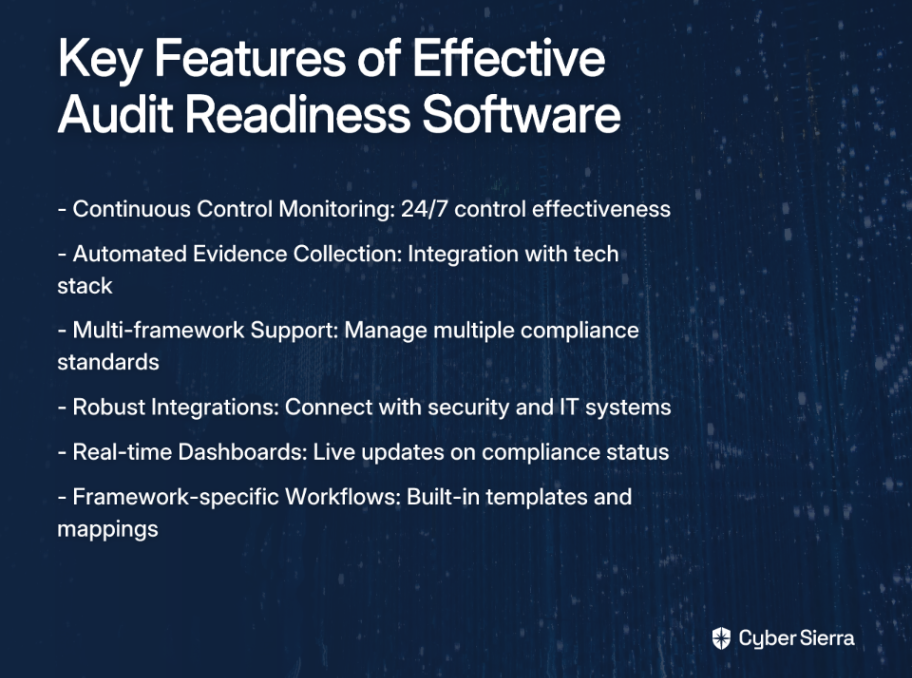
- Continuous Control Monitoring (CCM): The core of modern audit readiness, ensuring controls are effective 24/7, not just during audit periods.
- Automated Evidence Collection: The most crucial feature for alleviating the pain of manual evidence gathering. Look for tools that integrate with your tech stack (cloud providers, HR systems, etc.) to automatically collect and organize evidence.
- Multi-framework Support: Modern businesses often need to comply with multiple standards (SOC 2, ISO 27001, PCI DSS, GDPR, HIPAA). The right tool should manage these frameworks simultaneously from a single platform.
- Robust Integrations: The platform must connect seamlessly with your existing security and IT systems (AWS, Azure, Jira, Slack) to provide a single source of truth.
- Real-time Dashboards & Reporting: Look for tools that provide live updates on compliance status and generate audit-ready reports with minimal effort.
- Framework-specific Workflows: Built-in checklists, policies, and control mappings for standards like ISO27001 simplify the compliance journey and reduce guesswork.
Now, let's explore the top solutions that meet these criteria:
The 9 Best Audit Readiness Software Tools
1. Cyber Sierra
Overview: Cyber Sierra offers an AI-enabled cybersecurity platform designed to simplify and automate security compliance. It excels at transitioning organizations from periodic checks to proactive, near real-time risk management and continuous compliance.
Key Features for Audit Readiness:
- Continuous Control Monitoring (CCM): Builds a central controls repository with near real-time updates, provides clear visibility into security posture, and automates control testing and validation.
- Governance, Risk & Compliance (GRC): Automates data collection, risk assessments, and reporting for multiple frameworks including SOC2, ISO 27001, GDPR, HIPAA, and PCI DSS.
- Third-Party Risk Management (TPRM): Extends continuous compliance to the supply chain by simplifying vendor risk assessment and providing 24/7 visibility into vendor security compliance.
Unique Selling Points:
- Transforms security from periodic checks to continuous, automated monitoring
- Provides a unified platform that connects GRC, CCM, and vendor risk, eliminating silos
- AI-enabled automation simplifies complex GRC requirements, making enterprises audit-ready faster
Best For: CISOs, Compliance Managers, and IT Managers in regulated industries (BFSI, HealthTech, etc.) who need a unified, automated platform to manage multiple compliance frameworks.
2. Scrut Automation
Overview: An end-to-end compliance automation platform designed to streamline regulatory compliance and reduce audit preparation time.
Key Features:
- Automated evidence collection via 100+ integrations
- Continuous controls monitoring with real-time alerts
- Supports over 50 compliance standards with framework-specific checklists
Pros: Claims to reduce audit prep time by 70%, according to their research.
Cons: Complements existing security systems but doesn't replace them.
3. Drata
Overview: A popular compliance automation platform with a strong focus on continuous monitoring and user experience, particularly for tech-focused companies.
Key Features:
- Continuously monitors security controls with an automated evidence gathering system
- Features a centralized audit hub and pre-mapped controls for various frameworks
- AI-native platform with AI-powered workflows for risk management
Pros: Great customer support and intuitive user interface.
Cons: Can have a steep learning curve for organizations new to compliance automation.
4. Vanta
Overview: Known for its user-friendly interface and extensive integrations, Vanta helps fast-growing companies automate compliance for frameworks like SOC 2 and ISO 27001.
Key Features:
- Automated security checks and continuous monitoring
- Claims up to 90% automation for audits
- Policy templates and employee security training modules
Best For: Startups and tech companies looking to achieve their first certifications quickly.
5. AuditBoard
Overview: A cloud-native platform that unifies audit, risk, and compliance management with a focus on collaboration.
Key Features:
- Offers automated workflows and a centralized, user-friendly dashboard
- Strong features for collaborative document and audit management
- Streamlined audit preparation and project management tools
Pros: Excellent customer support and intuitive interface.
Cons: Can be more expensive and has limited customization options compared to others.
6. Hyperproof
Overview: A versatile compliance operations platform that centralizes audit preparation and evidence collection.
Key Features:
- Automated proof collection and controls integration
- Advanced collaboration tools to work with auditors and internal teams
- Customizable workflows for different compliance frameworks
Pros: Easy to implement with a sleek UI and good customer support.
Cons: Lacks some customization options found in more mature platforms.
7. Sprinto
Overview: A security management platform focused on simplifying GRC by automating compliance activities for cloud-based companies.
Key Features:
- Continuously monitors compliance and provides pre-built security program templates
- Features a collaboration dashboard for sharing evidence directly with auditors
- Automated policy management and implementation
Pros: User-friendly interface with minimal setup time.
Cons: Needs better customization options for complex environments.
8. LogicGate
Overview: A highly customizable, no-code GRC platform that allows organizations to build their own risk and compliance workflows.
Key Features:
- Intuitive drag-and-drop workflow builder
- Automated control testing and audit reporting
- Pre-built workflows for internal audit management
Pros: Highly customizable to fit specific business processes and compliance needs.
Cons: Some features are still under development, and the flexibility can sometimes lead to complexity.
9. MetricStream
Overview: A comprehensive and established GRC platform for large enterprises with complex needs, recognized for its "Connected GRC" approach according to industry analyses.
Key Features:
- AI-powered for enterprise-wide risk visibility
- Centralized compliance management and regulatory change monitoring
- Low-code customization options for tailoring to specific industry requirements
Best For: Large enterprises in highly regulated industries like financial services.
The Technical Shift to Continuous Compliance
Beyond just software tools, organizations embracing continuous compliance are adopting several technical approaches:
Policy-as-Code: Tools like Open Policy Agent (OPA) enforce compliance rules programmatically. This ensures rules are applied consistently and mitigates bottlenecks from manual checks.
Software Bill of Materials (SBOM): Generating an SBOM is critical for understanding all components in your software, which is foundational for tracking vulnerabilities and ensuring license compliance.
Emerging Frameworks: Standards like SLSA (Supply Chain Levels for Software Artifacts) and OSCAL (Open Security Control Assessment Language) are emerging to help automate and standardize compliance at scale.
The maturity of these practices means continuous compliance should be a default consideration in modern development, not an afterthought.
Transform Your Audit Experience with Continuous Compliance
The era of stressful, last-minute audit preparation is over. The shift to continuous compliance isn't just a trend—it's a strategic necessity for managing risk, building trust, and operating efficiently in a complex regulatory landscape.
To truly embrace continuous compliance, organizations need more than just a checklist manager; they need a unified, intelligent platform. A tool like Cyber Sierra enables this transition by providing:
- AI-enabled Automation: To handle the heavy lifting of evidence gathering and control monitoring
- A Single Source of Truth: Unifying GRC, CCM, and vendor risk to give you a complete, real-time picture of your compliance posture
- Proactive Risk Management: Helping you identify and fix gaps long before an auditor asks
The right audit readiness software doesn't just make compliance easier—it transforms it from a periodic burden into a continuous business advantage. By automating evidence collection, providing real-time visibility into your control effectiveness, and supporting multiple frameworks simultaneously, these tools free your team to focus on strategic initiatives rather than compliance fire drills.
As you evaluate the options in this list, consider your organization's specific needs, the complexity of your compliance requirements, and how each tool aligns with your existing tech stack. The investment in the right platform will pay dividends not just in audit preparation time saved, but in the overall maturity and effectiveness of your security program.
Stop treating audits like a fire drill. Discover how advanced audit readiness software can help you achieve a state of continuous, stress-free compliance and make your next audit your easiest one yet.
Learn more about Cyber Sierra's automated GRC platform and see how it can transform your approach to compliance today.
Frequently Asked Questions
What is continuous compliance and why is it important?
Continuous compliance is the ongoing, automated practice of ensuring that a company's systems and processes consistently adhere to regulatory and security standards. It is important because it transforms compliance from a stressful, periodic event into a proactive, real-time process. This approach provides constant visibility into your compliance posture, helps detect issues early, and dramatically reduces the manual effort required for audit preparation.
What are the most important features of audit readiness software?
The most crucial features in audit readiness software are Continuous Control Monitoring (CCM), automated evidence collection, and multi-framework support. CCM ensures your controls are working 24/7, automated evidence collection eliminates manual gathering of proof by integrating with your tech stack, and multi-framework support allows you to manage standards like SOC 2, ISO 27001, and GDPR from a single platform.
How does audit readiness software manage multiple compliance frameworks?
Audit readiness software manages multiple frameworks by centralizing controls and evidence in a single platform. It uses a "control mapping" technique where a single control (e.g., access control) can be mapped to satisfy requirements across several frameworks (like SOC 2, ISO 27001, and PCI DSS). This means you collect evidence once and reuse it for multiple audits, saving significant time and preventing redundant work.
What is the difference between continuous compliance and a traditional audit?
The key difference is that continuous compliance is a proactive, ongoing process, while a traditional audit is a reactive, point-in-time event. Continuous compliance uses automation to monitor controls and collect evidence constantly, providing a live view of your security posture. In contrast, a traditional audit involves a frantic, manual scramble to gather evidence just before the assessment, offering only a snapshot of compliance at that specific moment.
How does automated evidence collection actually work?
Automated evidence collection works by connecting the audit readiness platform to your organization's various systems via APIs. For example, it can integrate with your cloud provider (like AWS or Azure) to check security group configurations, your HR system to verify that employees have completed security training, and your version control system (like GitHub) to ensure code changes follow proper approval workflows. The platform then automatically captures screenshots, logs, and other data as proof that these controls are operating correctly.
Can small businesses benefit from audit readiness software?
Yes, small businesses can benefit greatly from audit readiness software. These tools help startups and SMBs achieve critical certifications like SOC 2, which are often required to sell to larger enterprise customers. By automating compliance tasks, the software saves valuable time for smaller teams that lack dedicated compliance staff, allowing them to build a strong, scalable security foundation from the start.
