How to Use AI Agents to Automate Continuous Controls Monitoring


Join thousands of professionals and get the latest insight on Compliance & Cybersecurity.
Summary
- Manual compliance monitoring is increasingly ineffective, with 59% of organizations citing resource constraints as a key barrier to success.
- Agentic AI transforms Continuous Controls Monitoring (CCM) by automating evidence collection and providing real-time risk insights, moving compliance from periodic checks to a continuous process.
- To get started, implement AI-powered CCM by launching a pilot program focused on a single, high-impact control to demonstrate value quickly.
- Platforms like Cyber Sierra’s Continuous Control Monitoring use AI to automate compliance, reduce audit fatigue, and provide a real-time view of your security posture.
You've heard about AI automation and maybe you're intrigued by the possibilities. But with a sea of tools like Zapier, Make, and N8N out there, the starting point seems murky at best. Should you choose per-node or per-workflow pricing? Do you need to master complex coding before you can create anything useful?
Instead of getting lost in these questions, let's focus on a specific, high-value application for AI agents that delivers immediate business impact: Continuous Controls Monitoring (CCM).
This isn't just about auto-categorizing emails or summarizing meeting notes. This is about transforming how your organization handles security, compliance, and risk—moving from periodic, manual checks to a real-time, automated framework that provides continuous assurance.
The Compliance Challenge: Why Manual Monitoring is No Longer Enough
Continuous Controls Monitoring (CCM) is the use of technology to continually validate the effectiveness of security and compliance controls in real-time. Unlike traditional audit methods that provide only periodic snapshots, CCM ensures ongoing cyber defense and regulatory compliance.
The challenge? Most organizations are stuck in a reactive cycle:
- Prepare frantically for audits
- Scramble to collect evidence
- Discover control failures too late
- Repeat next quarter or year
This approach is not just inefficient—it's increasingly dangerous in today's environment where:
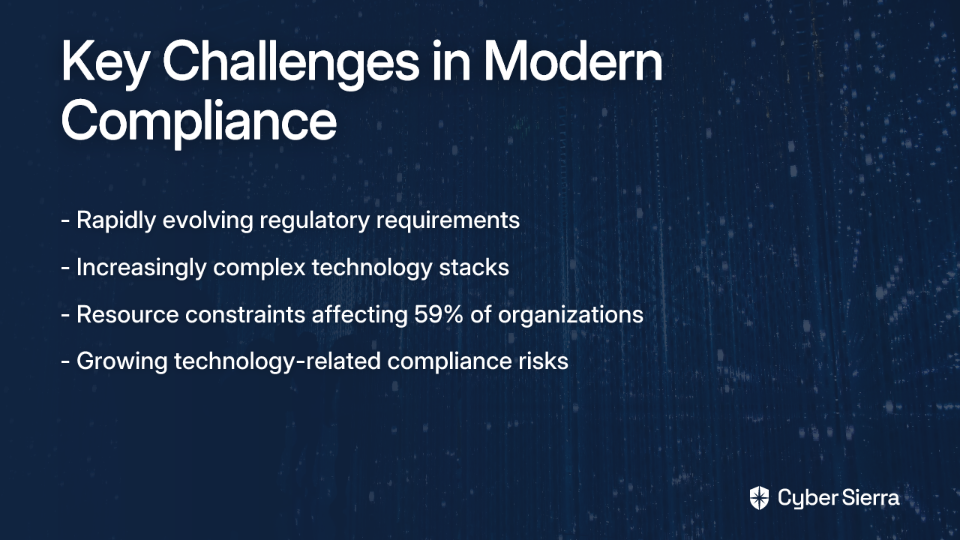
- Regulatory requirements are expanding and evolving rapidly
- Technology stacks are becoming more complex
- Resources are constrained, with 59% of organizations citing lack of resources as a key barrier to achieving ROI on compliance programs
According to PwC's 2025 Global Compliance Survey, executives now identify technology as their top compliance risk priority, yet most lack the tools to address it effectively.
The Power of Agentic AI in Transforming CCM
This is where AI agents—specifically what's called "Agentic AI"—come into play. Unlike simple automation scripts or even standard AI assistants, Agentic AI refers to autonomous systems powered by Large Language Models (LLMs) that can make decisions and take actions without constant human oversight.
According to research from Accenture, companies that achieve enterprise-level value from AI are 4.5 times more likely to have adopted agentic architectures. For CCM, this translates into transformative capabilities:
Automated, Agentic Evidence Collection
AI agents can autonomously gather audit-ready evidence across your entire tech stack—even reaching data that APIs can't access. This eliminates a significant amount of the manual labor of evidence gathering.
As CyberSaint notes, these agents operate within strict security guardrails to ensure safe, permissioned access to systems.
Predictive Analytics and Risk Forecasting
Beyond monitoring current states, AI can analyze historical data to identify patterns, predict potential control failures, and help prioritize risks before they lead to incidents.
Enhanced Accuracy and Reduced False Positives
Machine learning algorithms learn from historical data to improve detection accuracy and adapt to new threats, reducing the alert fatigue that plagues many compliance and security teams.
Dynamic Adaptation to Regulatory Changes
AI can interpret new regulations and automatically suggest updates to monitoring parameters and control tests, ensuring your compliance program stays current without manual reconfiguration.
A Step-by-Step Framework for Implementing AI-Automated CCM
If you're feeling overwhelmed by the prospect of implementing AI-powered CCM, you're not alone. Many professionals struggle with where to begin, which is why we've created this four-phase framework to guide you through the process.
Phase 1: Foundation & Planning
- Conduct a Comprehensive Compliance Assessment Start by evaluating risks across your organization to establish a baseline. This doesn't need to be complex—simply identify which regulations apply to your business and what controls you currently have in place.
- Select & Prioritize Key Controls Don't try to automate everything at once. As one Reddit user wisely advised about automation: "pick a specific use case first instead of trying to learn the platform generally." Start with controls that:
- Run frequently and generate clean, structured data
- Have high impact on your risk profile
- Are currently manual and time-consuming
- Define Clear Objectives & Test Criteria For each selected control, specify what "pass" and "fail" look like. Determine the required frequency of testing (e.g., daily, weekly) and set clear thresholds for alerts.
Phase 2: Technology Integration & Agent Deployment
- Integrate Your Tech Stack Use 1-click API integrations to connect your security solutions (e.g., vulnerability scanners, cloud configuration tools) to a central compliance platform. This normalizes security telemetry to align with control frameworks. If you're just starting, platforms like Hyperproof or Diligent offer user-friendly interfaces similar to what you might find in Zapier, but purpose-built for compliance.
- Deploy AI Agents for Evidence Collection Configure autonomous agents to collect evidence that APIs can't reach. These agents operate within strict security guardrails to ensure safe, permissioned access to systems.
Phase 3: Automation & Operations
- Implement Automated Tests Develop automated test scripts or configure AI-driven tests within your CCM platform to continuously validate controls against the defined criteria.
- Establish Alerting & Response Protocols Define alert severity levels for control failures and create clear escalation paths. As CyberSierra notes, don't just generate alarms; have a process to manage them.
- Adopt a "Human-in-the-Loop" Approach AI handles the high-volume, routine monitoring tasks, while human experts review flagged exceptions, investigate complex anomalies, and make final remediation decisions. This ensures accountability and reduces the risk of AI errors.
Phase 4: Optimization & Governance
- Continuously Refine and Improve Regularly analyze the performance of your AI models. Use feedback from compliance teams on false positives to refine the system and improve its accuracy over time.
- Measure Effectiveness Use KPIs to track the success of your CCM program and demonstrate its value to leadership.
Overcoming the Hurdles: Security and Accountability
Implementing AI agents isn't without risks. According to a MIT Sloan Review study, security professionals are increasingly concerned about two specific vulnerabilities:

- Data Poisoning: Malicious actors manipulating training data to undermine the AI system's integrity. 57% of organizations cite this as a major concern.
- Prompt Injections: Embedding malicious instructions in benign-looking content to hijack an AI agent's behavior.
To mitigate these risks:
- Map all interactions between systems to expose hidden data connections
- Implement robust safeguards to protect data integrity
- Simulate attacks to proactively identify and patch weaknesses
- Clearly define which decisions an AI agent can make autonomously
As one Reddit user aptly pointed out, "understanding the basics of how LLMs work and what makes a good prompt is more important than which tool you pick." This knowledge helps you implement proper safeguards against these vulnerabilities.
The Business Case: Why AI-Powered CCM is a Competitive Advantage
Beyond the technical benefits, AI-powered CCM delivers substantial business value:
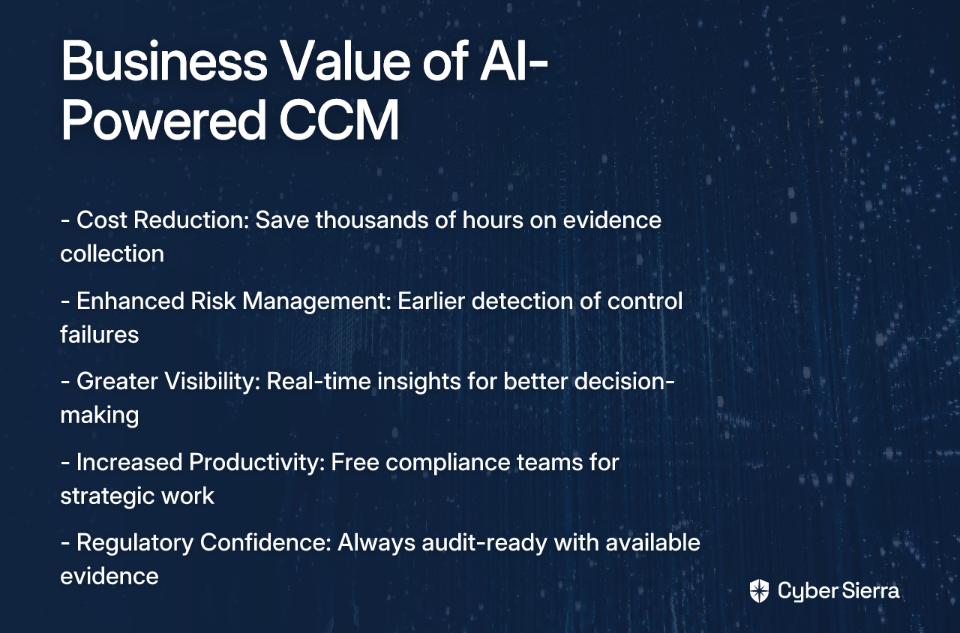
Cost Reduction: Automation significantly lowers compliance costs by reducing manual labor for testing and audit preparation. One CyberSaint client reported saving over 2,000 hours annually on evidence collection alone.
Enhanced Risk Management: Earlier detection of control failures mitigates potential damages, fines, and reputational harm. This is especially valuable as the SEC and other regulatory bodies emphasize proactive compliance measures.
Greater Visibility & Better Decisions: Senior leaders get improved, real-time insights into risk, security, and compliance, enabling better strategic prioritization. Instead of point-in-time snapshots, they have continuous visibility into the organization's compliance posture.
Increased Productivity: Compliance and audit teams are freed from tedious evidence gathering to focus on high-value strategic efforts, like resolving complex issues. This addresses the resource constraints that 59% of organizations cite as their biggest compliance challenge.
Regulatory Confidence: Readily available, audit-ready evidence of effective risk mitigation improves your standing with regulators, customers, and auditors.
Getting Started: Your First Step
The future of compliance isn't about replacing humans but augmenting them. The integration of AI agents with human expertise creates a resilient, adaptive, and efficient compliance ecosystem.
If you're concerned about scaling complexity—a common pain point among automation beginners—remember that you don't need to automate your entire compliance program at once. As one Reddit user advised about automation platforms: "Start simple... understand how triggers and actions work" before tackling more complex workflows.
Start your journey by identifying one critical, high-frequency control and build a pilot program to automate its monitoring. For example:
- Select a specific use case like monitoring user access reviews or software vulnerability management
- Define clear pass/fail criteria
- Implement a single AI agent to gather evidence and test the control
- Learn from the results and gradually expand
By starting small and scaling gradually, you'll avoid the "learning curve" concerns that many automation beginners express while still gaining significant value from AI-powered CCM.
The journey to automated continuous controls monitoring doesn't have to be overwhelming. With a thoughtful, phased approach, you can transform your compliance program from a reactive burden into a proactive, strategic asset powered by intelligent AI agents.
Whether you're concerned about pricing models, integration capabilities, or technical complexity, the key is to start with a specific, high-value use case rather than attempting to build a complete solution from day one. As your confidence grows, you'll find that AI agents provide the scalability and flexibility to adapt to your organization's evolving compliance needs.
Are you ready to take the first step toward automated continuous controls monitoring? The competitive advantages of enhanced security, reduced costs, and improved regulatory confidence await.
Frequently Asked Questions
What is Continuous Controls Monitoring (CCM)?
Continuous Controls Monitoring (CCM) is the use of technology to automatically and continuously check that security and compliance controls are working effectively in real-time. Unlike traditional audits which provide a snapshot in time, CCM offers ongoing assurance. This proactive approach helps organizations identify and fix control weaknesses as they happen, rather than discovering them months later during a manual review, thus maintaining a constant state of compliance.
How does Agentic AI differ from standard automation tools like Zapier?
Agentic AI consists of autonomous systems that can make decisions and take actions independently, whereas standard automation tools typically follow pre-defined, rigid "if-this-then-that" rules. Tools like Zapier are excellent for connecting apps and automating simple, linear workflows. Agentic AI, powered by Large Language Models (LLMs), goes a step further by interpreting data, making judgments, and performing complex, multi-step tasks without constant human intervention. For CCM, this means an agent can not only fetch data but also analyze it, decide if it constitutes a control failure, and initiate a response.
What are the main benefits of using AI for compliance monitoring?
The primary benefits of using AI for compliance monitoring are significant cost savings, enhanced risk management through real-time alerts, and increased productivity for compliance teams. AI automates the tedious, manual work of evidence collection, saving thousands of hours. It provides continuous visibility into your compliance posture, allowing for earlier detection of control failures. This frees up human experts to focus on strategic tasks like investigating complex anomalies and improving the overall risk framework, rather than getting bogged down in repetitive data gathering.
What is the best way to start implementing AI-powered CCM?
The best way to start is by selecting one high-impact, frequently-run control and launching a small pilot program to automate its monitoring. Avoid trying to automate your entire compliance program at once. Choose a specific use case, such as monitoring user access reviews or vulnerability scanning results. Define clear success criteria for the control, deploy an AI agent to handle the evidence collection and testing, and then learn from the results. This phased approach allows you to demonstrate value quickly and scale your efforts gradually as you gain experience.
What are the biggest security risks with AI agents and how can they be managed?
The two biggest security risks are data poisoning, where training data is maliciously altered, and prompt injections, which hijack the AI's behavior through malicious instructions. These risks can be managed by implementing robust security guardrails. This includes mapping all system interactions to identify potential vulnerabilities, protecting the integrity of training data, simulating attacks to find weaknesses proactively, and clearly defining the scope of decisions an AI agent can make autonomously. A "human-in-the-loop" approach, where experts review critical AI outputs, is also essential for accountability.
Will AI make compliance and audit roles obsolete?
No, AI is not designed to make compliance and audit roles obsolete but rather to augment them by handling repetitive tasks. AI excels at high-volume, routine monitoring and data collection, which frees human professionals from manual drudgery. This allows compliance and audit experts to focus on higher-value activities that require critical thinking, such as investigating complex anomalies, making strategic decisions on risk remediation, and managing the overall governance framework. The future is a collaborative one where human expertise guides and oversees powerful AI tools.