



10 Best Business Compliance Software With Continuous Monitoring Features

Join thousands of professionals and get the latest insight on Compliance & Cybersecurity.
Summary
- Traditional point-in-time compliance audits are resource-intensive, consuming 40-60 engineering hours per framework and leaving dangerous security gaps between assessments.
- Continuous compliance monitoring transforms this process from a reactive, periodic task into a proactive, automated function that provides real-time visibility into your security posture.
- By implementing automation, organizations can reduce audit preparation time by up to 80% and significantly lower the risk of costly non-compliance penalties.
- Platforms like Cyber Sierra's Continuous Control Monitoring (CCM) help automate evidence collection and provide 24/7 visibility, making you perpetually audit-ready.
You've set up a compliance program using SharePoint folders and well-templated spreadsheets, diligently collecting evidence for your annual audits. But between those audits? You're essentially flying blind. Your controls could be failing, configurations changing, or new vulnerabilities emerging—and you'd have no idea until your next scheduled assessment.
This point-in-time blindness isn't just inefficient; it's dangerous. Just ask Meta, which was hit with a $1.3 billion GDPR fine for violations that developed in the gaps between compliance checks. In today's rapidly evolving threat landscape, traditional periodic assessments are increasingly inadequate.
The solution? Business compliance software with continuous monitoring capabilities—tools that provide real-time visibility into your compliance posture rather than just occasional snapshots.
Why Traditional Point-in-Time Compliance Falls Short
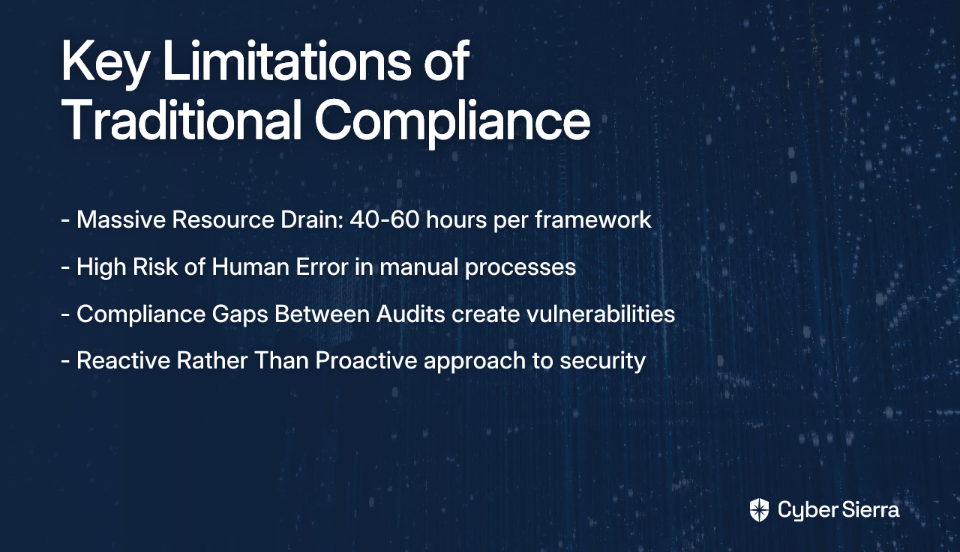
Traditional compliance approaches suffer from several critical weaknesses:
Massive Resource Drain: Manual compliance tasks can consume 40-60 hours of engineering time per framework, diverting valuable resources from innovation and growth. Many compliance teams find themselves perpetually behind, scrambling to gather evidence rather than proactively managing risk.
High Risk of Human Error: Manual evidence collection—taking screenshots, downloading reports, and filling spreadsheets—is notoriously error-prone. One misplaced document or outdated screenshot can lead to failed audits and security gaps.
Compliance Gaps Between Audits: The moment an audit concludes, traditional evidence becomes outdated. Your organization could be non-compliant for months without knowing it, creating significant vulnerability windows for attackers.
Reactive Rather Than Proactive: Without continuous visibility, you're always reacting to compliance issues after they occur rather than preventing them proactively.
Top 10 Business Compliance Software With Continuous Monitoring Capabilities
These solutions transform compliance from a periodic, manual process into an ongoing, automated function that provides continuous assurance and visibility.
1. Cyber Sierra
Best for: Organizations of all sizes seeking an AI-enabled, unified platform to automate compliance and proactively manage risk across multiple frameworks.
Key Continuous Monitoring Features:
- Continuous Control Monitoring (CCM): Provides ongoing, near real-time visibility into security controls, tracks digital assets, and assesses risk to proactively fix security gaps.
- Central Controls Repository: Builds a single source of truth for all controls with near real-time updates, ensuring consistency.
- Automated Evidence Collection: Eliminates manual evidence gathering through API integrations with cloud providers, code repositories, and HR systems.
- Multi-Framework Management: Manages controls across standards like NIST, ISO 27001, PCI DSS, GDPR, and HIPAA from a single dashboard.
- Actionable Risk Intelligence: Delivers data-driven insights to prioritize remediation efforts and optimize security investments.
What Sets It Apart: Cyber Sierra transforms compliance from a stressful, periodic event into a continuous, automated process, making organizations perpetually audit-ready. The platform's AI capabilities help identify control gaps and suggest remediation actions in real time.
Learn more about Cyber Sierra's CCM Module
2. MetricStream
Best for: Enterprises needing a comprehensive GRC platform with a strong focus on cloud security and continuous auditing.
Key Continuous Monitoring Features:
- Automated control testing and evidence collection
- Continuous auditing capabilities for key business processes
- Real-time risk insights through configurable dashboards
- Regulatory intelligence updates to keep pace with changing compliance requirements
What Sets It Apart: MetricStream offers a robust framework library and mapping capabilities ideal for organizations managing multiple compliance requirements simultaneously. However, some users report its software structure can be somewhat rigid and less customizable than other options.
View MetricStream's CCM capabilities
3. Sprinto
Best for: SaaS companies and startups focused on achieving and maintaining certifications like SOC 2, ISO 27001, and HIPAA.
Key Continuous Monitoring Features:
- Automates evidence collection from cloud environments (AWS, GCP, Azure)
- Provides real-time visibility into control status against specific compliance frameworks
- Seamlessly integrates with development workflows
- Offers continuous cloud security posture monitoring
What Sets It Apart: Sprinto excels at making compliance accessible for smaller organizations with limited compliance expertise. Its user-friendly interface and guided implementation significantly reduce the learning curve.
4. Panaseer
Best for: Security teams looking to validate and measure the effectiveness of their security controls across different tools and platforms.
Key Continuous Monitoring Features:
- Centralizes security control data from disparate sources
- Provides automated vulnerability analysis and prioritization
- Measures security posture against policies and frameworks
- Delivers continuous control validation across the enterprise
What Sets It Apart: Panaseer's platform stands out for its ability to measure control effectiveness and automatically identify security gaps, helping organizations quantify risk reduction and demonstrate compliance progress.
5. Hyperproof
Best for: Organizations looking for a flexible compliance operations platform to monitor a wide range of internal, security, and access controls.
Key Continuous Monitoring Features:
- Automates control testing and evidence collection
- Provides real-time monitoring across various control types
- Offers robust workflow automation for remediation tasks
- Enables cross-framework control mapping to reduce duplication
What Sets It Apart: Hyperproof's standout feature is its intuitive interface and workflow automation capabilities, which make it accessible even for teams without deep technical expertise.
6. AuditBoard
Best for: Internal audit, risk, and compliance teams needing an integrated platform for in-depth compliance management.
Key Continuous Monitoring Features:
- Connects risks to controls with real-time status updates
- Automates testing workflows and evidence collection
- Provides a continuous view of compliance status across frameworks
- Offers workflow automation for issue remediation
What Sets It Apart: AuditBoard excels in audit management capabilities and workflow automation, though some users note it has more limited integration options compared to other platforms.
7. XM Cyber
Best for: Organizations focused on cyber risk management and continuous validation of their security posture against potential attack paths.
Key Continuous Monitoring Features:
- Offers real-time threat detection and automated remediation suggestions
- Comes with over 5,000 predefined critical security controls for monitoring
- Provides attack path analysis to prioritize remediation efforts
- Delivers continuous validation of security control effectiveness
What Sets It Apart: XM Cyber's unique approach focuses on identifying and remediating attack paths rather than just monitoring individual controls, providing context-aware risk prioritization.
8. RSA Archer
Best for: Large enterprises needing a highly configurable, integrated risk management (IRM) solution.
Key Continuous Monitoring Features:
- Automates compliance management and risk assessments
- Provides a holistic, real-time view of risk and compliance
- Offers advanced reporting and analytics capabilities
- Supports complex organizational structures and workflows
What Sets It Apart: RSA Archer's enterprise-grade capabilities and extensive customization options make it ideal for complex organizations with mature GRC programs.
9. ServiceNow GRC
Best for: Organizations already invested in the ServiceNow ecosystem who want to integrate GRC processes with their IT service management.
Key Continuous Monitoring Features:
- Uses workflow automation for compliance tasks
- Provides real-time dashboards on compliance status
- Continuously monitors for control failures
- Integrates seamlessly with other ServiceNow modules
What Sets It Apart: ServiceNow GRC's tight integration with the broader ServiceNow platform creates a unified approach to IT operations, security, and compliance.
10. Pathlock
Best for: Companies in highly regulated industries like finance that need to monitor financial processes, transactions, and application access controls.
Key Continuous Monitoring Features:
- Specializes in risk quantification and transaction monitoring
- Monitors configuration changes within critical business applications
- Provides continuous compliance for ERP systems
- Offers automated segregation of duties monitoring
What Sets It Apart: Pathlock's focus on application-level controls and financial compliance makes it uniquely suited for organizations with complex ERP environments and strict regulatory requirements.
Implementing Continuous Compliance: A Practical Guide
Moving from traditional point-in-time assessments to continuous monitoring doesn't have to require a dedicated team and months of effort. Here's a streamlined approach:
1. Conduct Compliance Risk Assessment
Identify applicable regulations, assess current risks, and set clear automation goals. Determine which controls are most critical for continuous monitoring.
2. Map Processes & Develop Policies
Document existing compliance workflows and establish clear policies and responsibilities. This groundwork ensures your automation efforts align with organizational requirements.
3. Select the Right Tools
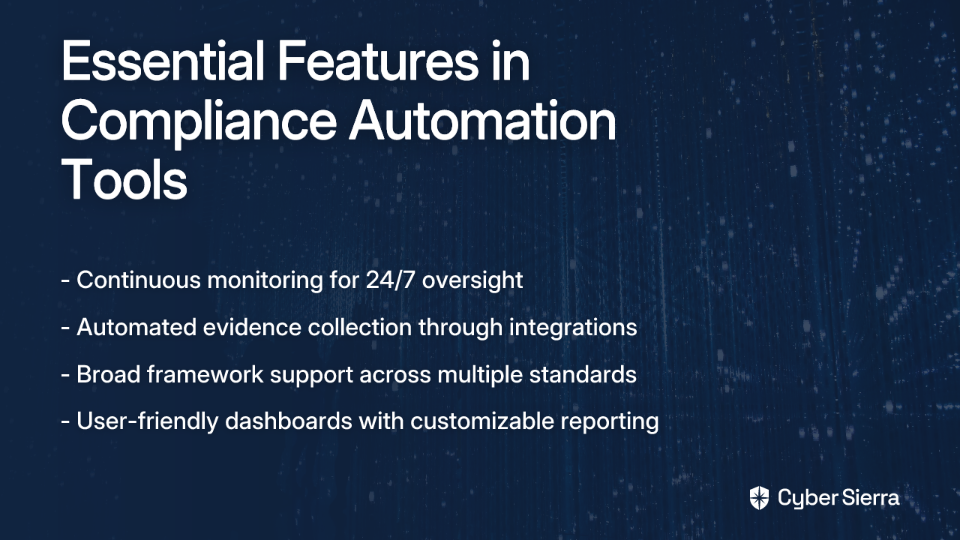
Choose an integrated platform that supports your necessary frameworks and offers robust APIs for integration so you can build out as you grow. Look for these key features:
- Continuous monitoring capabilities for 24/7 oversight of your tech stack
- Automated evidence collection through direct integrations
- Broad framework support to map controls across multiple standards
- User-friendly dashboards with customizable reporting
4. Implement and Integrate
Deploy your chosen solution incrementally, starting with your most critical compliance areas. Integrate compliance checks into daily operations and DevOps pipelines for maximum effectiveness.
5. Train Your Team
Ensure all employees understand the new tools and their role in maintaining a culture of continuous compliance. Proper training transforms compliance from a specialized function to an organization-wide responsibility.
6. Monitor & Iterate
Regularly review dashboards and reports to fine-tune processes and continuously improve your compliance posture. Use the insights gained to drive strategic security improvements.
The Tangible ROI of Continuous Compliance Monitoring
Implementing business compliance software with continuous monitoring capabilities delivers measurable returns:
Massive Efficiency Gains: 97% of organizations reduced time on compliance tasks after implementing automation, with 76% cutting workloads by at least half. This translates to thousands of engineering hours redirected to innovation rather than manual evidence collection.
Reduced Costs & Risk: Continuous monitoring significantly lowers the risk of non-compliance penalties (which can reach millions for GDPR violations), reduces audit preparation costs, and can potentially lower cyber insurance premiums through demonstrable security improvements.
Stronger Security Posture: By identifying and remediating control gaps in real-time, continuous monitoring transforms compliance from a checkbox exercise into a meaningful security improvement program.
Streamlined Audits: Organizations using continuous monitoring solutions report up to 80% reduction in audit preparation time, transforming audits from stressful scrambles into routine, data-driven processes.
Make Compliance Your Strategic Advantage
The shift from periodic to continuous compliance isn't just a trend—it's a fundamental requirement for modern business resilience. By implementing the right business compliance software with robust continuous monitoring capabilities, you can transform compliance from a resource-draining burden into a strategic advantage that builds trust with customers and partners.
Organizations that embrace continuous monitoring not only reduce risk but also free their compliance and engineering teams to focus on innovation rather than manual, repetitive tasks.
Stop chasing compliance and start mastering it. If you're ready to move from periodic stress to continuous confidence, see how Cyber Sierra's AI-enabled platform can automate your GRC program and make you audit-ready, 24/7.
Explore Cyber Sierra's Continuous Control Monitoring Platform
Frequently Asked Questions
What is continuous compliance monitoring?
Continuous compliance monitoring is an automated process that provides real-time visibility into an organization's adherence to security and regulatory standards. Unlike traditional audits that offer a point-in-time snapshot, continuous monitoring uses software to constantly collect evidence, test controls, and identify compliance gaps as they occur, allowing for immediate remediation.
Why is continuous monitoring better than traditional point-in-time audits?
Continuous monitoring is superior to traditional audits because it eliminates dangerous compliance gaps between assessments. Traditional audits are resource-intensive, prone to human error, and leave organizations vulnerable for months at a time. Continuous monitoring provides 24/7 visibility, automates manual tasks, and transforms compliance from a reactive, periodic event into a proactive, ongoing process.
How does business compliance software automate evidence collection?
Business compliance software automates evidence collection primarily through API integrations with your existing tech stack. It connects directly to cloud providers (like AWS, Azure, GCP), HR systems, code repositories, and security tools to automatically gather data, screenshots, and logs that prove controls are implemented correctly. This eliminates the need for manual, error-prone tasks like taking screenshots and filling out spreadsheets.
What types of businesses benefit most from continuous compliance?
Virtually any business subject to regulatory frameworks like SOC 2, ISO 27001, GDPR, HIPAA, or PCI DSS can benefit from continuous compliance. It is particularly valuable for cloud-native companies, SaaS providers, and organizations in highly regulated industries such as finance and healthcare. It helps businesses of all sizes, from startups to large enterprises, maintain a strong security posture and stay perpetually audit-ready.
What are the key features to look for in continuous compliance software?
The most important features to look for are continuous control monitoring for 24/7 oversight, automated evidence collection via API integrations, broad framework support (e.g., SOC 2, ISO 27001), and a centralized dashboard for real-time visibility. Additionally, look for capabilities like multi-framework mapping to reduce redundant work and actionable risk intelligence to help prioritize remediation efforts.
How does continuous monitoring improve an organization's security posture?
Continuous monitoring improves security posture by directly linking compliance activities to real-time security outcomes. By constantly checking for misconfigurations, vulnerabilities, and control failures, it enables security teams to identify and remediate risks immediately, rather than discovering them months later during an audit. This proactive approach closes security gaps and reduces the organization's overall attack surface.
