ISO 27001 vs SOC 2 Mapping: A Complete Control Crosswalk Guide

Join thousands of professionals and get the latest insight on Compliance & Cybersecurity.
Summary
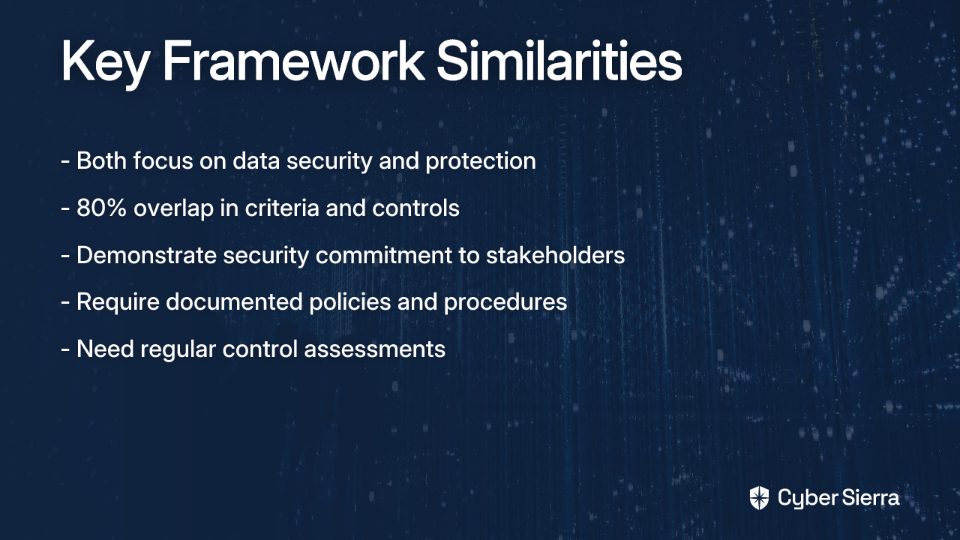
- ISO 27001 and SOC 2 share up to an 80% control overlap, creating a major opportunity to reduce duplicate compliance work.
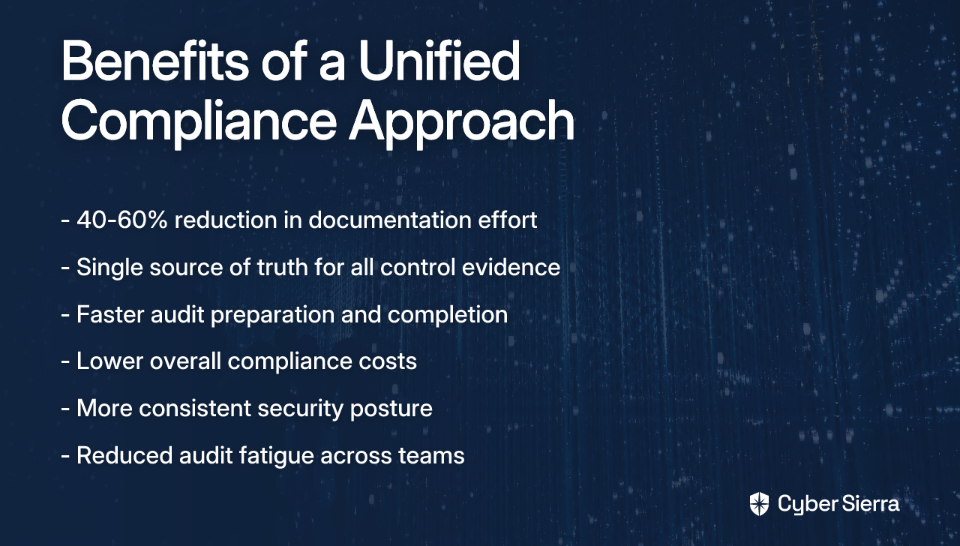
- The most effective strategy is to build a unified control library, mapping requirements from both frameworks to create a single source of truth for evidence.
- Save time during audits by defaulting to the stricter control requirement and tagging each piece of evidence for reuse across both frameworks.
- Cyber Sierra's GRC platform automates this unified approach by mapping controls across frameworks and continuously collecting evidence, keeping you audit-ready.
Are you stuck documenting everything twice in separate sheets for your ISO 27001 and SOC 2 audits? You're not alone. Many compliance professionals find that "running them as totally separate projects almost always leads to wasted effort." In fact, most companies end up re-documenting the same 60-70% of controls twice, creating a frustrating cycle of duplicate work.
This guide will provide you with a practical control crosswalk, downloadable resources, and a strategy to tackle both certifications simultaneously—saving significant time, effort, and resources. We'll show you how to build a unified control environment and leverage automation to eliminate duplicate work for good.
A Primer on the Frameworks: ISO 27001 vs. SOC 2
Before diving into the mapping process, let's understand the core differences between these frameworks:
What is ISO 27001?
ISO 27001 is an international standard for an Information Security Management System (ISMS). It's globally recognized and especially valued in Europe and international markets. The framework is prescriptive, with 93 mandatory controls in its latest version (ISO 27001:2022). Once certified, your certification is valid for three years with annual surveillance audits.
What is SOC 2?
SOC 2 is a framework developed by the American Institute of Certified Public Accountants (AICPA). It focuses on protecting customer data based on five Trust Services Criteria (TSC): Security (mandatory), Availability, Processing Integrity, Confidentiality, and Privacy. SOC 2 is highly recognized in North America and often a requirement for US-based customers, especially in the SaaS industry. The framework results in an attestation report (Type 1 or Type 2) that is typically renewed annually.
The Overlap is Real
Both frameworks aim to demonstrate a commitment to data security, integrity, availability, and confidentiality. According to Secureframe, there is approximately 80% overlap in their criteria and controls, with variations of only about 4%. This significant overlap presents a compelling opportunity to streamline your compliance efforts.
Key Differences at a Glance
| Feature | SOC 2 | ISO 27001 |
|---|---|---|
| Governing Body | AICPA (American) | ISO (International) |
| Focus | Controls related to customer data & services (TSC) | Comprehensive Information Security Management System (ISMS) |
| Flexibility | Flexible; choose applicable TSCs (70-150 controls) | Prescriptive; 93 Annex A controls |
| Output | Attestation Report (Type 1/2) | Certification |
| Validity | Annual | 3 Years (with annual surveillance) |
| Typical Cost | $10k-$60k | $10k-$50k |
The Unified Control Strategy: Map Once, Comply with Both
The Pitfall of Siloed Compliance
When organizations treat ISO 27001 and SOC 2 as separate projects, they often end up overwhelmed by documentation requests—sometimes handling as many as 300 submissions, with 100 exclusively for SOC 2, 100 exclusively for ISO 27001, and 100 common to both. This approach creates unnecessary duplication and stretches resources thin.
The Solution: A Master Control Library
The most efficient approach, as recommended by experienced compliance professionals, is to "build one master control library by mapping SOC 2 Trust Services Criteria directly to the equivalent ISO 27001 Annex A clauses." This creates a single source of truth for your controls and evidence.
The Control Crosswalk in Action
Let's look at some concrete mapping examples:
- Incident Response: SOC 2's requirement for an incident response strategy maps directly to ISO 27001's Annex A control A.5.26 (Information security incident management planning and preparation).
- Access Control: SOC 2's CC6.1 (Logical access controls) aligns with ISO 27001's A.5.15 (Access control) and A.8.2 (Privileged access rights).
For a complete crosswalk, the AICPA provides a detailed mapping spreadsheet. You can download it here: Trust Services Criteria to ISO 27001 Mapping.
Practical Tips for a Unified Approach
Based on these community discussions, here are some practical tips for implementing a unified approach:
- Default to the Stricter Rule: If ISO requires quarterly IAM reviews and SOC 2 only asks for them annually, just do them quarterly. This single piece of evidence will satisfy both auditors.
- Tag Evidence for Reuse: When you collect evidence (e.g., a vulnerability scan report), tag it with all relevant controls (e.g.,
SOC2-CC7.1,ISO-A.8.8). This makes it easy to pull for either audit. - Write Unified Policies: When drafting policies, reference both ISO clauses and SOC 2 criteria where applicable to streamline documentation.
A Step-by-Step Guide to a Combined Audit
Many audit firms, like BARR Advisory, offer coordinated audits to reduce time and cost. Here's a practical timeline for achieving both certifications efficiently:
Combined Implementation Timeline & Process
- Unified Gap Assessment: Start by assessing your current environment against your new master control library. This identifies gaps for both frameworks at once.
- ISO 27001 Stage 1 Audit (2-3 days): This initial audit involves walkthroughs of your ISMS and high-level documentation review. Your auditor will provide feedback and a remediation plan.
- SOC 2 Type 1 Audit (Point-in-Time): This can often be performed concurrently or immediately after the ISO Stage 1, as it assesses the design of your controls at a single point in time.
- Remediation Period (3-12 months): Address the findings from your gap assessment and Stage 1 audit. During this period, you are operating your controls and collecting evidence.
- SOC 2 Type 2 Observation Window: This is the 3-12 month period where an auditor will test the operating effectiveness of your controls.
- ISO 27001 Stage 2 Audit (1-2 weeks): This is the final, in-depth certification audit where the auditor tests your controls against the Annex A requirements. The evidence collected during the SOC 2 observation window is often the same evidence used here.
Examples of Reusable Evidence
Here are examples of evidence that can satisfy requirements for both frameworks:
- Documentation: ISMS policies, risk assessment reports, Statement of Applicability (SoA), system descriptions.
- Technical Proof: Vulnerability scan reports, penetration test results, logs from access control systems, change management tickets.
- Procedural Records: Records of security awareness training, minutes from management review meetings, incident response test results.
Stop Drowning in Spreadsheets: How Automation Streamlines the Crosswalk
Even with a perfect mapping spreadsheet, the process of manually collecting, tagging, and managing evidence is cumbersome and error-prone. This is where the real bottleneck occurs in compliance processes.
The Power of Continuous Control Monitoring (CCM)
Modern GRC platforms automate the entire compliance process, eliminating the manual burden of tracking controls across multiple frameworks.
How Cyber Sierra Solves the Mapping Problem
Cyber Sierra's Continuous Control Monitoring (CCM) platform is designed to eliminate this manual burden. Instead of living in spreadsheets, you can:
- Build a Central Control Repository: Cyber Sierra's platform acts as your single source of truth, with pre-built mappings for major frameworks like SOC 2 and ISO 27001. This directly solves the "separate sheets" problem.
- Automate Evidence Collection: The platform integrates with your cloud services (AWS, Azure, GCP), HR systems, and development tools to automatically collect evidence 24/7. This means no more chasing down screenshots for vulnerability scans or IAM reviews.
- Map Once, Use Everywhere: Once a piece of evidence is collected, it's automatically mapped to all relevant controls across every framework you're pursuing. A single vulnerability scan can satisfy requirements for both SOC 2 and ISO 27001 without any extra work.
- Stay Audit-Ready, Always: With Continuous Control Monitoring, the platform provides near real-time visibility into your security posture, detecting control failures or compliance drifts instantly so you can fix them long before an auditor arrives.
Real-World Application: ISO 27001 and SOC 2 Mapping in Action
Let's look at a practical example of how automation can streamline compliance:
Scenario: Your organization needs to demonstrate proper access control management for both ISO 27001 (control A.8.2 - Privileged access rights) and SOC 2 (CC6.1 - Logical access controls).
Manual Process:
- Create an access review spreadsheet for ISO 27001
- Create a separate access review spreadsheet for SOC 2
- Manually review user access rights quarterly
- Document findings in both spreadsheets
- Repeat this process for dozens of other controls
Automated Process with Cyber Sierra:
- Configure a single access review control in Cyber Sierra's GRC platform
- The platform automatically maps this control to both ISO 27001 A.8.2 and SOC 2 CC6.1
- Automated integrations with your IAM tools collect evidence of proper access management
- The platform alerts you to any access control violations in real-time
- During audit time, a single set of evidence is presented for both frameworks
This automation not only saves countless hours of manual work but also provides more reliable, consistent evidence collection that satisfies auditors for both frameworks.
Conclusion
Achieving both ISO 27001 and SOC 2 compliance doesn't have to be double the work. By using a unified control framework and leveraging automation, you can streamline audits, reduce costs, and build a stronger, more transparent security program.
The key steps to success are:
- Map your controls once using the AICPA's crosswalk document
- Default to the stricter requirements when conflicts arise
- Tag evidence to satisfy multiple framework requirements
- Consider automation to eliminate the manual burden of compliance management
Frequently Asked Questions
What is the main difference between ISO 27001 and SOC 2?
ISO 27001 is a global standard for an organization's entire Information Security Management System (ISMS), while SOC 2 is a US-focused framework that reports on controls related to customer data security. ISO is more prescriptive; SOC 2 is more flexible.
How much overlap is there between ISO 27001 and SOC 2 controls?
There is a significant overlap, typically estimated between 60-80%. Core principles around risk management, access control, and incident response are shared, allowing a unified compliance approach to save significant time and effort.
How can I combine ISO 27001 and SOC 2 audits to save time?
Combine audits by creating a unified control library that maps SOC 2 criteria to ISO 27001 clauses. This lets you collect evidence once and use it for both audits, drastically reducing duplicate work and streamlining the entire certification process.
Which should I get first: ISO 27001 or SOC 2?
It depends on your market. If you serve international or European clients, start with ISO 27001. If your focus is North America, SOC 2 is often the priority. However, the most efficient path is to pursue them simultaneously with a unified strategy.
What is a unified control framework?
A unified control framework is a central library of security controls mapped to multiple compliance standards like ISO 27001 and SOC 2. It creates a single source of truth, eliminating the need to manage separate documentation and evidence for each framework.
Can I use the same auditor for both ISO 27001 and SOC 2?
Yes, many auditing firms are accredited to perform both ISO 27001 and SOC 2 audits. Using a single firm for a coordinated audit is highly recommended as it can reduce costs, minimize redundant requests, and streamline the overall process.
Ready to ditch the spreadsheets and automate your compliance journey? Explore how Cyber Sierra's Continuous Control Monitoring platform can make you audit-ready faster by providing a unified approach to ISO 27001 and SOC 2 compliance.