



How to Implement Cyber Resilience for Financial Services Companies


Join thousands of professionals and get the latest insight on Compliance & Cybersecurity.
Summary
- Cyber resilience is no longer just a best practice but a regulatory mandate for financial institutions, with frameworks like DORA and CPS230 demanding comprehensive security.
- A successful resilience strategy involves adopting the NIST Cybersecurity Framework and focusing on five key pillars: integrated GRC, continuous monitoring, a strong 'human firewall', tested incident response, and third-party risk management (TPRM).
- Financial institutions can significantly strengthen their security posture by shifting from periodic, manual assessments to a proactive defense built on continuous monitoring and real-time risk intelligence.
- Implementing an integrated platform like Cybersierra's GRC solution helps automate compliance, streamline control monitoring, and centralize risk management to build a robust and audit-ready resilience program.
You've invested millions in cybersecurity tools, implemented every control on the compliance checklist, and hired top security talent. Yet at night, you still wonder: "Are we truly prepared for a sophisticated attack? Would our systems remain operational? Could we recover quickly enough to maintain customer trust?"
These questions haunt financial services CISOs and executives—and for good reason. Your organization doesn't just face garden-variety cyber threats; you're battling sophisticated adversaries targeting the very infrastructure that powers the global economy. Meanwhile, your security team struggles with misalignment between IT and business units, where "the business will often expect IT to simply protect" without understanding the collaborative nature of effective security.
The Unrelenting Threat Landscape & Regulatory Pressure
Cyber resilience—an organization's ability to prevent, withstand, and recover from cybersecurity incidents—has evolved from a best practice to a regulatory requirement for financial institutions worldwide. The regulatory landscape has become increasingly demanding:
- DORA (Digital Operational Resilience Act) in the EU mandates comprehensive resilience testing and incident reporting
- CPS230 / CORIE in Australia requires sophisticated cyber simulation exercises
- MAS TRM guidelines in Singapore establish stringent technology risk requirements
- FCA/PRA Operational Resilience rules in the UK focus on continuity of critical business services
- FFIEC IT Handbook in the US provides detailed expectations for financial institutions' technology controls
The Financial Stability Board (FSB), recognizing the systemic risk that cyber threats pose to global financial stability, has taken significant steps to standardize practices across the sector. Their initiatives include harmonizing cyber incident reporting, publishing a standardized Cyber Lexicon to create a common language, and developing the Format for Incident Reporting Exchange (FIRE) to standardize information sharing during crises.
The Blueprint for Resilience: Adopting the NIST Cybersecurity Framework
To navigate this complex landscape, financial institutions need a structured approach. The NIST Cybersecurity Framework provides a comprehensive blueprint that aligns with regulatory expectations and industry best practices. Its six core functions create a continuous cycle of protection:
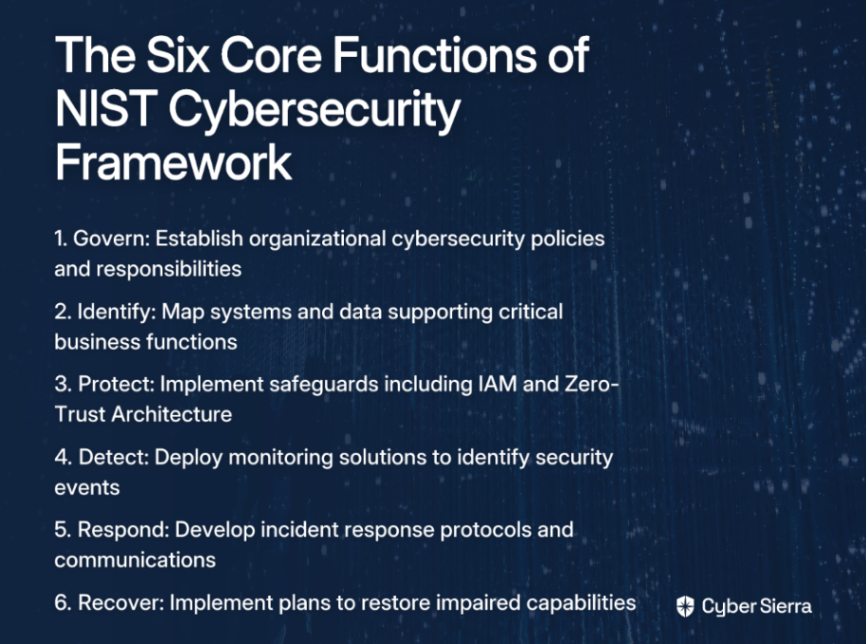
- Govern: Establish organizational cybersecurity policies, roles, and responsibilities. This is where many financial institutions falter, with misalignment between business and IT creating critical gaps in understanding.
- Identify: Develop an understanding of systems, assets, and data that support critical business functions. This requires genuine business engagement—not just IT working in isolation—to identify high-value systems.
- Protect: Implement appropriate safeguards including:
- Identity and Access Management (IAM) solutions
- Zero-Trust Architecture implementation
- System segmentation, often highlighted as "critically important in cyber resilience" yet challenging to implement due to expertise gaps
- Detect: Deploy monitoring solutions to identify cybersecurity events. This includes Security Information and Event Management (SIEM) systems and advanced threat detection tools.
- Respond: Develop and implement activities to take action regarding detected incidents, including communication protocols and stakeholder management.
- Recover: Implement plans to restore capabilities impaired during incidents, addressing the risk of "monolithic systems that would allow everything to be taken down by an attacker."
Practical Implementation: The Five Pillars of a Resilient Financial Institution
Pillar 1: Integrated Governance, Risk, and Compliance (GRC)
The foundation of cyber resilience is an integrated GRC approach that eliminates silos and creates a single source of truth for your security posture. Many financial institutions struggle with fragmented compliance efforts across multiple frameworks (SOC2, ISO 27001, GDPR, HIPAA, PCI DSS), creating massive inefficiencies and control gaps.
To implement an effective GRC program:
- Assess your current state, identifying fragmentation in risk and compliance processes
- Define clear objectives and scope for your GRC program
- Select a GRC tool that can manage multiple frameworks simultaneously
- Implement and integrate with existing security systems
- Train personnel on new processes and responsibilities
- Continuously improve based on operational feedback and emerging threats
Modern GRC platforms like Cyber Sierra automate data collection and ongoing compliance through continuous control monitoring, making your organization audit-ready while significantly reducing compliance fatigue.

Pillar 2: Continuous Monitoring and Proactive Defense
Financial institutions must shift from point-in-time assessments to continuous security monitoring. This shift addresses a common pain point: the persistent vulnerability of on-premise infrastructure compared to SaaS solutions.
Continuous Control Monitoring (CCM) provides real-time visibility into security control effectiveness, allowing for immediate identification and remediation of gaps. When paired with robust threat intelligence and vulnerability management, this creates a proactive defense posture that helps identify and address risks before they can be exploited.
Components of an effective continuous monitoring program include:
- Automated control testing and validation
- Real-time exception and anomaly detection
- Network and cloud infrastructure vulnerability scanning
- Comprehensive security dashboards for unified visibility
Platforms like Cyber Sierra's Continuous Control Monitoring build a central controls repository with near real-time updates, providing clear visibility into your security posture and delivering actionable risk intelligence for data-driven remediation.
Pillar 3: Fortifying the 'Human Firewall'
The persistent challenge of user behavior in cybersecurity remains one of the biggest vulnerabilities for financial institutions. Even the most basic security advice—"Don't click on suspicious links"—is difficult to consistently implement across an organization.
Building a robust "human firewall" requires:
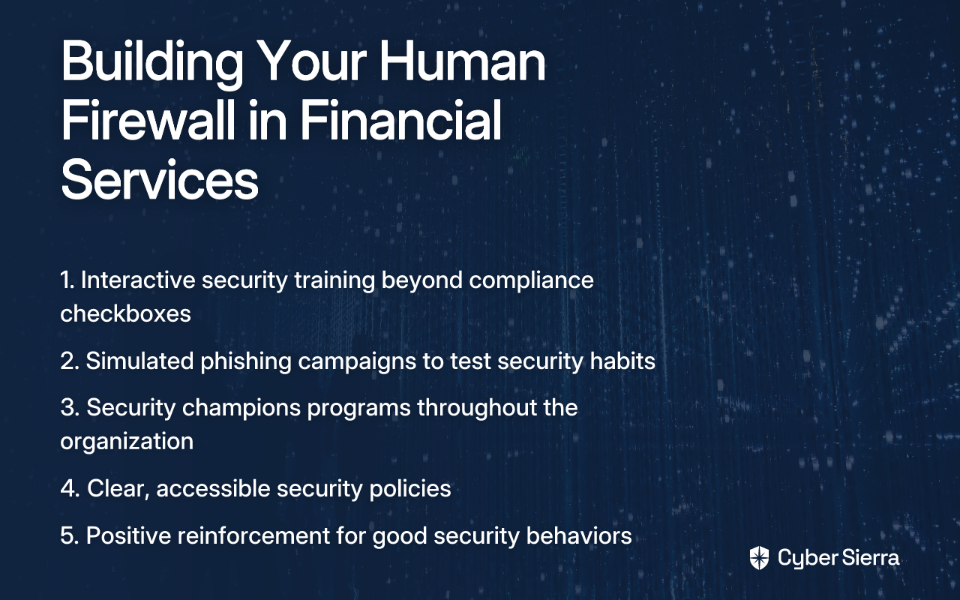
- Interactive security training that goes beyond compliance checkboxes to create genuine awareness
- Simulated phishing campaigns that test and reinforce good security habits
- Security champions programs that embed security-conscious individuals throughout the organization
- Clear security policies that are accessible and regularly communicated
- Positive reinforcement for good security behaviors
Employee Security Training platforms enable organizations to educate staff on security best practices, run simulated phishing campaigns, and measure security awareness across the organization. This directly addresses the critical need for improved education around cybersecurity practices.
Pillar 4: Mastering Incident Response and Recovery
Even with the strongest preventative controls, financial institutions must prepare for successful attacks. Effective incident response goes beyond having a written plan—it requires regular testing, cross-functional coordination, and clear communication channels.
The FSB's toolkit outlines 49 effective practices for cyber incident response and recovery, providing a valuable resource for financial institutions building their capabilities. Key components include:
- Well-defined incident classification and escalation procedures
- Regular tabletop exercises that evolve into complex, blended simulations
- Clearly documented roles and responsibilities during incidents
- Established communication protocols for stakeholders, regulators, and customers
- Detailed recovery plans that avoid dependency on monolithic systems
- Post-incident analysis processes to capture lessons learned
Regulations like DORA are raising the bar for incident response testing, requiring sophisticated exercises that simulate complex attack scenarios and test both technical and organizational response capabilities.
Pillar 5: Securing the Supply Chain with Third-Party Risk Management (TPRM)
Financial institutions rely heavily on third-party vendors, creating significant external risk surfaces. A supply chain compromise can be just as devastating as a direct attack, yet many organizations struggle with manual, point-in-time vendor assessments that provide limited visibility into actual risks.
A mature TPRM program includes:
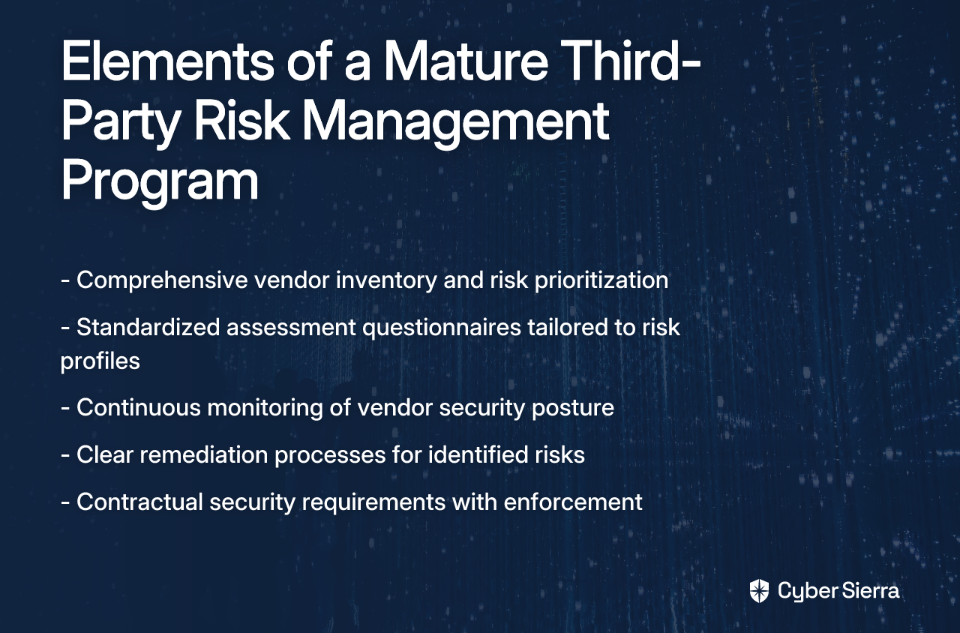
- Comprehensive vendor inventory and risk prioritization
- Standardized assessment questionnaires tailored to vendor risk profiles
- Continuous monitoring of vendor security posture
- Clear remediation processes for identified vendor risks
- Contractual security requirements with enforcement mechanisms
Third-Party Risk Management solutions can automate vendor assessments and provide continuous 24/7 monitoring of third-party security compliance, transforming TPRM from a periodic questionnaire exercise to a proactive risk management function.
The Final Safeguard: Cyber Insurance as a Risk Transfer Strategy
While comprehensive cyber resilience reduces both the likelihood and impact of attacks, residual risk can never be eliminated entirely. Cyber insurance provides a financial backstop for these remaining risks, covering costs related to data breaches, business interruption, and regulatory penalties.
However, the cyber insurance landscape has changed dramatically. Insurers now demand stringent "cyber hygiene" before offering coverage, requiring organizations to demonstrate robust security practices. According to IBM, organizations that leverage AI and automation in their security operations save an average of $1.9 million in breach costs—a powerful statistic to share with insurers during the application process.
A unified security platform that centralizes GRC, control monitoring, and risk data can help organizations demonstrate their cyber hygiene to insurers. This streamlines the application process and helps right-size coverage by providing a clear picture of the company's security posture. Cyber insurance solutions can also help organizations understand coverage needs and meet insurer requirements through demonstrable security practices.
Building Resilience is a Journey, Not a Destination
Implementing cyber resilience for financial services is not a one-time project but a continuous improvement cycle. The journey requires:
- Strategic alignment with the NIST Cybersecurity Framework
- Integrated governance through comprehensive GRC programs
- Proactive defenses powered by continuous monitoring
- A strong security culture built through effective training
- Tested response capabilities that evolve with the threat landscape
- Supply chain security through mature TPRM
- Risk transfer mechanisms like appropriate cyber insurance
Each step builds upon the last, creating layers of protection that allow your organization to prevent, withstand, and recover from even the most sophisticated attacks.
For financial institutions, cyber resilience isn't just about security—it's about maintaining customer trust and ensuring the stability of the global financial system. By implementing these strategies, you not only protect your organization but contribute to the resilience of the entire financial ecosystem.
As regulatory pressure continues to mount and threat actors grow more sophisticated, the organizations that thrive will be those that view cyber resilience not as a compliance burden but as a strategic advantage. They will invest in integrated platforms that automate routine security processes, provide continuous visibility into their security posture, and enable them to focus resources on the most critical risks.
Frequently Asked Questions
What is cyber resilience and why is it so important for financial institutions?
Cyber resilience is an organization's ability to prevent, withstand, and recover from cybersecurity incidents while maintaining critical business operations. It is crucial for financial institutions because they are high-value targets for sophisticated cyberattacks that can disrupt not only their own services but also the stability of the global financial system. Beyond just preventing attacks, resilience ensures that institutions can quickly restore services, maintain customer trust, and meet stringent regulatory requirements like DORA and CPS230.
How does the NIST Cybersecurity Framework help financial services build resilience?
The NIST Cybersecurity Framework provides a structured, comprehensive blueprint for financial institutions to manage and reduce cybersecurity risk. It helps by organizing efforts into six core functions: Govern, Identify, Protect, Detect, Respond, and Recover. This framework aligns with global regulatory expectations and offers a common language for discussing security, enabling organizations to build a continuous cycle of protection that addresses policies, asset management, defensive measures, incident handling, and recovery strategies in a holistic way.
What are the first steps to implementing an integrated GRC program?
The first step to implementing an integrated Governance, Risk, and Compliance (GRC) program is to assess your current state to identify fragmented risk and compliance processes across different frameworks. After this assessment, you should define clear objectives for the program, select a GRC tool that can centralize and automate control management, and begin integrating it with your existing security systems. This foundational work eliminates silos and creates a single source of truth for your security posture, making compliance more efficient and effective.
Why is Third-Party Risk Management (TPRM) critical for cyber resilience?
Third-Party Risk Management (TPRM) is critical because financial institutions rely heavily on external vendors, and a compromise in this supply chain can be as damaging as a direct attack. A mature TPRM program moves beyond periodic questionnaires to continuously monitor the security posture of vendors. This proactive approach helps identify and mitigate risks within your supply chain, preventing attackers from using a trusted partner as an entry point and ensuring the resilience of your entire business ecosystem.
How can we strengthen our 'human firewall' against social engineering attacks?
You can strengthen your 'human firewall' by implementing a continuous security awareness program that goes beyond basic compliance training. Key elements include interactive training modules, regular simulated phishing campaigns to test and reinforce good habits, and establishing a security champions program to embed security consciousness throughout the organization. By making security training engaging, practical, and ongoing, you empower employees to become an active line of defense against phishing and other social engineering tactics.
Does having cyber insurance mean we don't need to invest as much in cyber resilience?
No, cyber insurance is a risk transfer mechanism that complements, but does not replace, a strong cyber resilience strategy. In fact, insurers now demand robust "cyber hygiene" and demonstrable security controls before they will even offer coverage. Investing in cyber resilience—through measures like continuous monitoring and integrated GRC—not only reduces the likelihood and impact of an attack but also helps you qualify for better insurance coverage and potentially lower premiums. It's a financial backstop for residual risk, not a substitute for foundational security.

The choice is clear: build resilience now, or face the consequences of disruption later. The financial institutions that embrace this challenge will not only survive in an increasingly hostile digital environment—they will earn the lasting trust of their customers and emerge as leaders in a sector where security has become the ultimate competitive advantage.
