



Cyber Security Goals Beyond CIA


Join thousands of professionals and get the latest insight on Compliance & Cybersecurity.
You've meticulously implemented security controls based on the CIA triad—Confidentiality, Integrity, and Availability. Your systems are locked down, data is protected from tampering, and your uptime is impressive. Yet, you still wake up at night thinking: "What am I missing?" As one security professional confessed on Reddit, "I'm new to my position (1yr) and think that overall our company is in pretty good shape security-wise but fear I don't know enough to see what we may be missing."
If this sounds familiar, you're not alone. The CIA triad has been the cornerstone of information security for decades, providing a crucial foundation for protecting digital assets. But in today's complex threat landscape—with advanced persistent threats, sophisticated supply chain attacks, and the blurring lines between physical and digital systems—this traditional model is necessary but no longer sufficient.
This article explores why modern cyber security objectives must expand beyond the classic CIA triad, introducing additional security principles and practical frameworks like CISA's Cybersecurity Performance Goals (CPGs) that can help build a more comprehensive and resilient security program.
The CIA Triad: A Necessary Foundation
Before exploring its limitations, let's review what makes the CIA triad so fundamental to information security:
- Confidentiality: Ensuring that sensitive data is accessible only to authorized individuals. This prevents unauthorized access, such as password theft or data breaches where customer information is exposed.
- Integrity: Guaranteeing that data remains accurate and unaltered by unauthorized means. When integrity is compromised—for example, if an attacker modifies financial records—it can lead to incorrect or potentially catastrophic decisions based on tampered data.
- Availability: Making sure systems and data are accessible when needed by legitimate users. A classic example of an availability attack is a Denial of Service (DoS), where attackers overwhelm systems to make them inaccessible.
These principles remain essential, but as cybersecurity has evolved, practitioners have discovered significant gaps in this model.
The Cracks in the Foundation: Why the CIA Triad Isn't Enough
It's a Shifting Spectrum, Not a Balanced Stool
One fundamental misconception is that the three elements of the CIA triad should be equally balanced. In reality, as one cybersecurity professional noted, "It's a spectrum between the three, and depending on the needs, the point moves around between them."
This becomes clear when comparing different operational contexts:
- In OT/ICS Environments: For industrial control systems that manage physical processes, "In an OT environment, 'A' is king," as one practitioner put it. When a system controls critical infrastructure like power grids or manufacturing lines, downtime can result in massive financial losses or even safety hazards.
- In Healthcare Settings: The priority can shift dramatically depending on the specific system. As one security expert vividly explained, "Imagine you're operating a LINAC to treat a tumor. You'd probably prefer an inoperative system over sending 10x the dose." In this life-critical scenario, integrity trumps availability.
The CIA triad provides no inherent guidance on how to balance these priorities across different systems and contexts.
It Lacks Business Context
Another significant limitation is that the CIA triad "fails to prioritize information based on its criticality to business processes." It treats all data equally, without helping security teams identify what is most vital to protect based on business impact.
As organizations struggle with the question, "How do we ensure we're spending our resources wisely?" this lack of business alignment becomes critical. A security program disconnected from business priorities can't effectively justify its expenditures or demonstrate its value to leadership.
It's Blind to Modern Adversary Tactics
The CIA model doesn't inherently guide an understanding of adversarial Tactics, Techniques, and Procedures (TTPs) or intrusion kill chains. To be effective in today's threat landscape, security must be built to counter how attackers actually operate, not just protect static assets.
Modern threats like Business Email Compromise, supply chain attacks, and advanced persistent threats require security approaches that go beyond the traditional focus on information disclosure, alteration, and denial.
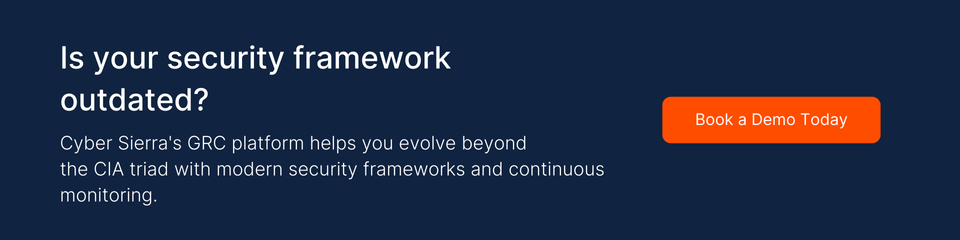
Expanding the Security Lexicon: Goals for the Modern Era
To address these limitations, security professionals have expanded the classic triad with additional principles that address modern cyber security objectives:
Authenticity
Ensuring that users are who they claim to be and that data comes from legitimate sources. This principle has become increasingly critical as phishing and identity theft have become primary attack vectors.
Accountability
The ability to trace actions to specific entities or users. This is crucial not only for forensic analysis after security incidents but also for establishing responsibility and appropriate access controls.
Non-repudiation
Providing cryptographic proof that a specific action was taken by a specific party, preventing later denial. This is vital for legal and transactional systems where proof of actions is required.
Privacy
Protecting personal data and ensuring individuals maintain rights and control over their information. With regulations like GDPR and CCPA, privacy has become a legal obligation as well as a security concern.
Safety
Ensuring cybersecurity measures don't create unsafe conditions, especially in operational technology (OT) and physical system contexts. This brings us back to the LINAC example—where integrity issues could create life-threatening situations.
Cyber Resilience
The ability to anticipate, withstand, recover from, and adapt to adverse conditions, stresses, attacks, or compromises. This goes beyond simple availability to encompass business continuity and disaster recovery capabilities.
These expanded principles create a more comprehensive security framework. But how do you translate these abstract concepts into practical actions?
A Practical Blueprint: CISA's Cross-Sector Cybersecurity Performance Goals (CPGs)
For organizations looking to implement these expanded security principles, the U.S. Cybersecurity and Infrastructure Security Agency's (CISA) Cybersecurity Performance Goals (CPGs) offer a concrete, actionable framework.
The CPGs are a voluntary set of baseline cybersecurity practices developed to protect critical infrastructure. While designed primarily for critical infrastructure, they provide invaluable guidance for organizations of all types looking for a "baseline set of protections" against common threats.
What makes the CPGs particularly valuable is their:
- Action-Orientation: Rather than abstract principles, they provide a concise list of impactful actions to prioritize.
- IT and OT Inclusivity: They uniquely incorporate practices for both information technology and operational technology environments.
- Benchmarking Capability: They help organizations measure and improve their security maturity.
The CPGs align with the NIST Cybersecurity Framework (CSF) and map to six key functions:

- Govern: Establish strategy and policy
- Identify: Understand current risks
- Protect: Implement safeguards
- Detect: Identify incidents
- Respond: Take action on incidents
- Recover: Restore operations
For organizations with specific operational contexts, CISA has also developed Sector-Specific Goals (SSGs) for areas including Chemical, Energy, Healthcare, and Information Technology, with Financial Services coming soon.
These resources are freely available at CISA's CPG website and in their comprehensive CPG report.
From Goals to Action: Risk Management and Future-Proofing
Ultimately, expanding beyond the CIA triad isn't just about adding more principles—it's about connecting security to business risk in monetary terms. As one practitioner noted, the challenge is "measuring the ROI on existing controls and proposed improvements—specifically, their risk reduction value relative to their cost."
For organizations struggling with this ROI problem, cyber risk quantification (CRQ) methodologies like the FAIR model can help translate security improvements into financial terms that leadership understands. While some express skepticism that these models are "black boxes," they provide a starting point for having meaningful conversations about security investments.
Looking ahead, new cybersecurity initiatives are already focusing on emerging threats:
- Quantum Computing and AI Security: Preparing for both the threats and opportunities presented by these transformative technologies.
- Supply Chain Security: Fortifying security across third-party suppliers, from hardware components to software dependencies.
- Public-Private Collaboration: Emphasizing the importance of information sharing and coordinated response to sophisticated threats.
Conclusion
While the CIA triad remains a useful concept, modern cybersecurity demands a more comprehensive approach. By incorporating additional principles like accountability and resilience, and leveraging frameworks like CISA's Cybersecurity Performance Goals, organizations can build security programs that address today's complex threat landscape.
As you evaluate your own cybersecurity program, consider moving beyond the limitations of the CIA triad. Use CISA's CPGs as a practical starting point to assess your current posture, identify gaps, and make impactful, data-driven security investments that align with your business objectives.
The fears that keep you up at night—"What am I missing?"—may never completely disappear. But by expanding your security goals beyond the traditional CIA model, you'll be better equipped to protect your organization against both current and emerging threats.
Frequently Asked Questions
What is the CIA triad and why is it important?
The CIA triad is a foundational model in information security that stands for Confidentiality, Integrity, and Availability. It is important because it provides a simple, fundamental framework for protecting digital assets: Confidentiality ensures data is accessible only to authorized users, Integrity ensures data is accurate and untampered, and Availability ensures systems and data are accessible when needed.
Why is the CIA triad no longer sufficient for modern cybersecurity?
The CIA triad is no longer sufficient on its own because it lacks business context, struggles to adapt to different operational environments like OT, and doesn't adequately address the sophisticated tactics, techniques, and procedures (TTPs) of modern adversaries. While still necessary, it must be supplemented with other principles to handle threats like supply chain attacks and advanced persistent threats.
What security principles should be considered beyond the CIA triad?
Beyond the CIA triad, organizations should consider several additional principles to build a comprehensive security program. These include Authenticity (verifying user and data origin), Accountability (tracing actions to users), Non-repudiation (providing proof of action), Privacy (protecting personal data), Safety (ensuring no physical harm), and Cyber Resilience (the ability to withstand and recover from attacks).
How can my organization practically implement a more modern security framework?
A practical way to implement a modern security framework is by using CISA's Cross-Sector Cybersecurity Performance Goals (CPGs). The CPGs offer a concrete, actionable set of baseline cybersecurity practices for both IT and OT environments. They provide a checklist of impactful actions that align with the NIST Cybersecurity Framework, helping organizations measure and improve their security posture against common threats.
How do security priorities in the CIA triad differ between IT and OT environments?
Security priorities shift dramatically between Information Technology (IT) and Operational Technology (OT) environments. In typical IT environments, Confidentiality is often the top priority. In OT environments, which control physical processes like manufacturing or power grids, Availability is king, as downtime can cause significant financial loss or safety hazards. In some critical systems, like medical devices, Integrity may be the highest priority to prevent catastrophic failures.
How can I justify security investments that go beyond the CIA triad?
You can justify security investments by connecting them directly to business risk and demonstrating their return on investment (ROI). Instead of focusing only on technical principles, use cyber risk quantification (CRQ) methodologies like the FAIR model to translate security improvements into financial terms. This helps leadership understand the value of security initiatives by showing how they reduce the financial risk of potential cyber incidents.
