



How to Detect Control Failures Before They Cause Security Incidents



Join thousands of professionals and get the latest insight on Compliance & Cybersecurity.
Summary
- Key Stat: 82% of enterprises have experienced security incidents that evaded existing controls, with successful attacks often requiring a chain of five or more control failures.
- Key Learning: Traditional point-in-time audits create a false sense of security by failing to detect control "drift" and vulnerabilities that arise between assessments.
- Key Action: Shift to a proactive approach by implementing Continuous Controls Monitoring (CCM) to automatically test controls, identify failures in near real-time, and prioritize remediation based on impact.
- The Solution: A unified platform like Cyber Sierra's Continuous Control Monitoring (CCM) automates this process, providing a single source of truth to make your organization audit-ready at all times.
What's an acceptable control failure rate? 5%? 10%?
If you're asking this question, you're already thinking about security controls in the wrong way. The raw number of failures tells you nothing without understanding their context, impact, and interactions with your broader environment.

In fact, a survey of 1,200 enterprise security leaders found that 82% have experienced security incidents that evaded controls they believed were in place. Even more concerning, a successful attack typically requires an average of five or more control failures in sequence. This means failures aren't isolated events but rather a chain of weaknesses that, when aligned, create the perfect conditions for a breach.
The problem isn't just that controls fail—it's that organizations lack visibility and confidence in their security posture. Only 36% of security leaders feel confident they can prove their controls are effective and fully operational at any given moment.
This article provides a practical guide for shifting from a reactive, audit-passing mindset to a proactive, continuous approach for detecting and remediating control failures before they become tomorrow's headlines.
The Silent Threat: Understanding the True Impact of Control Failures
Before we can detect control failures effectively, we need to understand what they actually are. According to audit standards, control failures fall into two main categories:
- Design Deficiency: A control is missing entirely or is improperly designed, so it cannot meet its objective even if operated perfectly. For example, a lack of segregation of duties in financial processes.
- Operation Deficiency: A properly designed control isn't operated as intended by the person performing it. This often happens due to insufficient training, manual errors, or circumvention of procedures.
The complexity of modern security environments makes these failures both common and difficult to detect. Security teams now manage an average of 76 different security tools—up from 64 in 2019—and spend over half their time (54%) on manual reporting rather than proactive security work.
This complexity creates critical visibility gaps, particularly in databases (27%), devices (17%), and IoT infrastructure (16%). As one security professional noted, "If your system admin control failed because someone modified code that they shouldn't have, that can undermine your entire reporting system." Meanwhile, a less significant failure, such as "someone not uploading evidence to the right folder (but they did the work and have the evidence)," may have minimal impact.
The goal isn't zero failures—that's unrealistic. The goal is zero impactful failures that could lead to security incidents.
Why Point-in-Time Audits Create a False Sense of Security
Traditional point-in-time audits are like taking a single photograph of a marathon runner. They can confirm a control was working on Tuesday at 2 PM but offer no assurance about Wednesday or any other time.
This approach has several critical flaws:
- Inherently Reactive: By the time an audit identifies a control failure, it's already existed for weeks or months—providing ample opportunity for exploitation.
- Resource-Intensive: Manual evidence collection consumes valuable security resources and contributes to widespread "audit fatigue."
- Fails to Capture Drift: Controls often "drift" from their intended configuration between audits, creating undetected vulnerability windows.
- Sampling Limitations: Most audits only examine a small sample of control executions, potentially missing patterns of failure.

Since the pandemic began, security leaders have reported a 42% increase in unpatched vulnerabilities—a direct result of the inability to continuously validate that patching controls are operating effectively. Each of these vulnerabilities represents a potential entry point for attackers during the long gaps between formal assessments.
A Proactive Framework for Continuous Control Detection
Shifting from reactive to proactive control monitoring requires both a mindset shift and a structured approach to implementation. Here's how to make that transition:
The Foundational Mindset Shift
The Cloud Security Alliance recommends four key principles for modern compliance and security:
- Automation: Reduce human error and free up teams for strategic work by automating routine control checks.
- Compliance by Design: Integrate security into the entire system development lifecycle, making it built-in rather than bolted on as an afterthought.
- Shifting Left: Engage security and compliance teams early in the development process to catch issues before they reach production environments.
- Continuous Compliance: Create a feedback loop for constant improvement and use infrastructure-as-code for rapid, compliant adaptation.
A Modern Approach to Evaluating Controls
To effectively detect control failures before they cause incidents, follow this structured evaluation process:
- Index Existing Controls: Create a comprehensive inventory of all security controls across your organization, mapping them to specific risks and compliance requirements.
- Assess the Control Environment: Evaluate your organization's "tone at the top" and commitment to ethical practices, as this influences how seriously controls are taken.
- Evaluate Risk Assessment Processes: Analyze how effectively your organization identifies and manages risks, with particular attention to fraud risks.
- Investigate Control Activities: Ensure appropriate procedures exist to mitigate each identified risk, with clear ownership and accountability.
- Examine Information & Communication Systems: Verify that communication channels effectively support internal controls and that information flows appropriately.
- Analyze Monitoring Activities: Confirm that controls are being continuously evaluated and adapted based on changing conditions.
For each control deficiency identified, perform both an Impact Analysis (what could happen if this control fails?) and a Root Cause Analysis (why did this control fail?). This provides the context necessary to prioritize remediation efforts based on materiality rather than arbitrary thresholds.
Implementing Continuous Controls Monitoring (CCM)
Continuous Controls Monitoring is defined as "automated, ongoing tracking of compliance, risk management, and security controls that mitigate vulnerabilities related to data and infrastructure."
Unlike point-in-time audits, CCM provides real-time visibility into control effectiveness through automated testing and validation. Key benefits include:
- Increased efficiency and cost reduction by finding issues early
- Improved decision-making with real-time risk data
- Reduced risk of data breaches and outages
- Enhanced ability to demonstrate compliance to auditors and regulators

To implement CCM effectively:
- Identify Key Processes and Controls: Use risk assessments and frameworks like ISO 27001 or the NIST Cybersecurity Framework to prioritize what to monitor. Focus on controls that protect your crown jewels and have the highest impact if they fail.
- Define Control Objectives: Clearly state what each control is meant to achieve, aligning with business and regulatory goals. For example, "Ensure all production servers receive critical security patches within 72 hours of release."
- Set Up Automated Tests: Implement scripts and tools to check control status at high frequencies (hourly or daily), not quarterly. For the patching example, this might involve automated scanning to verify patch levels across your server fleet.
- Monitor and Report: Use a centralized dashboard to track Key Risk Indicators (KRIs) and trigger automated alerts for remediation when a control fails or drifts from its baseline.
Operationalizing Proactive Detection with a Unified Platform
While the framework above provides the blueprint, implementing CCM effectively requires addressing the "76 different security tools" problem. Disparate tools create data silos, inconsistent monitoring approaches, and gaps in visibility.
A unified GRC platform provides the solution by centralizing control monitoring, automating evidence collection, and providing real-time visibility across the entire control environment.
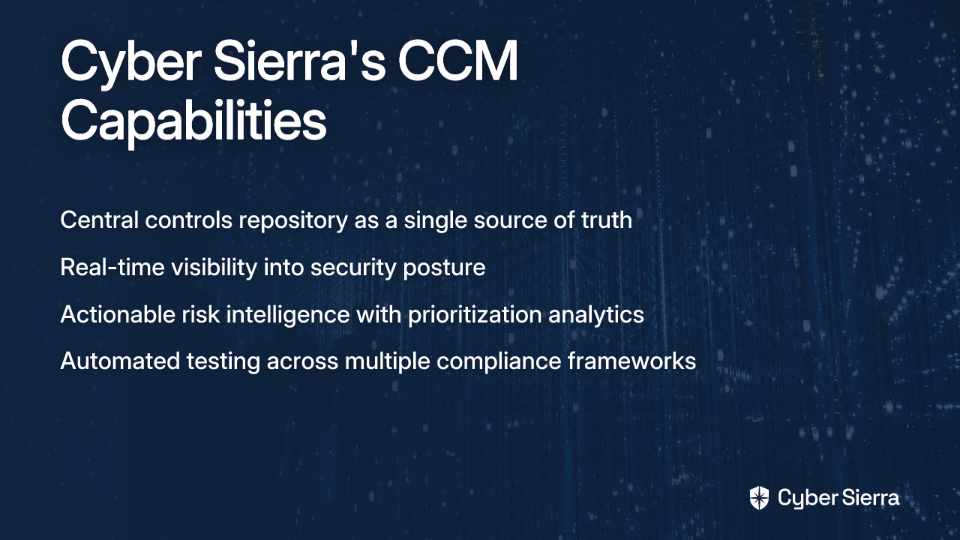
Cyber Sierra's Continuous Control Monitoring (CCM) module exemplifies this unified approach. It provides:
- A central controls repository that acts as a single source of truth with near real-time updates
- Clear visibility into security posture through continuous monitoring and real-time exception detection
- Actionable risk intelligence with analytics to help prioritize remediation efforts
- Automated control testing and validation across multiple compliance frameworks including NIST, ISO 27001, PCI DSS, GDPR, and HIPAA
This approach transforms the theoretical CCM framework into practical reality by addressing the core challenges of complexity and visibility.
What makes this approach particularly powerful is how it integrates with broader GRC functions. For instance, the data from CCM feeds directly into Cyber Sierra's Governance, Risk & Compliance (GRC) module, automating evidence collection and making the organization "audit-ready" at all times. This eliminates the resource drain and stress associated with periodic audit preparations.
Similarly, this proactive internal approach strengthens an organization's Third-Party Risk Management program by establishing clear standards for vendor security postures and enabling consistent monitoring across both internal and external environments.
Building a Resilient Security Posture Through Proactive Detection
The question shouldn't be "What's an acceptable control failure rate?" but rather "How quickly can we detect and remediate impactful failures?"
By combining a proactive mindset (Shifting Left, Compliance by Design), a structured evaluation process, and the right technology (CCM), organizations can:
- Detect control failures immediately rather than during the next audit cycle
- Understand the context and impact of each failure to prioritize response
- Remediate issues before they can be exploited by attackers
- Demonstrate continuous compliance to auditors, regulators, and customers
- Free up security resources to focus on strategic initiatives rather than manual evidence collection
The path forward is clear: abandon manual, periodic checks in favor of automation and continuous monitoring. This shift doesn't just improve security—it transforms how organizations approach risk management, making control effectiveness a continuous journey rather than a periodic destination.
As cyber threats continue to evolve in sophistication and scale, the organizations that thrive will be those that can detect the subtle warning signs of control degradation long before they manifest as security headlines. By implementing the proactive framework outlined in this article, you'll be well-positioned to join their ranks.
Frequently Asked Questions
What is a control failure in cybersecurity?
A control failure in cybersecurity occurs when a security measure is either designed improperly or is not operating as intended, creating a potential weakness that could be exploited. These failures fall into two main categories: design deficiencies, where a control is missing or flawed from the start, and operation deficiencies, where a correctly designed control is executed incorrectly due to human error, lack of training, or circumvention. A single successful attack often involves a chain of multiple control failures.
Why is relying on a control failure rate misleading?
Relying on a simple control failure rate is misleading because it lacks context. A low failure rate can still be catastrophic if the few failures that occur are critical, while a high rate of minor, low-impact failures might pose less overall risk. The focus should not be on an arbitrary number but on the potential impact of each failure. The goal is to achieve zero impactful failures that could lead to a breach, which requires understanding the context and materiality of each failure.
How does Continuous Controls Monitoring (CCM) differ from traditional audits?
Continuous Controls Monitoring (CCM) is a proactive, automated, and real-time approach to validating security controls, whereas traditional audits are reactive, manual, and provide only a point-in-time snapshot of control effectiveness. Audits can confirm a control was working during the assessment but offer no visibility into its status between audit cycles. CCM provides ongoing visibility, enabling teams to detect and remediate failures immediately and maintain a constant state of compliance.
What are the first steps to implementing a Continuous Controls Monitoring program?
The first step to implementing a Continuous Controls Monitoring (CCM) program is to inventory your existing controls and prioritize them based on risk. Focus on the controls that protect your most critical assets or "crown jewels." After identifying and prioritizing key controls, you should clearly define their objectives (e.g., "all critical vulnerabilities must be patched within 72 hours"), implement automated tests, and set up a centralized dashboard for monitoring and alerting.
How does a unified platform help with control failure detection?
A unified platform helps with control failure detection by centralizing data from disparate security tools, eliminating visibility gaps, and providing a single source of truth for your entire control environment. The average security team manages dozens of different tools, creating data silos. A unified platform integrates these sources, automates evidence collection, provides real-time analytics for risk prioritization, and ensures consistent monitoring across multiple compliance frameworks.
What is the difference between a design deficiency and an operation deficiency?
A design deficiency means a control is inherently flawed or missing, so it cannot achieve its objective even if performed perfectly. An operation deficiency occurs when a well-designed control is not executed correctly by the person responsible for it. For example, not having a policy that requires multi-factor authentication for administrative access is a design deficiency. In contrast, having the policy but an administrator failing to enable MFA on a new server is an operation deficiency.
Ready to implement continuous control monitoring in your organization? Learn more about Cyber Sierra's CCM solution and how it can help you detect control failures before they lead to security incidents.
